Quick Info
At a glance
La Venta in Mexico rises out of the flat, water-rich lowlands of Tabasco with a quiet authority that can feel surprising on first arrival. There are no towering limestone cities here like those farther east in the Maya world. Instead, the landscape is humid, green, and heavy with riverine life, and the ancient center reveals itself through sculpted basalt monuments, broad earthen platforms, and one of the earliest great ceremonial plans in Mesoamerica. This was not a marginal settlement but a place of power, ritual, and elite display, active at a time when the Olmec helped shape artistic and religious traditions that would echo for centuries across the region.
To visit La Venta is to encounter a civilization that still feels partly mysterious. The Olmec left no long readable historical inscriptions to explain every king, building phase, or ritual event. What remains instead are clues in clay, stone, and earth: colossal heads with individualized features, carefully arranged offerings buried beneath plazas, and a monumental core aligned with striking precision. The setting deepens the impression. Surrounded by tropical vegetation and the memory of marshes, rivers, and trade routes to the Gulf Coast, La Venta feels less like an isolated ruin and more like the center of a living ecological world. For travelers interested in the earliest chapters of ancient Mexico, it is one of the most important places to understand how complex society emerged in Mesoamerica.
History
Early Olmec foundations
La Venta flourished during the Middle Formative period, roughly from 900 BCE to 400 BCE, when it became one of the foremost centers of the Olmec civilization. Before La Venta rose to prominence, another major Olmec center, San Lorenzo, had already established many of the cultural patterns associated with the civilization: colossal heads, elite sculpture, large-scale landscape modification, and sophisticated craft production. As San Lorenzo declined, La Venta appears to have taken over as a leading political and ceremonial capital in the Gulf Coast lowlands.
Its location was strategic. The site stood on an island-like ridge in a wetland environment, making it both defensible and symbolically powerful. Waterways likely served as the main arteries of movement, connecting La Venta to communities across Tabasco, Veracruz, and farther inland. In a world where transport over swampy terrain could be difficult, river and coastal networks gave the city access to prestige goods and influence. Basalt used for monumental sculpture had to be brought from distant sources, a sign of organization, labor control, and elite ambition.
The ceremonial center at its height
At its peak, La Venta was not merely a settlement but a carefully planned ceremonial complex. Archaeologists have identified a site core composed of plazas, platforms, mounds, and ritual deposits laid out along a clear axis. This urban and sacred planning suggests that the Olmec elite had a developed vision of political theater and cosmological order. Public space mattered. Processions, rites, offerings, and elite display were likely central to life here.
The most famous structure is the large clay pyramid, often referred to as Complex C. Unlike later Mesoamerican pyramids built in cut stone, this one was primarily made of earth and clay, emphasizing that monumentality in early Mesoamerica did not depend on masonry alone. Nearby were other major ceremonial zones, including Complex A, known for its offerings and burials. Excavations there uncovered caches of jade, serpentine blocks, mosaic pavements, and other carefully arranged ritual materials, many intentionally buried. These discoveries transformed scholarly understanding of the Olmec, showing that they practiced elaborate ceremonial acts tied to sacred space and elite authority.
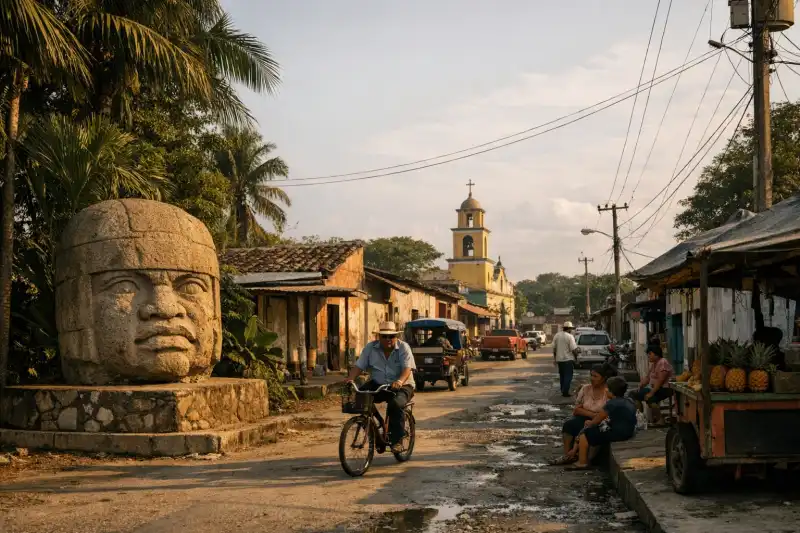
La Venta also became renowned for its sculpture. Colossal heads, altars or thrones, stelae, and smaller carved objects point to a society deeply invested in visual symbolism. The heads are especially striking because they appear individualized rather than generic, suggesting portraits of rulers or elite figures. Their helmets have prompted debates about warfare, ballgame ritual, or ceremonial regalia, but whatever their exact function, they communicate status and command.
Decline and abandonment
By around 400 BCE, La Venta began to decline. The reasons remain debated, and as with many ancient sites, there was probably no single cause. Environmental change, shifting river courses, political fragmentation, trade disruption, or the rise of other regional centers may all have played a role. The Gulf Coast lowlands were ecologically dynamic, and a city tied to wetlands and waterways would have been vulnerable to changes in landscape and subsistence patterns.
As La Venta lost influence, the broader Olmec cultural horizon also transformed. Rather than disappearing completely, many Olmec artistic and religious traditions were absorbed into later Mesoamerican societies. Motifs seen in Olmec art, concepts of sacred rulership, and aspects of ceremonial planning seem to foreshadow developments among later peoples, including the Maya and societies of central Mexico. In that sense, La Venta’s decline did not end its importance; it marked the transition of Olmec ideas into a wider shared heritage.
Rediscovery and modern archaeology
In modern times, La Venta attracted archaeological attention because of its unusual earthworks and extraordinary sculpture. Excavations in the twentieth century revealed the complexity of the site and helped establish the Olmec as one of the earliest major civilizations in Mesoamerica. Some monuments were relocated for preservation, most famously to Parque-Museo La Venta in Villahermosa, where many travelers encounter Olmec sculpture before or after visiting the original site.
Archaeology at La Venta has not answered every question. Scholars still debate the precise nature of Olmec political organization, whether La Venta ruled an empire, a regional chiefdom, or a looser ritual network. But its importance is no longer in doubt. Today, La Venta stands as one of the key places for understanding how ceremonial centers, elite power, and sacred art emerged in ancient Mexico long before the Classic-era cities most visitors know best.
Key Features
The first thing many visitors notice about La Venta is that its monumentality is subtle. This is not a city of vertical stone facades and sharply preserved temples. Instead, the site is shaped by the earth itself. Broad mounds and platforms rise gently from the lowland terrain, and their scale becomes clearer only as you walk through the core. That experience is part of La Venta’s character. It asks you to imagine architecture not as isolated buildings but as planned terrain, sculpted into ceremonial space.
The most celebrated feature is the Great Pyramid, usually identified as Complex C. Built largely from clay and earth, it is one of the earliest large pyramidal constructions in Mesoamerica. Even in its weathered state, it dominates the site. Its form reminds visitors that the builders of La Venta were capable of organizing immense labor long before the stone pyramids of later civilizations became famous. The structure also illustrates how architecture at La Venta was integrated with ritual topography. It was not simply a platform for a temple but a sacred mountain made from the landscape, a man-made prominence in a flat watery world.
Another remarkable area is Complex A, one of the most important ceremonial precincts known from the Olmec world. Here archaeologists discovered rich offerings intentionally buried beneath the surface. These included jade objects, polished stone, and intricate pavements made from serpentine blocks. Such finds suggest rituals of dedication, concealment, and sanctification. At La Venta, what lies beneath the ground can be just as significant as what rises above it. This layered sacredness gives the site unusual depth. You are walking over places that were designed not only to be seen, but also to contain hidden acts of power.
The stone monuments are among La Venta’s most memorable features. The colossal heads, carved from massive basalt boulders transported from distant sources, are extraordinary achievements of engineering and artistry. Their broad faces, full cheeks, and helmet-like headgear make them instantly recognizable, but what stays with many visitors is their individuality. These are not symbolic masks alone; they feel like portraits of real people, perhaps rulers whose political presence continued through stone after death. Some of the best-known heads from La Venta are displayed in Villahermosa, yet their connection to the original ceremonial center remains essential to understanding them.
In addition to the heads, La Venta yielded altars or thrones, stelae, and carved monuments featuring supernatural beings, rulers, and symbolic scenes. These works reveal a visual language in which power was intertwined with cosmology. Rulers seem to emerge from caves or niches, hold cords, or interact with beings that may represent ancestors, deities, or liminal forces. Even for travelers without specialist knowledge, the imagery communicates seriousness and ritual intensity. This was a society in which public art was not decorative but political and sacred.
The setting itself is also a key feature. La Venta belongs to the Gulf lowlands, and that environment shaped everything from subsistence to symbolism. Wetlands, lagoons, rivers, and tropical vegetation would have surrounded the ancient center. For modern visitors, this means heat, humidity, and dense greenery, but it also means that the site retains a sense of ecological context often missing from ruins in more urbanized areas. The Olmec did not build against nature; they built within a saturated world of water, mud, fertile soils, and transport corridors.
Finally, La Venta’s importance lies in what it represents in the wider story of ancient America. It is one of the clearest places to see the early development of ceremonial planning, elite art, and ideological authority in Mesoamerica. Even if some monuments have been moved and some structures survive mainly as earthworks, the site remains intellectually powerful. It gives form to a period that can otherwise seem distant and abstract. Here, the origins of later Mesoamerican traditions become tangible: sacred axes, rulers cast in stone, monumental construction, and ritual offerings designed to bind community, authority, and the cosmos together.
Getting There
La Venta is most commonly reached from Villahermosa, the capital of Tabasco, or from other towns in the western part of the state. If you are arriving by air, the nearest major gateway is Carlos Rovirosa Pérez International Airport in Villahermosa. From there, renting a car is the most flexible option. Depending on your exact route and current road conditions, the drive to the archaeological zone near Huimanguillo generally takes around 1.5 to 2.5 hours. Rental cars in Villahermosa often start around MXN 700 to 1,200 per day, while fuel costs for a round trip are usually moderate.
Public transport is possible but less straightforward. From Villahermosa, travelers can take a bus or colectivo toward Huimanguillo or nearby communities, with fares often in the MXN 80 to 180 range depending on service type. From there, a taxi to the site may cost roughly MXN 100 to 250 each way, though prices vary by distance and negotiation. If you are not comfortable with route changes in smaller transport hubs, a private driver or organized excursion may be worth the extra cost.
A private day trip from Villahermosa can be the simplest choice, especially if you want to combine La Venta with the Parque-Museo La Venta or other Tabasco attractions. Expect private transport or guided excursion prices to begin around MXN 1,800 to 3,500 per person for a day, depending on inclusions and group size. Because schedules can change and rural transport is not always frequent, it is wise to leave early, carry cash, and confirm return options before setting out.
When to Visit
La Venta can be visited year-round, but the experience changes noticeably with the seasons. The most comfortable period is generally the drier season from December to April. During these months, rainfall is lower, paths are easier to navigate, and the heat, while still present, tends to be more manageable than in late spring and summer. This is the best time for travelers who want to explore at a steady pace and spend longer outdoors without frequent downpours.
From May into October, the wet season brings heavier rains, lush vegetation, and high humidity. The landscape can look especially vivid, which suits the atmosphere of a Gulf lowland Olmec site, but conditions can also be tiring. Midday heat becomes intense, and sudden storms are common. If you visit during this period, aim for an early morning arrival, bring lightweight rain protection, and expect slippery or muddy areas.
November can be a transitional month, with some lingering rain but improving conditions. Whenever you travel, it is best to avoid the hottest part of the day if possible. Start early, wear breathable clothing, and carry more water than you think you need. The site is particularly rewarding for thoughtful, slower visits, so a cooler morning makes a real difference. If your schedule allows, pairing the archaeological zone with the museum collections in Villahermosa can also help you avoid too many hours in the afternoon heat while giving fuller context to what you have seen on site.
| Quick Facts | Details |
|---|---|
| Site name | La Venta |
| Country | Mexico |
| State | Tabasco |
| Civilization | Olmec |
| Main period | c. 900-400 BCE |
| Best known for | Colossal heads, earthen pyramid, ceremonial offerings |
| Nearest city | Huimanguillo |
| Main gateway | Villahermosa |
| Typical visit length | 2-3 hours |
| Best season | December to April |
| Terrain | Tropical lowland, humid and flat |
| Travel style | Best by car, taxi, or guided day trip |
La Venta rewards visitors who arrive with patience and imagination. Its power is not always immediate in the way of a city of towering masonry, yet that is part of what makes it memorable. This is a place where ancient authority was built from earth, water, and stone long before many of Mesoamerica’s later capitals emerged. The Olmec transformed a lowland ridge into a ceremonial landscape of enduring significance, and although time, climate, and archaeology have changed what survives, the site still conveys the ambition of one of the region’s foundational civilizations.
For travelers exploring ancient Mexico beyond the most famous routes, La Venta offers something rare: a direct encounter with beginnings. Here you can trace early forms of monumental planning, sacred kingship, and ritual art that would resonate across centuries. Whether you come as a specialist, a history enthusiast, or simply a curious traveler, La Venta leaves a lasting impression not through sheer scale alone, but through the depth of its legacy.
Guided tours: worth it?
Self-guided works here, but a guide can add real value if you want the ruins explained as a living place rather than just a sequence of monuments.
Best for
- First-time visitors who want context, not just photos
- Short visits where a planned route saves time
When to go self-guided
Go independently if you prefer setting your own pace, reading as you go, and checking official hours or ticket rules directly before you arrive.
What I’d avoid
Skip paid tours that bundle unrelated stops you do not actually want. The best option should either save meaningful planning time or add historical context you would miss on your own.
Tabasco archaeological sites tours
Useful when: you want to compare guided formats before deciding
Villahermosa La Venta Park and museum tours
Useful when: you want to connect a site and museum visit
Comalcalco and La Venta region tours
Useful when: you want to compare guided formats before deciding
Some tour links are affiliate links, which may earn Ancient Travel a small commission at no extra cost to you. I try to surface options that make practical sense for the site—not just anything bookable.
Frequently Asked Questions
What is La Venta known for?
La Venta is best known as one of the most important Olmec ceremonial centers, famous for colossal stone heads, rich burials, and monumental earthen architecture.
Where is La Venta located?
La Venta is located in the state of Tabasco in southeastern Mexico, near the Gulf Coast lowlands and close to the modern town of Huimanguillo.
Can you visit the original site of La Venta?
Yes, the archaeological zone can be visited, though some of its most famous monuments were moved to Parque-Museo La Venta in Villahermosa for protection and display.
How much time should I spend at La Venta?
Most visitors should allow two to three hours for the archaeological zone, and longer if combining it with the museum park in Villahermosa.
What is the best time of year to visit La Venta?
The driest and most comfortable months are generally from December to April, when humidity and rainfall are lower than in the summer wet season.
Is La Venta suitable for families?
Yes, La Venta can work well for families interested in history, though the climate is hot and humid, so water, sun protection, and light clothing are important.
Nearby Ancient Sites
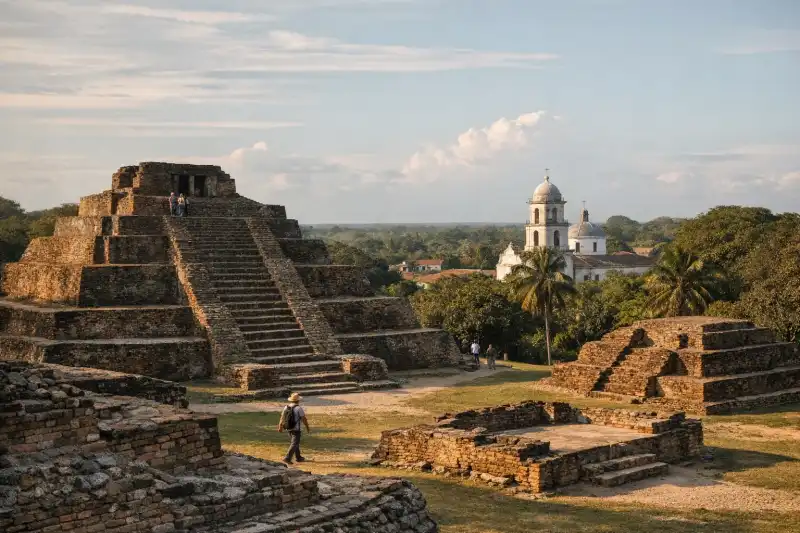
Comalcalco
MayaExplore Comalcalco, Mexico's distinctive Maya city built with brick, carved stucco, and rich Gulf Co...
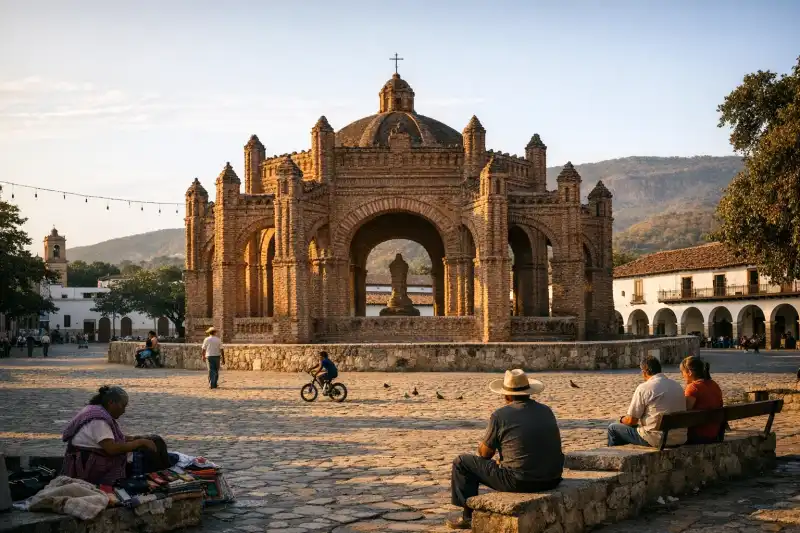
Chiapa de Corzo
Zoque and earlier Mesoamerican culturesExplore Chiapa de Corzo, Mexico, a major early Mesoamerican site beside the Grijalva River in Chiapa...
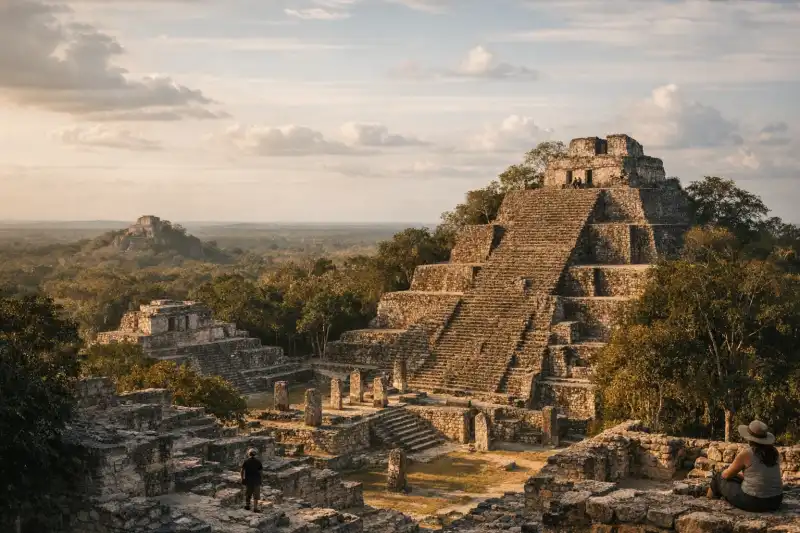
Calakmul
MayaExplore Calakmul, a vast Maya city deep in the forests of Campeche, Mexico, known for towering pyram...