Quick Info
At a glance
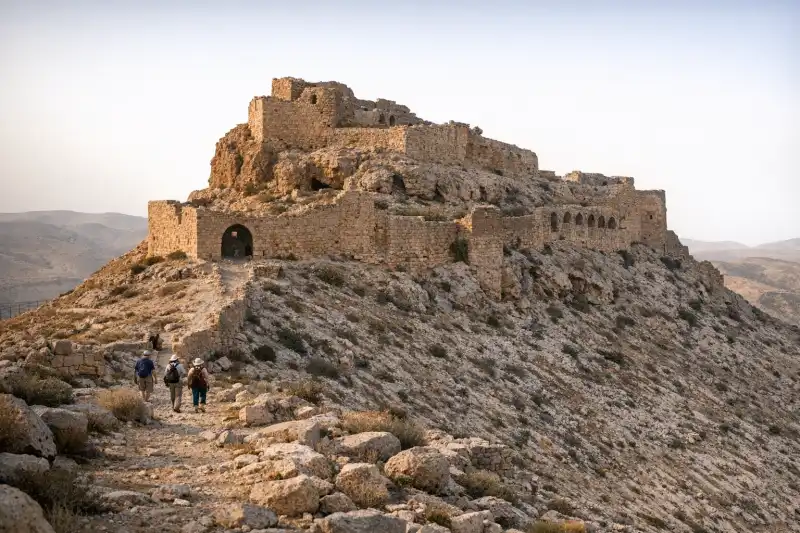
Montreal Castle (Shoubak) in Jordan rises from a solitary hill in the southern highlands, its weathered walls still commanding the roads that once linked Arabia, Petra, and the Crusader kingdoms of the Levant. Long before you step through its broken gateways, the fortress announces itself across the landscape: a stony crown above orchards, fields, and dry valleys, half military outpost and half medieval mirage. Compared with Jordan’s more famous monuments, Shoubak feels quieter and more exposed, a place where wind, distance, and ruin shape the experience as much as architecture does.
That isolation is part of its appeal. Built by Crusaders in the early 12th century and later fought over by Ayyubid and Mamluk rulers, Montreal Castle preserves the memory of a frontier world where fortresses were both symbols of power and practical instruments of survival. Its Arabic name, Shawbak, is now more commonly used locally, but the older Frankish name “Montreal,” meaning “royal mountain,” captures the site’s dramatic setting perfectly. Visiting today is less about polished museum interpretation and more about walking through layers of contested history. You can trace defensive walls, stand inside ruined churches and halls, and look out over terrain that made this hill worth defending for centuries. For travelers moving between Petra, Dana, and Kerak, Montreal Castle offers a compelling pause: austere, strategic, and deeply atmospheric.
History
Crusader foundation under Baldwin I
Montreal Castle was founded in 1115 CE by Baldwin I, king of Jerusalem, during a period when the Crusader states were consolidating their hold over the Levant. The choice of location was strategic. Southern Jordan sat near trade and pilgrimage corridors that connected Syria and Palestine with Arabia and Egypt. By establishing a fortress here, the Crusaders could monitor movement across a broad region, extract tribute, and project power far beyond the hilltop itself.
The new stronghold became one of the earliest major Crusader castles east of the Jordan River. It served not merely as a defensive post but as a center of administration for the surrounding district known to the Franks as Oultrejordain. From here, local lords oversaw taxation, agricultural estates, and access to routes that carried merchants and pilgrims. Medieval chroniclers suggest that the site was intended to anchor royal authority in a challenging frontier zone, and its imposing placement on a steep, isolated hill made that authority visible.
Life within the castle would have depended on careful planning. The region was not empty desert, but it was demanding, and any long-term garrison required water storage, food supply, and secure communication with allied strongholds. The builders responded by creating a substantial fortified complex with cisterns and underground features that helped sustain the population during siege conditions.
The lordship of Oultrejordain
As Crusader rule matured, Montreal became one of the key seats of the lordship of Oultrejordain, alongside Kerak Castle farther north. The territory was politically important because it linked the Kingdom of Jerusalem to lands east of the Dead Sea and gave the Franks leverage over caravan traffic. Its lords could influence commerce, diplomacy, and military movement throughout the region.
Over time, however, the balance of power shifted. Kerak gradually emerged as the dominant center, partly because of its size and position. Even so, Montreal retained military and symbolic value. It remained a substantial fortress on a frontier where alliances were fragile and warfare frequent. The castle’s defenses were periodically strengthened, and its role in regional politics continued through the mid-12th century.
This was also the era in which relations between Crusader lords and neighboring Muslim powers grew increasingly hostile. Raids, retaliatory expeditions, and efforts to control caravan routes placed Oultrejordain in the middle of wider conflicts. The fortress was not only a passive shield but part of an aggressive border system that could threaten surrounding territories.
Ayyubid siege and conquest
By the later 12th century, the rise of Salah ad-Din, known in the West as Saladin, transformed the political landscape. After the Crusader defeat at the Battle of Hattin in 1187, Muslim forces rapidly moved to reclaim key strongholds across the region. Montreal Castle, though formidable, became isolated. Its defenders could no longer rely on the same network of support that had sustained the Crusader states in earlier decades.
The siege of Montreal was difficult and prolonged. Medieval accounts describe severe hardship among those inside, suggesting that despite the fortress’s water systems and provisions, long-term resistance became unsustainable. Eventually, in 1189, the castle surrendered to Saladin’s forces. This marked the end of nearly three-quarters of a century of Crusader control.
The fall of Montreal was more than a local military event. It represented the collapse of one of the major Frankish footholds in southern Transjordan and confirmed the Ayyubid recovery of a strategically vital region. Yet the fortress did not lose importance after conquest. Like many captured castles in the medieval Near East, it was reused and adapted by its new rulers.
Ayyubid and Mamluk reuse
Under Ayyubid and later Mamluk administration, Montreal continued to function within the defensive and administrative geography of the region. The new rulers repaired sections of the complex, altered internal spaces, and incorporated Islamic architectural features. Inscriptions from later periods attest to this continued occupation and investment. Although the age of Crusader rule had ended, the logic of the hilltop fortress remained compelling.
The Mamluks, who dominated much of the eastern Mediterranean after the Ayyubids, maintained and modified many earlier castles. At Shoubak, they likely valued the site as a regional outpost rather than as a primary strategic capital. Over time, changing military technologies, shifting trade patterns, and the rise of new centers reduced its centrality. Nonetheless, the castle survived as a durable landmark embedded in local history.
Decline, ruin, and modern visitation
In the centuries that followed, Montreal Castle gradually fell into partial ruin. Earthquakes, weathering, stone robbing, and simple abandonment all contributed to the broken silhouette seen today. Yet the remains are still substantial enough to reveal the site’s former scale. Archaeological work and conservation efforts have helped clarify the sequence of construction and reuse, though much of the visitor experience still depends on reading the stones directly.
Modern travelers often encounter Shoubak as a quieter counterpart to Jordan’s headline destinations. It lacks the monumental polish of Petra or Jerash, but that understatement is exactly what gives it power. Here the history is legible in fragments: a tower base, a vault, a stair descending into shadow, an inscription set into reused masonry. Montreal Castle endures not as a complete monument but as a landscape of evidence, where Crusader ambition, Ayyubid conquest, and later adaptation all remain visible on the same commanding hill.
Key Features
The most striking feature of Montreal Castle is its setting. The fortress occupies a steep conical hill that rises above the surrounding countryside, making approach and defense easier while maximizing visibility in every direction. From the top, you can see how the castle’s builders took advantage of natural topography: slopes become defensive barriers, and the summit narrows into a controlled, easily fortified platform. Even before considering walls or towers, the hill itself was part of the architecture.
The outer fortifications, though broken in many places, still suggest the original scale of the defenses. Sections of curtain wall trace the edges of the hilltop, interrupted by towers and projecting points that would have allowed defenders to watch vulnerable approaches. Walking these edges gives visitors some of the best views on site. The relationship between fortress and landscape becomes obvious here; this was a place designed as much for surveillance as for refuge.
Inside the enclosure are the remains of a layered interior rather than a single preserved building. You may find fragments of halls, storage spaces, chapels or churches from the Crusader phase, and later Islamic additions or modifications. This mix is important. Montreal is not frozen in one moment of history; instead, it shows how successive rulers reused strategic architecture. Doorways are altered, masonry styles shift, and decorative details from one era sit beside practical repairs from another. That palimpsest quality gives the castle much of its scholarly interest.
Among the most memorable elements are the subterranean spaces. Medieval castles in dry regions depended heavily on water collection and storage, and Shoubak includes underground passages, cisterns, and chambers that hint at the logistical sophistication needed to survive siege. Some sections descend dramatically into the hill, creating a cool contrast with the bright, exposed upper ruins. These spaces are often the most atmospheric part of a visit, though they also require care because surfaces can be uneven and lighting limited.
Another notable feature is the surviving evidence of religious architecture. The Crusaders incorporated ecclesiastical spaces into their fortresses, and traces of church structures at Montreal reflect the dual military and spiritual world of a frontier stronghold. Later Islamic inscriptions and modifications reveal the site’s continued significance after its conquest. For visitors interested in cultural exchange and conflict, these overlapping religious and political markers are especially evocative.
The castle’s relationship to the surrounding agricultural landscape also deserves attention. Unlike the idea of a fortress standing in complete emptiness, Shoubak historically relied on nearby cultivation, orchards, and villages. From the ramparts, you can still look down onto terraced fields and settled land. This helps explain how such a remote-looking place could sustain prolonged occupation. The fortress dominated not just roads but a productive hinterland.
Architecturally, Montreal feels rougher and more fragmentary than Jordan’s larger castles, but that is part of its authenticity. You are not moving through reconstructed grandeur; you are exploring a site where age, climate, and conflict remain visible. Chisel marks, collapsed vaults, reused stones, and patched walls all tell stories. The best way to appreciate its features is slowly, allowing time to notice changes in masonry, the logic of the defensive plan, and the way each ruin frames the landscape beyond.
Getting There
Montreal Castle is easiest to reach by road, and most travelers visit it while moving between Petra, Dana, and Kerak. The site lies near the modern town of Shoubak in southern Jordan, roughly 30 minutes from Petra/Wadi Musa by car, depending on traffic and your exact starting point. If you are self-driving, this is the most convenient option. Roads in the area are generally straightforward, and parking is usually available near the entrance. Rental cars in Jordan commonly start around 25–40 JOD per day for a basic vehicle, with fuel extra.
From Wadi Musa or Petra, a private taxi is a simple alternative if you do not want to drive. Expect to pay roughly 20–35 JOD one way depending on negotiation, season, and whether the driver waits for you and returns you after the visit. A round-trip excursion with waiting time can often be arranged for 35–50 JOD. If you are continuing onward rather than returning, confirm this clearly before departure.
Public transport is less dependable for independent tourists. Shared minibuses may connect nearby towns, but schedules can be irregular and are not ideal if you are on a tight itinerary. If using public transport, you may still need a local taxi for the final stretch to the castle. Budget-conscious travelers should allow extra time and ask locally in Wadi Musa or Shoubak about current departures.
Many visitors instead include Montreal Castle as part of a private driver itinerary or guided day trip. This can be efficient if you also want to see Little Petra, Dana, or Kerak on the same route. Guided transport naturally costs more, but it saves time and provides historical context that is especially helpful at a ruin where signage may be limited.
When to Visit
The best times to visit Montreal Castle are spring and autumn, when southern Jordan is typically mild, skies are clear, and the surrounding highland scenery is especially attractive. In March through May, temperatures are usually comfortable for walking the exposed hilltop, and the countryside may show patches of green that soften the rocky landscape. September through November is similarly pleasant, with warm days and cooler evenings.
Summer visits are certainly possible, but conditions can be harsher. Midday sun can be intense, and because much of the site is open and treeless, heat builds quickly on stone surfaces. If you visit in June, July, or August, aim for early morning or late afternoon. Bring plenty of water, a hat, sunscreen, and shoes with good grip. The views are often excellent in summer, but the experience is more physically demanding.
Winter has advantages too. The lower number of visitors can make the ruins feel especially dramatic and solitary, and daytime temperatures are often manageable for exploring. However, this is a highland location, so wind and cold can be surprisingly strong, especially on cloudy days. Rain can make paths slippery, and occasional mist may reduce visibility. A jacket and sturdier footwear are wise in the cooler months.
Time of day matters almost as much as season. Morning light is generally best for photography and for appreciating the contours of the fortress before the sun becomes too strong. Late afternoon can also be beautiful, especially when shadows lengthen across the surrounding fields and valleys. If your schedule allows, avoid rushing through in the middle of the day. Montreal Castle rewards slower visits, when the light and silence help bring the site’s medieval atmosphere into focus.
| Quick Facts | Details |
|---|---|
| Location | Shoubak, Ma’an Governorate, Jordan |
| Alternate names | Shoubak Castle, Shawbak Castle, Crac de Montreal |
| Founded | 1115 CE |
| Founder | Baldwin I of Jerusalem |
| Historical periods | Crusader, Ayyubid, Mamluk |
| Site type | Hilltop medieval fortress |
| Best paired with | Petra, Little Petra, Dana, Kerak |
| Typical visit length | 1–2 hours |
| Access | Best by rental car, taxi, or guided tour |
| What to bring | Water, sun protection, sturdy shoes, camera, light jacket in cool weather |
Montreal Castle may not be Jordan’s most famous monument, but it is one of its most revealing. Few places communicate the strategic realities of the medieval Levant so clearly: a single hill commanding roads, farms, and horizons; a fortress repeatedly adapted by rival powers; a ruin whose silence still suggests watchfulness. For travelers interested in Crusader history, Islamic conquest, or the practical art of survival in a contested borderland, Shoubak offers depth far beyond its modest profile on most itineraries. It is a place to explore slowly, to read in stone rather than spectacle, and to remember that some of the most compelling sites are the ones that still feel a little remote.
Guided tours: worth it?
A guide can be genuinely useful at Montreal Castle (Shoubak), especially if you want help with transport, timing, tickets, or understanding a large site without losing half the day to logistics.
Best for
- First-time visitors who want context, not just photos
- Travelers who want transport, timing, or entry logistics handled
- Trips where tickets, circuits, or timed entry can shape the day
- Short visits where a planned route saves time
When to go self-guided
Go independently if you already have transport and tickets sorted, enjoy moving at your own pace, and are comfortable checking the latest official rules before you arrive.
What I’d avoid
Skip paid tours that bundle unrelated stops you do not actually want. The best option should either save meaningful planning time or add historical context you would miss on your own.
Shoubak Castle tours
Useful when: you want to compare guided formats before deciding
Petra and Shobak day tours
Useful when: you want to compare guided formats before deciding
Jordan castles and Petra tours
Useful when: you want to compare guided formats before deciding
Some tour links are affiliate links, which may earn Ancient Travel a small commission at no extra cost to you. I try to surface options that make practical sense for the site—not just anything bookable.
Frequently Asked Questions
Where is Montreal Castle (Shoubak)?
Montreal Castle, also called Shoubak or Shawbak Castle, stands in southern Jordan in Ma'an Governorate, roughly between Petra and Kerak on a prominent hill near the town of Shoubak.
Who built Montreal Castle?
The castle was founded in 1115 by the Crusader king Baldwin I of Jerusalem as part of a chain of strongholds controlling trade and pilgrimage routes east of the Jordan Valley.
Is Montreal Castle worth visiting if I am already going to Petra?
Yes. It is one of Jordan’s most atmospheric Crusader sites and makes an excellent stop before or after Petra, especially for travelers interested in medieval military architecture and wide desert views.
How much time should I allow for a visit?
Most visitors spend 1 to 2 hours exploring the walls, chambers, church remains, and viewpoints, though history enthusiasts may stay longer.
Can you visit Montreal Castle independently?
Yes. Many travelers visit by rental car or taxi from Petra/Wadi Musa, though joining a guided tour can provide useful historical context.
What should I bring to Shoubak Castle?
Bring water, sun protection, sturdy shoes with grip, and a light jacket in cooler months, as the site is exposed, uneven, and can be windy.
Nearby Ancient Sites
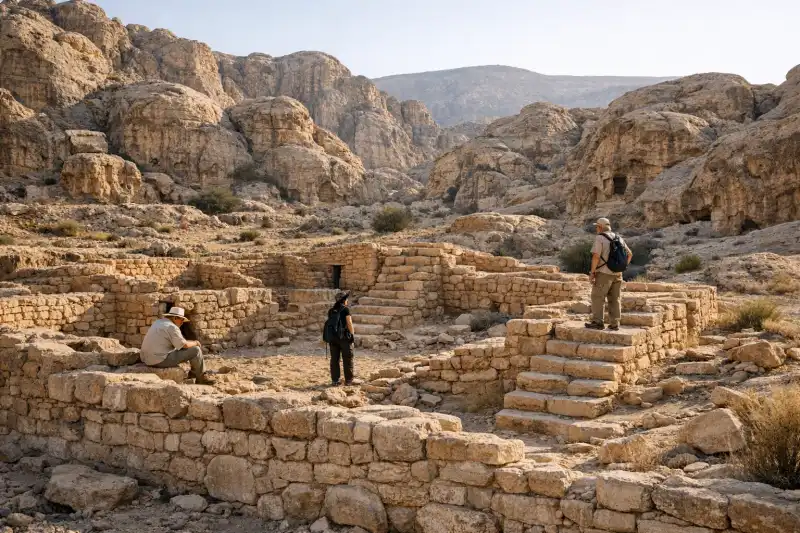
Beidha
Pre-Pottery Neolithic communities of the southern LevantExplore Beidha, a remarkable Neolithic village near Petra in Jordan, known for early farming, stone ...
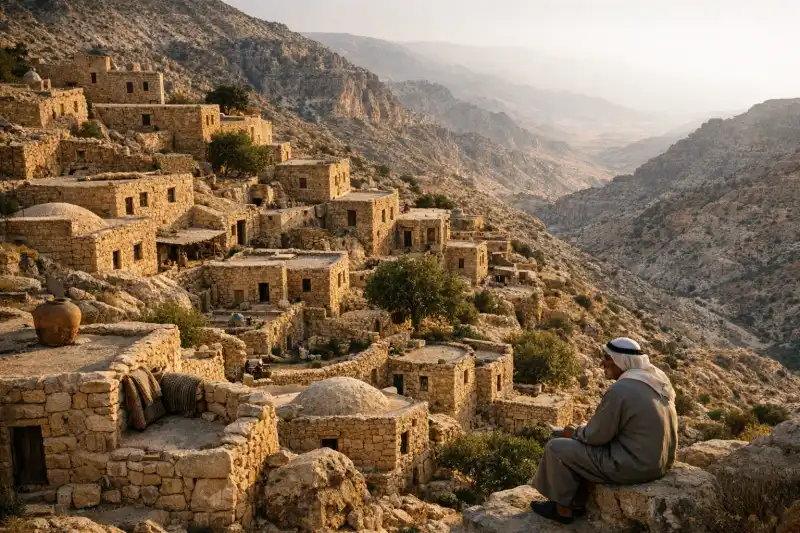
Dana Village
Nabataean, Ottoman, and local Jordanian highland communitiesA timeless stone village in Jordan overlooking Dana Biosphere Reserve, famed for mountain views, tra...
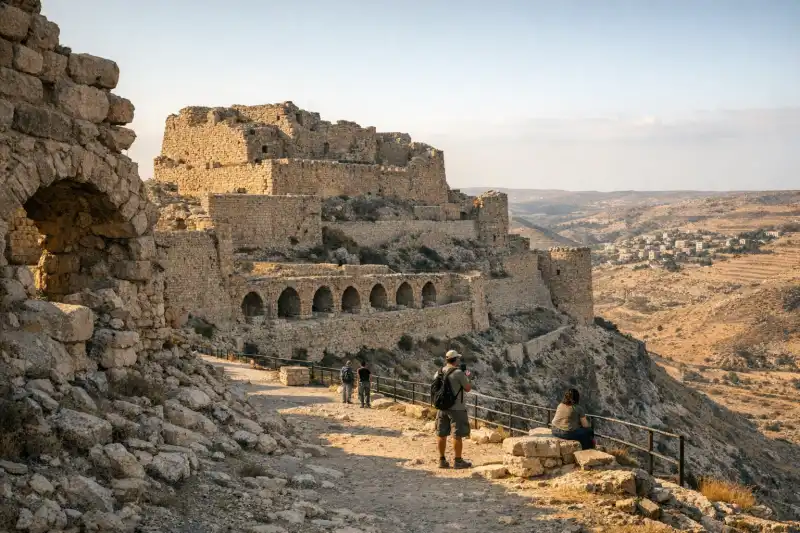
Kerak Castle
Crusader, Ayyubid, Mamluk, OttomanA vast Crusader fortress in Jordan, Kerak Castle crowns a hilltop with tunnels, towers, and sweeping...