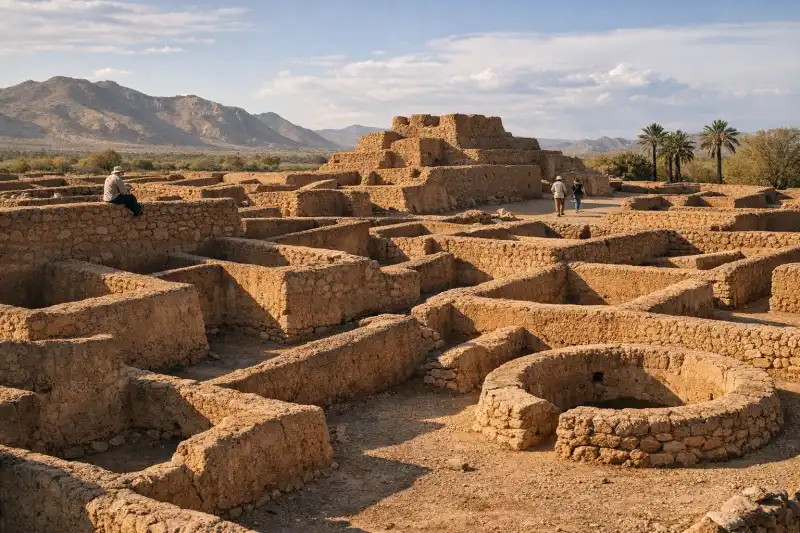
Quick Info
At a glance
Paquimé (Casas Grandes) in Mexico rises from the high desert of Chihuahua with a quiet authority that feels very different from the tropical Maya cities or the volcanic landscapes of central Mexico. Here the earth itself seems to have been shaped into architecture. Walls of sun-dried adobe, once part of a carefully organized settlement, still suggest rooms, courtyards, passageways, and a social world that connected northern Mexico with distant regions far beyond the horizon. Even in ruin, the site carries a powerful sense of order.
For many travelers, Paquimé is one of Mexico’s most surprising archaeological experiences because it does not fit the postcard image of monumental pyramids or jungle temples. Instead, it reveals an urban center adapted to an arid environment, one where trade, craft production, and water management mattered as much as ceremonial life. The landscape around it is open and dramatic, framed by desert vegetation, broad skies, and mountains in the distance. That setting helps explain why Paquimé became such an important node in a vast network linking Mesoamerica with the cultures of the American Southwest.
Today, visiting the site offers a rare chance to encounter a city built in adobe on an impressive scale and to understand a chapter of ancient North American history that is still less familiar to many international visitors. Paquimé rewards patience: the more closely you look, the more it reveals about engineering, exchange, ritual, and daily life on a frontier of civilizations.
History
Early settlement in the Casas Grandes valley
The story of Paquimé begins before the city reached its height. The Casas Grandes valley had long offered conditions that made settlement possible in a demanding desert environment: access to seasonal water, arable land, and routes leading across northern Mexico and into what is now the southwestern United States. Earlier communities in the region established the foundations for agriculture and local exchange, creating the social and economic background from which Paquimé later emerged.
Archaeologists generally place the major florescence of Paquimé between about 1200 and 1450 CE, though the broader developmental sequence began earlier. In its initial phases, settlement in the area appears to have been more modest. Over time, however, population, craft specialization, and social coordination increased. The site’s position was strategic. It sat at a crossroads where ideas, goods, and technologies could circulate between cultural worlds often treated separately in modern narratives.
Growth into a regional center
By the 13th century, Paquimé had become far more than a village. It developed into a substantial urban center with planned architecture, ceremonial spaces, workshops, and systems for channeling water. Its inhabitants built large adobe residential blocks, some of them multi-story, which remain among the most striking features of the site today. This was not haphazard growth but a highly organized settlement with clear attention to layout and function.
Paquimé is especially important because it appears to have played a mediating role in long-distance exchange. Archaeological evidence links the site to the movement of turquoise, copper objects, marine shells, ceramics, and live scarlet macaws. These macaws, associated strongly with ritual prestige in Mesoamerica, could not have thrived naturally in the Chihuahua desert without deliberate human care. Their presence at Paquimé suggests specialized husbandry and substantial connections to trade routes extending far south.
Ceramic production also flourished. The region became known for distinctive pottery traditions, and Paquimé likely served as a center of redistribution and perhaps elite control. Its architecture and certain ritual features have led scholars to debate the degree of influence from Mesoamerica, while others emphasize the city’s local development within northern traditions. Most likely, Paquimé was both rooted in its own cultural environment and deeply open to outside contact.
Ritual, power, and environmental adaptation
The built environment of Paquimé shows a society that invested heavily in both practical and ceremonial space. Water channels and reservoirs point to careful management of scarce resources. Doorways often have T-shaped forms, a feature also associated with sites in the American Southwest. Ballcourts indicate participation in a wider ritual tradition known across Mesoamerica, while platform mounds and special enclosures hint at public ceremonies and social hierarchy.
This blending of architectural and symbolic forms makes Paquimé one of the most compelling sites in northern Mexico. It was not merely copying another civilization’s style. Rather, it was creating a local expression of power and belief suited to its own landscape and political world. The city’s organization implies leadership capable of mobilizing labor, regulating exchange, and sustaining social complexity in a region where environmental pressures could be severe.
Decline, abandonment, and rediscovery
Around the mid-15th century, Paquimé entered a period of decline and was eventually abandoned. The exact causes remain debated. Scholars have considered a combination of political instability, conflict, ecological stress, changing trade patterns, and internal social transformation. Evidence of burning in some areas has raised the possibility of violence, though this alone does not fully explain the site’s fate.
By the time Spanish chroniclers passed through the broader region in the 16th century, the great city no longer functioned as it once had. Its ruins endured in the desert, attracting local memory and later antiquarian interest. Modern archaeological research, especially in the 20th century, transformed understanding of the site. Excavations clarified the complexity of its architecture, economic life, and regional significance.
UNESCO recognized Paquimé as a World Heritage Site in 1998, affirming its value as one of the most important archaeological locations in northern Mexico. Today it stands not only as a relic of a vanished city, but as evidence that major centers of innovation, exchange, and urban planning existed well beyond the better-known cores of ancient Mesoamerica.
Key Features
What makes Paquimé memorable is not one isolated monument but the coherence of the entire settlement. The site feels like the remains of a real city rather than a ceremonial complex detached from everyday life. As you move through the archaeological zone, the surviving adobe walls outline dense residential compounds that once rose in multiple levels. Though the upper stories are gone, the surviving lower structures still communicate a sense of verticality and enclosed space. This alone sets Paquimé apart from many other ancient sites in Mexico.
The adobe construction is a major feature in itself. Built from earth and adapted to local conditions, the architecture speaks directly to the desert environment. Thick walls helped regulate indoor temperatures, while the arrangement of rooms suggests a society attuned to both privacy and communal organization. Some spaces appear residential, others administrative or ceremonial. The result is a built landscape that rewards slow observation. Instead of looking for a single dramatic temple staircase, visitors notice patterns of movement, social clustering, and the practical intelligence of construction.
Water management is another essential part of the site’s significance. In an arid region, control of water was a form of power and survival. Archaeologists have identified channels, drains, and features related to storage and distribution. These systems reveal planning on a civic scale. They also reinforce the idea that Paquimé was a regional center capable of coordinating labor and maintaining infrastructure. Even if some details remain debated, it is clear that the city was engineered with environmental realities in mind.
Ceremonial architecture gives further insight into the society that lived here. Ballcourts connect Paquimé to a ritual tradition known across much of ancient Mexico and Central America. Their presence in Chihuahua is striking and reminds visitors that cultural ideas circulated across large distances. Platform mounds and specially arranged compounds suggest public functions, gatherings, and the symbolic display of authority. These features likely played roles in both ritual life and political legitimacy.
One of the most fascinating aspects of Paquimé is the evidence for craft production and long-distance exchange. The site is associated with fine ceramics, shell objects, copper bells, and especially scarlet macaws. Remains interpreted as macaw breeding or holding areas are among the site’s most talked-about discoveries because they underline Paquimé’s participation in prestige economies extending into Mesoamerica. The macaws were not casual imports. Their presence points to sustained networks, specialized care, and possibly ritual significance.
The T-shaped doorways are another detail that visitors often remember. These openings invite comparison with architectural traditions farther north, especially in the U.S. Southwest. Their appearance at Paquimé contributes to ongoing discussions about interaction, shared ideas, and regional diversity. You do not need to follow every academic debate to appreciate what they demonstrate: this city belonged to a broad world of exchange where boundaries were permeable and cultural identity was dynamic.
An important complement to the ruins is the on-site museum, which helps transform the visit from visual impression into historical understanding. There, artifacts and interpretive displays place the architecture in context, explaining trade routes, daily life, symbolism, and archaeological methods. If the ruins show you the skeleton of the city, the museum restores some of its living texture. Together they make Paquimé one of the most intellectually rewarding archaeological destinations in Mexico, especially for travelers interested in frontier societies, intercultural contact, and ancient urbanism beyond the standard tourist circuit.
Getting There
Paquimé is located near Casas Grandes and Nuevo Casas Grandes in the state of Chihuahua, and most visitors reach it overland. The most practical base is Nuevo Casas Grandes, which is roughly 10 to 15 minutes away by taxi or local transport. A taxi from central Nuevo Casas Grandes to the archaeological zone usually costs around MXN 100-180 each way, depending on time of day and negotiation. If you are staying in Casas Grandes town, the journey is similarly short and inexpensive.
For travelers coming from Chihuahua City, the trip is much longer. Driving generally takes around 4.5 to 5.5 hours depending on road conditions and your route. Rental cars offer the most flexibility, and daily rental rates in Chihuahua City often begin around MXN 900-1,500 before insurance and fuel. Long-distance buses may connect Chihuahua City with Nuevo Casas Grandes; fares commonly fall in the MXN 350-700 range one way, though schedules can change and should be checked in advance. From the bus station, you would continue by taxi to the site.
If you are traveling from Ciudad Juárez, the overland journey to Nuevo Casas Grandes typically takes about 4 to 5 hours by car or bus. Bus fares are often in the MXN 300-600 range one way. Organized archaeological tours are less common here than at Mexico’s more famous sites, so independent planning is often necessary.
Because public transport options can be limited and frequencies may not suit a tight schedule, many travelers find it easiest to stay overnight nearby. That allows a morning visit with cooler temperatures and enough time for the museum without rushing back to a major city the same day.
When to Visit
The best time to visit Paquimé is generally from October through April, when the desert climate is cooler and walking the site is more comfortable. Daytime temperatures in these months are usually mild to pleasant, though mornings and evenings can be chilly, especially in winter. Bringing layers is wise, since northern Chihuahua can shift quickly from cool shade to strong sun.
Spring is often particularly appealing because the weather is dry and visibility across the surrounding landscape is excellent. This is a good season for photography, especially early and late in the day when the adobe walls take on warmer tones. However, windy conditions can occur, so a light jacket and eye protection can be helpful.
Summer, especially from June through August, can be quite hot. Midday visits may feel exhausting because shade is limited across much of the archaeological zone. Afternoon storms are also possible during the rainy season, though rainfall is generally not continuous. If you must visit in summer, arrive as early as possible, carry plenty of water, and plan indoor museum time during the hottest hours.
Autumn offers a nice balance of stable weather, manageable temperatures, and fewer extremes. Winter visits can be rewarding as well, provided you dress for the cold mornings. Unlike tropical sites where humidity is the main challenge, Paquimé demands respect for sun exposure, dryness, and sudden temperature changes. Whenever you go, aim for a weekday morning if possible; the quieter atmosphere suits the site and makes it easier to appreciate the details of its layout and construction.
| Quick Facts | Details |
|---|---|
| Location | Near Casas Grandes and Nuevo Casas Grandes, Chihuahua, Mexico |
| UNESCO Status | World Heritage Site since 1998 |
| Cultural Attribution | Casas Grandes culture |
| Main Flourishing Period | c. 1200-1450 CE |
| Best Known For | Adobe urban ruins, trade networks, water management, macaw remains |
| Best Base for Visitors | Nuevo Casas Grandes |
| Suggested Visit Length | 2-4 hours |
| Best Season | October to April |
| Terrain | Open desert archaeological zone with limited shade |
| What to Bring | Water, hat, sunscreen, sturdy shoes, layers |
Guided tours: worth it?
A guide can be genuinely useful at Paquimé (Casas Grandes), especially if you want help with transport, timing, tickets, or understanding a large site without losing half the day to logistics.
Best for
- First-time visitors who want context, not just photos
- Travelers who want transport, timing, or entry logistics handled
- Short visits where a planned route saves time
When to go self-guided
Go independently if you already have transport and tickets sorted, enjoy moving at your own pace, and are comfortable checking the latest official rules before you arrive.
What I’d avoid
Skip paid tours that bundle unrelated stops you do not actually want. The best option should either save meaningful planning time or add historical context you would miss on your own.
Paquimé Casas Grandes tours
Useful when: you want to compare guided formats before deciding
Chihuahua archaeology tours
Useful when: you want to compare guided formats before deciding
Casas Grandes day trips
Useful when: transport or pickup logistics matter
Some tour links are affiliate links, which may earn Ancient Travel a small commission at no extra cost to you. I try to surface options that make practical sense for the site—not just anything bookable.
Frequently Asked Questions
Where is Paquimé (Casas Grandes)?
Paquimé is located near the town of Casas Grandes in the state of Chihuahua, northern Mexico, close to the modern community of Nuevo Casas Grandes.
What is Paquimé known for?
The site is famous for its extensive adobe architecture, planned urban layout, ceremonial mounds, water-control features, and evidence of long-distance trade between Mesoamerica and the American Southwest.
Is Paquimé a UNESCO World Heritage Site?
Yes. Paquimé, Archaeological Zone of Casas Grandes, was inscribed on the UNESCO World Heritage List in 1998 for its importance as a cultural and commercial center in northern Mexico.
How much time should I plan for a visit?
Most travelers should allow 2 to 4 hours to visit the ruins and the on-site museum comfortably, with extra time if you want a slower pace or detailed photography.
Can you visit Paquimé from Chihuahua City?
Yes, but it is a long overland journey. Many visitors stay overnight in Nuevo Casas Grandes or Casas Grandes rather than attempting a rushed same-day round trip from Chihuahua City.
What should I bring when visiting Paquimé?
Bring sun protection, water, comfortable walking shoes, and layers for changing desert temperatures, especially if visiting in cooler months.
Nearby Ancient Sites
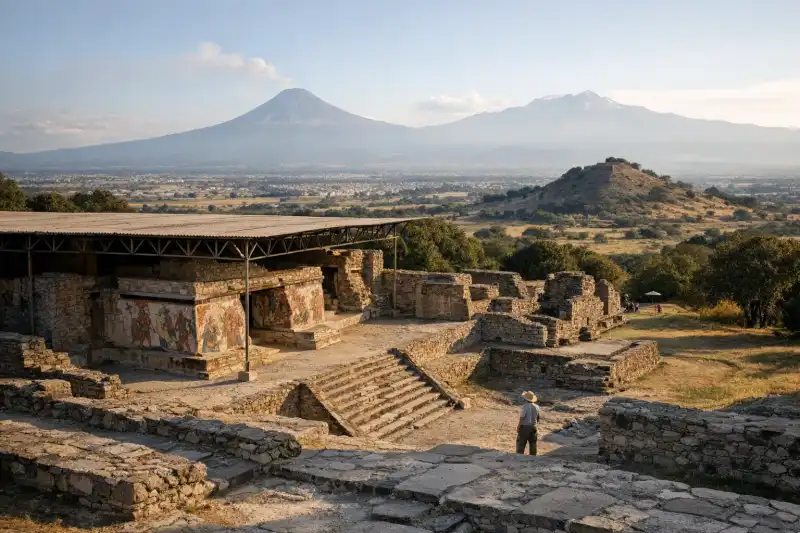
Cacaxtla
Olmeca-Xicalanca and broader Epiclassic Mesoamerican traditionsExplore Cacaxtla in Mexico, a hilltop archaeological site famed for vivid murals and Epiclassic hist...
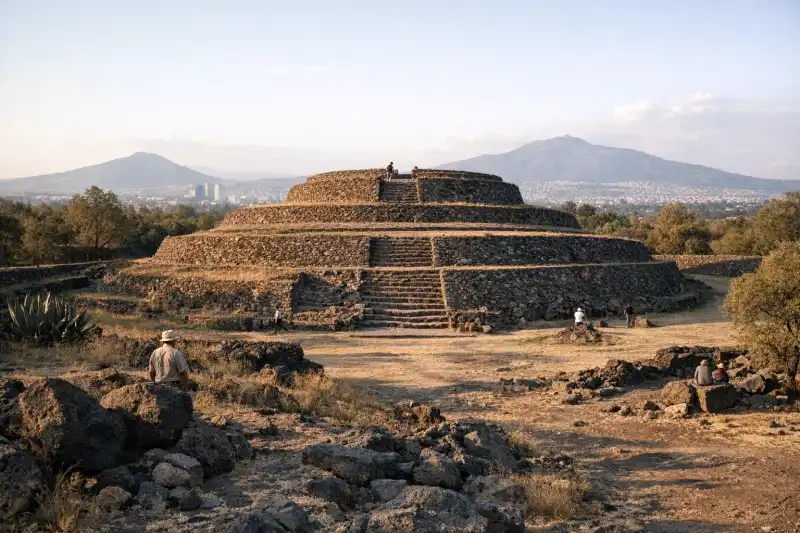
Cuicuilco
Preclassic MesoamericanExplore Cuicuilco, Mexico’s ancient circular pyramid site, a remarkable pre-Hispanic center on the s...
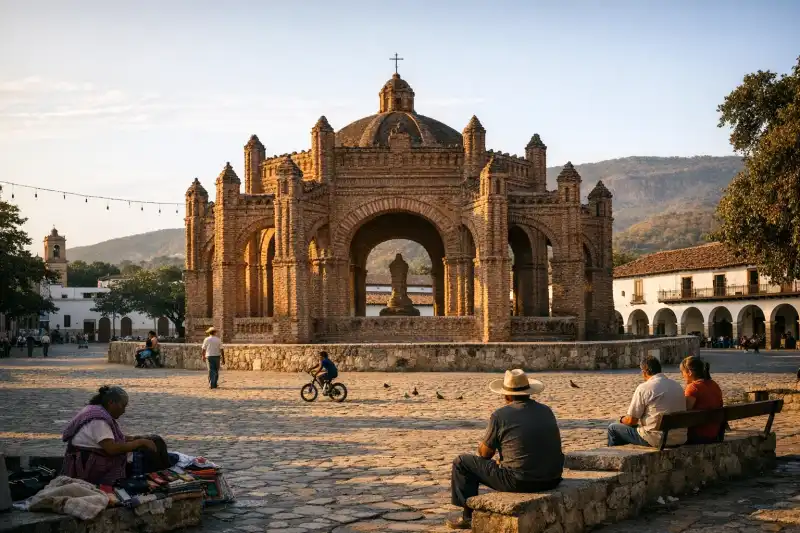
Chiapa de Corzo
Zoque and earlier Mesoamerican culturesExplore Chiapa de Corzo, Mexico, a major early Mesoamerican site beside the Grijalva River in Chiapa...