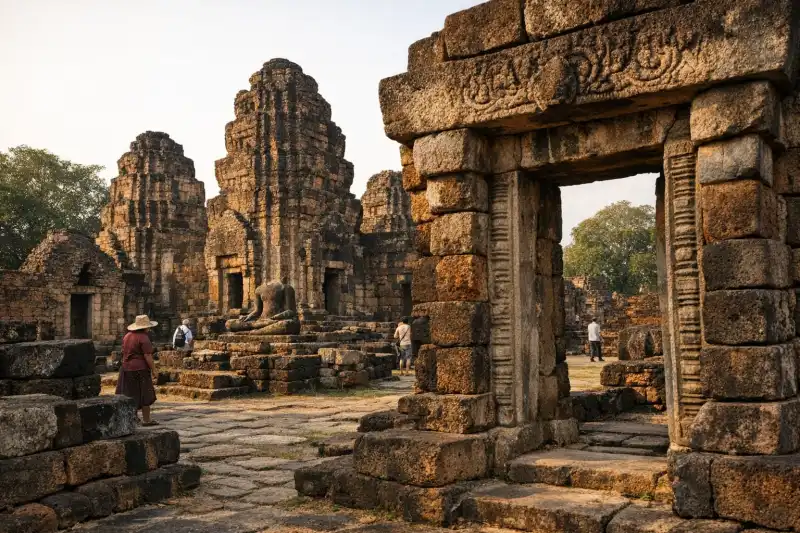
Quick Info
At a glance
Prasat Kamphaeng Yai in Thailand rises from the plains of Sisaket Province with a calm, dignified presence that can surprise first-time visitors. Far from the country’s busiest beach circuits and well beyond the better-known capitals of classical Siam, this Khmer sanctuary rewards travelers who venture into the cultural landscape of Isaan, northeastern Thailand. The site is not only large by regional standards but also atmospheric: a place where laterite walls, carved sandstone, and open lawns preserve the memory of centuries of worship, adaptation, and political change.
What makes Prasat Kamphaeng Yai especially compelling is its layered identity. It is visibly a Khmer monument, built when the political and artistic influence of Angkor reached deep into what is now Thailand. Yet it is also unmistakably local, shaped by the communities that maintained, repurposed, and reinterpreted it long after imperial power shifted. Visitors today encounter more than a set of ruins. They find a temple complex that still feels embedded in living geography: villages, fields, and regional roads surround it, while its towers and enclosures recall an era when sacred architecture helped organize both territory and belief.
The mood here is quieter than at Thailand’s headline archaeological destinations. Instead of crowds, there is space to notice the proportions of the sanctuary, the texture of weathered stone, and the way tropical light catches carved lintels and doorframes. For travelers interested in Khmer architecture outside Cambodia, or in the broader historical links between mainland Southeast Asia’s cultures, Prasat Kamphaeng Yai offers one of the most rewarding stops in the lower Isaan region.
History
Early Khmer Expansion into the Region
The origins of Prasat Kamphaeng Yai are tied to the spread of Khmer political and religious culture across mainland Southeast Asia between the 11th and 13th centuries. During this period, the Angkorian world extended far beyond present-day Cambodia, influencing large areas of northeastern Thailand. Temples such as this one were not isolated shrines built in wilderness; they were statements of authority, devotion, and regional integration. Roads, reservoirs, settlements, and religious monuments worked together to bind frontier provinces to the imperial center.
Scholars generally place the earliest phase of Prasat Kamphaeng Yai in the 11th century, likely during a time when Khmer builders were establishing and enlarging sacred centers across the Khorat Plateau. The site’s scale suggests that it held more than purely local significance. Its enclosing walls and planned layout imply institutional support, skilled labor, and connections to a larger sacred and administrative network. Like many Khmer temples of the era, it was probably associated first with Hindu worship, especially Shaivism, though exact ritual history can be difficult to reconstruct with certainty.
Development as a Major Sanctuary
Over time, the complex expanded and took on the monumental form seen in its surviving remains. The central sanctuary and associated structures reflect mature Khmer architectural ideas: axial planning, symbolic enclosure, and the use of sandstone details over a laterite core. These choices were not merely aesthetic. Khmer temple architecture embodied cosmic order, with central towers representing the sacred mountain at the center of the universe and surrounding walls marking a ritually defined space.
Prasat Kamphaeng Yai appears to have flourished during the high period of Khmer influence in the region. The sanctuary likely served a community that included elites, priests, laborers, and agricultural populations whose surplus supported religious institutions. In the wider Angkorian system, temples often functioned as economic centers as well as places of worship. Land, water management, and ritual endowments all contributed to their maintenance. Even when distant from Angkor itself, provincial temples expressed the same fundamental language of sacred kingship and organized devotion.
Architectural evidence suggests more than one building phase, something common at Khmer sites. Sanctuaries were repaired, enlarged, or ritually reoriented as political conditions changed. Decorative styles can also hint at shifts in date and patronage, especially when lintels and colonettes resemble better-dated monuments elsewhere in the Khmer world.
Religious Change and Buddhist Reuse
Like many ancient temples in Thailand and Cambodia, Prasat Kamphaeng Yai did not remain fixed to one religious identity forever. As the religious landscape of the region evolved, many originally Hindu sanctuaries were reused or transformed for Buddhist purposes. This transition occurred gradually rather than through a single dramatic event. In many cases, sacred places remained sacred, even if the forms of worship changed.
At Prasat Kamphaeng Yai, evidence of later Buddhist use points to this long continuity. The sanctuary’s significance outlasted the political supremacy of Angkor. Communities in the region adapted inherited monuments to new devotional needs, preserving the importance of the site even as original rituals faded. This pattern is one reason Khmer temples in Thailand often feel historically layered rather than frozen in a single era.
The shift also reflects broader cultural developments in mainland Southeast Asia, where Theravada Buddhism became increasingly influential from the late medieval period onward. Ancient Hindu structures were not always abandoned; they were often absorbed into a changing religious environment. Prasat Kamphaeng Yai stands as a strong example of this continuity through transformation.
Rediscovery, Conservation, and Modern Appreciation
In the modern era, Prasat Kamphaeng Yai became part of Thailand’s protected archaeological heritage. Conservation efforts have aimed to stabilize the surviving structures, preserve decorative details, and maintain the layout of the complex so visitors can still understand its scale. As with many restored monuments, what stands today is the result of both ancient building and modern stewardship.
The site now occupies an important place in the interpretation of Thailand’s Khmer past. While destinations such as Phimai and Phanom Rung are more widely known internationally, Prasat Kamphaeng Yai helps complete the picture of how extensive Khmer cultural influence once was across the northeast. It is valued not only for its architecture but also for what it reveals about frontier regions, regional devotion, and the movement of ideas across borders that did not yet exist in their modern form.
Today, visitors come for history, photography, and quiet exploration. The temple is no museum object sealed off from the world. It remains part of Sisaket’s cultural identity, connecting present-day Thailand with a medieval landscape shaped by empire, religion, and local resilience.
Key Features
Prasat Kamphaeng Yai is impressive first for its overall plan. This is not a single isolated tower but a substantial temple compound, defined by enclosure walls and an organized sacred core. As you approach, the sense of monumentality comes from breadth as much as height. The surviving structures are spread across a broad precinct that allows visitors to appreciate how Khmer architects controlled movement, sightlines, and ritual access. Even in ruin, the design still communicates hierarchy: outer areas lead inward toward the most sacred zone, where the central sanctuary once concentrated religious meaning.
The principal tower and its associated shrines are the heart of the complex. Built with laterite and faced or detailed in sandstone, these structures show the classic Khmer contrast between mass and refinement. Laterite gives the monument its durable, earthy body; sandstone provides the surface for carving, moldings, doorframes, and decorative elements. When sunlight hits these materials at an angle, the difference in texture becomes especially striking. The coarser walls absorb light, while carved sandstone edges define openings and corners with greater clarity.
Among the most rewarding details are the carved lintels and architectural frames. Even where erosion has softened the original precision, the artistry remains visible. Floral motifs, geometric rhythms, and mythic imagery tie the temple to the wider visual culture of Angkorian architecture. For travelers interested in style rather than only scale, these carved surfaces offer some of the site’s most memorable moments. They reveal the hand of trained artisans working within a standardized sacred language yet adapting it to a provincial sanctuary.
Another notable feature is the enclosure itself. Khmer temple walls were both practical and symbolic. They marked the boundary between ordinary space and sacred precinct, creating a controlled environment for ritual. At Prasat Kamphaeng Yai, the surviving enclosure helps visitors imagine the temple as an active religious center rather than a mere collection of structures. It also gives the site a pleasing sense of coherence. Even where elements are damaged or incomplete, the larger plan remains legible.
The grounds around the sanctuary add to the experience. Open lawns and cleared areas make it easier to read the architecture and to move slowly around the complex, noticing changes in perspective. From one angle, the towers look compact and severe; from another, they seem integrated into a much larger ceremonial setting. This changing visual effect is part of the site’s appeal. Khmer builders designed temples to be approached, circled, and entered in sequence, and the surviving layout still encourages that kind of movement.
Prasat Kamphaeng Yai also stands out because it reflects both grandeur and regional intimacy. It is clearly an important monument, yet it does not feel detached from local life. Visitors often encounter a quieter atmosphere than at Thailand’s major tourist landmarks, which allows close attention to the architecture. You can hear birds, feel the heat rising from the ground, and study the weathering of stone without heavy crowd pressure. That stillness can make the temple seem more eloquent, especially for those who enjoy sites where contemplation matters as much as photography.
Finally, the complex embodies the layered religious history of the region. Architectural forms rooted in Hindu cosmology coexist with evidence of later Buddhist use, reminding visitors that monuments change over time. Prasat Kamphaeng Yai is not important only because it was built. It is important because it endured, was adapted, and remained meaningful long after its original patrons disappeared. That continuity, visible in both structure and setting, is one of its strongest and most moving features.
Getting There
Prasat Kamphaeng Yai is most easily reached by road from Sisaket city, the provincial capital, which lies roughly 30-35 kilometers away depending on your route. The simplest option is to hire a taxi or private car. A one-way trip from Sisaket typically costs around 400-700 THB, while a half-day charter with waiting time may run 1,200-2,000 THB depending on negotiation, vehicle type, and whether you combine the visit with other Khmer sites in the province.
If you are traveling on a tighter budget, local buses or songthaews toward Kamphaeng Yai District may be available from Sisaket, though schedules can be limited and are better suited to flexible travelers. Expect fares in the range of 30-80 THB, but note that you may still need a short motorcycle taxi or tuk-tuk ride from the drop-off point to the temple grounds. This last stretch can cost roughly 40-100 THB.
From Ubon Ratchathani, a larger city with an airport and stronger domestic transport links, the drive usually takes around 1.5 to 2 hours. A private transfer from Ubon can cost about 1,500-3,000 THB round trip. Renting a car is also practical, especially for independent travelers exploring Isaan; daily rentals often start at about 900-1,500 THB before fuel.
For most visitors, the best combination of convenience and value is to base yourself in Sisaket or Ubon Ratchathani and arrange private transport for the day. Roads in the area are generally straightforward, and pairing Prasat Kamphaeng Yai with nearby Khmer-era sites creates a fuller picture of the region’s archaeological landscape.
When to Visit
The most comfortable time to visit Prasat Kamphaeng Yai is during Thailand’s cool season, usually from November to February. At this time, daytime temperatures are milder by regional standards, humidity is lower, and walking around the exposed temple grounds is much more pleasant. This is the best season for travelers who want to spend time studying architectural details without feeling rushed by intense midday heat.
March to May is the hottest period in northeastern Thailand. Visits are still possible, but the stone surfaces and open spaces can become very warm by late morning. If you come during these months, plan to arrive as early as possible, bring plenty of water, and wear a hat or carry an umbrella for shade. Early morning light can also be excellent for photography, giving the sandstone and laterite richer color and softer contrast.
The rainy season, generally from May or June through October, brings greener surroundings and a fresher atmosphere, but also the possibility of sudden heavy showers. For some visitors, this is a rewarding time to see the temple in a more dramatic landscape, with clouds, lush vegetation, and fewer travelers. The trade-off is humidity, slippery surfaces, and less predictable conditions for long overland journeys.
Time of day matters almost as much as season. Early morning and late afternoon are ideal for both comfort and atmosphere. Midday light can flatten carvings and make the grounds feel harshly exposed. If you want the most memorable experience, arrive soon after opening hours or in the final hours before closing, when the temple feels quieter and the architecture gains depth from angled sunlight.
| Quick Facts | Details |
|---|---|
| Location | Kamphaeng Yai District, Sisaket Province, Thailand |
| Historical Culture | Khmer Empire |
| Main Period | 11th-13th centuries CE |
| Original Religious Association | Primarily Hindu, later adapted for Buddhist use |
| Building Materials | Laterite and sandstone |
| Best Base for Visitors | Sisaket city |
| Ideal Visit Duration | 45 minutes to 1.5 hours |
| Best Season | November to February |
| Best Time of Day | Early morning or late afternoon |
| Why Visit | Large Khmer sanctuary with strong regional history and relatively शांत atmosphere |
Prasat Kamphaeng Yai is one of those destinations that deepens the more you look at it. At first glance, it is an impressive Khmer ruin in rural Thailand. Spend a little longer, however, and it becomes a lens onto the medieval world of mainland Southeast Asia: the expansion of Angkorian power, the spread of artistic forms, the endurance of sacred landscapes, and the local communities that carried these places forward through changing centuries. For travelers willing to go beyond Thailand’s best-known circuits, it offers substance, beauty, and a rare sense of historical continuity.
Guided tours: worth it?
Self-guided works here, but a guide can add real value if you want the ruins explained as a living place rather than just a sequence of monuments.
Best for
- First-time visitors who want context, not just photos
- Short visits where a planned route saves time
When to go self-guided
Go independently if you prefer setting your own pace, reading as you go, and checking official hours or ticket rules directly before you arrive.
What I’d avoid
Skip paid tours that bundle unrelated stops you do not actually want. The best option should either save meaningful planning time or add historical context you would miss on your own.
Sisaket and Khmer Temple Day Tours
Useful when: you want to compare guided formats before deciding
Ubon Ratchathani to Khmer Ruins Excursions
Useful when: you want to compare guided formats before deciding
Thailand Isaan Cultural Heritage Tours
Useful when: you want to compare guided formats before deciding
Some tour links are affiliate links, which may earn Ancient Travel a small commission at no extra cost to you. I try to surface options that make practical sense for the site—not just anything bookable.
Frequently Asked Questions
What is Prasat Kamphaeng Yai?
Prasat Kamphaeng Yai is a large Khmer temple complex in Sisaket Province, northeastern Thailand, known for its sandstone towers, enclosure walls, and evidence of both Hindu and later Buddhist use.
Where is Prasat Kamphaeng Yai located?
The site is in Kamphaeng Yai District, Sisaket Province, in Thailand’s Isaan region. It is typically reached from Sisaket city or Ubon Ratchathani by road.
How much time should I plan for a visit?
Most visitors spend 45 minutes to 1.5 hours exploring the main sanctuary, galleries, and grounds. History enthusiasts may want longer to appreciate architectural details and inscriptions.
Is Prasat Kamphaeng Yai suitable for casual travelers?
Yes. The complex is accessible for travelers with a general interest in history, architecture, or photography, and the site can be visited as part of a wider Isaan cultural itinerary.
When is the best time to visit Prasat Kamphaeng Yai?
The coolest and most comfortable months are generally from November to February. Early morning and late afternoon are best for softer light and lower heat.
Are there other ancient sites near Prasat Kamphaeng Yai?
Yes. Other important regional sites include Ku Phra Kona, Khao Phra Viharn, and Ku Santarat, all of which reflect the Khmer cultural landscape of northeastern Thailand.
Nearby Ancient Sites
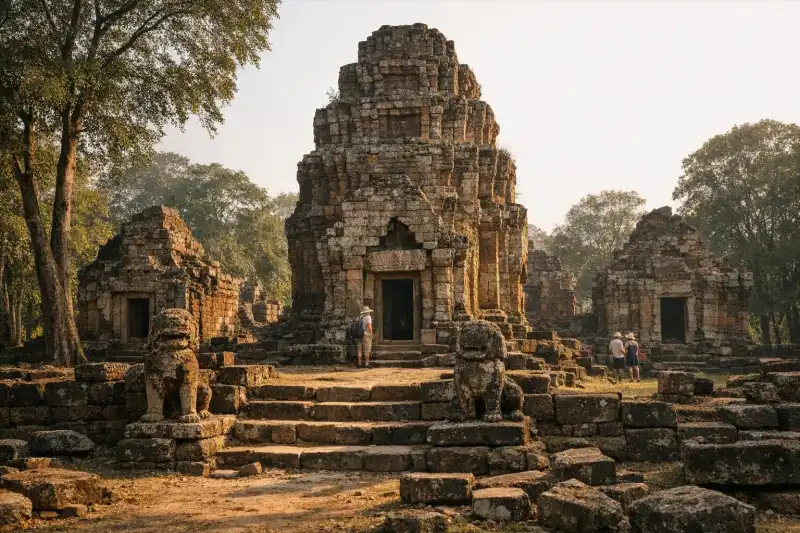
Ku Phra Kona
KhmerAn early Khmer sanctuary in northeastern Thailand, Ku Phra Kona preserves brick towers, carvings, an...
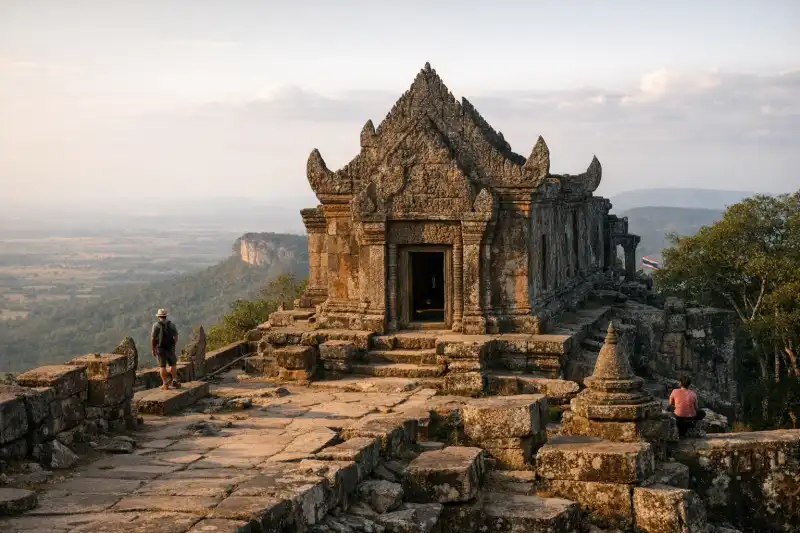
Khao Phra Viharn
Khmer EmpireA dramatic Khmer temple on Thailand’s frontier, Khao Phra Viharn crowns a cliff with sweeping views ...
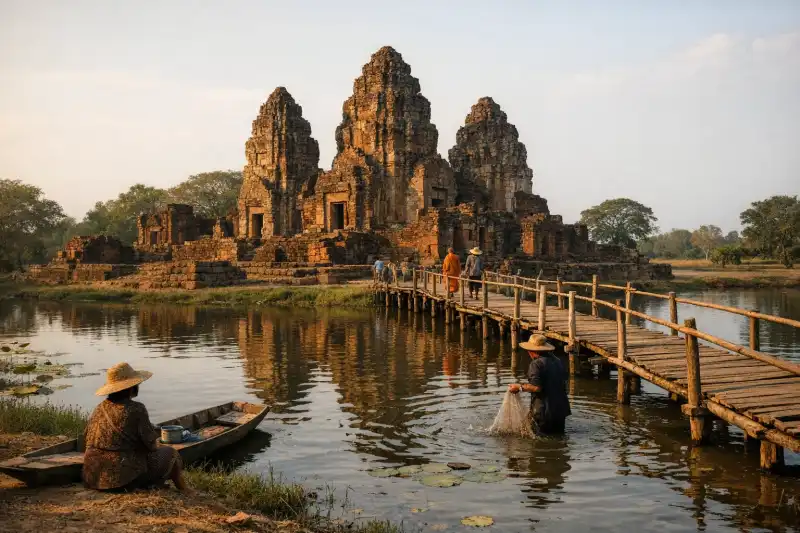
Ku Santarat
Khmer EmpireKu Santarat is a quiet Khmer-era temple ruin in northeastern Thailand, known for laterite towers, mo...