Quick Info
At a glance
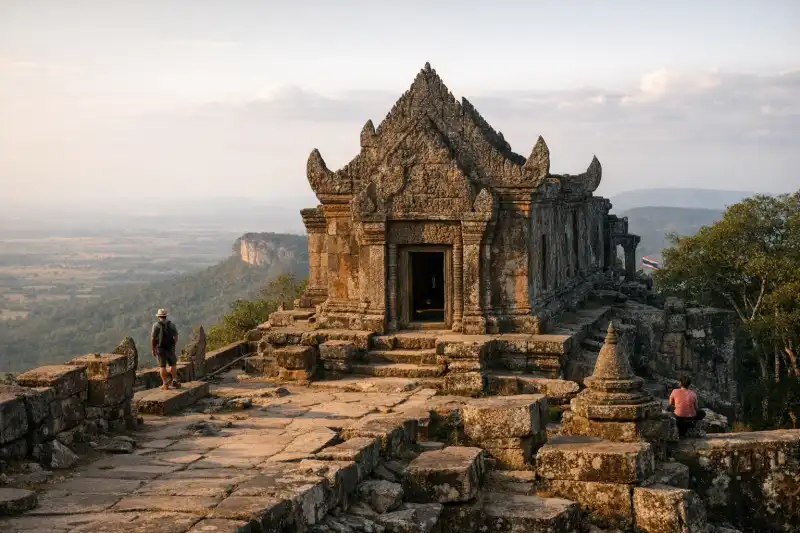
Khao Phra Viharn in Thailand rises with a kind of theatrical certainty from the edge of the Dangrek range, where ancient stone, wind, and open sky seem to collaborate in creating one of mainland Southeast Asia’s most unforgettable sacred landscapes. Unlike many temple sites that reveal themselves gradually from flat countryside, this monument is experienced as an ascent in every sense: geographical, ceremonial, and emotional. The approach moves visitors toward a long axial sequence of gateways, terraces, and courtyards that culminate at the cliff line, where the land suddenly falls away into a vast panorama. Even before one starts thinking about dynasties or inscriptions, the setting explains why rulers and pilgrims regarded this mountain sanctuary as exceptional.
Though often discussed in connection with border history and modern politics, Khao Phra Viharn rewards a slower gaze. It is, at heart, a temple conceived in dialogue with the terrain. The builders used the ridge as more than a defensive perch; they transformed it into a ritual path, shaping an experience of movement toward the divine. Weathered lintels, naga-flanked steps, reservoirs, and processional spaces all speak to a period when Khmer architects could bind cosmology to landscape with remarkable confidence. For travelers in northeastern Thailand, the site offers something rare: a major Khmer monument that still feels remote, dramatic, and deeply tied to the mountain itself. It is a place where history is not only read in stone but also felt in the long climb, the changing light, and the startling silence between gusts of wind.
History
Early sacred use and mountain worship
The high ridge now known as Khao Phra Viharn was likely regarded as a sacred place long before the monumental temple took shape. In the Khmer world, mountains were not merely scenic elevations; they were natural expressions of divine geography, often linked to the abode of gods and to the cosmic axis between earth and heaven. This escarpment, with its commanding views and difficult access, would have lent itself naturally to spiritual associations. Scholars generally believe that the earliest phases of worship here began around the 9th century CE, when regional Khmer influence was expanding and mountain sanctuaries became increasingly important in state religion.
At first, the site may have consisted of relatively modest shrines or ritual markers tied to Shaivism, the branch of Hindu practice devoted to Shiva. The mountain setting suited that tradition well. The temple’s later development suggests not an abrupt creation but a gradual enhancement of an already revered location. Springs, stone outcrops, and the natural drama of the ridge likely contributed to its sanctity. As elsewhere in the Khmer realm, royal patronage would eventually formalize what had begun as a sacred focus embedded in local geography.
Expansion under the Khmer Empire
The major building campaigns at Khao Phra Viharn belong to the mature period of the Khmer Empire, particularly between the 10th and 12th centuries CE. Successive rulers contributed to the complex, and inscriptions connect the temple with elite religious foundations and royal endowments. The sanctuary is especially associated with worship of Shiva, though, as with many Khmer monuments, the exact ritual life of the site probably evolved over time. Its strategic location near the northern edge of the Khmer cultural sphere also gave it importance beyond religion alone.
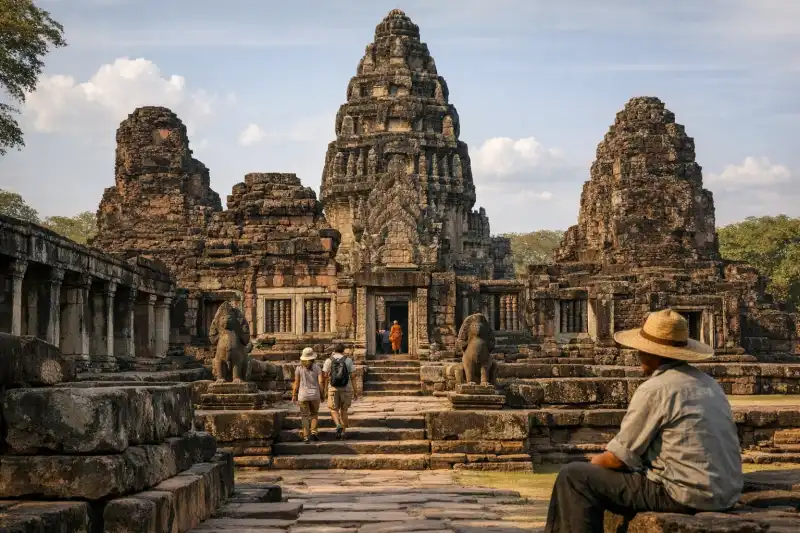
Architecturally, the temple reflects the confidence and resources of imperial Angkor-era construction. Rather than concentrating all attention on a single central tower, Khao Phra Viharn unfolds as a processional route. Long causeways, gopuras or gateway pavilions, staircases, courtyards, and subsidiary structures guide movement along a north-south axis. This careful sequencing reveals a highly developed understanding of ceremonial approach. The monument did not simply house the sacred; it prepared visitors to encounter it through ordered progression.
Building materials include sandstone for sculptural and formal architectural elements and laterite for structural mass. Decorative carvings once enriched pediments, door frames, and lintels, though time and weather have softened many details. Even so, enough remains to show the site’s place within the broader Khmer artistic tradition. Khao Phra Viharn’s architecture belongs to the same cultural universe as other celebrated Khmer temples in present-day Thailand and Cambodia, yet its cliff-edge position makes its design uniquely responsive to terrain.
Religious change and regional transition
From the late 12th century onward, the Khmer world underwent significant changes. Royal patronage patterns shifted, Buddhist influence strengthened, and political authority moved through periods of centralization and fragmentation. Like many major Khmer sanctuaries, Khao Phra Viharn probably experienced changes in ritual use rather than simple abandonment. Sacred sites in Southeast Asia often continued to be visited and reinterpreted even when dynasties changed or original cult practices declined.
As political control in the region fluctuated, the temple’s frontier character became more pronounced. What had once been a monument integrated into a large imperial network gradually came to stand in a more contested and peripheral landscape. Nevertheless, its monumental form ensured continued recognition. Local communities, pilgrims, and later state authorities all inherited a place whose importance was too visible to disappear entirely.
Modern rediscovery, scholarship, and access
In the 19th and 20th centuries, French scholars, surveyors, and administrators working in the former territories of French Indochina documented many Khmer sites, including this one. Their publications helped place the monument within the canon of Khmer architecture, though earlier local knowledge of the temple had never vanished. Conservation interest grew alongside archaeological study, and the site became better known to wider audiences.
Modern history, however, has also shaped how Khao Phra Viharn is discussed. Because the temple stands near a sensitive border zone, questions of sovereignty, mapping, and access have periodically overshadowed its architectural and religious significance. For travelers, this means conditions can change, and official guidance should always be checked before planning a visit. Yet beyond diplomatic headlines, the monument remains what it has long been: a Khmer mountain sanctuary of extraordinary power, rooted in the religious imagination of the medieval region and preserved in one of the most dramatic settings in Thailand’s northeast.
Key Features
What sets Khao Phra Viharn apart immediately is its processional layout. Many temple complexes in Southeast Asia are approached frontally, but here the experience is stretched into a long, deliberate sequence. The path is not merely practical; it is ceremonial architecture. As visitors move through successive gateway pavilions, they become aware that the complex was designed to stage arrival. Each threshold narrows attention, frames the landscape, and marks progress toward a more sanctified interior. Even in ruin, this choreography remains remarkably legible.
The gateways themselves are among the site’s most striking features. These gopuras are built with the characteristic Khmer sense of axial order, balancing structural solidity with sculptural detail. Some retain portions of carved pediments and lintels, where floral motifs, divine imagery, and decorative moldings once offered a richer visual program than survives today. Weathering has erased much, but the surviving fragments still convey the refinement of the original workmanship. Doorways are often framed in sandstone, creating transitions that feel monumental even when the rooflines have partially collapsed.
Equally important is the relationship between architecture and topography. Khao Phra Viharn does not impose a geometric plan onto neutral land; it adapts itself to the ridge in a way that heightens the drama of ascent. Stairways and terraces respond to natural changes in elevation, and the long axis carries visitors toward the escarpment with almost narrative momentum. This interaction between built form and mountain landscape is central to the site’s identity. The temple would lose much of its meaning if removed from the cliff edge that defines it.
The cliff viewpoint is one of the most memorable elements of any visit. Near the sanctuary, the land drops away dramatically, opening broad views across the plains below. This visual release after the enclosed progression of gates and courtyards is deeply effective. It is easy to imagine how the medieval builders used this setting symbolically. Height implied nearness to the divine; distance and horizon suggested cosmic order. The viewpoint is not a modern scenic bonus but part of the temple’s spiritual logic.
Within the complex, traces of water management and ritual planning can also be detected. As at many Khmer sites, access to water mattered practically and symbolically. Reservoirs, channels, and associated structures formed part of the wider sacred environment. Even where individual features are fragmentary, they remind visitors that the temple was once animated by ceremonies, offerings, maintenance routines, and resident communities rather than existing as an isolated ruin.
The sanctuary area at the upper end of the processional route contains the remains of the holiest spaces. Here, one finds the densest concentration of architectural fragments and the clearest evidence of the temple’s religious purpose. Though the central cult image or linga no longer remains in situ in its original ritual context, the spatial hierarchy is still evident. Smaller enclosures and chambers lead the eye inward, while elevated platforms emphasize the importance of the innermost zone. The arrangement reveals a sophisticated understanding of sacred access: not every space was equivalent, and movement through the complex reflected degrees of ritual privilege.
Another notable feature is the stonework itself. Khmer builders were masters of combining laterite cores with sandstone surfaces, and at Khao Phra Viharn this technique gives the monument both durability and elegance. The blocks are cut and fitted with impressive precision, and even damaged sections reveal an architectural language built on rhythm, repetition, and proportion. Visitors interested in construction history will notice how the temple’s surviving walls, stairs, and thresholds still communicate technical skill despite centuries of exposure.
Finally, there is the atmosphere. Ruins can be visually impressive without being emotionally resonant, but Khao Phra Viharn possesses both qualities. The wind on the escarpment, the remoteness of the ridge, and the long ceremonial approach create a sense of separation from ordinary space. It feels like a place designed not simply to be seen but to transform the state of mind of those who entered it. That intangible feature may be the most enduring one of all.
Getting There
Khao Phra Viharn is most commonly reached from Kantharalak in Sisaket Province, with onward travel arranged by private car, hired driver, or local transport where available. For most international travelers, the easiest route begins in Bangkok. Domestic flights to Ubon Ratchathani often cost around ฿1,200-฿3,000 one way if booked ahead, while trains or long-distance buses to Sisaket are usually cheaper, roughly ฿250-฿900 depending on class and comfort level. From Sisaket town, buses or minivans to Kantharalak can cost about ฿50-฿120.
From Kantharalak, travelers usually continue by songthaew, taxi, chartered car, or hotel-arranged transport. Expect a private car or local driver for a half-day or day trip to cost roughly ฿1,500-฿3,500 depending on distance, waiting time, and current conditions. If you are self-driving, road access is generally straightforward by regional standards, but mountain weather and checkpoints can affect travel times. Always allow extra time, especially in the rainy season.
Because this is a frontier-area historic site, access regulations may change. It is wise to verify opening conditions with local tourism offices, your accommodation, or Thai park and provincial authorities shortly before departure. Carry identification, water, sun protection, and cash, as facilities can be limited. If you are combining the visit with other Khmer sites in northeastern Thailand, arranging a private vehicle from Ubon Ratchathani or Sisaket can be the most efficient option, even if it costs more than public transport.
When to Visit
The best time to visit Khao Phra Viharn is generally the cool and dry season from November to February. During these months, daytime temperatures are more comfortable, humidity is lower, and walking the exposed stone pathways is far easier than in the hotter part of the year. Clearer air also improves the famous cliff views, making this the ideal season for photography and for appreciating the full drama of the surrounding landscape.
March to May brings intense heat across northeastern Thailand. While the site can still be visited, midday conditions can be punishing, especially because much of the monument is exposed and shade is limited. If you travel during this period, plan to arrive early in the morning, carry plenty of water, and wear a hat and breathable clothing. Heat fatigue can set in faster than visitors expect, particularly on elevated terrain.
The rainy season, typically from June to October, transforms the landscape into a greener and often more atmospheric setting. Clouds rolling across the escarpment can be beautiful, and the countryside below looks especially lush. However, rain can make stone surfaces slippery, reduce visibility at viewpoints, and complicate road travel. Sudden showers are common, so waterproof bags and good footwear become essential.
For the best balance of comfort and scenery, aim for late November, December, or January. Weekdays are preferable if you want a quieter visit. Early morning or late afternoon light is also best for seeing the texture of the stone and enjoying the mountain setting before the day grows too bright.
| Quick Facts | Details |
|---|---|
| Site name | Khao Phra Viharn |
| Location | Sisaket Province, northeastern Thailand |
| Nearby city | Kantharalak |
| Cultural tradition | Khmer |
| Main period | 11th-12th centuries CE, with earlier origins |
| Original religious affiliation | Primarily Shaivite Hinduism |
| Setting | Mountain ridge on the Dangrek escarpment |
| Best visit duration | 2-4 hours |
| Best season | November to February |
| Access style | Usually by private car, hired driver, or regional transport |
| Highlights | Processional gateways, cliff views, Khmer stone architecture |
| What to bring | Water, sun protection, sturdy shoes, ID, cash |
Guided tours: worth it?
A guide can be genuinely useful at Khao Phra Viharn, especially if you want help with transport, timing, tickets, or understanding a large site without losing half the day to logistics.
Best for
- First-time visitors who want context, not just photos
- Travelers who want transport, timing, or entry logistics handled
- Short visits where a planned route saves time
When to go self-guided
Go independently if you already have transport and tickets sorted, enjoy moving at your own pace, and are comfortable checking the latest official rules before you arrive.
What I’d avoid
Skip paid tours that bundle unrelated stops you do not actually want. The best option should either save meaningful planning time or add historical context you would miss on your own.
Khao Phra Viharn day tours
Useful when: you want to compare guided formats before deciding
Sisaket heritage tours
Useful when: you want to compare guided formats before deciding
Khmer temple tours in northeast Thailand
Useful when: you want to compare guided formats before deciding
Some tour links are affiliate links, which may earn Ancient Travel a small commission at no extra cost to you. I try to surface options that make practical sense for the site—not just anything bookable.
Frequently Asked Questions
Where is Khao Phra Viharn located?
Khao Phra Viharn is in Sisaket Province in northeastern Thailand, on the Dangrek mountain range near the Thai-Cambodian border.
Is Khao Phra Viharn the same as Preah Vihear?
Khao Phra Viharn is the Thai name commonly used for the temple known internationally as Preah Vihear, a Khmer sanctuary complex associated with the frontier escarpment.
Do I need a guide to visit Khao Phra Viharn?
A guide is not strictly necessary, but hiring one can greatly improve the visit by explaining the temple’s symbolism, Khmer history, and the site’s unusual topography.
How long should I spend at Khao Phra Viharn?
Most travelers should allow two to four hours on site, enough time to walk the causeway, explore the sanctuary remains, and enjoy the cliff viewpoints.
What should I wear when visiting Khao Phra Viharn?
Wear breathable clothing, sun protection, and shoes with good grip; because it is a sacred historic place, modest dress covering shoulders and knees is recommended.
When is the best time of year to visit Khao Phra Viharn?
The coolest and most comfortable period is roughly November to February, when temperatures are lower and the views from the escarpment are often clearest.
Nearby Ancient Sites
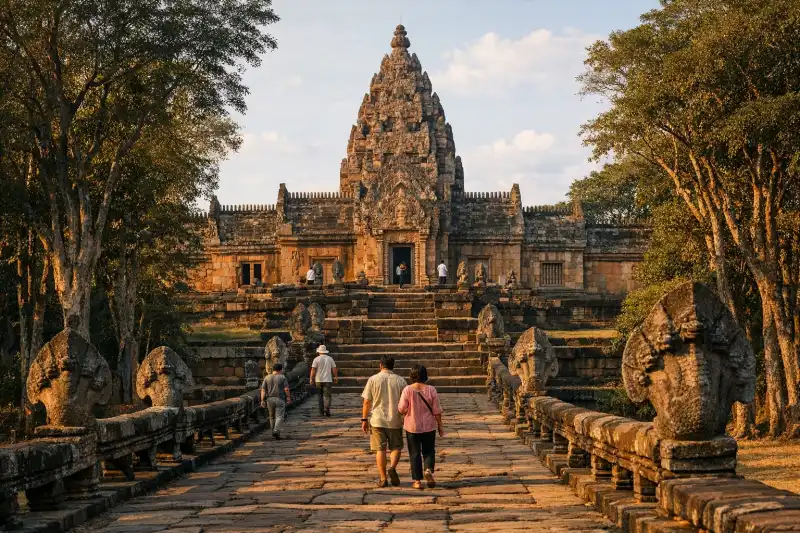
Phanom Rung
Khmer EmpireA dramatic Khmer hilltop temple in Thailand, Phanom Rung is famed for its sandstone carvings and sun...
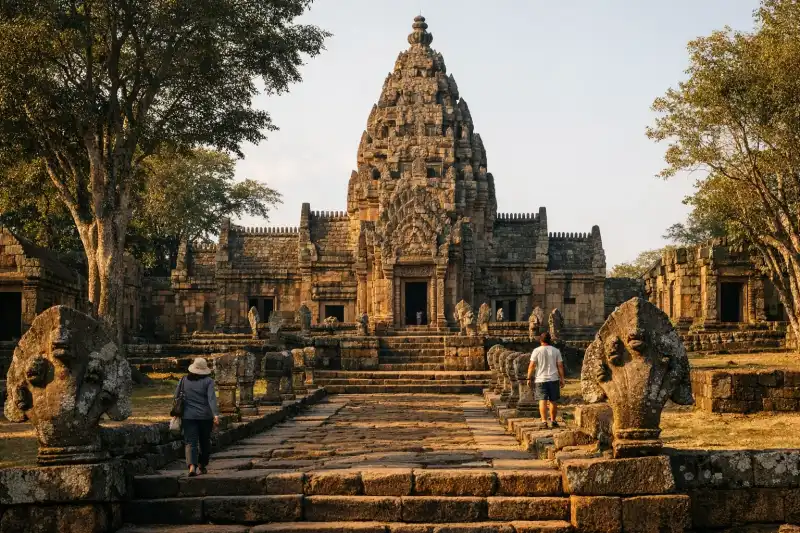
Prasat Hin Khao Phnom Rung
Khmer EmpireA dramatic Khmer hilltop temple in Thailand famed for its sandstone architecture, sacred processiona...
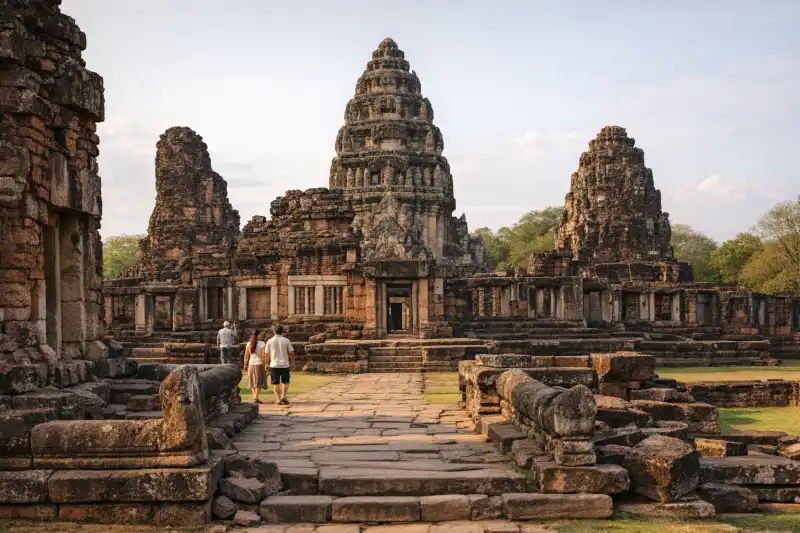
Phimai Historical Park
Khmer EmpireExplore Phimai Historical Park, a remarkable Khmer temple complex in northeastern Thailand famed for...
Phimai Sanctuary
Khmer EmpireExplore Phimai Sanctuary, a grand Khmer temple complex in Thailand known for elegant stone carvings ...