Quick Info
At a glance
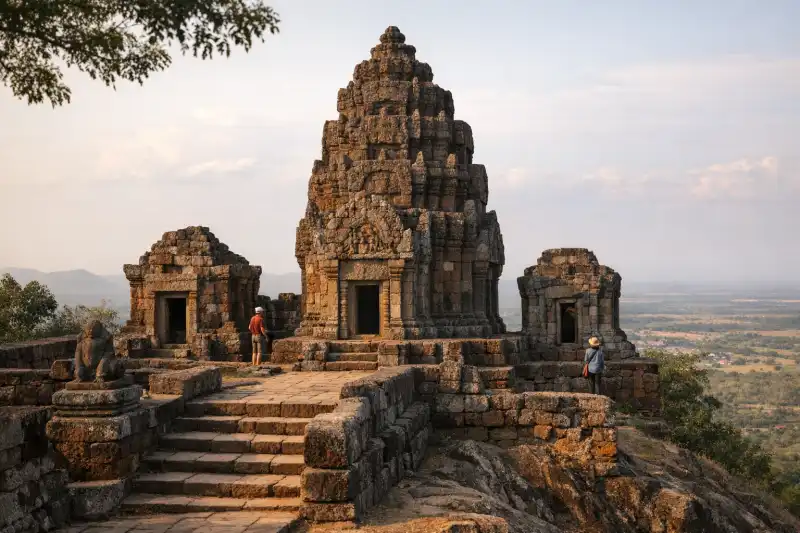
Prasat Khao Noi in Thailand rises from a low hill in Sa Kaeo Province, where the landscape begins to hint at the cultural and geographic transition between central Thailand and the Khmer world to the east. It is not one of the country’s largest or most lavish temple monuments, and that is part of its appeal. The sanctuary feels intimate, weathered, and quietly observant, a place where brick, laterite, and surviving sculptural fragments reveal a long history without overwhelming the visitor. Instead of processional grandeur, you find a compact sacred complex and an elevated position that offers broad views over the plains below.
For travelers interested in ancient Southeast Asia, Prasat Khao Noi rewards close attention. The site helps explain how Khmer religious architecture spread beyond the imperial center and adapted to regional settings. It also shows how sacred geography mattered: a hill, even a modest one, could transform a small temple into a symbolic mountain, linking the earthly realm to divine space. Today, the ruins carry an atmosphere of endurance. Trees, wind, and open sky frame the remains, while the traces of masonry and carved stone encourage visitors to imagine the sanctuary when it still drew worshippers, priests, and local elites. A visit here is less about spectacle and more about texture, setting, and historical continuity. For those exploring eastern Thailand’s ancient sites, Prasat Khao Noi offers a memorable encounter with an older sacred landscape that still feels distinctly alive.
History
Early Khmer influence in eastern Thailand
Prasat Khao Noi belongs to the period when Khmer cultural and political influence extended into what is now eastern Thailand. Between the 10th and 11th centuries CE, temple construction spread through frontier zones linked by trade routes, agricultural networks, and elite patronage. This was not a remote backwater cut off from larger developments. Instead, the region sat within a dynamic sphere where ideas about kingship, religion, art, and architecture moved across present-day borders.
The temple’s materials and design point to this larger Khmer tradition. Brick sanctuaries on elevated ground were common in the earlier phases of Khmer architecture, before the later flowering of larger sandstone complexes. At Prasat Khao Noi, the hilltop location likely mattered both ritually and politically. A sanctuary on a height visually marked authority in the landscape, while also invoking the sacred mountain symbolism central to Hindu cosmology and, later, Buddhist reinterpretations.
Foundation and religious purpose
Like many Khmer sanctuaries in Thailand, Prasat Khao Noi was probably established as a religious center serving a local community tied to regional administrators or landholding elites. The main cult may originally have been Hindu, quite possibly associated with Shiva, as was common in early Khmer state temples and provincial shrines. Brick towers often housed a sacred image or linga, and ritual specialists would have maintained offerings, rites, and seasonal observances.
The name “prasat” itself refers to a temple or sanctuary, while “Khao Noi” means “small hill” in Thai, a fitting description of the site’s setting. Although the monument is not massive, its placement would have amplified its symbolic importance. Pilgrims or local residents ascending the hill would have experienced a gradual separation from the ordinary world below, entering a sacred precinct elevated both physically and spiritually.
Scholars have associated sites of this type with the expansion of Khmer-style religious institutions beyond the imperial heartland. These temples did not merely copy central models; they translated them for local conditions. Brick was often easier to use than sandstone, and scale depended on resources, but the ritual logic remained consistent. The result was a network of sacred places that helped integrate border regions into a broader Khmer cultural sphere.
Change, reuse, and decline
Over time, religious landscapes in mainland Southeast Asia changed. Political centers shifted, trade patterns evolved, and the balance between Hindu and Buddhist traditions also moved. Many older Khmer sanctuaries were reused, adapted, or partially abandoned as patronage systems weakened or populations reorganized. At Prasat Khao Noi, as at many small provincial monuments, the original ritual intensity likely faded gradually rather than ending in a single dramatic event.
Natural weathering also took its toll. Brick and stucco are vulnerable to rain, vegetation, and centuries of neglect. Decorative details that would once have been more vivid have largely disappeared, leaving the underlying structural form easier to read than the full ornamental program. Yet this erosion also gives the site its present character. What remains is enough to show the sanctuary’s age and cultural affiliation, even when many finer details have been lost.
The region around Aranyaprathet remained important in later centuries because of its role as a frontier and exchange zone. Even when the temple’s original function diminished, the hill and ruins likely stayed visible to nearby communities, becoming part of local memory and identity.
Archaeological recognition and present-day preservation
In the modern period, Prasat Khao Noi came to be recognized as an archaeological monument worth preserving as part of Thailand’s Khmer-era heritage. Conservation efforts at sites like this often focus on stabilizing walls, clearing invasive vegetation, and documenting surviving architectural fragments. Such work can be modest compared with the restoration of more famous temples, but it is essential. Without maintenance, brick sanctuaries can deteriorate quickly.
Today, the site stands as a valuable historical reference point for travelers, students, and heritage enthusiasts. It helps fill in the map of Khmer-period Thailand, showing that the story of the civilization was not limited to headline destinations like Phanom Rung or the great Angkorian centers across the border. Prasat Khao Noi may be smaller, but it is historically significant precisely because it preserves the provincial dimension of the Khmer world: local, strategic, sacred, and enduring.
Key Features
What makes Prasat Khao Noi memorable is the way architecture and topography work together. The temple does not dominate by sheer size. Instead, it draws the eye through contrast: compact ruins set on a hill, with open air and far-reaching views all around. Even before examining the masonry, visitors tend to feel the intentionality of the location. The sanctuary was meant to stand apart from the plain below, and that separation still shapes the experience of visiting.
The surviving structure reflects early Khmer building traditions, especially the use of brick and laterite. Brick temples often have a softer visual texture than later sandstone monuments. Their surfaces absorb light differently, and where stucco decoration has disappeared, the remaining walls show the practical logic of construction. At Prasat Khao Noi, that material simplicity becomes part of the aesthetic. You are looking not only at a sacred building, but at an architectural phase when Khmer temple design was still compact, concentrated, and closely tied to symbolic placement.
Another important feature is the site’s sense of scale. Because Prasat Khao Noi is relatively small, visitors can understand the whole complex quickly and then return to details. This is a different experience from navigating a sprawling archaeological park. Here, the sanctuary reads almost like a distilled lesson in Khmer sacred architecture: elevated location, axial logic, durable core materials, and a central shrine focused on a single ritual purpose. The ruins invite careful observation rather than hurried sightseeing.
The hilltop setting adds a strong scenic dimension. From the summit area, the surrounding countryside unfolds in broad stretches, reinforcing why this location mattered. The elevation may be modest by mountain standards, but in a largely level landscape it creates a commanding vantage point. Ancient builders would have understood the visual authority that came with such placement. Modern visitors can appreciate that same advantage, especially in softer morning or late-afternoon light when the ruins and plains gain more depth and color.
Stone fragments and surviving decorative elements, where visible, also matter. Even when carvings are worn, they help connect the site to the artistic language of the Khmer world. Lintels, doorframes, and sacred thresholds were never merely structural. They marked the transition into divine space. At small sanctuaries like this, these elements are often fragmentary, but they remain among the most evocative parts of the monument because they suggest the richer sculptural program that once existed.
The atmosphere is another key feature, though less tangible than masonry. Prasat Khao Noi tends to feel quieter than Thailand’s major heritage destinations. That relative calm allows the site to be experienced at a slower pace. Instead of competing with crowds, visitors can listen to wind in the trees, notice the changing color of the bricks, and imagine the ritual life that once animated the shrine. This stillness makes the monument especially appealing to travelers who enjoy archaeology as a reflective experience rather than a checklist stop.
Finally, Prasat Khao Noi’s broader importance lies in its role as a regional witness. It shows how Khmer architectural and religious forms spread into eastern Thailand and adapted to local contexts. The temple is not only a ruin but also a historical marker of exchange, power, and belief in a frontier landscape. For anyone interested in ancient networks across mainland Southeast Asia, that combination of modest scale and wide significance is exactly what makes the site so rewarding.
Getting There
Prasat Khao Noi is most easily reached from Aranyaprathet in Sa Kaeo Province. From central Aranyaprathet, the trip by taxi or private car usually takes around 20 to 30 minutes, depending on your starting point and road conditions. A local taxi or hired car for a round trip with waiting time may cost roughly THB 500-1,000. If you are staying in Sa Kaeo town instead, expect a longer journey and a somewhat higher fare.
From Bangkok, the simplest option is to travel by private car or arranged driver. The road journey usually takes about 3.5 to 4.5 hours. A private day hire from Bangkok can range widely, but THB 3,500-6,500 is a reasonable estimate depending on vehicle type, fuel inclusion, and total waiting time. Budget travelers can take a train or bus from Bangkok to Aranyaprathet first. Third-class train fares are low, often under THB 100, while more comfortable rail or bus options may range from about THB 150-300. From Aranyaprathet station or bus stop, continue by tuk-tuk, local taxi, or app-based hire where available.
Public transport directly to the hill is limited, so the final stretch usually requires private local transport. If you prefer independence, renting a car in Bangkok or in a larger regional center is practical, especially if you plan to combine Prasat Khao Noi with other heritage sites in eastern Thailand. Bring cash for local drivers, and confirm whether the driver will wait or return at a fixed time. Because the site involves a hill approach and some walking, comfortable shoes and water are advisable, especially in hot weather.
When to Visit
The best time to visit Prasat Khao Noi is during Thailand’s cooler, drier months, generally from November to February. During this season, temperatures are more manageable, skies are often clearer, and the hilltop views are at their best. Morning visits are especially pleasant, offering softer light for photography and a more comfortable climb. Late afternoon can also be attractive, though midday heat is best avoided whenever possible.
From March to May, temperatures in eastern Thailand can become intense. The site remains visitable, but the exposed hilltop and limited shade can make the experience tiring. If you come during the hot season, arrive early, wear a hat, and carry more water than you think you need. Heat exhaustion is a greater concern here than difficult terrain.
The rainy season, typically from May or June through October, transforms the surrounding landscape into a greener and sometimes more dramatic setting. This can be a beautiful time for photographs, with richer vegetation and moody skies. However, paths may be slippery, humidity will be higher, and occasional downpours can interrupt your plans. If you visit in these months, lightweight rain protection and grippy footwear are useful.
In practical terms, weekdays are usually quieter than weekends or Thai holiday periods. If your goal is a contemplative visit with minimal distraction, a weekday morning in the cool season offers the best combination of comfort, light, and atmosphere. If you enjoy lush scenery and do not mind weather uncertainty, the wet season has its own appeal. Either way, the key is timing your visit around the heat: this is a site best appreciated when you can move slowly, look closely, and spend a few extra minutes taking in the view.
| Quick Facts | Details |
|---|---|
| Site name | Prasat Khao Noi |
| Location | Sa Kaeo Province, Thailand |
| Nearest city | Aranyaprathet |
| Cultural affiliation | Khmer |
| Estimated date | c. 10th-11th century CE |
| Setting | Hilltop sanctuary |
| Main materials | Brick and laterite |
| Best visit length | 45-90 minutes |
| Best season | November to February |
| Ideal time of day | Early morning or late afternoon |
Prasat Khao Noi is the kind of place that quietly improves the longer you stay with it. At first glance, it may seem modest beside Thailand’s better-known Khmer monuments, but that modesty is deceptive. The site condenses many of the qualities that make ancient architecture compelling: a meaningful landscape setting, durable but expressive materials, and a layered history that links local life to wider regional worlds. For visitors exploring Sa Kaeo Province or tracing Khmer heritage beyond the most famous routes, it offers both a rewarding stop and a useful historical reference point.
Its hilltop sanctuary reminds us that sacred architecture did not depend only on scale or ornament. Position, symbolism, and continuity mattered just as much. Standing among the ruins, looking out over the plains, it becomes easier to imagine how this small temple once anchored ritual life and asserted presence in a frontier zone shaped by movement and exchange. Prasat Khao Noi may not be Thailand’s most famous ancient site, but it is one of those places that gives depth to the map. It shows how empires were experienced at the edges, how beliefs took material form in local settings, and how even a small surviving sanctuary can preserve a remarkably large story.
Guided tours: worth it?
A guide can be genuinely useful at Prasat Khao Noi, especially if you want help with transport, timing, tickets, or understanding a large site without losing half the day to logistics.
Best for
- First-time visitors who want context, not just photos
- Travelers who want transport, timing, or entry logistics handled
- Short visits where a planned route saves time
When to go self-guided
Go independently if you already have transport and tickets sorted, enjoy moving at your own pace, and are comfortable checking the latest official rules before you arrive.
What I’d avoid
Skip paid tours that bundle unrelated stops you do not actually want. The best option should either save meaningful planning time or add historical context you would miss on your own.
Sa Kaeo and Aranyaprathet cultural sites tours
Useful when: you want to compare guided formats before deciding
Eastern Thailand temple and heritage tours
Useful when: you want to compare guided formats before deciding
Bangkok to Sa Kaeo private day trips
Useful when: you want flexible timing or a private guide
Some tour links are affiliate links, which may earn Ancient Travel a small commission at no extra cost to you. I try to surface options that make practical sense for the site—not just anything bookable.
Frequently Asked Questions
Where is Prasat Khao Noi located?
Prasat Khao Noi is in Sa Kaeo Province in eastern Thailand, near Aranyaprathet and the modern border with Cambodia.
What is Prasat Khao Noi known for?
It is known as an early Khmer hilltop sanctuary, built primarily in brick and laterite, and for its commanding views across the surrounding plains.
How much time should I allow for a visit?
Most travelers spend 45 minutes to 1.5 hours at the site, depending on how long they linger for photos, inscriptions, and the panoramic viewpoint.
Is Prasat Khao Noi difficult to access?
Access is generally straightforward by car or taxi from Aranyaprathet, though the final approach involves a hill and some walking steps, so sturdy footwear is helpful.
Can I visit Prasat Khao Noi on a day trip from Bangkok?
Yes, it can be visited as a long day trip from Bangkok, but many travelers find it more comfortable to overnight in Sa Kaeo or Aranyaprathet.
What should I bring when visiting?
Bring water, sun protection, comfortable shoes, cash for local transport, and a camera since the hilltop setting is one of the site's highlights.
Nearby Ancient Sites
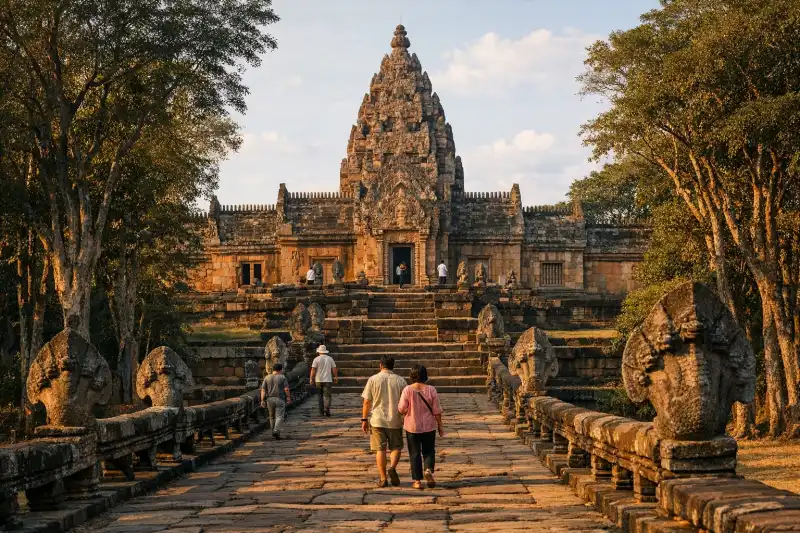
Phanom Rung
Khmer EmpireA dramatic Khmer hilltop temple in Thailand, Phanom Rung is famed for its sandstone carvings and sun...
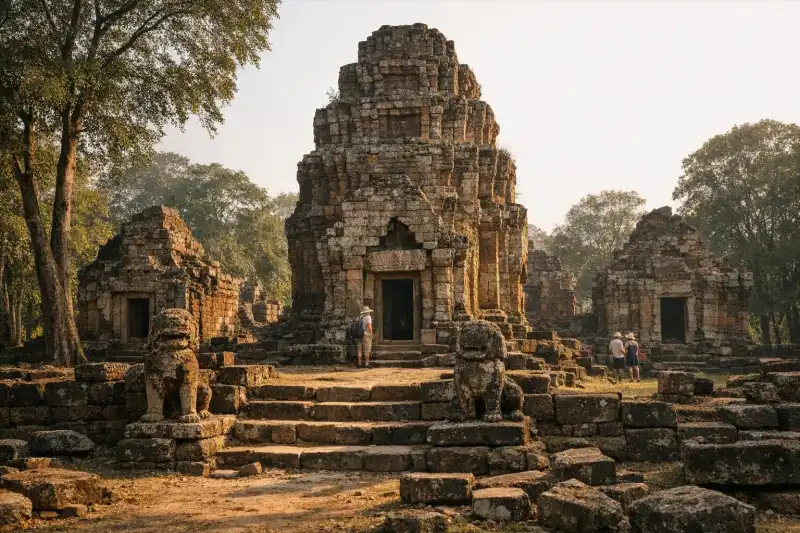
Ku Phra Kona
KhmerAn early Khmer sanctuary in northeastern Thailand, Ku Phra Kona preserves brick towers, carvings, an...
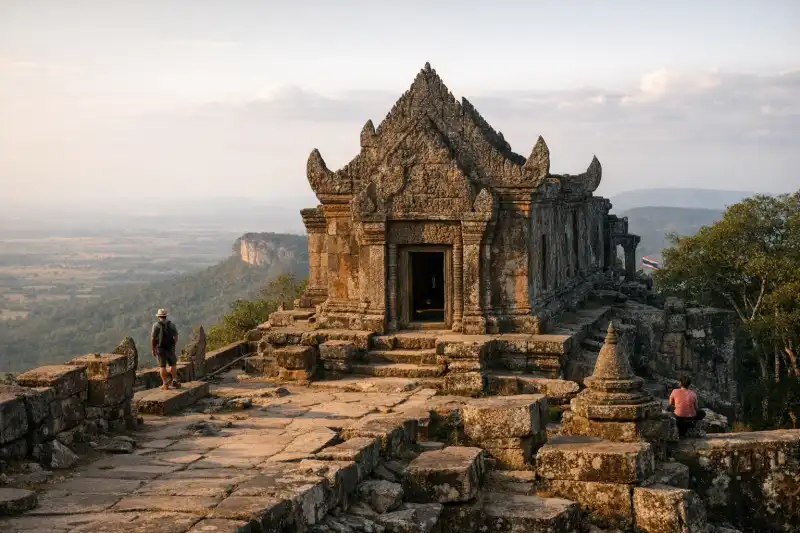
Khao Phra Viharn
Khmer EmpireA dramatic Khmer temple on Thailand’s frontier, Khao Phra Viharn crowns a cliff with sweeping views ...