Quick Info
At a glance
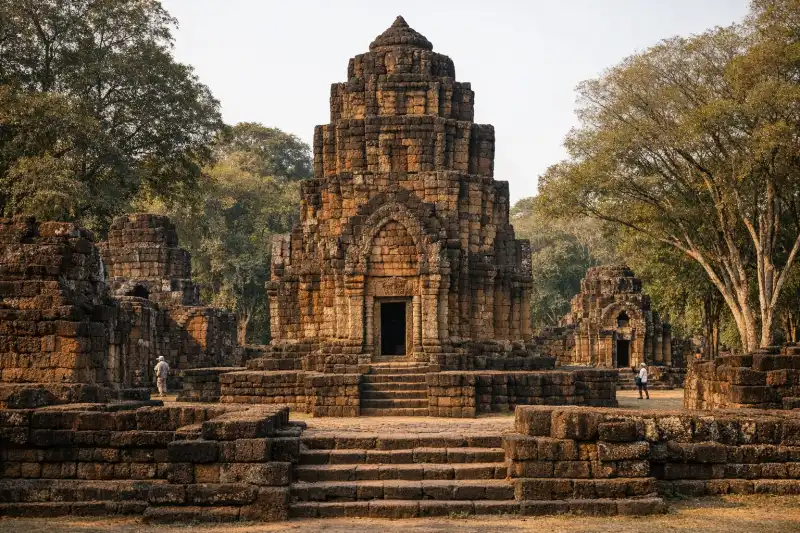
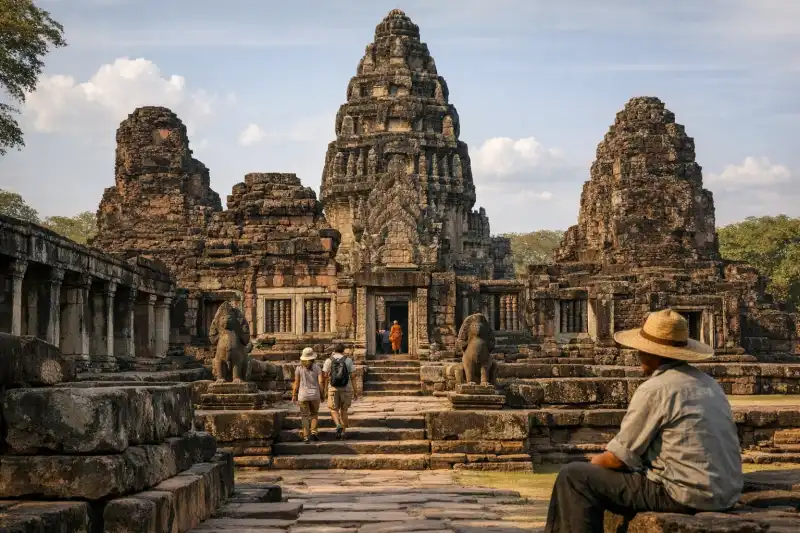
Prasat Muang Sing in Thailand feels at once remote and quietly monumental, a Khmer-era sanctuary set within green lawns, old trees, and the broad historical landscape of Kanchanaburi Province. Unlike the country’s most famous beach or capital attractions, this site rewards a slower kind of attention. You arrive not to a crowded urban ruin hemmed in by traffic, but to an archaeological park where walls of laterite rise from the earth in dark reddish blocks and where the outline of an ancient settlement still shapes the land. The name “Muang Sing” is often translated as “City of Lions,” and while the park today is calm rather than fierce, there is still something powerful in the geometry of its enclosure, its surviving towers, and its relationship to river routes and frontier politics.
For many travelers, Prasat Muang Sing is a surprise: a distinctly Khmer monument in western Thailand, far from the Angkor heartland that usually dominates discussions of Khmer architecture. Yet this is precisely what makes it compelling. It reveals how far Khmer political and religious influence once extended and how borderlands could become places of exchange, ritual, and strategic importance. A visit here is not only about looking at old stones. It is about stepping into a landscape where empire, religion, and local adaptation met. The result is one of Thailand’s most atmospheric historical parks, ideal for travelers who enjoy archaeology, photography, and the quieter edges of Southeast Asian history.
History
Khmer expansion into western Thailand
Prasat Muang Sing emerged during the period when the Khmer Empire projected its power far beyond present-day Cambodia. Between the 12th and early 13th centuries, Khmer rulers developed a wide network of roads, sanctuaries, administrative centers, and rest houses that tied peripheral regions to the imperial core. Western Thailand, including the Kanchanaburi area, lay along strategic corridors linking the Chao Phraya basin with routes toward the west. In this setting, Muang Sing became more than a local settlement. It formed part of a frontier zone where imperial ambitions, military logistics, and sacred architecture came together.
Scholars generally associate the main monuments at the site with the reign of Jayavarman VII, the great Khmer king known for expansive building projects and for promoting Mahayana Buddhism. His era saw the construction of hospitals, temples, and state foundations across a broad territory. The architecture and artistic remains at Prasat Muang Sing fit well within this wider pattern. The enclosure walls, laterite construction, and sanctuary layout all suggest a strong Khmer state presence. Rather than being an isolated temple, the site likely functioned within a larger settlement enclosed by defensive or symbolic boundaries, showing that it had both practical and ceremonial significance.
A Buddhist sanctuary in a frontier city
One of the most interesting aspects of Prasat Muang Sing is its religious identity. While many Khmer monuments are associated in the popular imagination with Hindu traditions, the late 12th and early 13th centuries were also a major period for Mahayana Buddhist patronage. Archaeological evidence from the site, including sculpture and iconography, points to Buddhist use. This places the sanctuary within the remarkable religious transformation of Jayavarman VII’s empire, when images of the Buddha and bodhisattvas became central to state-sponsored architecture.
The principal shrine, now known as Prasat Muang Sing 1, would once have contained sacred images and ritual spaces aligned with Khmer cosmological ideas. Its layout reflected more than aesthetics. Walls, gateways, and the raised sanctuary platform helped define sacred movement, creating a progression from the outer world to a ritual center. At the same time, the surrounding urban enclosure suggests that religion and governance were closely connected. Like many Khmer foundations, the temple likely served political goals as well as spiritual ones, reinforcing authority in a region far from the imperial capital.
Decline, change, and local memory
As Khmer influence waned in mainland Southeast Asia during the 13th century and regional powers shifted, Muang Sing gradually lost its original role. Political centers moved, religious practices changed, and once-important frontier settlements could become peripheral. The temple complex fell into disuse, and over time the forest and soil reclaimed large portions of the site. This was not an abrupt disappearance but a long process of transformation, in which monumental architecture remained visible while its original functions faded.
Even when abandoned as an active Khmer sanctuary, the place survived in local memory through its ruins, earthworks, and place names. Like many ancient sites in Thailand, Muang Sing entered a layered afterlife. Later communities lived around it, interpreted it through new cultural frameworks, and preserved fragments of its story without necessarily retaining all of its original meanings. Such continuity matters: archaeological parks do not emerge from total oblivion but from landscapes where the past has remained present in partial, altered ways.
Archaeological rediscovery and preservation
Modern archaeological attention brought Prasat Muang Sing back into national historical consciousness. Surveys and excavations in the 20th century documented the scale of the enclosure, the layout of sanctuaries, and the artistic remains scattered across the area. Restoration work stabilized major structures and helped clarify the site’s Khmer-era chronology. The designation of the area as a historical park protected both the central temple group and the wider archaeological landscape.
Today, Prasat Muang Sing stands as one of the most important Khmer sites in Thailand outside the better-known complexes of the northeast. Its value lies not only in what survives above ground but in what the broader settlement reveals about movement, power, and cultural exchange in premodern Southeast Asia. For visitors, that means the site is best understood not as a single ruin but as an ancient urban and ceremonial landscape, one that reflects the western reach of the Khmer world and the enduring complexity of Thailand’s historical geography.
Key Features
The first thing many visitors notice at Prasat Muang Sing is the material. Laterite dominates the architecture, giving the ruins their dense, dark, almost porous texture. In strong sunlight it appears reddish brown; after rain it can look nearly purple-black. This creates a very different visual experience from the pale stone of some other Southeast Asian monuments. The walls feel grounded and heavy, as if they grew from the soil itself. The restored sections are enough to convey the original monumentality without making the site seem over-reconstructed, and this balance adds to the park’s appeal.
The principal sanctuary, often referred to as Prasat No. 1, is the heart of the complex. It stands within a rectangular enclosure and preserves the basic form of a Khmer temple adapted to local conditions. As you move through the approach, the surviving walls and openings still organize your sense of space. There is a clear passage from outer precinct to inner sanctuary, and even without all the original superstructure, the design communicates hierarchy and ritual focus. The central tower remains the symbolic anchor, hinting at the sacred image or images that once occupied this space. Visitors with an eye for architectural planning will appreciate how carefully the site stages entry, enclosure, and revelation.
Nearby stands another important monument, commonly called Prasat No. 2. It is less imposing than the main sanctuary but valuable for understanding that Muang Sing was not a single-building site. Instead, it was a complex environment with multiple structures serving different purposes. The relationship between the sanctuaries helps visitors imagine a once-active settlement with ceremonial, administrative, and perhaps residential functions. Walking between these structures across the open grounds can be especially evocative in the early morning, when the scale of the enclosure becomes easier to feel than to measure.
The wider city walls are among the most significant features of the historical park. They trace the perimeter of an ancient moated and enclosed settlement, transforming the visit from a temple stop into an encounter with urban archaeology. Even where the walls are low or fragmentary, they reveal planning on a large scale. This was not simply a shrine placed in the countryside. It was a bounded center with a defined footprint and a relationship to movement, defense, and authority. For travelers familiar with Angkor or the great temple cities of the region, Muang Sing offers a smaller but highly instructive example of how Khmer spatial ideas were translated beyond the empire’s core.
Another highlight is the setting itself. The park’s lawns, trees, and broad paths create an accessible experience, yet the landscape still conveys the sense of a site reclaimed from nature. Depending on the season, the grass may be vividly green or sun-bleached gold, changing the atmosphere considerably. The relative quiet of the park also matters. Without the pressure of large crowds, you can notice subtle details: the alignment of walls, the shape of doorframes, the contrast between restored masonry and eroded surfaces, and the way shadows collect inside ruined chambers.
Small museum displays and interpretive panels help connect these visible remains with the sculptures found here, including Buddhist imagery linked to the site’s original religious function. Although the park does not overwhelm visitors with objects, this restraint is part of its charm. Prasat Muang Sing invites interpretation through walking and looking rather than through spectacle. It is a place where scale, texture, and setting do much of the storytelling.
Photographers often find the site rewarding because of this interplay between architecture and environment. The best images are not always close-ups of carvings, since many decorative elements are fragmentary, but wider compositions where the sanctuary rises from grass and trees under open sky. The monument’s silhouette, framed by foliage or lit by low sun, can be especially striking. For history-minded travelers, meanwhile, the key feature is conceptual: this site demonstrates how far Khmer political and religious culture extended into Thailand, making it a crucial stop for anyone tracing Southeast Asia’s connected past.
Getting There
Prasat Muang Sing is most easily reached from Kanchanaburi town, which serves as the practical base for most visitors. The historical park lies roughly 35 to 45 kilometers northwest of the city, depending on your route, and the drive usually takes about 45 minutes to 1 hour. If you have your own car or rental scooter, this is the simplest option. Fuel costs are modest, and roads are generally straightforward, though signage can vary, so using GPS is helpful.
A taxi or private car from Kanchanaburi typically costs around 800 to 1,500 THB for a half-day arrangement, depending on negotiation, waiting time, and whether other stops are included. Many travelers combine Prasat Muang Sing with nearby attractions in Sai Yok District, which can make hiring a driver good value. Songthaews and local transport options exist in the broader region, but they are less predictable for international visitors and may require transfers. If you are comfortable with flexible schedules and basic Thai-language logistics, local buses toward Sai Yok can reduce costs, but the final stretch may still require a motorcycle taxi or ride-hailing option where available.
From Bangkok, the journey is best done either by rental car, private transfer, or as part of a guided day tour to Kanchanaburi. A private car from Bangkok can cost roughly 2,500 to 4,500 THB for the day depending on vehicle type and itinerary. Public transport to Kanchanaburi is inexpensive, usually around 120 to 200 THB by bus or train, but continuing onward to the site adds time and coordination. For most visitors, staying at least one night in Kanchanaburi makes the visit more comfortable.
Entrance fees can change, but foreign visitor pricing at Thai historical parks is commonly around 100 THB, sometimes with lower rates for Thai nationals. Bring cash, sun protection, and water, especially if visiting independently.
When to Visit
The most comfortable time to visit Prasat Muang Sing is during Thailand’s cooler dry season, generally from November to February. Morning temperatures are gentler, the sky is often clear, and walking around the exposed parts of the park is much easier than in the hotter months. This is the best season for travelers who want to spend time reading the site, taking photographs, and exploring the grounds without rushing between shaded areas.
March to May is the hottest period. The park remains visitable, but midday can be intense, with strong sunlight reflecting off the open ground and very little shelter once you move beyond tree-lined sections. If you come during these months, arrive as early as possible, ideally soon after opening time. Light clothing, a hat, and plenty of water are essential. The benefit of the hot season is that the site can feel especially quiet, and early morning light can be beautiful on the laterite structures.
The rainy season, usually from May or June through October, changes the atmosphere in appealing ways. The surrounding landscape becomes greener, the lawns look lush, and the dark masonry often appears richer in color after showers. On the other hand, humidity rises, sudden rain can interrupt a visit, and paths may feel slick in places. If you do not mind carrying an umbrella or poncho, this season can actually be very rewarding for photography and for experiencing the park at its most verdant.
Whatever the month, the best time of day is early morning or late afternoon. The softer light improves the mood of the ruins, and the lower temperatures make it easier to appreciate the full layout of the historical park rather than simply hurrying through the main sanctuary.
| Quick Facts | Details |
|---|---|
| Location | Sai Yok District, Kanchanaburi Province, Thailand |
| Historical significance | Khmer-era temple and walled settlement on the western frontier of the Khmer world |
| Main period | 12th-13th century CE |
| Associated ruler | Commonly linked to the era of Jayavarman VII |
| Religious tradition | Primarily Mahayana Buddhist during its main phase |
| Building material | Predominantly laterite, with some sandstone elements |
| Time needed | 1.5 to 3 hours |
| Best base | Kanchanaburi town |
| Best season | November to February |
| Best time of day | Early morning or late afternoon |
Prasat Muang Sing is not Thailand’s biggest archaeological park, and that is part of its strength. It is manageable without being minor, historically rich without feeling overinterpreted, and atmospheric without relying on dramatic scale. For travelers interested in the Khmer world beyond Cambodia, it offers a crucial perspective: empire was never only about capitals, but also about distant nodes where architecture, belief, and political influence were translated into local landscapes. Here, on the quiet plains of Kanchanaburi, that frontier story remains visible in walls, towers, and the enduring geometry of an ancient city.
What lingers after a visit is often not a single sculptural masterpiece but the total experience of the place. You remember the dark stone against bright grass, the stillness inside the sanctuary enclosure, and the surprising realization that western Thailand once stood firmly within a wider network of Khmer power and Buddhist devotion. For anyone building a more nuanced understanding of mainland Southeast Asia, Prasat Muang Sing deserves a place on the itinerary. It is a site that rewards patience, and in return offers one of the most quietly meaningful historical encounters in Thailand.
Guided tours: worth it?
Self-guided works here, but a guide can add real value if you want the ruins explained as a living place rather than just a sequence of monuments.
Best for
- First-time visitors who want context, not just photos
- Short visits where a planned route saves time
When to go self-guided
Go independently if you prefer setting your own pace, reading as you go, and checking official hours or ticket rules directly before you arrive.
What I’d avoid
Skip paid tours that bundle unrelated stops you do not actually want. The best option should either save meaningful planning time or add historical context you would miss on your own.
Kanchanaburi historical sites tours
Useful when: you want to compare guided formats before deciding
Kanchanaburi day trips from Bangkok
Useful when: transport or pickup logistics matter
Thailand Khmer temple tours
Useful when: you want to compare guided formats before deciding
Some tour links are affiliate links, which may earn Ancient Travel a small commission at no extra cost to you. I try to surface options that make practical sense for the site—not just anything bookable.
Frequently Asked Questions
Where is Prasat Muang Sing located?
Prasat Muang Sing is in Sai Yok District, Kanchanaburi Province, western Thailand, near the Khwae Noi River and west of Bangkok.
What is Prasat Muang Sing known for?
It is known for being one of Thailand’s most important Khmer-period temple complexes, with laterite walls, sanctuary towers, and links to the Angkor world.
How much time should I spend at Prasat Muang Sing?
Most visitors spend 1.5 to 3 hours exploring the main sanctuary, the surrounding enclosure, museum displays, and walking paths through the historical park.
Can I visit Prasat Muang Sing as a day trip from Bangkok?
Yes. It can be visited on a long day trip from Bangkok, though many travelers combine it with an overnight stay in Kanchanaburi for a more relaxed pace.
Is Prasat Muang Sing suitable for families?
Yes. The site is relatively easy to walk, has open green space, and offers a manageable introduction to Khmer archaeology for adults and children.
When is the best time to visit Prasat Muang Sing?
The coolest and most comfortable months are generally November to February, while early morning visits are best year-round to avoid midday heat.
Nearby Ancient Sites
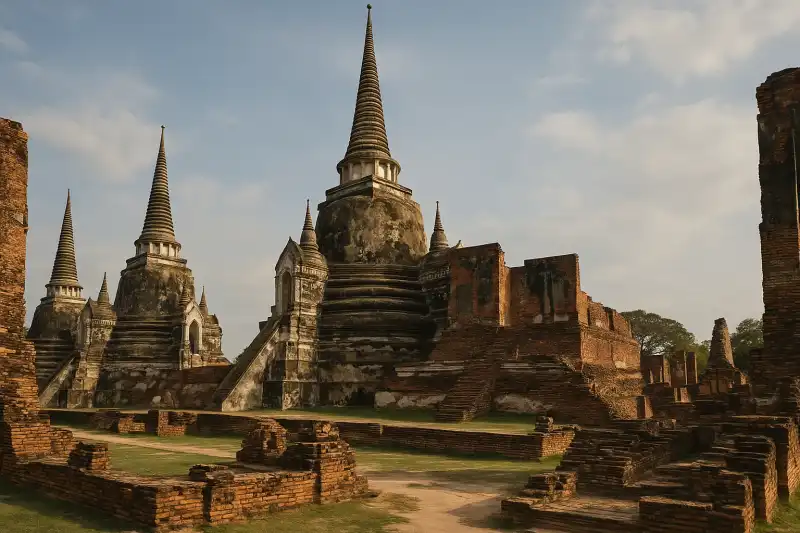
Ayutthaya Travel Guide 2026: Temple Ruins, Day Trip Planning, and What to Prioritize
Ayutthaya KingdomPlan a focused Ayutthaya visit with practical temple routing, timing, and transport guidance from Ba...
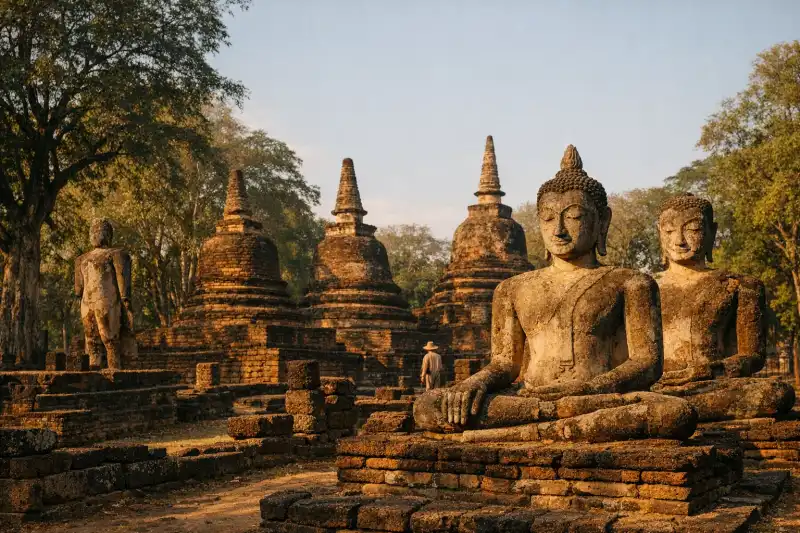
Kamphaeng Phet
Sukhothai KingdomExplore Kamphaeng Phet in Thailand, a walled historic city of temples, laterite ruins, and forested ...
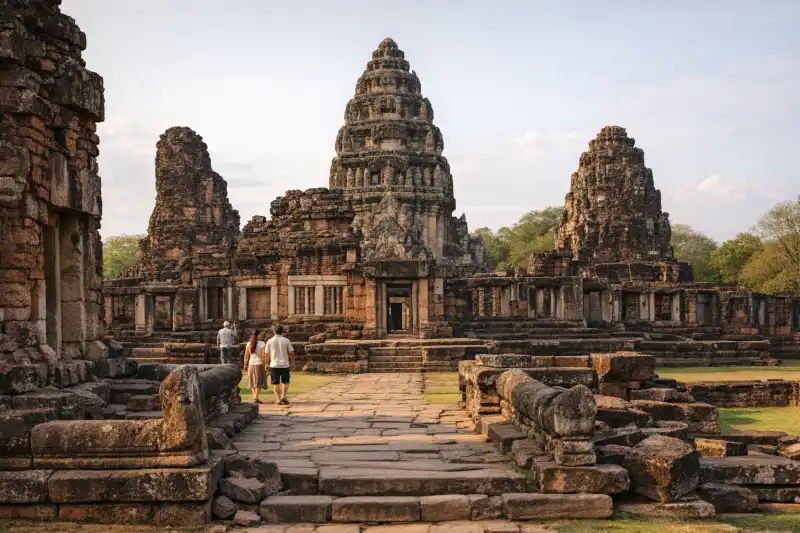
Phimai Historical Park
Khmer EmpireExplore Phimai Historical Park, a remarkable Khmer temple complex in northeastern Thailand famed for...
Phimai Sanctuary
Khmer EmpireExplore Phimai Sanctuary, a grand Khmer temple complex in Thailand known for elegant stone carvings ...