Quick Info
At a glance
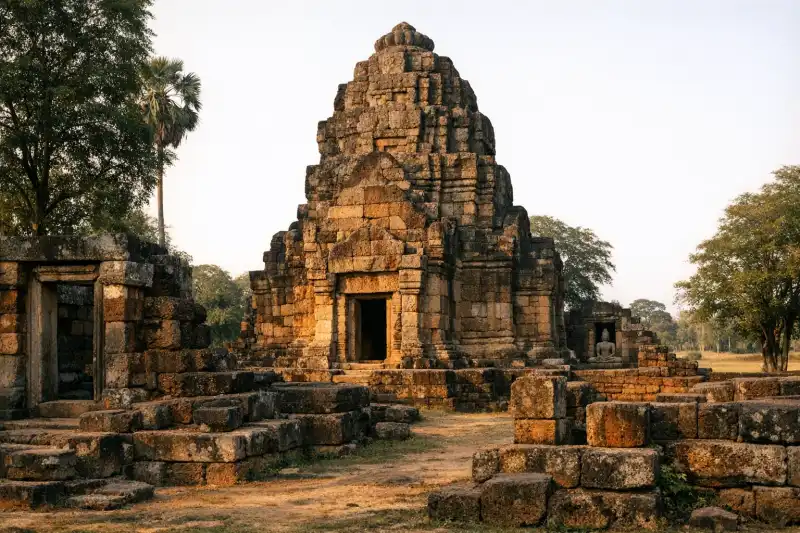
Prasat Non Ku in Thailand sits quietly in the agricultural heartland of Isan, far from the country’s most crowded heritage circuits, yet it rewards travelers with the kind of atmosphere that makes ancient places memorable. There are no grand ticket lines, no dramatic modern staging, and often no rush at all. Instead, the sanctuary emerges from the rural landscape with a sense of stillness: weathered stone, low vegetation, open skies, and the everyday rhythm of northeastern Thai village life continuing around it. For visitors interested in Khmer history outside Cambodia, this modest temple ruin offers an intimate encounter with the architectural and religious world that once linked much of mainland Southeast Asia.
What makes Prasat Non Ku appealing is not monumental scale but context. It belongs to the network of Khmer-period sanctuaries scattered across modern Thailand, especially in the northeast, where the influence of Angkor extended through roads, ritual centers, reservoirs, and stone shrines. At sites like this, you can see how imperial styles were adapted in local settings. The remains may be fragmentary, but they still speak through layout, masonry, carved elements, and orientation. Standing here, it becomes easier to imagine the site not as an isolated ruin but as part of a larger sacred geography connected to trade, governance, and devotion.
For travelers who enjoy lesser-known archaeological places, Prasat Non Ku is especially satisfying. It asks for a bit more effort to reach, but in return it offers rare calm, a strong sense of place, and a closer view of Thailand’s Khmer heritage than many first-time visitors ever experience.
History
Early Khmer influence in northeastern Thailand
The history of Prasat Non Ku begins with the expansion of Khmer cultural and political influence into what is now northeastern Thailand. Between the 10th and 12th centuries, the region known today as Isan was not a distant fringe but an active frontier within a wider world shaped by the Angkorian state. Roads linked settlements and sanctuaries across the plateau, and elite patrons sponsored the construction of shrines that reflected both religious devotion and political legitimacy.
Like many Khmer sites in Thailand, Prasat Non Ku was likely founded during a period when temple building served several purposes at once. A sanctuary was a sacred space, but it also signaled status, organization, and participation in a larger imperial order. The use of laterite for structural components and sandstone for decorative or symbolic elements reflects the construction habits seen at other regional Khmer monuments. Even when these temples were relatively small, they were carefully planned according to cosmological principles, often aligned to the east and enclosed within formal boundaries.
Prasat Non Ku probably functioned as a local religious center rather than a major royal temple. That does not lessen its importance. Smaller sanctuaries are often the best evidence for how Khmer culture was embedded in everyday provincial life, beyond the famous capitals and flagship monuments.
Religious purpose and architectural development
Most Khmer sanctuaries in the region were associated either with Shaivism, Vaishnavism, or later Buddhist practices, and Prasat Non Ku likely passed through one or more of these religious phases. In the Angkorian world, temple use could evolve over time as dynastic priorities shifted, local patrons changed, and regional traditions blended. The surviving structure suggests a sanctuary built according to recognizable Khmer conventions, with a central tower or shrine space serving as the ritual core.
In its original state, the site would have looked far more complete than it does today. A brick, laterite, or sandstone sanctuary would have included architectural details that framed ritual movement and sacred symbolism: doorways, false doors, lintels, pilasters, and perhaps enclosure elements around the central shrine. Some of these features survive only in fragments at many rural sites, but together they allow archaeologists to identify chronology and stylistic influences.
Prasat Non Ku belongs to a long tradition in which architecture was intended to represent a sacred universe. The central sanctuary often symbolized Mount Meru, the cosmic axis in Hindu and Buddhist cosmology. Even modest shrines reproduced this idea in compact form. This is one reason why a small ruin can still carry a strong spiritual and visual presence. Its plan was designed not simply for shelter or display, but to organize sacred experience.
Decline, reuse, and survival in the local landscape
As political and economic centers shifted over the centuries, many Khmer shrines in Thailand gradually lost their original ritual roles. Some were abandoned, others reused, and many became integrated into local memory in new ways. Stones might be moved, decorative elements weathered, and old compounds partly absorbed by fields or settlements. This process was gradual rather than dramatic. Rural sanctuaries often survived precisely because they remained part of the lived landscape, even when their original meanings changed.
Prasat Non Ku appears to have followed this pattern of slow decline rather than catastrophic destruction. Time, climate, vegetation, and human reuse likely all contributed to the ruinous condition visible today. Yet the site endured. Its surviving elements continued to mark it as a special place, preserving a link between present-day communities and the region’s Khmer past.
In many parts of Isan, ancient monuments have long coexisted with village shrines, modern temples, and agricultural routines. This layered landscape is part of the significance of Prasat Non Ku. It is not sealed off from local life; rather, it shows how heritage survives within it.
Modern recognition and conservation
In the modern era, Thailand’s archaeological and cultural agencies have documented and protected many Khmer monuments across the northeast, and Prasat Non Ku has gained recognition as part of this broader heritage network. Conservation at smaller sites is often selective, focusing on stabilization, clearing vegetation, and preserving visible architectural remains rather than fully reconstructing missing sections.
This approach can actually benefit the visitor experience. At Prasat Non Ku, the ruin still feels authentic to its setting. You encounter old stone in open country, with enough preservation to understand the form of the sanctuary, but not so much intervention that the site feels overly curated. For historians and travelers alike, that balance is valuable.
Today Prasat Non Ku stands as a reminder that Thailand’s ancient past is not limited to Ayutthaya, Sukhothai, or the most heavily visited Khmer temples. Rural sanctuaries like this one deepen the story, revealing how far Khmer artistic and religious traditions reached and how enduring those traces remain in the landscapes of modern Isan.
Key Features
Prasat Non Ku’s most compelling feature is its scale. That may sound surprising, but smaller Khmer sites often provide a clearer sense of architectural intention because visitors can take in the entire sanctuary at once. Rather than being overwhelmed by a sprawling complex, you can notice how the builders organized space: the orientation of the shrine, the relationship between surviving walls and openings, and the way decorative stone was used to emphasize sacred thresholds. The ruin invites slow looking.
The masonry itself is one of the site’s main attractions. Khmer builders in northeastern Thailand frequently worked with laterite blocks for core structural elements, using sandstone for carved details and areas of ritual or visual importance. At Prasat Non Ku, the contrast between these materials helps define the monument’s character. Laterite gives the structure its earthy, textured mass, while sandstone would originally have carried the refined sculptural vocabulary associated with Khmer temple design. Even if some decorative elements are now worn or incomplete, the craftsmanship remains legible in outlines, joints, and surviving fragments.
Another key feature is the temple’s relationship with the landscape. Unlike urban monuments that are framed by roads, fences, and visitor infrastructure, Prasat Non Ku is experienced against the horizontal openness of rural Thailand. Rice fields, village roads, scattered trees, and changing light all shape the visit. In the early morning or late afternoon, this setting can be especially beautiful. The low angle of the sun brings out the rough surface of the stone and gives the ruins a quiet monumentality. The site feels rooted rather than displayed.
The sanctuary’s plan also matters. Even in ruined form, Khmer religious architecture is rarely random. Doorways and false doors, axial alignments, and the compact arrangement of shrine space all reflect cosmological ideas. At Prasat Non Ku, visitors can still appreciate the formal clarity typical of Khmer temple design. The main structure likely served as the focal point for worship, while the surrounding area would have defined sacred approach and separation from ordinary space. Understanding this basic logic enriches the visit considerably. You are not just looking at collapsed stone; you are reading the remains of ritual choreography.
There is also a strong sense of regional continuity at Prasat Non Ku. Travelers who have visited other Khmer sites in Thailand, such as Phimai, Phanom Rung, or smaller local sanctuaries in Isan, will recognize familiar forms here on a more intimate scale. That continuity helps place the site within a larger cultural map. At the same time, Prasat Non Ku retains local distinctiveness through its condition, setting, and proportions. It is not a miniature copy of a more famous monument but a local expression of Khmer architectural language.
One of the understated pleasures of the site is the chance to observe weathering. Centuries of rain, heat, and biological growth have softened edges and altered surfaces, producing a visual record of time itself. Scholars may focus on chronology and style, but many visitors respond most immediately to this material aging. Prasat Non Ku does not hide its antiquity. The ruin’s worn textures are part of its appeal, reminding you that survival is always partial.
Finally, the site’s atmosphere deserves emphasis as a feature in its own right. Some heritage places impress through grandeur; others through silence. Prasat Non Ku belongs to the second category. Because it is not usually crowded, you can hear wind in the grass, distant village sounds, birds, and the soft hush that often surrounds old stone in open country. That calm changes the pace of a visit. Instead of moving quickly from viewpoint to viewpoint, you are more likely to pause, circle the sanctuary, and notice how architecture, history, and landscape meet. For many travelers, that unforced intimacy becomes the most memorable aspect of all.
Getting There
Prasat Non Ku is best reached from Roi Et or another regional base in northeastern Thailand, though travelers also sometimes approach from Khon Kaen depending on their itinerary. Public transport in the area is limited for direct archaeological sightseeing, so the most practical option is usually a rental car, hired driver, or motorbike. From Roi Et, a private car or taxi for a half-day excursion may cost roughly THB 1,500 to 2,500 depending on distance, waiting time, and negotiation. If you rent a car, expect daily rates starting around THB 900 to 1,500, not including fuel.
Motorbike rental, where available, can be a cheaper and more flexible choice, usually around THB 250 to 400 per day. This option suits confident riders comfortable with rural roads, heat, and limited signage in English. Having offline maps is helpful, as smaller heritage sites are not always clearly marked.
If you prefer public transport, you can often take a bus or minivan toward the relevant district and then continue by local transport, but this tends to be time-consuming and may require improvisation. Short regional bus journeys in Isan often cost around THB 50 to 150, after which you may need a motorcycle taxi, songthaew, or informal local ride for the final stretch. Because schedules can be infrequent, this method works best for patient travelers with flexible plans.
For a smoother visit, consider combining Prasat Non Ku with other Khmer ruins in the region. A custom day trip with a local driver can be more economical when split between several sites and gives you time to explore without transport stress.
When to Visit
The best time to visit Prasat Non Ku is during Thailand’s cool season, usually from November to February. At that time, northeastern Thailand is generally drier, the skies are often clearer, and daytime temperatures are more comfortable for walking around exposed ruins. Early morning and late afternoon are especially pleasant, both for photography and for avoiding the harshest sun. Since the site is in a rural setting with limited shade, these cooler months make a noticeable difference.
The hot season, typically from March to May, can still be manageable if you arrive soon after sunrise. Midday temperatures in Isan can become intense, and stone surfaces radiate heat. If you travel then, bring plenty of water, a hat, sunscreen, and light but protective clothing. The advantage of visiting in the hot season is that roads are usually dry and access tends to be straightforward.
The rainy season, generally from June to October, transforms the countryside into a greener landscape and can make the area particularly beautiful. However, rainfall may be heavy, paths can be muddy, and photography may be interrupted by sudden storms. Travel is still possible, but it requires more flexibility. If you enjoy atmospheric skies and fewer fellow visitors, this can still be a rewarding time.
Whenever you go, try to avoid the strongest midday heat. A visit timed for morning light not only feels easier physically but also suits the character of the site. Prasat Non Ku is a place best appreciated slowly, and comfort matters when you want time to linger.
| Quick Facts | Details |
|---|---|
| Location | Roi Et Province, northeastern Thailand |
| Historical era | Khmer period, circa 10th-12th century CE |
| Cultural affiliation | Khmer |
| Main appeal | Quiet rural sanctuary with surviving stone architecture |
| Best time to visit | November to February |
| Typical visit length | 30-60 minutes |
| Access | Best by car, hired driver, or motorbike |
| Nearby base | Roi Et |
| Atmosphere | Peaceful, uncrowded, and locally rooted |
| What to bring | Water, sun protection, cash, and offline navigation |
Prasat Non Ku is not the kind of site that overwhelms with scale or spectacle, and that is exactly why it deserves attention. In a country where many travelers follow established heritage routes, this sanctuary offers a chance to encounter ancient Thailand more quietly and more closely. Its weathered stones preserve the imprint of Khmer artistic and religious traditions, while its rural setting keeps the experience grounded in the living landscape of Isan. For anyone interested in archaeology, architecture, or the less-visited corners of Southeast Asian history, it is a meaningful stop.
What lingers after a visit is often not a single dramatic ruin but a combination of impressions: the texture of laterite, the geometry of a surviving doorway, the openness of fields around the sanctuary, and the realization that imperial history once reached deeply into these now-peaceful villages. Prasat Non Ku may be modest, but it is far from minor. It helps complete the picture of Thailand’s ancient past, showing how regional monuments carried sacred and political significance far beyond the famous centers. If your travels leave room for patience and curiosity, this quiet Khmer ruin can become one of the most memorable stops in northeastern Thailand.
Guided tours: worth it?
Self-guided works here, but a guide can add real value if you want the ruins explained as a living place rather than just a sequence of monuments.
Best for
- First-time visitors who want context, not just photos
- Short visits where a planned route saves time
When to go self-guided
Go independently if you prefer setting your own pace, reading as you go, and checking official hours or ticket rules directly before you arrive.
What I’d avoid
Skip paid tours that bundle unrelated stops you do not actually want. The best option should either save meaningful planning time or add historical context you would miss on your own.
Roi Et and Isan cultural tours
Useful when: you want to compare guided formats before deciding
Khon Kaen temple and countryside tours
Useful when: you want to compare guided formats before deciding
Northeast Thailand historical site tours
Useful when: you want to compare guided formats before deciding
Some tour links are affiliate links, which may earn Ancient Travel a small commission at no extra cost to you. I try to surface options that make practical sense for the site—not just anything bookable.
Frequently Asked Questions
What is Prasat Non Ku?
Prasat Non Ku is a small ancient Khmer sanctuary in northeastern Thailand, valued for its laterite and sandstone architecture and its connection to the Khmer cultural sphere in Isan.
Where is Prasat Non Ku located?
Prasat Non Ku is located in Roi Et Province in northeastern Thailand, within the broader Isan region where several Khmer-era ruins survive.
How much time do you need at Prasat Non Ku?
Most visitors spend 30 to 60 minutes exploring the sanctuary, though history enthusiasts may want longer to study the carvings, layout, and surrounding landscape.
Is Prasat Non Ku easy to visit independently?
Yes, but independent travel usually requires a car, hired driver, or motorbike because public transport in rural areas can be limited and indirect.
When is the best time to visit Prasat Non Ku?
The cool season from roughly November to February is usually the most comfortable time to visit, with lower humidity and gentler daytime temperatures.
Are there facilities at Prasat Non Ku?
Facilities can be basic, so visitors should bring water, sun protection, and cash, and should not expect extensive tourist services on site.
Nearby Ancient Sites
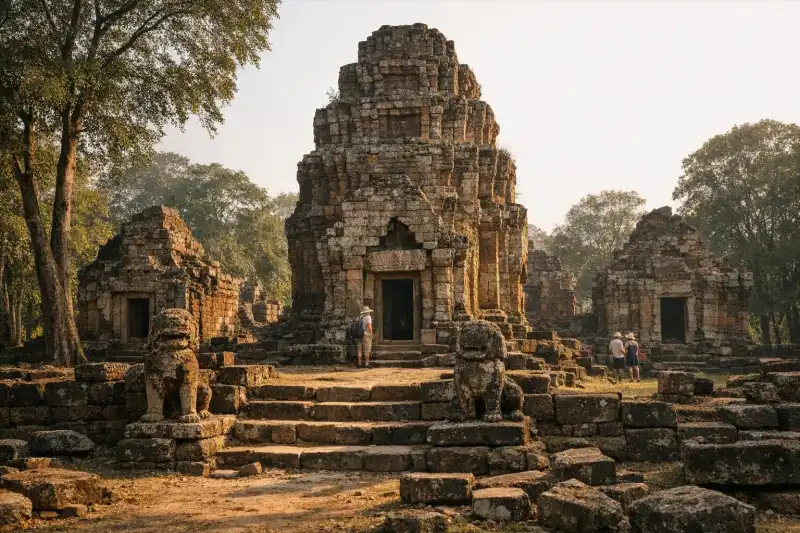
Ku Phra Kona
KhmerAn early Khmer sanctuary in northeastern Thailand, Ku Phra Kona preserves brick towers, carvings, an...
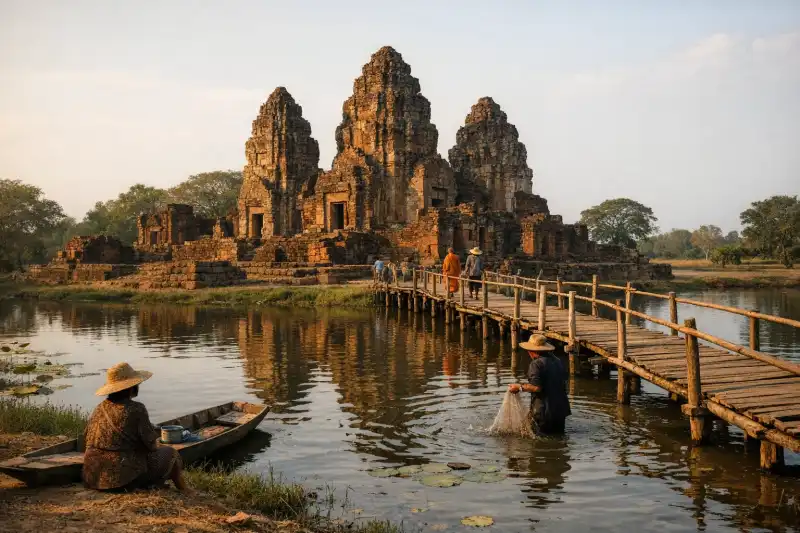
Ku Santarat
Khmer EmpireKu Santarat is a quiet Khmer-era temple ruin in northeastern Thailand, known for laterite towers, mo...
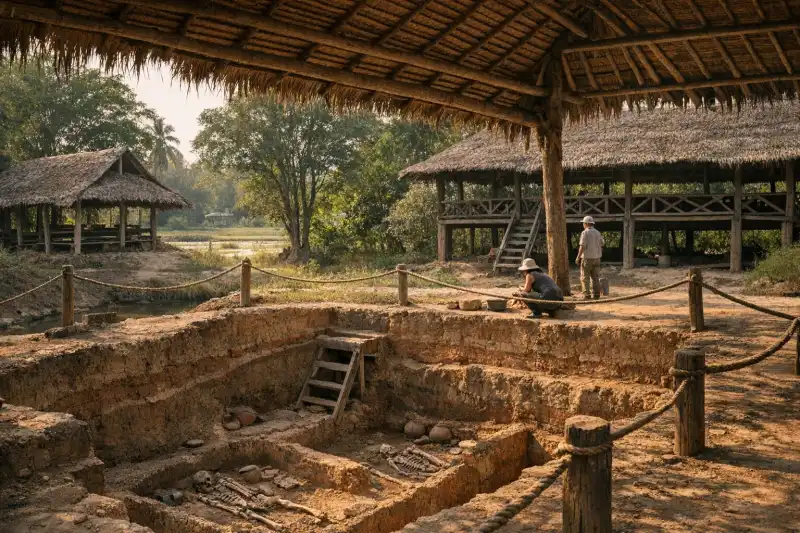
Ban Prasat Archaeological Site
Prehistoric communities of the Mun River basinExplore Ban Prasat Archaeological Site, a prehistoric burial and settlement site in Thailand’s Nakho...