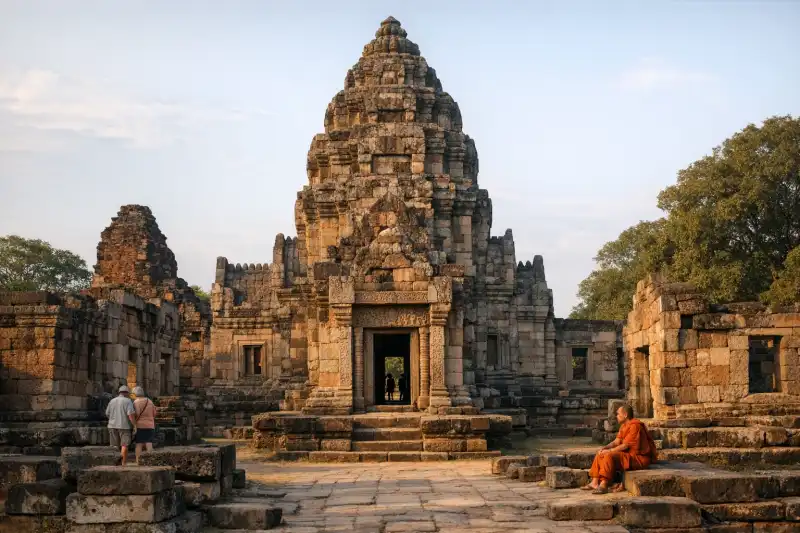
Quick Info
At a glance
Prasat Phanom Wan in Thailand is one of those places that rewards travelers who slow down. Set in the plains of Nakhon Ratchasima Province, not far from the modern city of Korat, this Khmer sanctuary does not overwhelm with size in the way some of Southeast Asia’s most famous temple complexes do. Instead, it draws visitors in through atmosphere: weathered stone, fragments of sacred geometry, and the quiet persistence of a monument that has stood through centuries of political change, shifting religious practice, and the steady rhythms of rural life. The site sits within a landscape that once formed part of the greater Khmer cultural sphere, and even today the remains carry the visual language of that world—lintels, doorframes, galleries, and a carefully ordered plan that linked earthly movement to divine space.
What makes Prasat Phanom Wan especially memorable is the sense of transition preserved in its architecture. Here, earlier materials and forms coexist with later refinements, revealing a temple that evolved over time rather than appearing all at once. Visitors can read that story in brick foundations, sandstone ornament, and the arrangement of structures around the central sanctuary. Although it is often overshadowed by larger or more famous Khmer sites in Thailand, Prasat Phanom Wan offers something rarer: room to observe details, imagine rituals, and appreciate the regional texture of ancient history without the pressure of large crowds. For travelers interested in Khmer architecture, the history of northeastern Thailand, or simply a thoughtful archaeological stop near Korat, it is a rewarding destination.
History
Early Sacred Foundations
The origins of Prasat Phanom Wan likely reach back to an early phase of Khmer-influenced temple building in northeastern Thailand, probably around the 11th century CE, though some scholars suggest that parts of the sacred site may reflect even earlier occupation or ritual use. During this period, the Khorat Plateau was increasingly integrated into the political and cultural orbit of the Khmer Empire, centered at Angkor. That influence did not simply mean military control or taxation; it also brought administrative models, religious ideas, artistic motifs, and the architectural vocabulary of temple construction.
Like many Khmer sanctuaries in what is now Thailand, Prasat Phanom Wan appears to have been conceived as more than an isolated shrine. It was part of a network of sacred and strategic places connected by routes, local communities, and courtly patronage. Temples such as this one helped project religious legitimacy and political authority into provincial landscapes. Their design reflected cosmic order, placing the central sanctuary at the symbolic heart of a planned enclosure. Even in ruins, that intention is still legible at Phanom Wan.
Expansion Under Khmer Rule
The temple’s most significant construction phases seem to belong to the mature Khmer period, especially the 11th and 12th centuries. Over time, earlier brick structures were supplemented or replaced by more durable and prestigious sandstone elements. This transition was common in Khmer architecture, where building campaigns often updated a sanctuary’s appearance in line with changing artistic tastes or the ambitions of new patrons. At Prasat Phanom Wan, these phases can be seen in the contrast between structural remains and carved details that belong to different moments in the site’s life.
The temple was likely first associated with Hindu worship, probably focused on Shaivism, one of the dominant forms of state-supported religion in the Khmer world. Shaivite temples typically housed a linga, representing Shiva, within the innermost sanctuary. Architectural symbolism reinforced this sacred center: movement inward from the outer enclosure to the sanctuary mirrored movement from the ordinary world toward divine presence. Decorative carvings on lintels and pediments would have expressed mythological themes, royal ideology, and protective motifs.
As the Khmer Empire changed, so too did many of its temples. By the later 12th and 13th centuries, Mahayana and then Theravada Buddhist influence became increasingly important across the region. At many Khmer sites, this resulted in adaptation rather than total replacement. Images, rituals, and local beliefs layered onto older sacred frameworks. Prasat Phanom Wan likely experienced similar transformations, becoming part of a long continuum of worship rather than a monument frozen in a single religious identity.
Regional Role and Decline
Prasat Phanom Wan’s importance was tied to its place within northeastern Thailand’s historical landscape. The Khorat region connected central mainland Southeast Asia with routes leading toward Angkor and other provincial centers. While the temple may not have held the same rank as major urban sanctuaries, it would have mattered as a local ritual and administrative point. Its architecture suggests investment, skilled labor, and access to artistic conventions associated with the Khmer court.
Over the centuries, however, broader political changes altered the temple’s role. As Angkor’s influence declined and regional power shifted, many provincial Khmer sanctuaries lost direct elite support. Some remained active in local religious life; others gradually fell into disuse or partial ruin. Building materials weathered, wooden components disappeared, and tropical conditions encouraged collapse and overgrowth. Yet complete abandonment is often too simple a word for sites like this. Rural communities frequently continued to regard such temples as spiritually meaningful places, even when their original state structures had faded.
Rediscovery, Conservation, and Modern Interest
In the modern era, Prasat Phanom Wan came to be recognized as an important archaeological and cultural site within Thailand’s national heritage framework. Survey, documentation, and conservation efforts aimed to stabilize standing remains and make the monument legible to visitors. Restoration at Khmer sites in Thailand has often involved careful reassembly of fallen architectural elements, cleaning of sculptures and stonework, and interpretation that explains construction phases and stylistic development.
Today, Prasat Phanom Wan is valued not only as a relic of Khmer political reach but also as evidence of the deep historical layers of northeastern Thailand. It helps illustrate how the region participated in broader Southeast Asian currents while retaining its own local texture. For visitors, that means the site is not merely an outpost of Angkorian art; it is a window into the lived history of Korat’s landscape, where empire, faith, and community met in stone.
Key Features
The first thing many visitors notice at Prasat Phanom Wan is the clarity of its layout. Even if parts of the complex survive only in fragments, the sacred geometry remains persuasive. You move through a sequence of spaces that once guided ritual approach: outer areas, enclosure walls, gateways, and the more restricted heart of the sanctuary. This planned movement is central to Khmer temple design, and at Phanom Wan it still shapes the way the site is experienced. Rather than looking at a single ruined building, you are tracing an ordered sacred environment.
The central sanctuary is the emotional anchor of the complex. Though time has damaged portions of the structure, its surviving stonework conveys weight and authority. Sandstone doorframes, surviving wall sections, and architectural fragments hint at what would once have been a highly charged inner chamber. The sanctuary’s form reflects the Khmer understanding of the temple as a cosmic mountain and divine residence. Even in a quieter provincial setting, the symbolism remains powerful. Standing before the central structure, you can sense how architecture served ritual, framing the encounter between worshipper and deity.
One of the most engaging aspects of Prasat Phanom Wan is the combination of building materials. Brick, laterite, and sandstone each appear in ways that reveal both practical concerns and artistic ambition. Brick often belongs to earlier construction phases, while sandstone marks a more formal and monumental statement. Laterite, with its rougher texture, provided durable mass. For travelers interested in architecture, this mixture turns the site into a readable lesson in Khmer construction methods. You can see where walls once rose, where decorative details were concentrated, and how successive builders revised the original scheme.
The carvings deserve close attention. Although not every decorative element survives intact, the remaining lintels, columns, and stone frames show the refinement associated with Khmer artisanship. Floral patterns, scrolling motifs, and mythic imagery animate stone surfaces that might otherwise appear austere from a distance. These details are easy to miss if you rush. At Phanom Wan, the reward comes from lingering—looking at how light catches worn reliefs, how edges soften after centuries of weather, and how fragments still communicate the prestige the temple once held.
Another striking feature is the relationship between monument and landscape. Prasat Phanom Wan does not stand atop a dramatic cliff or within a dense urban archaeological park. Instead, it sits within the relatively open environment of the Korat plain, which gives the site a different emotional register. The openness makes the temple feel embedded in lived geography rather than isolated from it. Rural roads, local settlements, and cultivated land nearby remind visitors that ancient monuments in Thailand often survive within active communities. This continuity can make the site feel more intimate than larger, more touristic complexes.
The entrance elements and enclosure traces are also important. Khmer temple gateways were not merely functional openings; they marked transitions in status and sanctity. At Prasat Phanom Wan, surviving gateway architecture helps define the ceremonial path into the site. Even where walls are incomplete, the boundaries of sacred space can still be imagined. This is one reason the temple works so well for visitors who like archaeological sites that require a bit of interpretation. You are not handed a complete monument; you reconstruct the whole through surviving clues.
A final feature worth appreciating is the site’s relative calm. Because Prasat Phanom Wan is less famous than Thailand’s headline temple destinations, the experience tends to be quieter and more reflective. That changes the way details register. Without heavy crowds, it is easier to observe proportions, listen to the ambient sounds of the surrounding countryside, and understand the temple as a place of sustained local memory. For photographers, the site offers clean lines and changing light. For history-minded travelers, it offers a manageable but meaningful encounter with Khmer art outside the busiest circuits. In that sense, one of its greatest features is not a single ruin at all, but the quality of attention the place invites.
Getting There
Prasat Phanom Wan is easiest to visit from Nakhon Ratchasima, commonly called Korat, the main city of the province. From central Korat, the site is roughly a short road trip to the north, and the simplest option for most travelers is a taxi or ride-hailing service. Expect a one-way fare of about 250 to 450 THB depending on distance, waiting time, and vehicle type. Hiring a driver for several hours to include nearby stops can be more practical, usually costing around 1,200 to 2,000 THB for a half-day itinerary.
If you prefer public transport, local buses or songthaews may serve the general area, but services can be infrequent and may require asking locally for the latest route and drop-off point. Budget around 20 to 60 THB for a local ride, then allow for a short motorcycle taxi or tuk-tuk transfer if the final approach is not walkable. This is the cheapest option but also the least predictable for visitors on a fixed schedule.
Travelers arriving from Bangkok can take a train or intercity bus to Nakhon Ratchasima first. Train fares vary widely by class, often around 70 to 400 THB, while buses are commonly about 200 to 350 THB. From Korat, continue onward by taxi or rented car. Self-driving is a good choice if you plan to combine Prasat Phanom Wan with Phimai Historical Park or other Khmer sites in the region. Roads are generally straightforward, and parking is typically easier than at more crowded heritage attractions. Bring cash for transport and small local purchases, as rural services may not always support card payment.
When to Visit
The best time to visit Prasat Phanom Wan is generally during Thailand’s cooler dry season, from November to February. At this time, daytime temperatures are more comfortable, humidity is lower, and walking around the exposed temple grounds is much easier than during the hottest months. Mornings are especially pleasant, with softer light that brings out the tones of the sandstone and creates better conditions for photography. If you enjoy quieter visits, arriving early also helps you experience the site before the day warms up.
From March to May, northeastern Thailand becomes significantly hotter. Midday temperatures can feel intense, particularly because much of the site is open and shade may be limited. Visits are still possible, but early morning or late afternoon is strongly recommended. Carry water, wear a hat, and avoid planning a long midday stay unless you are very comfortable with heat.
The rainy season, usually from May or June through October, transforms the surrounding landscape into a greener, more atmospheric setting. This can be a beautiful time to visit, especially for travelers who appreciate dramatic skies and lush scenery. However, rain showers can be sudden, paths may become slippery, and humidity can be high. If you travel in these months, lightweight rain gear and shoes with good grip are helpful.
For overall balance between comfort, access, and scenery, December and January are excellent choices. That said, Prasat Phanom Wan is not typically overwhelmed by mass tourism, so timing your visit is more about weather than crowd control. Whenever you go, aim for the gentler hours of the day. The temple’s details reveal themselves best when you are not rushing through heat or rain.
| Quick Facts | Details |
|---|---|
| Location | Nakhon Ratchasima Province, Thailand |
| Nearest city | Nakhon Ratchasima (Korat) |
| Cultural tradition | Khmer |
| Main period | 11th-12th century CE |
| Likely original religion | Hinduism, later adapted within Buddhist traditions |
| Main materials | Sandstone, laterite, brick |
| Best visit length | 45 minutes to 1.5 hours |
| Best time of day | Early morning or late afternoon |
| Best season | November to February |
| Good combined visits | Phimai Historical Park, regional Khmer sites around Korat |
Prasat Phanom Wan may not be the most famous ancient site in Thailand, but that is part of its appeal. It offers a more measured encounter with Khmer architecture, one in which the visitor can notice transitions in style, materials, and religious meaning without being distracted by crowds or spectacle. The monument’s surviving walls and carvings tell a story of provincial importance within a much larger world, when northeastern Thailand was tied into the cultural and political networks of the Khmer Empire. At the same time, its quiet location near Korat reminds you that ancient history here is not abstract. It remains rooted in local ground, visible in a temple that has endured weather, shifting kingdoms, and centuries of reinterpretation. For travelers who value atmosphere, historical depth, and the pleasure of discovery beyond the obvious itinerary, Prasat Phanom Wan is well worth the journey.
Guided tours: worth it?
Self-guided works here, but a guide can add real value if you want the ruins explained as a living place rather than just a sequence of monuments.
Best for
- First-time visitors who want context, not just photos
- Short visits where a planned route saves time
When to go self-guided
Go independently if you prefer setting your own pace, reading as you go, and checking official hours or ticket rules directly before you arrive.
What I’d avoid
Skip paid tours that bundle unrelated stops you do not actually want. The best option should either save meaningful planning time or add historical context you would miss on your own.
Nakhon Ratchasima Ancient Temples Tours
Useful when: you want to compare guided formats before deciding
Phimai Historical Park Day Tours
Useful when: you want to compare guided formats before deciding
Korat Cultural and Heritage Tours
Useful when: you want to compare guided formats before deciding
Some tour links are affiliate links, which may earn Ancient Travel a small commission at no extra cost to you. I try to surface options that make practical sense for the site—not just anything bookable.
Frequently Asked Questions
Where is Prasat Phanom Wan located?
Prasat Phanom Wan is in Nakhon Ratchasima Province in northeastern Thailand, north of the city of Nakhon Ratchasima, often called Korat.
What is Prasat Phanom Wan known for?
The site is known as a Khmer temple complex that preserves an important mix of brick, laterite, and sandstone construction, along with decorative carvings and a plan linked to the wider Khmer world.
How much time should I allow for a visit?
Most visitors spend around 45 minutes to 1.5 hours exploring the main sanctuary, entrance structures, grounds, and interpretive features.
Is Prasat Phanom Wan suitable as a day trip from Korat?
Yes. It is an easy half-day or day trip from Nakhon Ratchasima city and can be combined with other historical stops in the region.
What should I wear when visiting Prasat Phanom Wan?
Wear light, breathable clothing, comfortable walking shoes, sun protection, and modest attire out of respect for the temple setting.
When is the best time of day to visit?
Early morning and late afternoon are usually the most comfortable times, with softer light for photography and less midday heat.
Nearby Ancient Sites
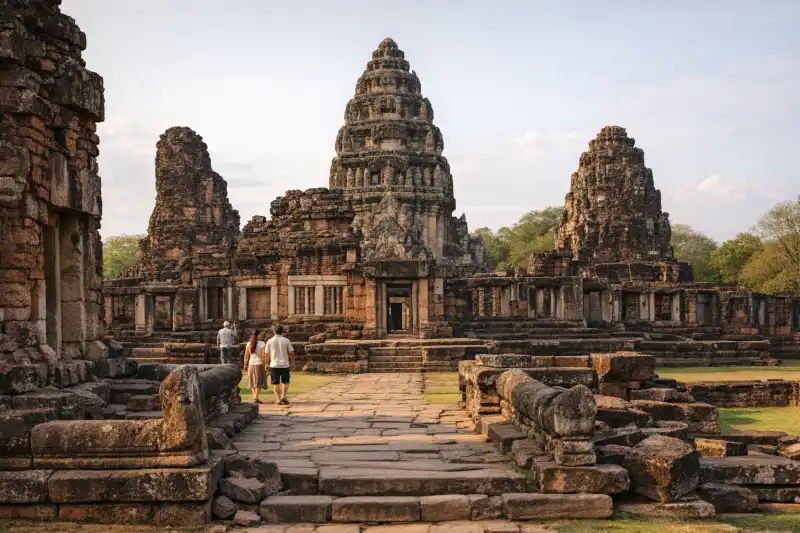
Phimai Historical Park
Khmer EmpireExplore Phimai Historical Park, a remarkable Khmer temple complex in northeastern Thailand famed for...
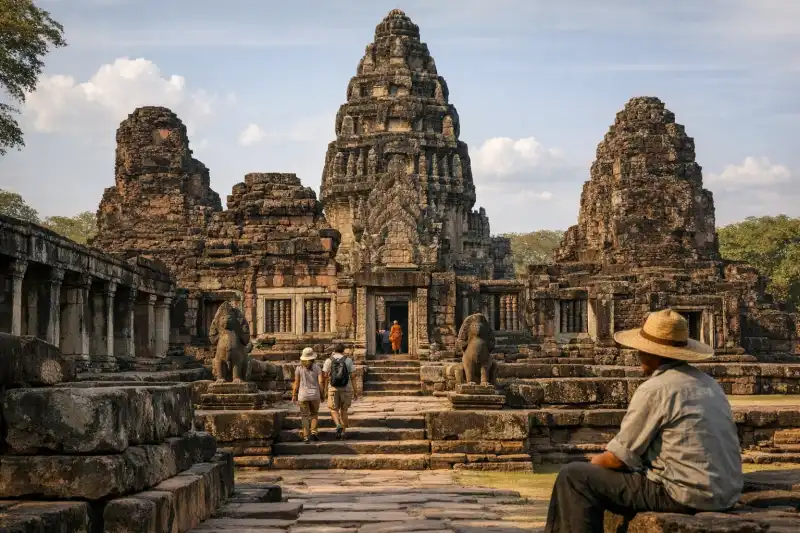
Phimai Sanctuary
Khmer EmpireExplore Phimai Sanctuary, a grand Khmer temple complex in Thailand known for elegant stone carvings ...
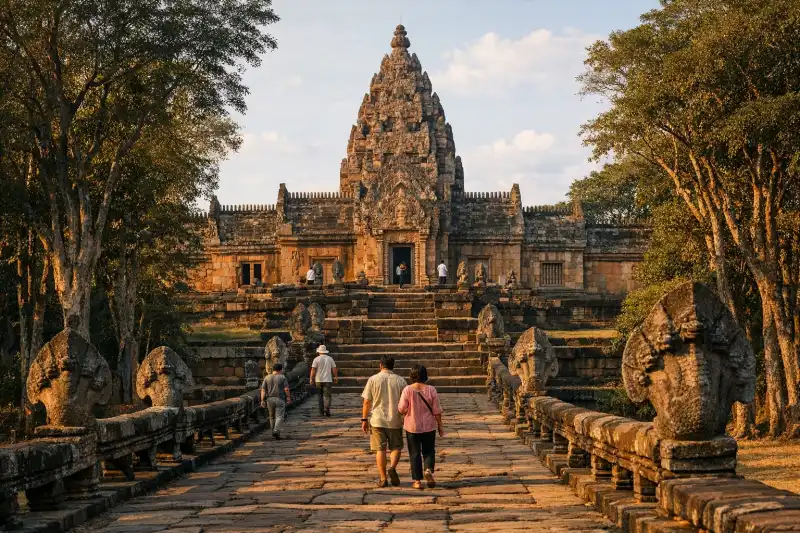
Phanom Rung
Khmer EmpireA dramatic Khmer hilltop temple in Thailand, Phanom Rung is famed for its sandstone carvings and sun...