Quick Info
At a glance
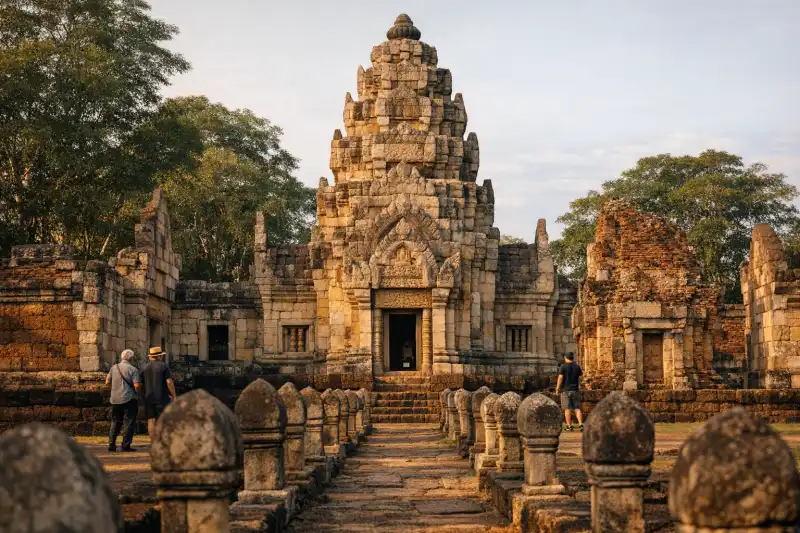
Prasat Sdok Kok Thom in Thailand rises from a quiet landscape of trees, open lawns, and ancient waterworks near the Cambodian border, far from the crowds that gather at more famous Khmer monuments. The approach feels almost ceremonial. A broad moat, linear causeways, and weathered stone structures slowly reveal that this was not an isolated shrine but a carefully planned sacred complex tied to one of mainland Southeast Asia’s greatest civilizations. For travelers interested in ancient architecture, inscriptions, and the spread of Angkor-era culture beyond present-day Cambodia, this temple offers an experience that is both serene and intellectually rewarding.
Unlike sites where the romance lies mainly in ruin, Prasat Sdok Kok Thom also matters for what it says. The temple is associated with one of the most important Khmer inscriptions ever found, a text that helps historians reconstruct royal lineages, court ritual, and the role of Brahmin families in the Khmer world. Yet the site never feels like a dry historical footnote. Its laterite walls, sandstone ornament, and carefully ordered plan still convey the ambitions of the builders who shaped this frontier landscape into a religious center. Visiting today means walking through architecture, epigraphy, hydrology, and regional history at once, all within one of eastern Thailand’s most compelling ancient places.
History
Early Khmer Presence in the Borderlands
The region around present-day Sa Kaeo Province formed part of a wider cultural zone long linked to the Khmer sphere. Before modern borders divided Thailand and Cambodia, this landscape was a connective corridor where political authority, religious practice, and artistic forms circulated across plains and forested uplands. By the early second millennium CE, Khmer influence had extended deeply into what is now eastern Thailand, and temple building became one of the clearest signs of that reach.
Prasat Sdok Kok Thom emerged in this setting, probably on a site chosen not only for symbolic reasons but also for practical ones. Water management was central to Khmer sacred planning, and the temple’s surrounding moat and formal layout suggest a carefully conceived environment rather than a casual rural sanctuary. The name itself has often been interpreted in ways that evoke reeds, marshy woodland, or a watery grove, which fits the landscape character that may once have defined the area.
Foundation and 11th-Century Development
The temple is usually dated to the 11th century, during the Angkor period, when Khmer royal power was expressed through temple construction across a wide territory. Like many Khmer sanctuaries, Prasat Sdok Kok Thom was not built in a single moment. It likely developed through successive phases, with structures added, modified, or rebuilt in accordance with changing patronage and ritual needs.
Its greatest historical significance comes from the famous Sdok Kok Thom inscription, dated to 1053 CE during the reign of Udayadityavarman II. Written in Sanskrit and Old Khmer, the inscription is a foundational source for the history of the Khmer Empire. It records the genealogy and ritual duties of a Brahmin family connected to the royal cult of the devaraja, a concept often described as linking kingship, divine legitimacy, and sacred authority. The text traces lineages back through earlier reigns and offers rare detail about how court ritual and temple service were transmitted across generations.
For historians, this inscription is invaluable because it helps clarify political succession, the role of learned religious specialists, and the relationship between regional temples and the Angkorian center. For the site itself, it confirms that Prasat Sdok Kok Thom was not peripheral in a cultural sense, even if it sat at a geographic edge of the empire. It was integrated into larger religious and administrative networks.
Religious Role and Architectural Maturity
As the temple matured, it would have functioned as more than a monument to be admired. Khmer temples were active ritual spaces where offerings, processions, recitations, and acts of maintenance helped sustain sacred order. The arrangement of enclosure walls, gopura gateways, sanctuary towers, and processional approaches points to a ceremonial choreography. Moving inward was both physical and symbolic, carrying worshippers from the outer world into increasingly sacred space.
The temple’s architecture reflects the broader vocabulary of Khmer design: laterite for structural mass, sandstone for carved details, and brick or stone sanctuary components depending on the building phase. These materials linked durability with visual contrast. At Prasat Sdok Kok Thom, the result was a frontier temple that nevertheless shared in the artistic language of Angkor.
Decline, Rediscovery, and Restoration
Over time, shifts in political power, religious practice, and settlement patterns reduced the temple’s central role. As with many Khmer sites outside the Angkor heartland, abandonment did not necessarily mean sudden destruction. Instead, structures weathered gradually, stones shifted, vegetation encroached, and local memory preserved the site in altered form. The landscape remained ancient even when ritual systems changed.
In the modern era, archaeological attention restored the temple to wider historical visibility. Scholars recognized the inscription’s importance, and conservation work helped stabilize and present the surviving complex. Restoration has aimed not to turn the site into an artificial reconstruction, but to make its plan intelligible and its remains accessible. Today, Prasat Sdok Kok Thom stands as both a monument and a document: a place where architecture and inscription together illuminate the reach of Khmer civilization in what is now Thailand.
Key Features
The first striking feature of Prasat Sdok Kok Thom is its overall plan. This is not simply a lone tower in a field, but a carefully ordered sacred enclosure shaped by gateways, walls, and water. The surrounding moat immediately signals the Khmer concern with cosmic symbolism and environmental control. In practical terms, it frames the monument and creates a sense of separation. In visual terms, it prepares the visitor for a structured progression inward. Even before reaching the sanctuary, you sense that the builders intended movement through the site to feel deliberate.
The causeway and entrance sequence are equally important. Khmer architecture often relies on controlled approach rather than instant revelation, and this temple follows that logic well. As you cross the grounds, the composition unfolds in layers. The outer enclosure gives scale to the complex, while the gopura gateways create thresholds that divide ordinary terrain from ritual space. These transitions are part of the site’s enduring power. The temple is experienced not just as a building, but as a series of spatial decisions.
Within the complex, the sanctuary structures preserve the characteristic materials and forms of Angkor-period temple architecture. Laterite provides much of the mass and enclosure, its dark reddish blocks still conveying strength despite erosion. Sandstone appears in more refined architectural elements, including doorframes, lintels, and decorative surfaces where carving could be more precise. Even where ornament has softened over time, the workmanship remains evident. The balance between robust structural material and detailed sculptural stone is one of the pleasures of visiting the site slowly.
The central tower or sanctuary area holds the greatest ritual significance. Though time has taken away some of the original vertical drama, the surviving form still anchors the complex. Khmer sanctuaries were meant to house sacred images or emblems, and their towered shape often suggested a cosmic mountain. At Prasat Sdok Kok Thom, that symbolism survives in reduced but legible form. You do not need complete preservation to feel the hierarchy of the layout: the center was privileged, elevated in meaning even when not towering in height.
Another major feature is the relationship between architecture and inscription. Many ancient sites have beautiful buildings and separate historical records; here the two are inseparable. The Sdok Kok Thom inscription gives the temple extraordinary interpretive depth. It transforms masonry into evidence and ritual space into historical narrative. When you look at the sanctuary and surrounding structures, you are not merely viewing anonymous ruins. You are standing in a place tied to named individuals, remembered lineages, and documented ceremonies. That level of textual connection is rare and helps explain why the site occupies such an important place in Southeast Asian historiography.
The temple grounds also deserve attention. Modern landscaping can sometimes flatten the character of archaeological places, but at Prasat Sdok Kok Thom the open setting helps visitors understand the scale and organization of the monument. Lawns and paths make it easier to trace the edges of moats, alignments, and enclosure walls. Trees provide shade without fully obscuring the plan. The resulting atmosphere is unusually calm. Instead of fighting crowds or dense urban surroundings, visitors can absorb the geometry of the site and the way architecture sits within the broader terrain.
What many travelers remember most is the contrast between the temple’s significance and its relative quiet. This is a site of first-rank historical value, but it still often feels intimate. That quietness is itself a feature. It allows careful observation of stone joints, weathering patterns, and subtle decorative fragments that might be missed in busier monuments. It also reinforces the sense of being at a threshold region of the Khmer world, where imperial forms were adapted to local landscapes yet remained fully connected to larger currents of power and belief.
Getting There
Prasat Sdok Kok Thom is in Sa Kaeo Province, near Thailand’s border with Cambodia, and the most practical base for most travelers is Aranyaprathet. From Aranyaprathet, hiring a private car or local driver is usually the easiest option. Depending on negotiation, a round-trip car for a half-day visit often costs around THB 1,200 to 2,000, which is reasonable if split between several travelers. Travel time is roughly 45 to 75 minutes each way, depending on your starting point and local roads.
If you are coming from Bangkok, the simplest route is by car. The drive generally takes about 3.5 to 4.5 hours. A private transfer from Bangkok can cost anywhere from THB 3,500 to 6,000 for the day, while a self-drive rental car may be cheaper if you are comfortable navigating highways and provincial roads. Travelers using public transport can take a train or bus from Bangkok to Aranyaprathet first. Budget buses and vans typically cost around THB 200 to 350, and trains may be similarly inexpensive, though slower. From Aranyaprathet station or bus terminal, you would then need a taxi, songthaew, or arranged driver to reach the temple.
Because public connections right to the site are limited, independent visitors should bring water, charge their phone fully, and confirm return transport in advance. Ride-hailing options can be inconsistent in rural areas. If you are exploring Khmer heritage in eastern Thailand as part of a broader itinerary, a dedicated driver offers the most flexibility and saves considerable time.
When to Visit
The best time to visit Prasat Sdok Kok Thom is the cool and dry season from November to February. During these months, temperatures are generally more comfortable, humidity is lower, and walking the exposed grounds is far more pleasant than in the hotter part of the year. Morning light is especially good for photography, softening the stone and making the moat, lawns, and gateways feel particularly atmospheric. Arriving early also helps you enjoy the site before midday heat builds.
March to May is the hottest period. The temple remains visitable, but the combination of strong sun and limited shade across parts of the complex can make exploration tiring. If you travel then, aim for opening hours in the early morning, wear a hat, and carry more water than you think you need. Heat shimmer can also make long-distance views less crisp for photography.
The rainy season, broadly from May or June through October, brings greener surroundings and fewer visitors, which can be appealing. The landscape often looks lush, and the temple’s relationship to water becomes easier to imagine. However, showers can be heavy, paths may be slippery, and skies can change quickly. If you do not mind occasional rain and plan with flexibility, this can still be a rewarding season.
For the best balance of weather, comfort, and visibility, December and January are especially attractive months. Weekdays are usually quieter than weekends and public holidays, giving you more of the meditative atmosphere that makes the site memorable.
| Quick Facts | Details |
|---|---|
| Location | Sa Kaeo Province, eastern Thailand |
| Nearest city | Aranyaprathet |
| Cultural affiliation | Khmer Empire |
| Main period | 11th century CE |
| Famous for | The Sdok Kok Thom inscription and Khmer temple architecture |
| Architectural elements | Moat, causeways, enclosure walls, gateways, sanctuary structures |
| Best visit length | 1.5 to 3 hours |
| Best season | November to February |
| Ideal transport | Private car or hired driver from Aranyaprathet or Bangkok |
| Travel style | Best for history-focused independent travelers and heritage enthusiasts |
Prasat Sdok Kok Thom rewards visitors who appreciate places where landscape, architecture, and historical record reinforce one another. It may not have the scale of Angkor’s most monumental temples, but that is part of its appeal. Here, the Khmer world is encountered in a quieter register, one that invites close attention rather than awe alone. The broad moat, measured processional layout, and weathered sanctuaries reveal a frontier temple of real ambition, while the inscription ties the site directly to the intellectual and ritual life of the empire.
For travelers moving through eastern Thailand, the temple offers a compelling reason to look beyond the standard circuit. It provides a deeper understanding of how Khmer power extended across regions that modern maps now divide, and it shows that ancient Thailand contains important chapters of Angkorian history in its own right. Whether you come for architecture, epigraphy, or the simple pleasure of walking through an uncrowded archaeological landscape, Prasat Sdok Kok Thom leaves a lasting impression. It is a place where one of Southeast Asia’s great historical traditions can still be read in stone, in space, and in silence.
Guided tours: worth it?
A guide can be genuinely useful at Prasat Sdok Kok Thom, especially if you want help with transport, timing, tickets, or understanding a large site without losing half the day to logistics.
Best for
- First-time visitors who want context, not just photos
- Travelers who want transport, timing, or entry logistics handled
- Trips where tickets, circuits, or timed entry can shape the day
- Short visits where a planned route saves time
When to go self-guided
Go independently if you already have transport and tickets sorted, enjoy moving at your own pace, and are comfortable checking the latest official rules before you arrive.
What I’d avoid
Skip paid tours that bundle unrelated stops you do not actually want. The best option should either save meaningful planning time or add historical context you would miss on your own.
Sa Kaeo and Khmer Temple Tours
Useful when: you want to compare guided formats before deciding
Aranyaprathet and Border Region Day Trips
Useful when: transport or pickup logistics matter
Thailand to Cambodia Heritage Tours
Useful when: you want to compare guided formats before deciding
Some tour links are affiliate links, which may earn Ancient Travel a small commission at no extra cost to you. I try to surface options that make practical sense for the site—not just anything bookable.
Frequently Asked Questions
Where is Prasat Sdok Kok Thom located?
Prasat Sdok Kok Thom is in Sa Kaeo Province in eastern Thailand, near the Cambodian border and not far from Aranyaprathet.
Why is Prasat Sdok Kok Thom important?
The temple is famous for its Khmer architecture and especially for the Sdok Kok Thom inscription, a key text for understanding the religious and political history of the Khmer Empire.
How much time should I plan for a visit?
Most travelers spend 1.5 to 3 hours exploring the main sanctuary, surrounding walls, causeways, and landscaped grounds.
Is Prasat Sdok Kok Thom suitable for independent travelers?
Yes. It can be visited independently by car or hired driver, though public transport options are limited and signage may be easier to appreciate with some background reading or a guide.
What is the best time of year to visit?
The cool and dry season from November to February is generally the most comfortable, with lower humidity and better conditions for walking around the site.
Can I combine Prasat Sdok Kok Thom with other destinations?
Yes. Many visitors combine it with Aranyaprathet, border-area travel, or broader Khmer heritage routes linking eastern Thailand and northwestern Cambodia.
Nearby Ancient Sites
Khao Phra Viharn
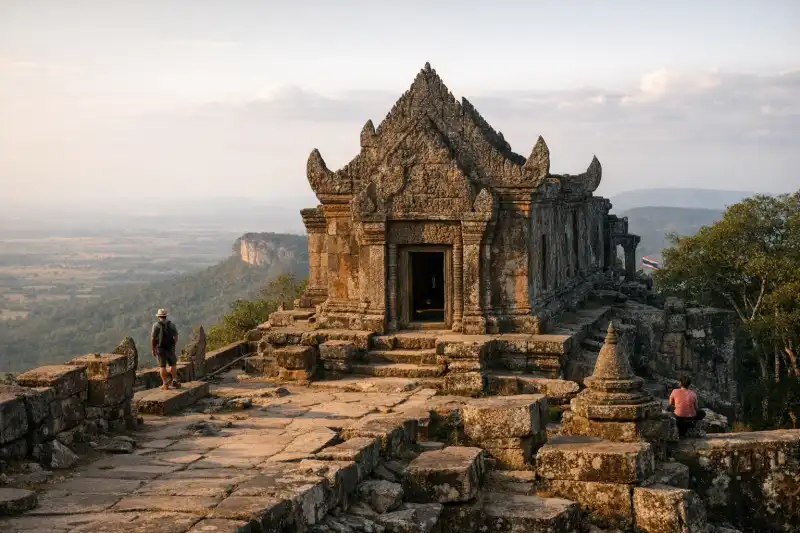
Khmer EmpireA dramatic Khmer temple on Thailand’s frontier, Khao Phra Viharn crowns a cliff with sweeping views ...
Ku Phra Kona
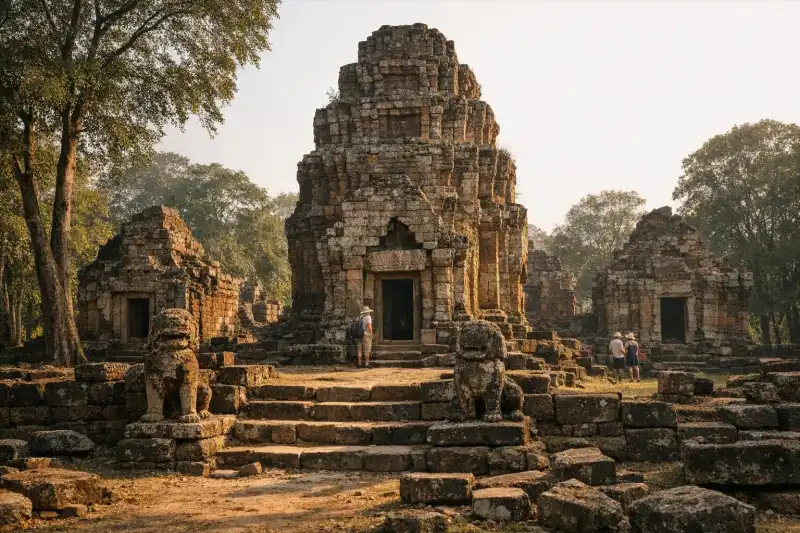
KhmerAn early Khmer sanctuary in northeastern Thailand, Ku Phra Kona preserves brick towers, carvings, an...
Ku Santarat
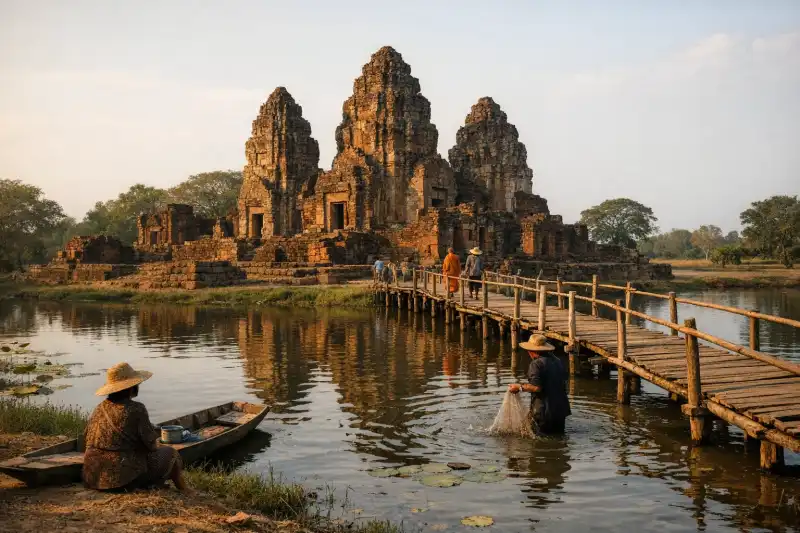
Khmer EmpireKu Santarat is a quiet Khmer-era temple ruin in northeastern Thailand, known for laterite towers, mo...