Quick Info
At a glance
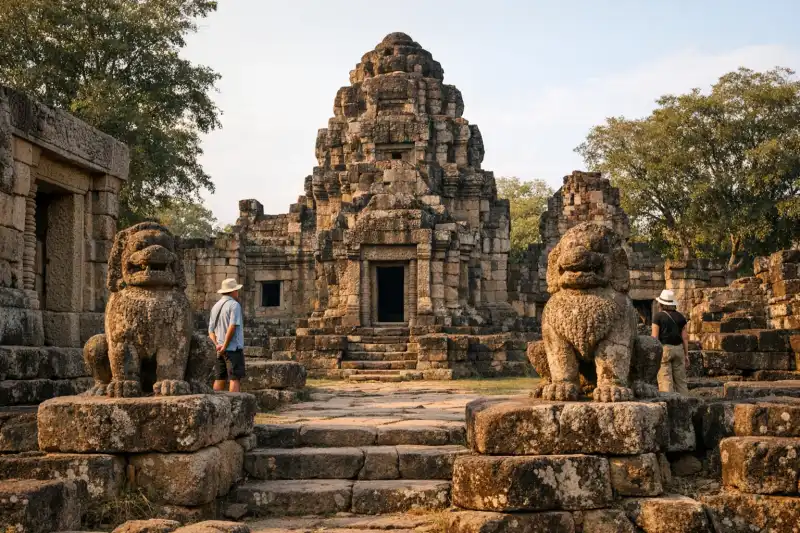
Prasat Ta Muen in Thailand feels less like a single monument and more like a quiet historical corridor hidden at the edge of the forest. In Surin Province, close to the Cambodian border, the temple group sits beside an old mountain pass that once carried soldiers, pilgrims, officials, traders, and ideas between the Khmer lowlands and the plateau to the north. The setting is part of its appeal. Instead of the monumental theatricality found at larger temple cities, here the experience is intimate: weathered sandstone, laterite walls, shade trees, and the long memory of a road that shaped the region.
For travelers interested in Khmer heritage beyond the most famous ruins, Prasat Ta Muen offers a rewarding sense of discovery. The complex is usually discussed as three closely related monuments: Prasat Ta Muen, Prasat Ta Muen Tot, and Prasat Ta Muen Thom. Together they show how architecture served multiple roles in the Khmer world. This was not only a sacred site, but also a practical node on an important communication route through the Dongrek Mountains. The sanctuaries reveal how religion, administration, medicine, and border geography could overlap in a single place. Visiting today, you encounter broken lintels, surviving shrines, and sacred spaces aligned with springs and pathways, all wrapped in a landscape that still feels remote. That remoteness is exactly what makes Prasat Ta Muen memorable: it preserves the atmosphere of a frontier, where empires once met the terrain on its own terms.
History
Early Khmer expansion and the frontier road
The history of Prasat Ta Muen is inseparable from the growth of the Khmer Empire and its need to connect distant territories. From roughly the 10th and 11th centuries onward, Khmer rulers expanded influence across much of mainland Southeast Asia, including areas of what is now northeastern Thailand. This expansion was not just military. It relied on roads, rest points, religious foundations, and administrative outposts that helped integrate provinces into a larger imperial system.
The Dongrek range formed both a barrier and a passage. Mountain chains can separate regions, but where a pass exists, they also channel movement. Prasat Ta Muen developed along one of these strategic routes linking the Angkor region with settlements to the north and west. Its placement was therefore practical as much as symbolic. Temples built beside roads were not isolated acts of devotion; they marked authority, supported travelers, and anchored imperial presence in contested or distant zones.
The earliest components of the complex likely date to the 11th century, when Khmer stone architecture spread widely across the region. Builders used familiar materials, including sandstone for doorframes and decorative elements and laterite for structural mass. The sanctuaries were small compared with grand state temples, but their importance came from location and function rather than sheer scale.
Sacred architecture and royal patronage
By the 12th century, the temple group appears to have gained renewed significance. The period of strong royal patronage under major Khmer kings saw increasing investment in road systems and associated religious institutions. Scholars often connect parts of the Ta Muen group, especially Prasat Ta Muen Tot, with the network of hospital chapels established during the reign of Jayavarman VII in the late 12th to early 13th century. His rule is known for public works, Mahayana Buddhist influence, and foundations that served both spiritual and social needs.
This context helps explain why the three monuments at Ta Muen are distinct rather than repetitive. One shrine appears tied to a natural spring and traditional worship, another to institutional service along the route, and the largest sanctuary to a more substantial sacred foundation. Such diversity suggests the site evolved over time instead of being built in one single campaign. It was adapted as political and religious priorities changed.
Prasat Ta Muen Thom, the largest and most visually commanding of the group, likely functioned as the principal sanctuary. Its plan and surviving architectural details indicate a mature Khmer idiom shaped by imperial building traditions. Nearby, Prasat Ta Muen Tot’s simpler arrangement fits well with a utility-oriented sacred structure. These differences give the complex unusual historical value: it shows multiple layers of Khmer rule in one compact setting.
Later centuries, decline, and survival
As the power of Angkor shifted and regional politics changed from the 13th century onward, frontier sites like Prasat Ta Muen gradually lost their original administrative importance. Roads that once carried official movement became less central. Religious patterns also changed as Theravada Buddhism spread more strongly across the region, often transforming how older Khmer monuments were used and understood.
Like many sandstone temples in mainland Southeast Asia, Prasat Ta Muen did not vanish at once. Instead, it passed through a long afterlife. Local communities continued to recognize the sanctity of the place even after imperial structures faded. Stones collapsed, vegetation advanced, and decorative carving weathered away, but the site remained embedded in cultural memory. The presence of springs and the naturally defensive setting of the pass likely helped sustain its significance.
In modern times, the temple complex became part of Thailand’s archaeological heritage, though its location near the international border has occasionally complicated access and conservation. Border sensitivities can affect security arrangements and visitor movement. Even so, the site has endured as one of the most evocative Khmer remains in Surin Province. Its survival owes much to its modest scale, durable materials, and continued recognition as a place of historical and spiritual importance.
Today, Prasat Ta Muen stands not as a restored imperial showpiece, but as a layered archaeological landscape. Its value lies precisely in that condition. Visitors can read the movement of empire, the adaptation of sacred architecture, and the persistence of place across many centuries.
Key Features
What makes Prasat Ta Muen remarkable is the way several different monuments work together to tell one story. Rather than arriving at a single large temple enclosure, visitors encounter a sequence of structures that reflect the route, the terrain, and the varied needs of the Khmer world. The site’s architecture is best understood as a network in miniature.
Prasat Ta Muen Thom is the centerpiece. It is the most substantial of the three sanctuaries and the one most likely to leave a strong first impression. Built of sandstone and laterite, it stands with the compact confidence typical of Khmer provincial architecture. Though damaged and incomplete, it still preserves the essential grammar of a Khmer temple: axial organization, carefully framed entrances, and a sense of sacred inwardness. The surviving stonework reveals how even comparatively remote temples participated in a sophisticated architectural tradition tied to the political core of the empire.
One of the most intriguing aspects of Ta Muen Thom is its relationship to a natural spring. Water was not incidental in Khmer sacred planning. Springs, reservoirs, moats, and channels often carried ritual meaning as well as practical utility. At Prasat Ta Muen, the linkage between sanctuary and water source suggests that the site was chosen not only because it lay on a route, but because it possessed a naturally auspicious feature. That blend of geography and religion is characteristic of Khmer site selection.
Prasat Ta Muen Tot, by contrast, has a more restrained and specialized character. It is often identified as part of a hospital chapel tradition associated with Jayavarman VII’s program of welfare-oriented foundations. Whether a traveler comes with deep historical background or not, the atmosphere here feels different. The building is simpler and more functional, suggesting that sacred activity was tied to care, shelter, and service on the road. In this way, the complex preserves an important truth about premodern temples: they were not always isolated places of worship, but often institutions embedded in everyday life.
The smaller Prasat Ta Muen sanctuary adds another layer. It helps bridge the scale between the hospital chapel and the principal temple, reinforcing the sense that this was once a living waypoint rather than a single-purpose monument. Walking between the structures, you understand distance in human terms. The temples are close enough to form a coherent ensemble, yet separated enough to reveal their distinct roles.
Materially, the site is a study in Khmer construction methods adapted to a rugged environment. Laterite blocks form much of the structural core, while sandstone was reserved for doorways, lintels, columns, and carved surfaces. This combination was practical and durable. Even where decoration has worn away, you can still sense the original elegance of moldings and openings. Fragments of carving, surviving pediments, and shaped doorframes all hint at the visual richness the monuments once possessed.
The landscape itself is one of the key features. Prasat Ta Muen is not a temple divorced from nature; it is a temple complex defined by topography. The surrounding forest, the nearby pass, and the line of movement through the mountains all remain legible. This gives the visitor something rare: the ability to understand why the site exists where it does. At many archaeological destinations, urban growth or heavy reconstruction can obscure the original setting. Here, the setting still explains the architecture.
Another striking feature is the borderland atmosphere. Although modern political boundaries are recent compared with the age of the temples, the site’s location makes questions of territory and movement impossible to ignore. This gives Prasat Ta Muen unusual resonance. It embodies a period when the region was connected through Khmer administration rather than divided by present-day nation-states. For travelers interested in the deep history of mainland Southeast Asia, that perspective is invaluable.
Because the complex is less visited than many famous Thai ruins, the experience often feels contemplative. You can observe the weathering of stone, hear insects and birds in the trees, and move through the site at a measured pace. There may be fewer interpretive signs and fewer amenities than at major tourist centers, but that sparseness contributes to the site’s power. Prasat Ta Muen rewards visitors who enjoy reading ruins directly: the texture of blocks, the angle of a doorway, the logic of a pathway, the orientation toward water and pass.
Getting There
Prasat Ta Muen is usually reached from Surin city, which serves as the most practical base in Thailand. The drive is around 120 to 130 kilometers and generally takes 2.5 to 3 hours, depending on road conditions and any local security checks near the border. Because the site is remote and public transport options are limited, the easiest approach is by private car, rented vehicle, or hired driver.
A full-day car with driver from Surin commonly costs about THB 2,500 to 4,000, depending on vehicle type, waiting time, and whether you combine the visit with other regional stops. This is often the best value for travelers who want flexibility and a straightforward return the same day. If you are already touring Khmer heritage in northeastern Thailand, some drivers can arrange a custom route linking Surin with other temple sites.
Local buses or songthaews may get you part of the way toward district towns nearer the border, with fares often in the THB 50 to 120 range for one leg, but services can be infrequent and rarely deliver you directly to the ruins. From a local drop-off point, you may still need a motorcycle taxi or informal transfer, which can add THB 100 to 300 depending on distance and negotiation. Because schedules are limited and can change, public transport is better suited to experienced travelers with time to spare.
If you are self-driving from Surin or Buriram, fuel and navigation are straightforward, but always check current access conditions before departure. Since Prasat Ta Muen lies close to the international frontier, temporary restrictions are possible. Carry identification, bring water, and plan to return before dusk, as roadside services become sparse the farther you get from the provincial centers.
When to Visit
The best time to visit Prasat Ta Muen is generally the cool and dry season from November to February. During these months, daytime temperatures are more manageable, the roads are easier to navigate, and walking between the three monuments is far more comfortable than in the hotter months. Mornings are especially pleasant, with softer light on the sandstone and a quieter atmosphere in the surrounding woodland.
March to May is the hottest period in northeastern Thailand. Temperatures can rise sharply by late morning, and because the site has limited tourist infrastructure, heat can quickly become the main challenge. If you visit in this season, aim to arrive early, carry plenty of water, and wear a hat or light sun protection. The reward is clearer skies and good visibility, but the midday heat can shorten your time on site.
The rainy season, usually from June to October, brings greener scenery and a more dramatic landscape. Forest edges appear lush, and the ancient route feels especially evocative under heavy clouds or after a shower. However, rain can make travel slower, and muddy conditions may affect the comfort of walking around the complex. Roads are usually still passable, but delays are more likely in remote areas.
No matter the season, border proximity is a more important planning factor here than festival timing. Before visiting, check the latest local information from Thai authorities or your accommodation in Surin. On a clear, calm day with stable access, the ideal visit is a morning or late afternoon stop, when the low sun emphasizes the texture of the stone and the site’s frontier stillness is at its most memorable.
| Quick Facts | Details |
|---|---|
| Location | Surin Province, northeastern Thailand |
| Nearest city | Surin |
| Cultural context | Khmer Empire frontier temple complex |
| Main monuments | Prasat Ta Muen, Prasat Ta Muen Tot, Prasat Ta Muen Thom |
| Date | Primarily 11th-13th centuries CE |
| Best for | Khmer architecture, borderland history, offbeat archaeology |
| Typical visit length | 1-2 hours |
| Best season | November to February |
| Access | Best by private car or hired driver from Surin |
| Notable feature | Built beside an ancient pass and associated with a natural spring |
Prasat Ta Muen is not the kind of place that overwhelms with scale. Its appeal is subtler and, for many travelers, more lasting. Here you stand at a meeting point of route and ritual, imperial ambition and local terrain, architecture and memory. The temple group rewards patience and imagination. If you come expecting a polished tourist monument, you may find it austere. If you come ready to read the stones and the landscape together, you will discover one of Thailand’s most compelling Khmer frontier sites.
Guided tours: worth it?
A guide can be genuinely useful at Prasat Ta Muen, especially if you want help with transport, timing, tickets, or understanding a large site without losing half the day to logistics.
Best for
- First-time visitors who want context, not just photos
- Travelers who want transport, timing, or entry logistics handled
- Short visits where a planned route saves time
When to go self-guided
Go independently if you already have transport and tickets sorted, enjoy moving at your own pace, and are comfortable checking the latest official rules before you arrive.
What I’d avoid
Skip paid tours that bundle unrelated stops you do not actually want. The best option should either save meaningful planning time or add historical context you would miss on your own.
Surin cultural and temple tours
Useful when: you want to compare guided formats before deciding
Phanom Rung and Khmer ruins tours from Thailand
Useful when: transport or pickup logistics matter
Isan historical sites tours
Useful when: you want to compare guided formats before deciding
Some tour links are affiliate links, which may earn Ancient Travel a small commission at no extra cost to you. I try to surface options that make practical sense for the site—not just anything bookable.
Frequently Asked Questions
What is Prasat Ta Muen?
Prasat Ta Muen is a small group of Khmer-period sanctuaries in Surin Province, Thailand, built along an ancient route linking the Khmer heartland with the Korat Plateau.
How far is Prasat Ta Muen from Surin city?
The temple complex is roughly 120 to 130 kilometers southwest of Surin city, and the journey by road usually takes around 2.5 to 3 hours depending on conditions.
Is Prasat Ta Muen near the Cambodia border?
Yes. The site lies very close to the Thai-Cambodian frontier, so travelers should check current local access conditions and any security advisories before setting out.
How much time do you need at Prasat Ta Muen?
Most visitors spend 1 to 2 hours exploring the three principal structures, reading the landscape, and walking between the sanctuaries.
What makes Prasat Ta Muen special?
Its significance comes from its position on an ancient mountain pass, its preserved Khmer architecture, and the combination of shrine, hospital chapel, and frontier route infrastructure in one compact area.
Can you visit Prasat Ta Muen independently?
Yes, many travelers visit independently by private car or hired driver, but public transport is limited and a local driver is often the easiest option.
Nearby Ancient Sites
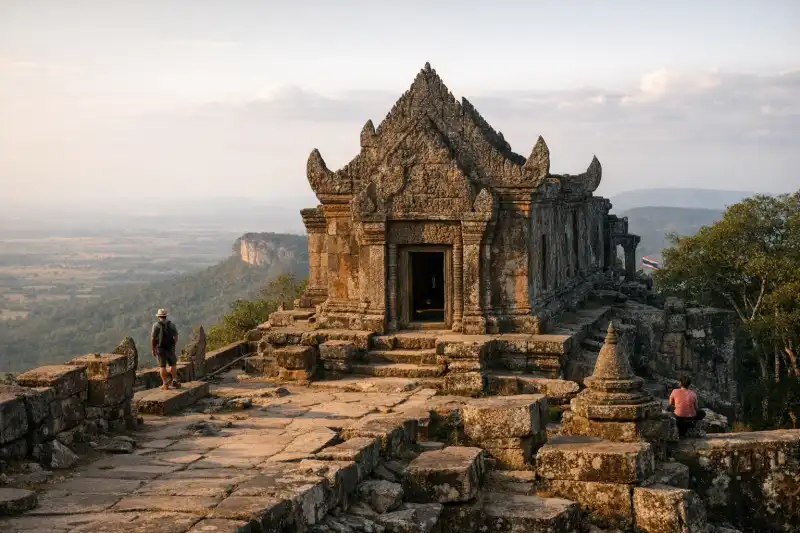
Khao Phra Viharn
Khmer EmpireA dramatic Khmer temple on Thailand’s frontier, Khao Phra Viharn crowns a cliff with sweeping views ...
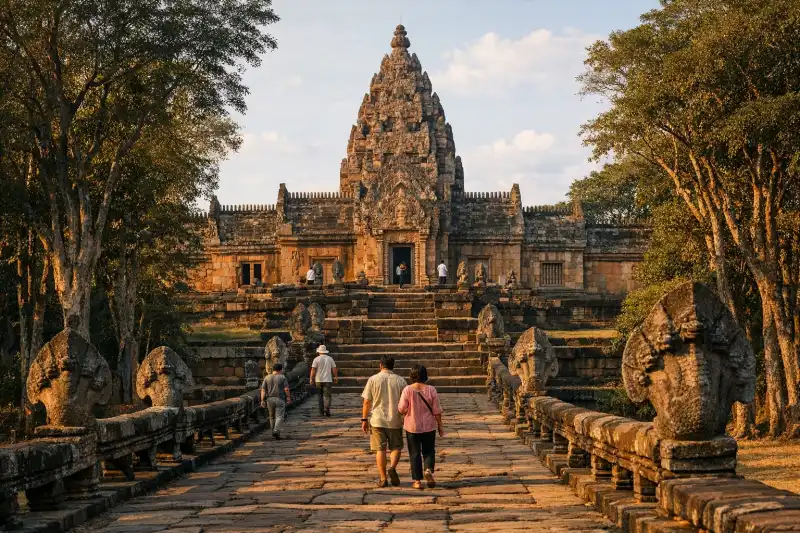
Phanom Rung
Khmer EmpireA dramatic Khmer hilltop temple in Thailand, Phanom Rung is famed for its sandstone carvings and sun...
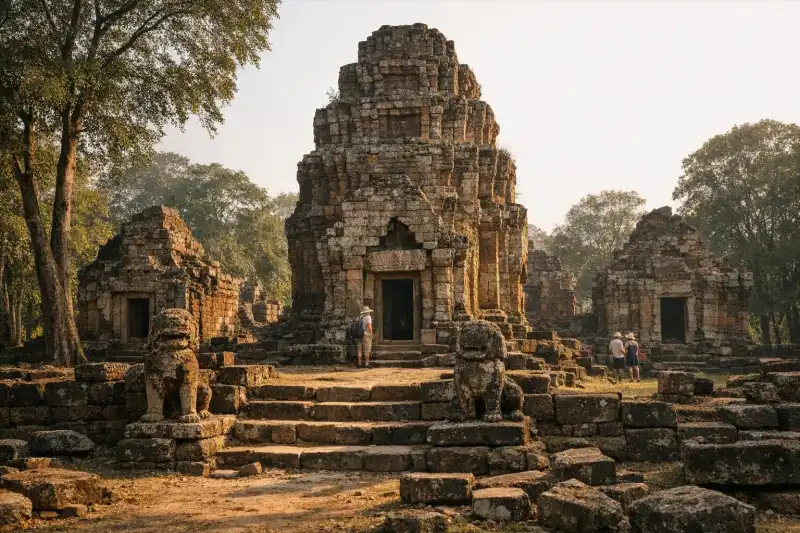
Ku Phra Kona
KhmerAn early Khmer sanctuary in northeastern Thailand, Ku Phra Kona preserves brick towers, carvings, an...