Quick Info
At a glance
Reask Monastic Settlement in Ireland sits quietly on the windswept Dingle Peninsula, where low stone walls, salt-heavy air, and broad Atlantic skies create one of the most atmospheric early Christian landscapes in the country. Far from the scale of Ireland’s great monastic centers, Reask feels intimate and remote, a place where the physical remains are modest but the sense of continuity is remarkably strong. Grass grows over ancient foundations, weathered stones still stand where they were placed centuries ago, and the surrounding fields and hills help explain why religious communities once chose places like this for prayer, work, and contemplation.
For modern visitors, Reask offers something rare: a site that is both archaeological and deeply environmental. You do not arrive at a monumental ruin dominating the countryside. Instead, you enter a subtle sacred space that reveals itself slowly through details: an enclosing boundary, the traces of small buildings, carved stones, and the careful relationship between settlement and terrain. It is one of the best places on the Dingle Peninsula to appreciate the texture of early medieval Irish monastic life at a human scale. If you are exploring County Kerry beyond its famous driving routes and coastal viewpoints, Reask rewards curiosity with a more reflective experience, linking Ireland’s Christian past to one of the country’s most striking western landscapes.
History
Origins in Early Christian Ireland
Reask Monastic Settlement emerged during the early medieval period, likely between the 6th and 7th centuries CE, when monastic communities were becoming central to religious and social life across Ireland. This was an era in which Christianity had already taken root, but its institutions were still developing in a characteristically Irish way. Rather than relying only on large urban churches, the faith often spread through small monastic communities established in rural locations. These settlements functioned not only as places of worship but also as centers of learning, farming, craftsmanship, burial, and regional influence.
The Dingle Peninsula was especially important in this period. Its relative isolation, maritime links, and long record of settlement made it attractive to religious founders seeking both seclusion and connection. Reask was well placed within this landscape: sheltered enough for habitation, fertile enough for subsistence, and near routes that linked the peninsula’s communities. Archaeological evidence suggests a carefully organized enclosure rather than an accidental cluster of buildings. That points to a settled, intentional religious foundation, not simply a temporary hermitage.
Development of the Monastic Community
As the community developed, Reask appears to have taken the form typical of smaller Irish monasteries. It likely included a church or oratory, domestic structures, burial areas, and a boundary defining sacred space. Excavations at the site revealed several structural phases, showing that it was used and adapted over time. This is significant because it suggests continuity rather than a brief episode of occupation.
The inhabitants would have lived a disciplined but practical life. Prayer structured the day, but survival and local engagement were equally essential. Monks or clerics at Reask probably cultivated the surrounding land, cared for livestock, copied or taught religious texts in some form, and served nearby populations. Small sites like this were often woven into local society. They were religious communities, but not cut off from ordinary people. Families may have brought their dead here for burial, donated goods, sought blessing, or attended liturgical observances.
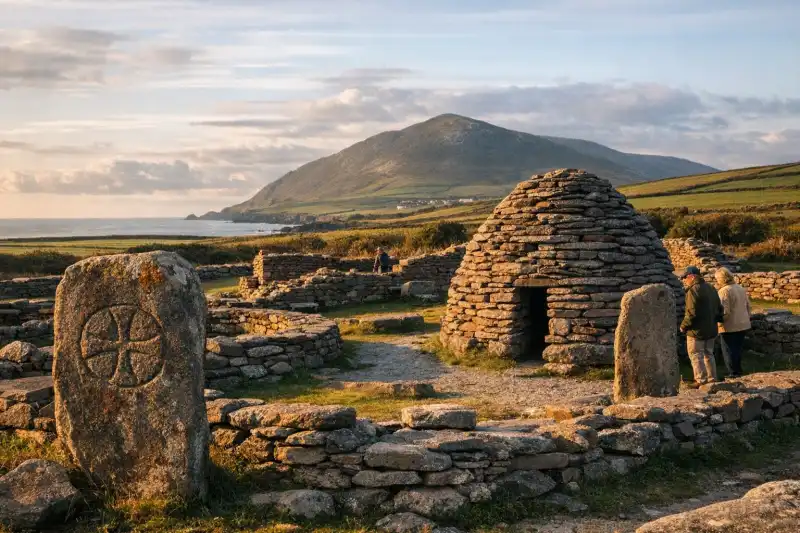
One of the most striking indicators of Reask’s significance is its collection of carved stones and cross slabs. These connect the site to broader artistic and devotional traditions in early Christian Ireland while retaining a regional character. Some stones bear crosses and motifs that help archaeologists interpret the site as both sacred and commemorative. In a place with little surviving height above ground, such carved elements are vital clues to status, function, and belief.
Archaeological Rediscovery and Interpretation
Like many early Irish monastic sites, Reask gradually faded from active use. Over centuries, buildings collapsed, materials weathered, and the visible monument softened into the landscape. Yet the memory of sacred places often persisted in local tradition, place-names, and burial practices. Modern archaeological work was therefore crucial in recovering Reask’s history from beneath the surface.
Excavation in the 20th century brought much of the site’s layout into clearer focus. Archaeologists identified an enclosure, structural remains, burials, and decorated stones, allowing Reask to be interpreted as a coherent monastic settlement rather than an isolated ruin. Finds from the excavations also pointed to daily life, including evidence of occupation and craft. Such work transformed Reask from a locally known antiquity into an important reference point for understanding western Ireland’s early Christian landscape.
Today, historians see Reask as especially valuable because it preserves the pattern of a smaller monastery in a rural Atlantic setting. Large monastic complexes often dominate public imagination, but places like Reask reveal how widespread and varied Irish Christian communities really were. They help scholars reconstruct how belief, settlement, and local geography interacted during the early medieval centuries. For visitors, that scholarly importance translates into a more grounded experience: Reask is not just a ruin to look at, but a rare surviving plan of community life from more than a thousand years ago.
Key Features
The first feature that defines Reask Monastic Settlement is its enclosure. Early Irish monastic sites were often marked by a circular or sub-circular boundary that separated sacred community space from the surrounding world. At Reask, this sense of an enclosed religious landscape remains one of the clearest ways to understand the site. Even where the walls no longer stand high, the shape of the ground and the surviving stonework allow visitors to imagine the original perimeter. This boundary was practical, but it was also symbolic. Crossing into the enclosure meant entering a place organized around prayer, burial, and communal discipline.
Within that space, the structural remains speak quietly but eloquently. Rather than grand masonry, the buildings were modest, built to local conditions and materials. Foundations indicate small structures that likely served domestic, liturgical, and possibly workshop functions. These low remains demand attention from the visitor. Reask is not a site of towering architecture; it is a site of footprints, plans, and traces. That is part of its power. You read it less as a ruin and more as a lived landscape.
The carved stones are among the most memorable features. Cross-inscribed slabs and grave markers give Reask much of its character and scholarly significance. Their decoration is not elaborate in the way of later high crosses, yet it is deeply expressive. The crosses announce Christian identity in unmistakable terms, while the stones themselves may have marked burials, commemorated individuals, or structured devotional space. Seen in situ or associated with the site, they bridge the gap between abstract history and personal presence. Someone carved these symbols, someone was remembered here, and someone prayed in front of them.
Another notable aspect of Reask is its relationship with the broader Dingle Peninsula landscape. The site is not visually isolated from its environment; it is defined by it. The open skies, nearby hills, shifting weather, and the Atlantic atmosphere are part of the experience. Early monastic communities in Ireland often selected places that balanced remoteness with habitability, and Reask exemplifies that choice. The settlement feels withdrawn enough for contemplation but not so inaccessible that it would have been detached from local life. This balance helps explain why such communities could survive and matter.
Burial is also central to understanding the site. Like many monastic enclosures, Reask appears to have served as a place where the dead were laid to rest close to holy ground. Burial within or near a monastery carried spiritual meaning, connecting individuals and families to the prayers and sanctity of the community. Even if the graves are not visually dramatic, the archaeological evidence reminds visitors that this was not only a working settlement but also a memorial landscape shaped by generations of reverence.
Finally, Reask’s greatest feature may be its scale. Because it is compact, visitors can grasp the site as a whole without feeling overwhelmed. You can stand in one position and understand the relationship between enclosure, structures, stones, and surrounding terrain. For anyone interested in early Christian archaeology, this clarity is invaluable. Reask offers not spectacle but coherence. It demonstrates how a small religious community occupied space, marked identity, and endured in one of Ireland’s most compelling coastal regions.
Getting There
Reask Monastic Settlement is located near Ballyferriter on the western Dingle Peninsula in County Kerry. The most practical base for visitors is Dingle town, which lies roughly 15 to 20 minutes away by car depending on route and traffic. From Dingle, a taxi to the site area will typically cost around €25 to €40 one way, though prices can vary by season and time of day. Hiring a car is the easiest option if you want flexibility to combine Reask with other peninsula stops such as Gallarus Oratory, beaches, and coastal viewpoints.
If you are coming from farther afield, Killarney is the main transport hub in the region. Driving from Killarney to Reask usually takes around 1.5 to 2 hours. Car rental in Kerry often starts around €35 to €70 per day for a small vehicle, with higher rates in summer. Buses run from Killarney to Dingle, with standard fares often in the €10 to €20 range each way depending on operator and booking time. From Dingle, however, public transport to small archaeological sites is limited, so you may need a taxi, guided tour, or a combination of local cycling and walking.
For active travelers, cycling on the Dingle Peninsula is a scenic option, especially in dry weather, though roads can be narrow and windy. Some bike rentals in Dingle start at about €25 to €40 per day. If you join a guided historical or sightseeing tour of the peninsula, Reask may be included or paired with other early Christian monuments. Always check access conditions before setting out, as rural heritage sites may have limited signage or informal parking arrangements.
When to Visit
The best time to visit Reask Monastic Settlement is from late spring to early autumn, especially May through September, when daylight is long and the Dingle Peninsula’s roads and paths are generally easier to navigate. In these months, temperatures are usually mild rather than hot, often ranging from about 12°C to 19°C, and the extended evening light gives you more flexibility to combine Reask with other archaeological and scenic stops. Summer also brings the greenest landscapes and some of the clearest views across the peninsula.
That said, County Kerry’s weather can change quickly in any season. Even in July or August, you should expect wind, passing showers, and cool conditions at exposed sites. Waterproof layers and sturdy shoes are advisable year-round. Reask is especially appealing on bright mornings or late afternoons, when the lower sunlight brings out the textures of stone and grass and gives the site a more contemplative atmosphere.
Spring and early autumn are excellent choices for travelers who prefer fewer people on the peninsula. While Reask is never among Ireland’s most crowded attractions, nearby roads and villages are busier in peak summer. Visiting in May, June, or September often gives you the best balance of decent weather, manageable traffic, and softer light for photography.
Winter visits are possible, but they require more flexibility. Days are shorter, rain is more frequent, and strong Atlantic weather can make outdoor exploration less comfortable. If you do come in winter, aim for a dry forecast and visit earlier in the day. Reask’s subtle features are best appreciated when the ground is not overly waterlogged and when you have enough time to walk the site carefully.
| Quick Facts | Details |
|---|---|
| Location | Near Ballyferriter, Dingle Peninsula, County Kerry, Ireland |
| Country | Ireland |
| Period | Early Medieval |
| Established | Likely 6th-7th century CE |
| Site Type | Early Christian monastic settlement |
| Known For | Enclosure, structural remains, burials, cross-inscribed stones |
| Best Base | Dingle |
| Typical Visit Length | 30-60 minutes |
| Entry Fee | Usually free |
| Best Season | Late spring to early autumn |
Reask Monastic Settlement is one of those places that rewards patience more than speed. It does not compete with Ireland’s biggest ruins in size or decoration, and that is precisely why it stands out. Here, the appeal lies in atmosphere, scale, and authenticity. The remains are close to the ground, but the historical reach is vast: this small enclosure opens onto the world of early medieval Ireland, when communities of faith shaped the social and spiritual map of the island from places just like this one.
For travelers on the Dingle Peninsula, Reask offers a richer understanding of the region beyond its dramatic scenery. It shows that the west of Ireland was not merely remote, but deeply inhabited, organized, and connected through religious life. Standing among the stones, with the Atlantic climate moving across the fields, it becomes easier to imagine the rhythms of prayer, burial, labor, and memory that once defined this place. If you want a heritage stop that feels reflective, historically important, and rooted in its landscape, Reask is among County Kerry’s most rewarding ancient sites.
Guided tours: worth it?
Most travelers can visit Reask Monastic Settlement independently. Compare a tour only if you want a tighter history-focused visit, easier logistics, or a guide who can answer questions on the spot.
Best for
- Short visits where a planned route saves time
When to go self-guided
Go independently if you prefer setting your own pace, reading as you go, and checking official hours or ticket rules directly before you arrive.
What I’d avoid
Skip paid tours that bundle unrelated stops you do not actually want. The best option should either save meaningful planning time or add historical context you would miss on your own.
Dingle Peninsula Archaeology and History Tours
Useful when: you want to compare guided formats before deciding
County Kerry Historical Day Trips
Useful when: transport or pickup logistics matter
Ireland Early Christian Sites Tours
Useful when: timing or entry windows matter
Some tour links are affiliate links, which may earn Ancient Travel a small commission at no extra cost to you. I try to surface options that make practical sense for the site—not just anything bookable.
Frequently Asked Questions
What is Reask Monastic Settlement?
Reask Monastic Settlement is an early Christian archaeological site on the Dingle Peninsula in County Kerry, Ireland, known for its stone oratory remains, cross slabs, enclosure, and evidence of monastic life.
Where is Reask Monastic Settlement located?
The site lies near Ballyferriter on the western Dingle Peninsula in County Kerry, Ireland, a short drive from Dingle town along a scenic Atlantic route.
Is there an entrance fee for Reask Monastic Settlement?
Reask Monastic Settlement is generally accessible as an open heritage site and is typically free to visit, though local access conditions and parking arrangements can change.
How much time should I allow for a visit?
Most visitors spend 30 to 60 minutes at Reask Monastic Settlement, though those interested in archaeology, early Christianity, or photography may want longer.
What can I see at Reask Monastic Settlement?
Visitors can see the remains of the enclosing wall, stone foundations, grave markers, cross-inscribed stones, and the evocative landscape setting that helps explain why a monastic community settled here.
Is Reask Monastic Settlement suitable for families?
Yes, the site can suit families interested in history and outdoor exploration, but paths may be uneven and children should be supervised around stone remains and rural ground conditions.
Nearby Ancient Sites
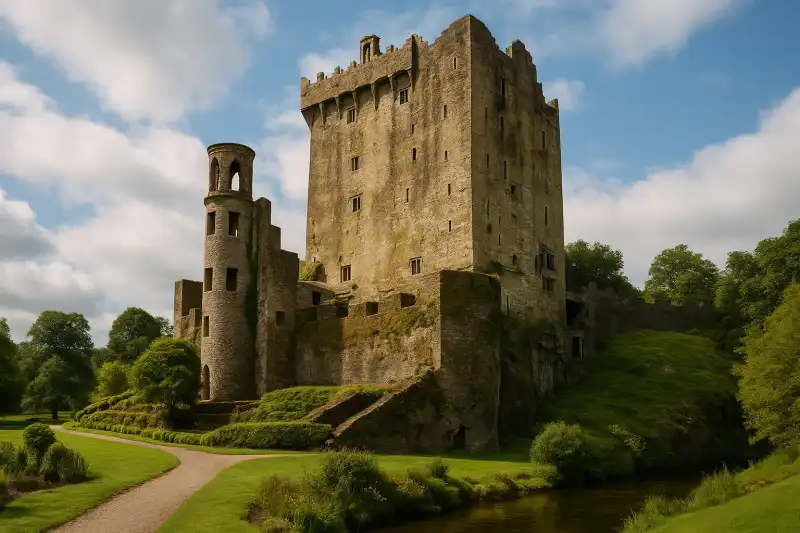
Blarney Castle Travel Guide 2026: Cork Day-Trip Timing, Gardens, and Stone Access
Medieval IrelandPlan a practical first visit to Blarney Castle with timing for the Stone queue, garden route priorit...
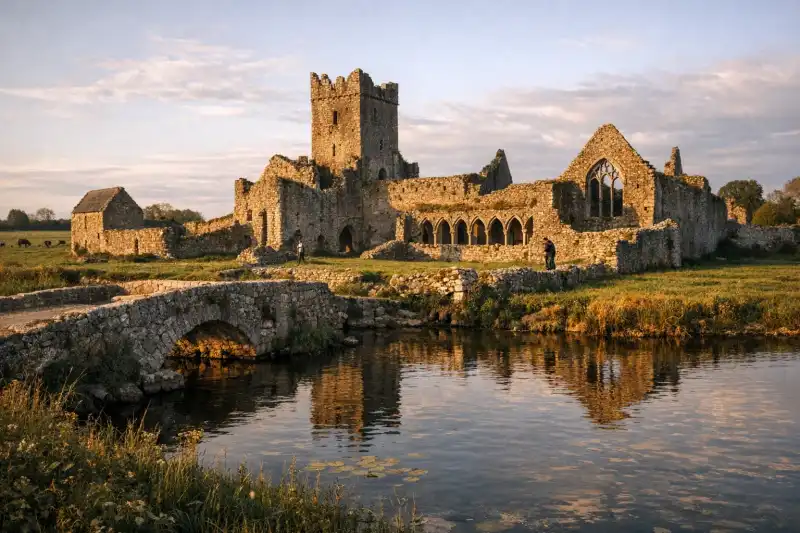
Athassel Priory
Medieval Irish and Anglo-NormanExplore Athassel Priory, Ireland’s vast medieval Augustinian monastery, set beside the River Suir in...
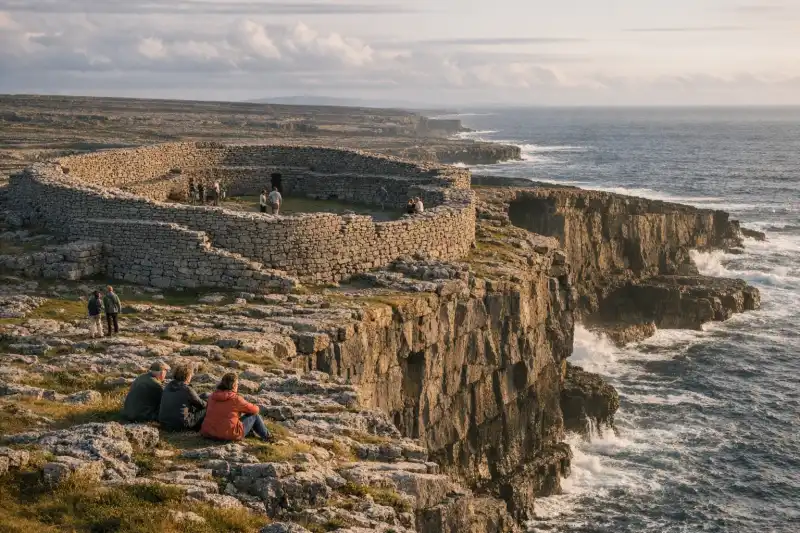
Aran Islands Stone Forts
Prehistoric and early medieval IrishExplore the dramatic prehistoric stone forts of Ireland’s Aran Islands, where Atlantic cliffs and an...
Carrowmore Megalithic Cemetery
Neolithic communities of prehistoric IrelandExplore Carrowmore Megalithic Cemetery, Ireland’s vast Neolithic burial landscape near Sligo, with t...