Quick Info
At a glance
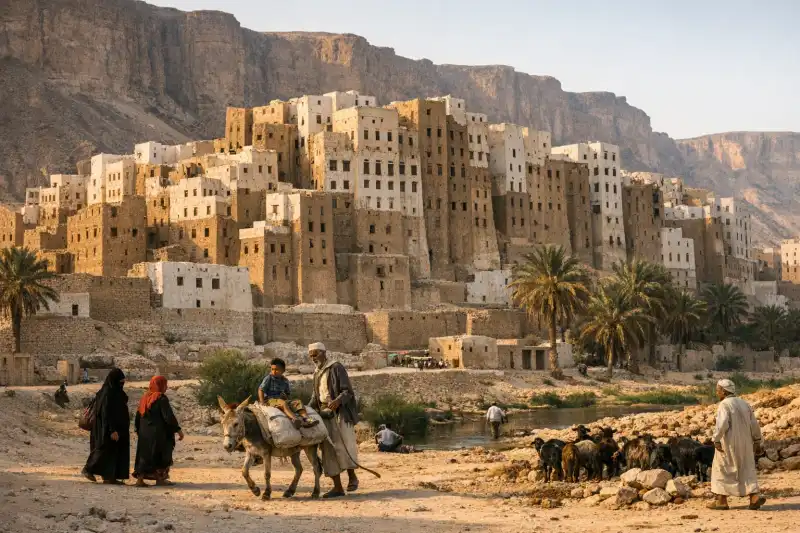
Shibam in Yemen rises from the floor of Wadi Hadramawt with a skyline so improbable that first-time visitors often stop speaking for a moment when it appears. Here, in one of the Arab world’s most storied desert valleys, compact earthen towers stand shoulder to shoulder behind a defensive wall, their vertical forms catching light and shadow in a way that makes the whole settlement look both ancient and startlingly modern. The city is famous for its mud-brick high-rises, but its true power lies in how complete the urban ensemble remains: streets, drainage, houses, gates, and the relationship between settlement and valley still tell a coherent story.
Often called the “Manhattan of the Desert,” Shibam is more than a picturesque nickname or a UNESCO listing. It is a rare example of a city built upward rather than outward long before steel frames or elevators made height commonplace elsewhere. In a harsh climate where floodwater, heat, and limited arable land shaped every decision, the people of Hadramawt developed an urban form that was practical, defensive, and elegant all at once. Walking through Shibam means entering a place where architecture is inseparable from environment: thick earthen walls temper the sun, narrow lanes manage circulation and shade, and the clustered towers preserve precious space around them. For travelers drawn to historic cities, vernacular architecture, and landscapes where human ingenuity is visibly etched into every surface, Shibam is one of Yemen’s most unforgettable destinations.
History
Early settlement in Wadi Hadramawt
The Hadramawt valley has been inhabited for millennia, and Shibam’s importance begins with geography. Wadi Hadramawt served as a corridor linking the interior of southern Arabia with caravan routes, oasis settlements, and Indian Ocean trade networks. Even before the present urban form took shape, settlements in this region benefited from access to seasonal agriculture, groundwater, and long-distance exchange. The valley’s communities were shaped by scarcity and opportunity in equal measure: fertile patches were limited, but routes for trade and movement encouraged prosperity.
Shibam emerged within this wider Hadrami world, where towns were often tied to tribal alliances, irrigation systems, and commerce in goods ranging from incense and agricultural products to textiles and imported luxuries. Although the existing cityscape is not primarily ancient in the classical sense, the site itself reflects much deeper continuity of occupation. Its role as a settled center within the valley helped establish the conditions for later urban consolidation.
Medieval growth and strategic urban form
Over the medieval centuries, Shibam became more distinctly urban and more strategically organized. In a region where rivalries, raids, and political fragmentation were recurring realities, compactness offered security. A walled town with tightly packed multi-story houses allowed a population to shelter wealth, grain, and family networks within a defendable footprint. This pattern also conserved surrounding agricultural land, a critical concern in a valley where cultivable plots were precious.
The city’s street plan and building pattern reflect this logic. Rather than dispersing into low horizontal neighborhoods, residents concentrated construction into vertically layered family homes. Lower floors handled storage and service functions, while upper levels provided living spaces with better air movement and more privacy. The result was not accidental improvisation but a mature urban strategy that responded to climate, defense, and social organization at once.
Shibam’s location also gave it significance in local political life. As dynasties and local rulers competed for influence across Hadramawt, towns like Shibam acted as nodes of administration, tribute, religious life, and market activity. Its architecture reveals a place where communal resilience mattered as much as prestige.
The 16th-century rebuilding and the tower-house city
Much of the Shibam visitors see today dates from the 16th century and later, following destructive flooding that affected earlier settlement fabric in the valley. This rebuilding phase is central to Shibam’s identity. Instead of abandoning the site or reconstructing in a more sprawling manner, residents renewed the city in mud brick and raised its houses to remarkable heights, often five to eight stories. This produced the famous skyline that later travelers and scholars would celebrate.
The choice of mud brick was anything but primitive. Earthen construction was deeply suited to local conditions: it was available, repairable, thermally efficient, and familiar to skilled builders. Timber elements supported floors and roofs, while exterior surfaces required regular maintenance through replastering. In this way, Shibam’s architecture embodied a cycle of renewal. The city survives not because mud brick is permanent in the modern sense, but because generations continuously repaired it.
This rebuilding period also demonstrates a sophisticated understanding of flood risk. The settlement sat on a raised spur within the valley, and the defensive wall, drainage systems, and compact plan worked together to mitigate environmental threats. Shibam’s famed verticality therefore represents environmental adaptation as much as urban daring.
Modern recognition and preservation challenges
In the modern era, Shibam came to international attention as one of the world’s most extraordinary examples of traditional urbanism. Scholars of architecture highlighted its tower houses as an early high-rise model, while conservationists emphasized the rarity of a nearly intact mud-brick city functioning as a living settlement. UNESCO World Heritage recognition confirmed its global importance.
Yet admiration has always been paired with fragility. Earthen cities demand care. Wind, rain, flooding, neglect, inappropriate materials, and conflict can all accelerate deterioration. Political instability in Yemen has further complicated preservation efforts, restricting tourism, limiting resources, and placing strain on local communities who remain the first custodians of the site. Even so, Shibam continues to endure through the same principle that sustained it for centuries: maintenance rooted in local knowledge. Its history is not only a record of survival in the past, but an ongoing test of how historic cities can remain inhabited without losing the very traditions that made them possible.
Key Features
The first and most famous feature of Shibam is its skyline. Unlike many historic settlements that reveal themselves gradually as low walls and roofs, Shibam presents an almost theatrical profile of tall earthen towers emerging from the desert valley. The visual effect is especially striking from a distance, where the clustered buildings resemble a miniature forest of vertical blocks. Up close, however, the city feels less monumental than intimate. The towers are not isolated monuments but homes, arranged in close relation to one another and connected by narrow lanes that produce alternating zones of sun, shade, enclosure, and sudden openness.
These tower houses are Shibam’s architectural signature. Built of sun-dried mud brick and often rising five to eight stories, they demonstrate a highly refined domestic tradition. Their façades are shaped by small windows, rhythmic lines, and subtle variations in plaster that soften the bulk of the structures. The lower levels were commonly used for storage or animals, creating a durable base and separating household life from street-level activity. Upper stories held reception rooms, family spaces, kitchens, and sleeping areas. As in many traditional Islamic urban settings, vertical organization also supported privacy, with functions distributed according to social use and household hierarchy.
Another defining feature is the city’s compact plan within its enclosing wall. This is urbanism compressed to an extraordinary degree. The wall itself gives Shibam an almost citadel-like presence, reinforcing the impression of a protected island of habitation within the wider valley landscape. Entering through the gates, visitors experience a clear threshold between agricultural and open space outside and dense civic space inside. That transition is one reason Shibam feels so coherent: the city still reads as a complete organism rather than a fragment.
Equally important is the relationship between architecture and environment. Shibam’s buildings were not designed merely to look impressive. Thick earthen walls moderate temperature by slowing the transfer of heat, while narrow lanes reduce solar exposure and create airflow patterns that improve comfort. Height also captures breezes and helps separate cleaner living areas from dust and activity near the ground. In a climate where adaptation was essential, beauty emerged from utility.
The city’s details reward slow observation. Decorative gypsum work around windows and interiors, carved wooden elements, and carefully proportioned openings show that Shibam is not just a feat of engineering but a place of craft. The apparent uniformity of the skyline gives way to individual distinctions once you begin to notice façade treatments, rooflines, and household arrangements. Mosques and communal spaces anchor the town’s spiritual and social rhythms, adding layers of meaning beyond the residential towers.
The surrounding setting is also part of the experience. Shibam cannot be separated from Wadi Hadramawt, whose broad floor, cliffs, cultivated plots, and neighboring settlements explain why the city took its present form. Seen against the valley’s pale earth tones and immense sky, the mud-brick towers appear at once integrated with the landscape and defiantly upright within it. This union of city and desert is one of Shibam’s great aesthetic achievements. It is not an imported urban model imposed on nature, but an indigenous form that grew from local constraints and possibilities.
Finally, what makes Shibam especially compelling is that it remains a living town. Its significance does not rest solely on archaeological remnants or restored façades curated for visitors. Life continues within and around the historic fabric, and that continuity preserves the sense that the city is still performing its original function. For travelers interested in authentic urban heritage, this living dimension often becomes the most memorable feature of all.
Getting There
Reaching Shibam usually involves traveling first to Sayun, the principal nearby city in Hadhramawt, and then continuing by road for roughly 20 to 30 kilometers. In normal local conditions, the onward drive from Sayun can take around 30 to 45 minutes. Taxi fares in the region can vary widely depending on security, fuel prices, road conditions, and whether the driver is hired one-way or return, but budget-minded travelers should expect a private taxi quote in the rough range of USD 15 to 35 equivalent for the short transfer. Shared vehicles, if operating, may cost much less.
Historically, domestic flights have connected major Yemeni hubs with Sayun at different times, though schedules and availability can change abruptly. When flights operate, tickets are often priced according to demand and route, and fares may range from about USD 80 to 200 or more equivalent. Overland travel within Yemen is possible in principle, but in practice it must be approached cautiously, with up-to-date local advice, security clearance where required, and contingency planning.
For independent travelers, the most important point is that access conditions in Yemen can shift quickly. Many visitors who do reach Shibam do so through arranged local contacts, guides, or agencies familiar with Hadhramawt. Those arrangements may include airport pickup, permit assistance, driver services, and lodging coordination in Sayun or nearby towns. If tourism services are operating, expect a full-day car and driver arrangement in the broader area to cost roughly USD 60 to 120 equivalent, though prices can be higher depending on conditions. Always verify current safety advisories, transport status, and local permissions before making plans.
When to Visit
The most comfortable time to visit Shibam is generally during the cooler months, especially from November through February. Daytime temperatures are more manageable for walking the lanes, viewing the city from surrounding vantage points, and making short excursions around Wadi Hadramawt. Mornings and late afternoons are particularly rewarding, as the low sun brings out the sculptural character of the mud-brick towers and softens the valley’s harsh light. Even in winter, however, midday sun can be strong, so water, sun protection, and sensible pacing remain essential.
Spring and autumn can also be viable, but heat begins to build and comfort depends on exact weather conditions. From roughly March to April and again in October, visitors may still find good windows for exploration if they plan activities early and late in the day. Photographers often appreciate these shoulder seasons because the atmosphere can be clear and the town less affected by whatever limited visitor traffic is present.
Summer is the most challenging period. Temperatures can become intense, especially in exposed areas outside shaded lanes. Heat fatigue is a real concern, and sightseeing during midday can be unpleasant. In addition, rainfall events elsewhere in the valley can affect conditions unexpectedly, and because Shibam is an earthen city, weather always matters. After rain, the architecture can look especially beautiful, but access, maintenance work, and local movement may be affected.
Beyond climate, timing your visit should also depend on current security and infrastructure conditions, which are more decisive than weather in Yemen. If travel is feasible, aim for a cooler season, allow schedule flexibility, and confirm local conditions shortly before departure.
| Quick Facts | Details |
|---|---|
| Location | Wadi Hadramawt, Hadhramaut Governorate, Yemen |
| Famous for | Dense cluster of multi-story mud-brick tower houses |
| Nickname | ”The Manhattan of the Desert” |
| UNESCO Status | World Heritage Site |
| Main period of standing city | Largely 16th century and later |
| Building material | Sun-dried mud brick with timber and plaster elements |
| Nearest city | Sayun |
| Best season | November to February |
| Ideal visit length | Half day to full day |
| Travel note | Access depends heavily on current security and local arrangements |
Shibam rewards visitors who look beyond superlatives. Yes, it is dramatic, photogenic, and often described in terms of records and nicknames. But its deeper importance lies in showing how a community created a resilient urban form from earth, climate, and necessity. In an age that often treats old cities as either museum pieces or development obstacles, Shibam offers another model: a city where tradition, practicality, and beauty remain inseparable. To stand before its towers in the Yemeni valley light is to see not only one of Arabia’s great historic skylines, but also a profound lesson in how people once built intelligently with the materials and knowledge they had close at hand.
Guided tours: worth it?
Self-guided works here, but a guide can add real value if you want the ruins explained as a living place rather than just a sequence of monuments.
Best for
- First-time visitors who want context, not just photos
- Short visits where a planned route saves time
When to go self-guided
Go independently if you prefer setting your own pace, reading as you go, and checking official hours or ticket rules directly before you arrive.
What I’d avoid
Skip paid tours that bundle unrelated stops you do not actually want. The best option should either save meaningful planning time or add historical context you would miss on your own.
Shibam Yemen
Useful when: you want to compare guided formats before deciding
Hadramawt Valley Yemen
Useful when: you want to compare guided formats before deciding
Sayun Yemen
Useful when: you want to compare guided formats before deciding
Some tour links are affiliate links, which may earn Ancient Travel a small commission at no extra cost to you. I try to surface options that make practical sense for the site—not just anything bookable.
Frequently Asked Questions
What is Shibam best known for?
Shibam is best known for its dense cluster of tall mud-brick tower houses, which earned it the nickname 'the Manhattan of the Desert' and recognition as a UNESCO World Heritage Site.
Where is Shibam located?
Shibam is located in Yemen's Hadhramaut Governorate, in the Wadi Hadramawt region of eastern Yemen, near the city of Sayun.
Is Shibam an ancient site or a living town?
Shibam is both a historic urban settlement and a living town. Many of its famous tower houses date from the 16th century onward, while the site itself has much older roots.
How do visitors usually reach Shibam?
Most visitors approach Shibam via Sayun in Hadhramawt, then continue by road. In practice, travel conditions depend heavily on current security conditions, permits, and local transport availability.
Why are Shibam's buildings made of mud brick?
Mud brick has long been the practical building material of the Hadramawt valley. It offers insulation against heat, can be repaired locally, and supports the region's traditional tower-house architecture.
When is the best time to visit Shibam?
The cooler months from roughly November to February are generally the most comfortable for walking around Shibam, as daytime temperatures are milder than in the hotter seasons.
Nearby Ancient Sites
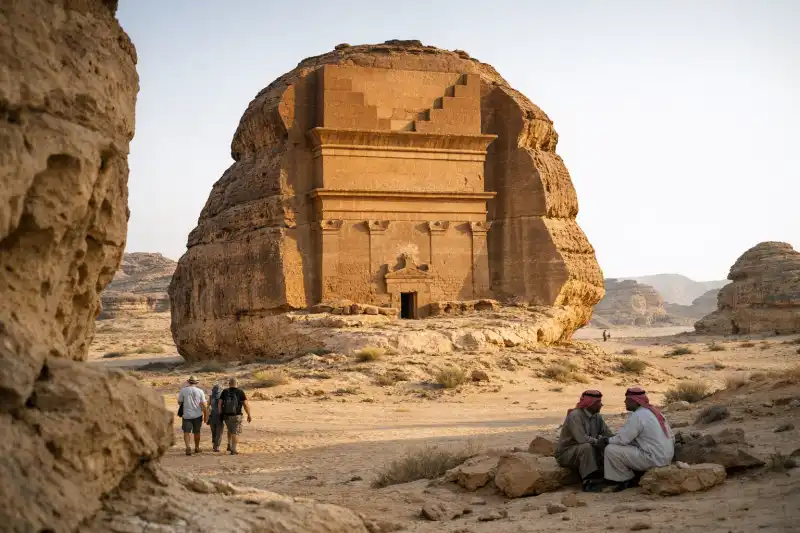
Hegra (Madain Saleh)
NabataeanExplore Hegra (Madain Saleh), Saudi Arabia's Nabataean rock-cut city of tombs, desert landscapes, an...
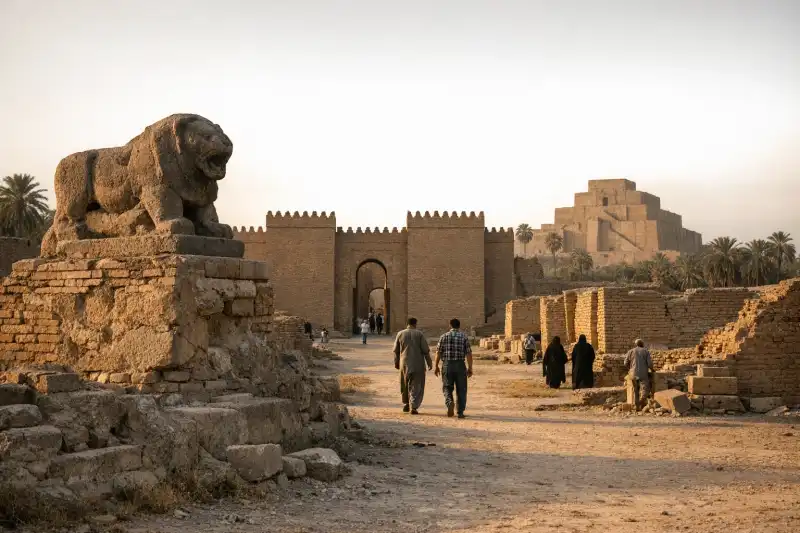
Babylon
Babylonian and MesopotamianExplore Babylon in Iraq, the famed Mesopotamian city of kings, temples, and legends on the Euphrates...
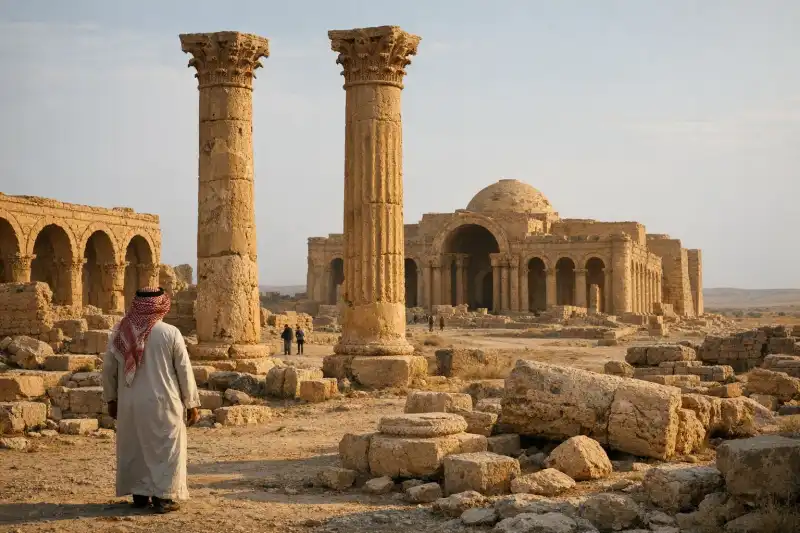
Hatra
Parthian with Mesopotamian and Arab influencesExplore Hatra in Iraq, a fortified desert city famed for its temples, walls, and blend of Parthian a...