Quick Info
At a glance
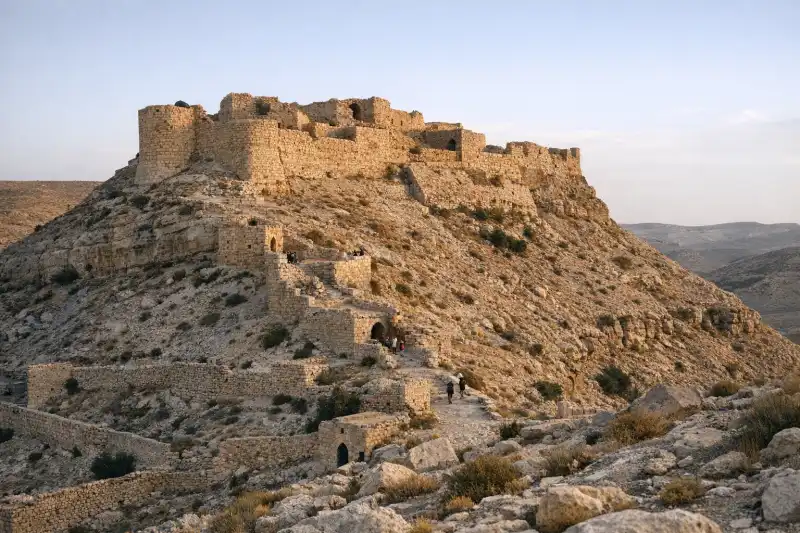
Shobak Castle in Jordan stands on a lonely, commanding hill between Petra and the central highlands, its weathered walls still projecting the confidence of a fortress built to control roads, water, and movement across a harsh but strategic landscape. Seen from afar, the castle appears almost fused with the mountain itself, a crown of pale stone above cultivated terraces, dry valleys, and the wide southern plateau. Unlike Jordan’s more famous monuments, Shobak often feels quiet and spacious, giving visitors room to notice the texture of the masonry, the angles of the towers, and the way centuries of rebuilding have layered one political world over another.
The site is also known historically as Montreal, a name given during the Crusader era, and that double identity tells you much about its story. It was conceived as a frontier stronghold by Latin Christian rulers, then besieged, captured, and adapted by Muslim dynasties who understood its value just as clearly. Today, the remains preserve traces of churches, inscriptions, defensive walls, vaulted rooms, and subterranean passages, all framed by sweeping views over the surrounding hills. Visiting Shobak is less about a single intact monument and more about reading a medieval stronghold in fragments: a place where architecture, war, faith, and geography all left visible marks. For travelers driving the King’s Highway or making a detour from Petra, it offers one of Jordan’s most atmospheric and underrated historical stops.
History
Crusader foundation in the early 12th century
Shobak Castle was founded in 1115 CE by Baldwin I of Jerusalem, one of the early Crusader kings who expanded Latin Christian power east of the Jordan River. At the time, the newly established Kingdom of Jerusalem was seeking to secure trade routes, pilgrimage roads, and military corridors linking the interior of the Levant with the Red Sea and Arabia. The hill chosen for the fortress was ideal: isolated, steep-sided, and well positioned to monitor movement through southern Jordan. The Crusaders called it Montreal, usually interpreted as “Royal Mountain,” a name that reflected both prestige and strategic ambition.
This was not a decorative stronghold but a functioning frontier castle. It formed part of a wider chain of Crusader defenses that included other major fortresses in Transjordan, especially Kerak to the north. From Shobak, garrisons could tax caravans, project military power, and maintain pressure on routes used by merchants and pilgrims. The region’s dry environment made control of water especially important, so the fortress was designed not only with walls and towers but also with systems for storing supplies and enduring siege conditions. Its first decades were therefore tied closely to the broader Crusader effort to hold a vulnerable and contested borderland.
Expansion, conflict, and regional pressure
As the 12th century progressed, Shobak gained military and political importance. The lords who governed the Crusader territories east of the Jordan often exercised considerable local autonomy, and castles like Shobak were central to that power. The fortress became associated with the Lordship of Oultrejordain, a frontier region where local rulers could profit from tolls, raids, and negotiations with neighboring Muslim powers. Its position meant that it stood close to the fault lines of diplomacy and war.
During this period, the balance of power in the region began to change. Muslim states that had once been fragmented gradually became more coordinated under leaders capable of mounting serious offensives against Crusader strongholds. Tensions increased under figures such as Reynald of Châtillon, whose aggressive actions against Muslim caravans and pilgrimage routes helped inflame conflict. While Shobak itself was not always the main theater of these confrontations, it was deeply embedded in the same system of castle warfare, road control, and frontier provocation.
The site’s architecture likely evolved in response to this pressure. Defensive circuits were reinforced, towers improved, and internal facilities adapted to prolonged resistance. Medieval castles were rarely static; they grew through need, improvisation, and changing technology. At Shobak, the surviving remains suggest repeated construction phases rather than a single unified design.
Siege and Ayyubid conquest
The decisive turning point came in the later 12th century, during the campaigns of Salah ad-Din, known in the West as Saladin. After his major victory at the Battle of Hattin in 1187, the strategic position of Crusader fortresses across the region deteriorated rapidly. Though some castles held out for a time, they were increasingly isolated. Shobak endured siege conditions and resisted longer than many places, relying on stored provisions and its formidable hilltop setting.
Eventually, however, resistance could not last indefinitely. Shobak fell to Ayyubid forces in 1189, marking the end of its role as a Crusader stronghold. Its capture was significant not only because it removed a major Latin fortress from southern Jordan but also because it helped consolidate Muslim control over a region long contested for its roads and agricultural potential. The fall of the castle symbolized the wider reversal of Crusader expansion east of the Jordan.
Under Ayyubid rule, the fortress did not lose importance. Instead, it was absorbed into a new political order. Like many captured castles, Shobak was repurposed rather than abandoned. Existing defenses were retained and modified, and the site continued to function as an administrative and military center. Arabic inscriptions and later architectural additions testify to this next chapter in its life.
Mamluk adaptation and later decline
In the 13th and 14th centuries, the Mamluks inherited and further transformed the castle. They were experienced military rulers with a keen understanding of fortifications, and throughout the Levant they repaired, reoccupied, and in some cases substantially altered earlier Crusader sites. At Shobak, they strengthened parts of the fortification system and integrated the castle into their own network of regional authority. Inscriptions from the period provide evidence of these works and help anchor the visible ruins in specific historical phases.
Yet strategic value can shift. As political centers changed, military technology evolved, and regional routes were reorganized, Shobak gradually declined in importance. It remained inhabited in some fashion for centuries, but it no longer stood at the center of grand regional struggles in the way it had during the Crusader and Ayyubid periods. Time, earthquakes, stone robbing, and weathering reduced it from fortress to ruin.
What survives today is therefore a palimpsest rather than a pristine castle. Crusader masonry stands beside later Islamic modifications; defensive elements coexist with religious and domestic remains. For visitors, this layered condition is part of the site’s appeal. Shobak is not merely a relic of one era but a witness to successive powers that all recognized the same truth: this hill was worth holding.
Key Features
The first striking feature of Shobak Castle is its setting. The fortress rises from a conical hill detached enough from the surrounding terrain to create strong natural defenses, yet close enough to fertile pockets of land to sustain a resident community. The approach itself helps explain the site’s strategic logic. As you climb, the walls seem to grow out of the rock, and the surrounding views widen in every direction. This command of the landscape was one of the castle’s greatest assets. Watchers posted here would have seen movement along routes threading through southern Jordan, while the defenders benefited from steep slopes that made direct assault difficult.
Within the ruins, the outer walls and towers remain the most visually dramatic elements. Even in their damaged state, they convey the mass and seriousness of medieval military architecture. The stonework varies from section to section, reflecting repairs and later alterations, and attentive visitors can often detect how different rulers adapted earlier construction rather than replacing it wholesale. Some areas preserve arrow slits, chambers, and vaulted spaces that hint at the rhythms of life inside the fortress: soldiers on watch, administrators managing supplies, and civilians or dependents living in the protected enclosure.
One of Shobak’s most memorable features is its subterranean engineering. Like other frontier castles in arid zones, it needed secure access to water and protected storage during siege. Parts of the castle include deep passageways and staircases descending through the rock, often associated with springs or concealed routes. These underground sections are among the most atmospheric parts of the site. They transform the visit from a simple hilltop walk into something more immersive, reminding you that survival here depended as much on hidden infrastructure as on imposing walls. The descent can be dark, uneven, and sometimes slippery, so it also gives a vivid sense of how demanding fortress life must have been.
The remains of a church add another important dimension. Although heavily ruined, they preserve evidence of the castle’s original Crusader religious life, showing that the stronghold was not solely a military machine but a complete community organized around worship as well as defense. Later Islamic inscriptions and modifications nearby underscore the castle’s changing identity after conquest. Shobak is therefore especially valuable for the way sacred and military spaces overlap within the same enclosure.
Architectural details reward slow exploration. There are carved stones reused in later walls, fragments of arches, collapsed halls, and projecting platforms where towers once dominated vulnerable approaches. From some vantage points, the ruins frame broad views over orchards, villages, and dry ridgelines, creating a powerful contrast between cultivated human life below and the hard defensive world above. The silence of the site often heightens that contrast. Compared with Jordan’s busiest attractions, Shobak feels less curated and less crowded, which can make the stones seem closer to their medieval reality.
Another notable feature is the sense of historical layering. At many ancient and medieval sites, one period dominates public imagination so strongly that later phases are overlooked. At Shobak, however, the Crusader story remains inseparable from the Ayyubid and Mamluk ones. The visitor experiences this not through museum labels alone but through the fabric of the castle itself. Its broken walls are records of continuity, adaptation, conquest, and reuse. This complexity makes Shobak especially rewarding for travelers who enjoy reading architecture as evidence. Rather than presenting a single frozen moment, the castle reveals how frontier strongholds evolved over centuries in response to new rulers, threats, and technologies.
Getting There
Shobak Castle is most commonly visited by road, and the easiest base for many travelers is Wadi Musa, the town beside Petra. The drive usually takes about 35 to 45 minutes, depending on the route and traffic, and a taxi from Petra can often be arranged for roughly 20 to 35 Jordanian dinars for a return trip with waiting time, though prices vary by season and negotiation. If you are self-driving, the castle is a straightforward stop on the King’s Highway and combines well with Dana, Little Petra, or Kerak for a full day of historical sightseeing.
From Amman, the journey is much longer, typically around 3.5 to 4.5 hours by car depending on traffic and whether you travel via the Desert Highway or the more scenic King’s Highway. Rental cars are popular for this part of Jordan because they offer flexibility, especially if you want to stop at viewpoints and smaller heritage sites along the way. Fuel costs are moderate by regional standards, and road signage is generally adequate, though downloading offline maps is wise.
Public transport to Shobak is less convenient. Service taxis and minibuses may connect larger towns in southern Jordan, but schedules can be irregular and may not align well with sightseeing plans. For that reason, organized tours or private drivers are often the most practical alternatives if you are not renting a car. Many visitors pair the castle with Petra, and some local drivers offer half-day or full-day itineraries that include multiple sites. Bring cash for transport, entry fees, and any small purchases near the entrance, as card payment cannot always be assumed.
When to Visit
The best times to visit Shobak Castle are spring and autumn, when temperatures are usually comfortable for walking exposed ruins and climbing uneven paths. In spring, usually from March to May, the surrounding highlands can be surprisingly green, with cultivated terraces and patches of seasonal vegetation softening the rugged scenery. The light is excellent for photography, and daytime conditions are generally pleasant without the intense summer heat that can make hilltop exploration tiring. Autumn, especially September through November, offers similarly mild weather and clear skies.
Summer visits are possible, but midday can be hot and dry, with strong sun reflecting off pale stone. If traveling between June and August, aim to arrive early in the morning or later in the afternoon. Carry more water than you think you need, and expect limited shade inside the castle. The site’s elevation can moderate temperatures slightly compared with lower desert zones, but exposure is still significant.
Winter has its own appeal, particularly for travelers who enjoy dramatic skies and quieter roads. Days can be cool, windy, and occasionally wet, and southern Jordan sometimes experiences sharp temperature drops. On bright winter days, visibility can be excellent, making the castle’s views especially memorable. However, stairs and underground sections may feel slick after rain, so sturdy footwear becomes even more important.
If your main goal is atmosphere rather than convenience, weekdays and shoulder seasons are often ideal. Shobak is never as crowded as Petra, but arriving outside domestic holiday periods can make the experience feel even more secluded. Because the site is open-air and minimally shaded, the quality of your visit depends heavily on weather, light, and energy levels. Choosing a cooler time of day is often the simplest way to enjoy the castle fully.
| Quick Facts | Details |
|---|---|
| Location | Shobak, Ma’an Governorate, Jordan |
| Historic names | Shobak Castle, Montreal |
| Built | 1115 CE |
| Founded by | Baldwin I of Jerusalem |
| Main periods | Crusader, Ayyubid, Mamluk |
| Type | Hilltop medieval fortress |
| Best base for visitors | Wadi Musa (Petra) |
| Typical visit length | 1–2 hours |
| Best seasons | Spring and autumn |
| What to bring | Water, sturdy shoes, sun protection, cash |
Shobak Castle rewards travelers who like their history tangible, windswept, and slightly off the main circuit. It lacks the theatrical façade of Petra and the urban scale of Amman’s better-known ruins, but that is exactly why it lingers in memory. Here, history is felt in the climb up the hill, in the roughness of masonry under changing light, and in the silence between broken towers. The castle’s importance lies not only in who built it or who captured it, but in how clearly it expresses the realities of medieval frontier power: isolation, vigilance, adaptation, and endurance.
For anyone tracing Jordan’s historic landscapes beyond the headline attractions, Shobak offers an essential chapter. It connects naturally with other castles, desert routes, and highland settlements, yet it also stands confidently on its own. A short visit can reveal strategic geography, Crusader ambition, Islamic reconquest, and centuries of architectural reuse all in one place. That mixture of drama and depth makes Shobak Castle one of southern Jordan’s most compelling historical stops.
Guided tours: worth it?
A guide can be genuinely useful at Shobak Castle, especially if you want help with transport, timing, tickets, or understanding a large site without losing half the day to logistics.
Best for
- Travelers who want transport, timing, or entry logistics handled
- Short visits where a planned route saves time
When to go self-guided
Go independently if you already have transport and tickets sorted, enjoy moving at your own pace, and are comfortable checking the latest official rules before you arrive.
What I’d avoid
Skip paid tours that bundle unrelated stops you do not actually want. The best option should either save meaningful planning time or add historical context you would miss on your own.
Shobak Castle tours from Petra
Useful when: transport or pickup logistics matter
Shobak Castle and Kerak Castle day tours
Useful when: you want to compare guided formats before deciding
Dana, Little Petra, and Shobak Castle tours
Useful when: you want to compare guided formats before deciding
Some tour links are affiliate links, which may earn Ancient Travel a small commission at no extra cost to you. I try to surface options that make practical sense for the site—not just anything bookable.
Frequently Asked Questions
What is Shobak Castle?
Shobak Castle is a 12th-century fortress in southern Jordan, originally built by Crusaders and later modified by Ayyubid and Mamluk rulers.
How far is Shobak Castle from Petra?
Shobak Castle is roughly 30 kilometers northwest of Petra by road, and the drive usually takes about 35 to 45 minutes depending on traffic and stops.
How much time do you need at Shobak Castle?
Most visitors spend 1 to 2 hours exploring the walls, towers, church remains, and underground passages, though history enthusiasts may stay longer.
Is Shobak Castle worth visiting?
Yes, Shobak Castle is worth visiting for travelers interested in Crusader history, dramatic hilltop views, and a quieter alternative to Jordan's busier major sites.
Can you visit Shobak Castle independently?
Yes, many travelers visit independently by rental car or taxi from Petra, Wadi Musa, or the King's Highway, though guided day trips are also common.
What should you wear to Shobak Castle?
Wear sturdy walking shoes, sun protection, and light layers, since the terrain is uneven and exposed, with cooler winds possible in winter and at higher elevations.
Nearby Ancient Sites
Kerak Castle
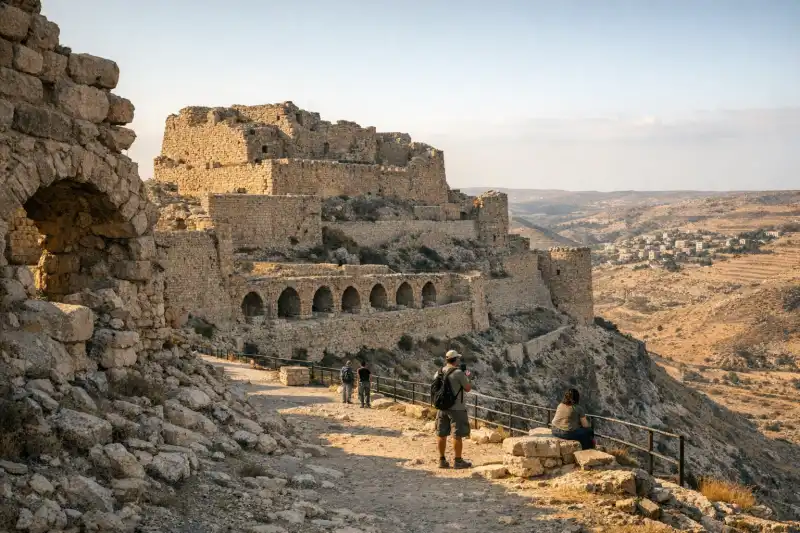
Crusader, Ayyubid, Mamluk, OttomanA vast Crusader fortress in Jordan, Kerak Castle crowns a hilltop with tunnels, towers, and sweeping...
Dana Village
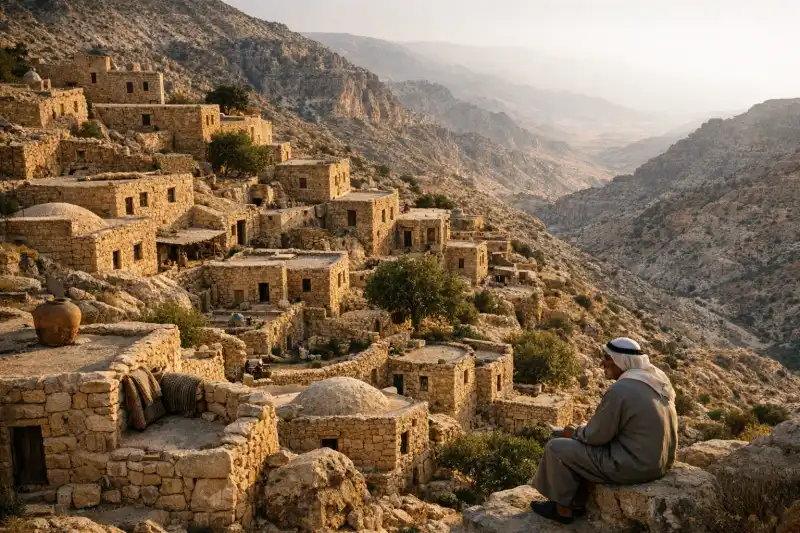
Nabataean, Ottoman, and local Jordanian highland communitiesA timeless stone village in Jordan overlooking Dana Biosphere Reserve, famed for mountain views, tra...
Beidha
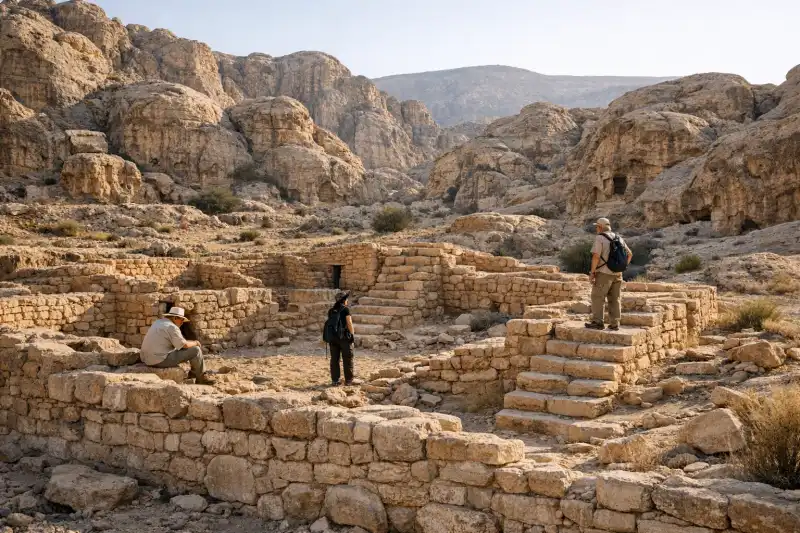
Pre-Pottery Neolithic communities of the southern LevantExplore Beidha, a remarkable Neolithic village near Petra in Jordan, known for early farming, stone ...