Quick Info
At a glance
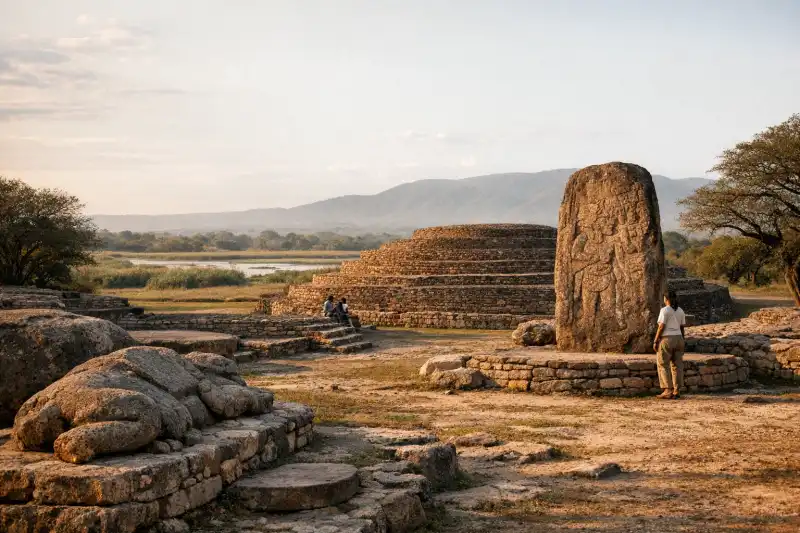
Tamtoc in Mexico feels less like a single ruin and more like an ancient landscape slowly revealing its shape. In the humid lowlands of San Luis Potosí, where rivers and fertile plains helped support dense communities for centuries, the site opens out into broad grassy spaces, low rises, and ceremonial platforms that can seem modest at first glance. Yet that first impression changes quickly. The scale of the plazas, the arrangement of mounds, and the surviving sculptures suggest a place that once held deep regional importance in the Huastec world. Unlike stone-built hilltop cities that impress through height and fortification, Tamtoc draws visitors in through layout, symbolism, and a strong sense of continuity between settlement, ritual, and environment.
Part of what makes Tamtoc memorable is its setting. The Huasteca is green, warm, and often lush, and the site’s earthen architecture appears rooted in that landscape rather than imposed on it. Archaeology here tells a story of long occupation, ceremonial life, elite power, and sophisticated local traditions that developed alongside wider Mesoamerican exchanges. Tamtoc is also one of those places that rewards patience. Its meaning emerges not through a single monumental pyramid but through plazas, sculpted stones, residential sectors, and the careful geometry of sacred space. For travelers interested in ancient Mexico beyond the best-known Maya and Aztec destinations, Tamtoc offers a quieter but deeply compelling encounter with a major regional center.
History
Early settlement and the rise of a regional center
The story of Tamtoc begins well before its most visible ceremonial phase. Archaeological research indicates that the area was occupied from at least the Late Formative period, likely around the first millennium BCE, when communities in the Huasteca were already taking advantage of rich agricultural land and riverine resources. The region’s environment supported maize cultivation, fishing, and trade, helping small settlements grow into more organized centers.
Over time, Tamtoc developed from a local community into a significant ceremonial and political center. Its growth was not based on the dramatic limestone architecture associated with the Maya lowlands, but on earthen platforms, carefully planned plazas, and elevated zones used for ritual and elite occupation. This adaptation reflects the local environment as well as a cultural tradition distinctively Huastec. The Huastec peoples, speakers of a Mayan-related language but long established in northeastern Mexico, developed their own artistic and social forms. Tamtoc appears to have been one of the important nodes in that world.
By the late first millennium CE, the site had acquired increasing complexity. Distinct sectors suggest a social hierarchy, while ceremonial architecture points to organized public ritual. The city’s layout was likely tied to cosmology, seasonal observance, and elite authority. Even where buildings survive only as mounds, the overall arrangement indicates deliberate urban planning.
Flourishing in the Classic and Postclassic eras
Tamtoc seems to have reached its greatest prominence during the Classic and especially the Postclassic periods, when the Huasteca was home to prosperous communities linked by exchange networks stretching across Mesoamerica. Goods, ideas, and styles moved widely in this era, and Huastec centers such as Tamtoc participated in broader cultural currents without losing their regional identity.
This was the period in which many of the site’s visible ceremonial spaces were formalized. Large open plazas created settings for gatherings, rituals, and perhaps markets or political display. Elevated structures likely supported temples, elite residences, or spaces associated with lineage authority. Sculptural finds from Tamtoc have been especially important to scholars because they illuminate local beliefs and the symbolic roles of gender, fertility, and rulership.
Some interpretations of the site emphasize the unusual prominence of female-associated iconography and burials. Although debate continues over the exact meaning of this evidence, Tamtoc has become notable for suggesting that women may have held especially visible ritual or social importance in its local context. That possibility has helped distinguish the site in discussions of ancient Mexican societies, where male rulers often dominate historical narratives.
The site’s prosperity was supported by its position in a productive and connected landscape. Rather than standing in isolation, Tamtoc was part of a network of settlements and ceremonial places across the Huasteca. It likely managed agricultural production, local exchange, and religious authority over a surrounding population.
Decline, transformation, and rediscovery
Like many Mesoamerican centers, Tamtoc did not simply vanish in a single dramatic collapse. Its importance appears to have changed over time as political networks shifted and new pressures emerged in the late pre-Hispanic period. By the time of the Spanish invasion in the 16th century, the broader Huasteca had already experienced cycles of conflict, migration, and reorganization. Some centers declined while others adapted.
Spanish colonization profoundly disrupted indigenous life across the region. Population loss from disease, forced labor, and social upheaval affected ancient settlements and severed traditions tied to ceremonial landscapes. Tamtoc’s monumental core gradually became part of the rural environment, its mounds and carved stones absorbed into pasture and agricultural land.
Modern archaeological attention brought the site back into focus. Surveys, excavations, and conservation work revealed the extent of its ceremonial plan and helped identify it as one of the most significant Huastec archaeological zones in Mexico. Discoveries of sculpted monuments, burials, and carefully arranged architectural sectors transformed Tamtoc from a little-known ruin into a key site for understanding the cultural history of the Huasteca.
Today, Tamtoc stands not only as a destination for visitors but also as an important research site. It reminds us that ancient Mexico was never defined by just a handful of famous empires. Regional societies such as the Huastec produced cities, ritual spaces, and artistic traditions of their own, and Tamtoc is among the clearest surviving expressions of that heritage.
Key Features
What visitors notice first at Tamtoc is space. The site is organized around broad open plazas framed by low platforms and mounds, giving it a ceremonial clarity that becomes more impressive the longer you walk through it. Because much of the architecture was built in earth rather than tall masonry, the effect is subtle but powerful. The raised forms shape movement and perspective, creating an environment where ritual processions and public gatherings would once have been highly visible. Instead of being overwhelmed by a single massive temple, you begin to understand the site through relationships between structures.
One of Tamtoc’s defining features is its monumental plaza system. These open areas likely functioned as stages for ceremonies, assemblies, and displays of authority. Their scale suggests that the site drew participants from a wider territory, not just local residents. Walking across them today, especially in the early morning or late afternoon light, gives a strong sense of how collective ritual may have worked here. The site’s openness also makes it easier to appreciate its planning. The mounds are positioned with clear intention, creating axes, boundaries, and elevated focal points.
Another major feature is the group of earthen and stone-supported platforms associated with elite or ceremonial use. Some structures probably held temples made with perishable materials, while others may have served as residences for high-status individuals or ritual specialists. Although the superstructures have not survived, the platforms themselves help define the site’s hierarchy. Elevated space in Mesoamerica was rarely neutral; height signaled access, control, and sacred distinction. At Tamtoc, these raised sectors suggest a community in which status and ceremony were tightly connected.
The sculptural record makes the site especially important. Tamtoc is known for carved monuments and figurative pieces that provide insight into Huastec iconography. Some sculptures are associated with human figures, while others carry symbolic or possibly calendrical significance. These finds give the site a richer interpretive texture than the surviving architecture alone might suggest. They also show that Tamtoc was not merely a provincial settlement but a center capable of commissioning and displaying meaningful ritual art.
Archaeologists have also identified residential and burial areas that help flesh out daily life and social organization. Burials discovered at the site have contributed to discussions of lineage, ceremonial status, and gender roles. In particular, evidence interpreted as pointing to the prominence of women in ritual or elite contexts has drawn significant scholarly interest. This does not mean every question has been answered, but it does make Tamtoc stand out among ancient Mexican sites as a place where social complexity may have been organized in ways not fully mirrored elsewhere.
The surrounding landscape is itself a feature of the visit. Tamtoc was built within a fertile, water-rich environment, and that ecological context mattered. Ancient planners chose a place where agriculture, movement, and ceremonial visibility could reinforce one another. The lowland setting helps explain the site’s form: broad platforms instead of steep pyramids, integrated settlement rather than isolated monumentality. For modern visitors, this creates a different kind of archaeological experience. The site feels woven into the land, and understanding it means paying attention not only to mounds and artifacts but also to terrain, vegetation, and the quiet expanse between structures.
Getting There
Tamtoc is usually visited from Ciudad Valles, the main transport hub of the Huasteca Potosina, or from the town of Tamuín, which lies much closer to the site. If you are arriving from Mexico City, the easiest option is to fly to San Luis Potosí city and continue by rental car or intercity bus, though many travelers headed for the Huasteca come by long-distance bus directly to Ciudad Valles. Bus fares from San Luis Potosí city to Ciudad Valles commonly range from about MXN 300 to 550 depending on the operator and class of service, with journeys often taking around 4 to 5 hours.
From Ciudad Valles to Tamuín, regional buses or colectivos are generally affordable, often around MXN 50 to 100 one way. From Tamuín, local taxi service to Tamtoc is the most practical final leg; expect roughly MXN 150 to 300 each way depending on distance, waiting time, and negotiation. If you want flexibility, renting a car is often the best choice in this region, especially if you plan to combine Tamtoc with waterfalls, rivers, or other Huasteca attractions.
Organized tours focused specifically on Tamtoc are less common than nature excursions in the Huasteca, so independent travel is often simpler. Roads in the region are generally manageable, but signage may be limited, so offline maps are helpful. Bring water, sun protection, and cash for small local expenses. If you rely on public transport, plan your return carefully, since frequencies can be limited outside major routes.
When to Visit
The best time to visit Tamtoc is usually during the drier and slightly cooler months from November to March. During this period, temperatures are more comfortable for walking open archaeological grounds, and humidity is often lower than in late spring or summer. Morning visits are especially pleasant, with softer light and less heat radiating from the earthworks and pathways.
April and May can be very hot in the Huasteca. If you travel then, arrive as early as possible and carry more water than you think you will need. The site has broad exposed areas, so shade may be limited in some sections. Summer and early autumn bring greener landscapes and dramatic skies, but they also coincide with the rainy season. Heavy showers can make travel slower and the ground muddier, even if the scenery is at its most lush.
For photography, the shoulder months can be excellent. The grass is often greener than in the driest part of the year, while weather remains relatively manageable. Cultural travelers may also want to coordinate a visit with festivals in nearby Huasteca communities, though Tamtoc itself is best appreciated when you have time for a calm, unhurried walk.
Weekdays are preferable if you want a quieter atmosphere. Even when visitor numbers are low, arriving early helps you avoid midday heat and gives the site a more contemplative mood. Because Tamtoc’s appeal lies partly in its landscape and spatial organization, the gentler light of morning or late afternoon makes a real difference.
| Quick Facts | |
|---|---|
| Location | Near Tamuín, San Luis Potosí, Mexico |
| Cultural affiliation | Huastec |
| Time period | Late Formative to Postclassic |
| Best base | Ciudad Valles or Tamuín |
| Typical visit length | 2–4 hours |
| Best season | November to March |
| Main highlights | Ceremonial plazas, earthen mounds, sculpture, Huastec heritage |
| Travel style | Best reached by car, taxi, or regional transport |
Guided tours: worth it?
Most travelers can visit Tamtoc independently. Compare a tour only if you want a tighter history-focused visit, easier logistics, or a guide who can answer questions on the spot.
Best for
- Short visits where a planned route saves time
When to go self-guided
Go independently if you prefer setting your own pace, reading as you go, and checking official hours or ticket rules directly before you arrive.
What I’d avoid
Skip paid tours that bundle unrelated stops you do not actually want. The best option should either save meaningful planning time or add historical context you would miss on your own.
Huasteca Potosina Archaeology Tours
Useful when: you want to compare guided formats before deciding
San Luis Potosi Cultural Day Trips
Useful when: transport or pickup logistics matter
Ciudad Valles and Huasteca Region Tours
Useful when: you want to compare guided formats before deciding
Some tour links are affiliate links, which may earn Ancient Travel a small commission at no extra cost to you. I try to surface options that make practical sense for the site—not just anything bookable.
Frequently Asked Questions
What is Tamtoc?
Tamtoc is a major Huastec archaeological site in San Luis Potosi, Mexico, known for its ceremonial plazas, earthen mounds, sculpted monuments, and evidence of long occupation.
Where is Tamtoc located?
Tamtoc is located in the Huasteca region of eastern San Luis Potosi, near Ciudad Valles and Tamuin, in northeastern Mexico.
How much time do you need to visit Tamtoc?
Most visitors spend 2 to 4 hours exploring the site and its museum areas, though archaeology enthusiasts may want a longer half-day visit.
Is Tamtoc suitable for a day trip?
Yes. Tamtoc is often visited as a day trip from Ciudad Valles or nearby towns in the Huasteca Potosina region.
What makes Tamtoc important?
Tamtoc is important for understanding the Huastec world, including urban planning, ritual spaces, elite residences, sculpture, and the role of women in ceremonial life suggested by several finds.
Do you need a guide at Tamtoc?
A guide is not always essential, but hiring one can greatly improve the visit by explaining the site’s chronology, architecture, and symbolism.
Nearby Ancient Sites
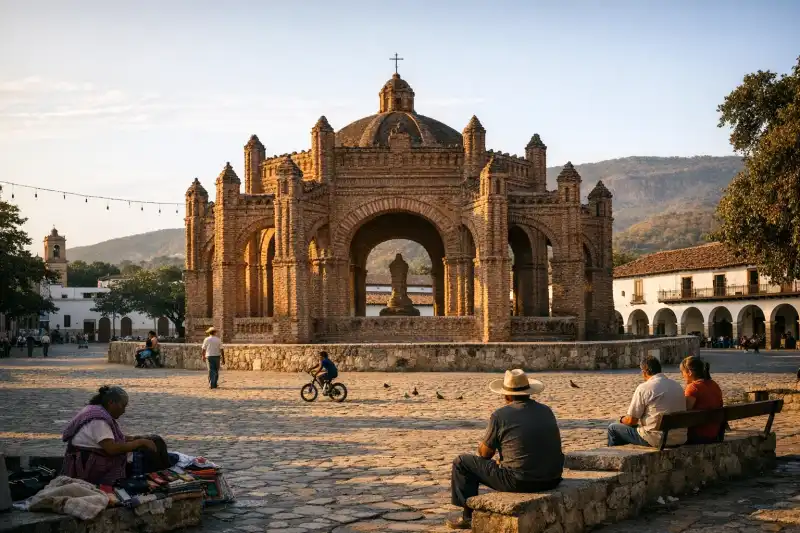
Chiapa de Corzo
Zoque and earlier Mesoamerican culturesExplore Chiapa de Corzo, Mexico, a major early Mesoamerican site beside the Grijalva River in Chiapa...
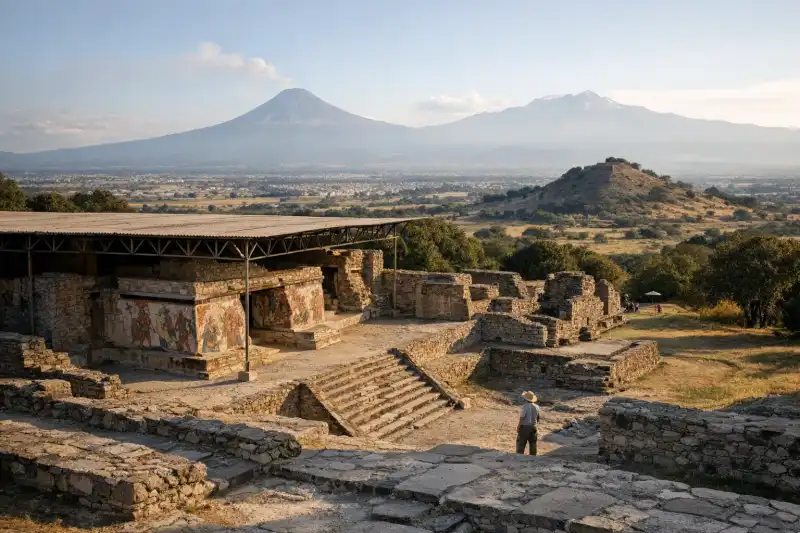
Cacaxtla
Olmeca-Xicalanca and broader Epiclassic Mesoamerican traditionsExplore Cacaxtla in Mexico, a hilltop archaeological site famed for vivid murals and Epiclassic hist...
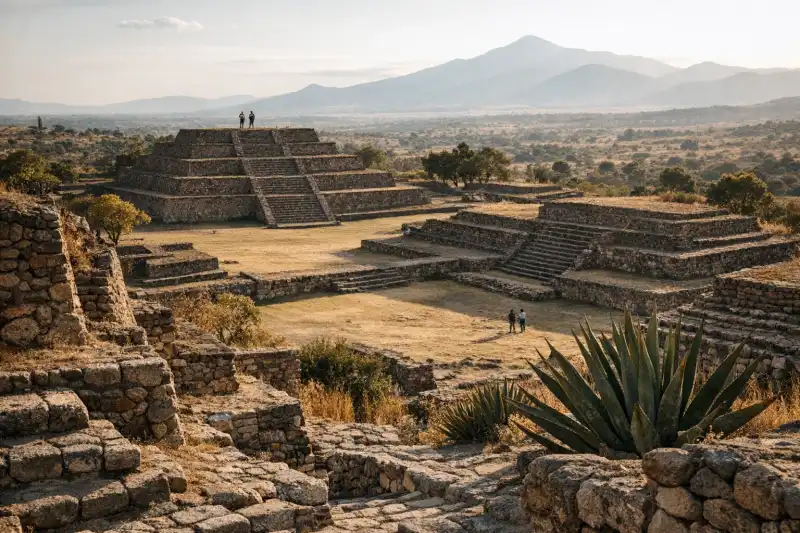
Cantona
MesoamericanExplore Cantona, a vast fortified archaeological city in Puebla, Mexico, known for its stone roads, ...