Quick Info
At a glance
Tingambato, Mexico, sits quietly among the highlands of Michoacán, far from the crowds that gather at the country’s better-known ruins. For travelers who enjoy ancient places with a sense of discovery, this compact archaeological zone offers something special: broad grassy plazas, low pyramidal platforms, and a setting that feels deeply tied to the volcanic landscape of western Mesoamerica. Unlike monumental sites that overwhelm with scale, Tingambato invites a slower kind of visit, one where the value lies in subtle details, in the shape of its ceremonial center, and in the clues it offers about societies that flourished here long before the rise of the Purépecha state for which Michoacán later became famous.
The site is especially compelling because it stands at a crossroads of cultures. Archaeologists have long noted signs that Tingambato participated in networks extending beyond its immediate region, with architectural and ceremonial features that suggest contact with broader Mesoamerican traditions. That makes a visit more than a local excursion: it becomes a way to understand how western Mexico fit into the ancient world of trade, ritual, and political exchange. Surrounded by farmland and forested uplands, Tingambato feels approachable and reflective. It is the kind of destination where the wind over the grass, the geometry of old plazas, and the quiet of the landscape combine to create a memorable encounter with Mexico’s ancient past.
History
Early settlement and regional beginnings
The area around Tingambato was occupied long before the site emerged as a formal ceremonial center. Michoacán’s fertile valleys, temperate climate, and access to obsidian, agricultural land, and mountain resources made it attractive for early communities. By the late Formative period, villages in western Mexico were already participating in changing social and economic systems, and Tingambato appears to have grown from this wider regional foundation.
Its location was important. The settlement stood in a part of central-western Mexico that connected highland and lowland routes, allowing the movement of goods, ideas, and people. This strategic setting likely helped Tingambato develop beyond a simple farming community. Over time, local leaders seem to have organized labor for public construction, marking the transition toward a ceremonial and political center. The site we see today reflects this shift: planned open spaces, elevated platforms, and architectural order indicate a community with hierarchy, ritual obligations, and enough stability to reshape the landscape.
Growth during the Classic period
Tingambato reached its greatest prominence during the Classic period, roughly between the 3rd and 8th centuries CE. This was an era when many parts of Mesoamerica saw expanding cities, stronger regional identities, and more visible long-distance interaction. At Tingambato, the ceremonial core took shape with plazas, stepped constructions, and a ballcourt, all of which point to a community integrated into broader Mesoamerican patterns of public life.
One of the most discussed aspects of the site is its apparent connection to Teotihuacan, the great metropolis of central Mexico. Archaeologists have identified materials and stylistic elements that suggest some level of influence or contact. This does not necessarily mean Tingambato was controlled by Teotihuacan, but it indicates that people here were not isolated. They participated in exchange networks and perhaps adopted certain ceremonial ideas, architectural forms, or symbols associated with one of the most powerful urban centers of the era.
That possibility gives Tingambato unusual significance in western Mexico. While many travelers associate Mesoamerican archaeology with central and southern regions, Tingambato demonstrates that Michoacán too was part of these major currents. Its public architecture shows a society capable of incorporating outside influences while remaining rooted in local traditions. This combination of regional character and wider connectivity is one of the reasons the site matters so much to researchers.
Ritual life, public space, and power
Like many ancient centers, Tingambato was not simply a place of residence. It was a stage for ritual, authority, and social gathering. The arrangement of plazas and ceremonial buildings suggests controlled public movement, with open areas for assemblies and raised spaces that likely elevated elite or sacred activities above ordinary ground level. The presence of a ballcourt is especially important. Across Mesoamerica, the ballgame was more than sport: it was linked to status, diplomacy, myth, and ritual performance. Its inclusion at Tingambato indicates participation in a shared sacred and political tradition.
Burials found in the area have also contributed to understanding the site. Grave goods and funerary patterns reveal differences in status and point to the existence of local elites. Such evidence suggests that authority here was organized and visible, even if Tingambato never reached the monumental scale of larger urban centers. Power may have rested in a combination of political leadership, ritual specialists, and control over exchange routes or agricultural production.
Decline, abandonment, and rediscovery
Like many ancient sites, Tingambato eventually declined. The reasons are not fully understood, but changing trade systems, environmental pressures, shifting political alliances, or transformations in regional population patterns may all have played a role. By around the end of the Classic period, the ceremonial center seems to have lost importance. New powers and new cultural formations would later define Michoacán, especially the Purépecha state that flourished centuries afterward, but Tingambato belonged to an earlier chapter.
After abandonment, the structures gradually blended into the landscape. Earth, vegetation, and local memory covered much of the old center until archaeological work began revealing its layout and significance. Modern excavation and conservation have made the site accessible while preserving its modest, open-air character. Today, Tingambato is less famous than many Mexican ruins, but that relative obscurity is part of its appeal. It remains a place where archaeology still feels intimate, and where the traces of ancient western Mexico can be appreciated without distraction.
Key Features
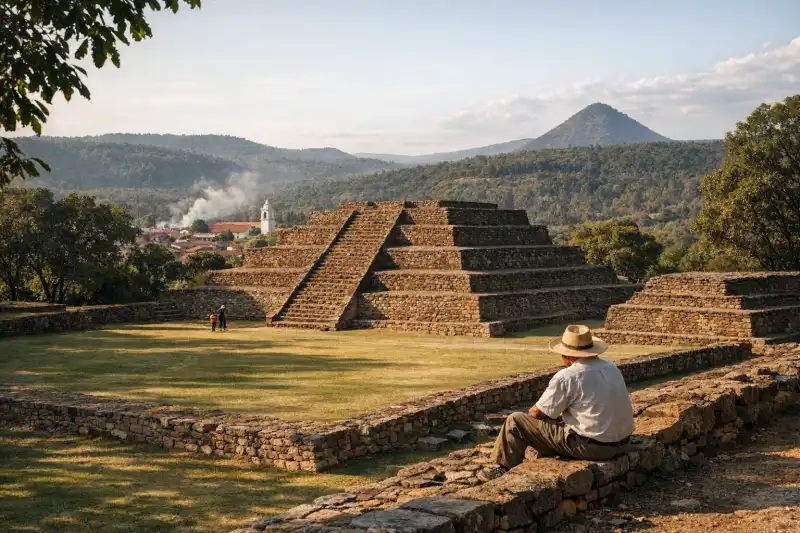
The first thing many visitors notice at Tingambato is the clarity of its plan. Even though the surviving architecture is not towering, the site reads well on the ground. Broad open plazas create a sense of ceremonial order, and the raised mounds and platforms around them define a public center designed for processions, gatherings, and ritual display. The grassy expanses make it easy to imagine movement through the space: participants entering a plaza, spectators watching events, and leaders ascending structures that marked sacred or political importance.
The principal pyramid is one of the site’s most visually recognizable elements. It does not dominate the horizon in the way of Mexico’s largest temples, but its form is enough to establish hierarchy within the complex. From its base, visitors can understand how elevation mattered in ancient ceremonial settings. Height was symbolic as well as practical, separating the world of public ritual from everyday ground level. The structure’s surviving lines also reveal how carefully planned these buildings were, even in a site often described as understated.
Another standout feature is the ballcourt. For travelers interested in Mesoamerican culture, this is one of Tingambato’s most meaningful elements because it links the site to a tradition found across much of ancient Mexico and Central America. The ballgame carried social and religious significance, and its presence here suggests that Tingambato was fully engaged in the ceremonial life of the wider region. Standing beside the court, it is easy to reflect on how games in the ancient world could be tied to cosmology, elite competition, and community identity.
The layout as a whole offers insight into social organization. Unlike ruins that survive mainly as scattered foundations, Tingambato preserves enough spatial structure to show intentional planning. The arrangement of plazas, structures, and circulation routes indicates a community that invested in public architecture and in the symbolic use of space. This kind of design matters because it tells us how ancient leaders shaped experience. Visitors were not meant to wander randomly; they were guided into specific areas where authority, ritual, and social order could be displayed.
Tingambato is also notable for what it lacks: overwhelming commercialization and heavy crowds. That absence becomes a feature in itself. The quieter atmosphere lets visitors pay closer attention to the site’s environmental context. The surrounding highlands, cultivated fields, and broad skies help explain why ancient communities chose this region. There is a strong relationship between the archaeological remains and the natural setting. The site does not feel detached from the land that sustained it.
Interpretive value is another strength. Because the site is compact, travelers can grasp its essential features without exhaustion or confusion. This makes Tingambato especially rewarding for those who enjoy learning how archaeologists reconstruct urban and ceremonial life from earthworks, masonry, and spatial arrangement. Subtle details become legible here: the edges of platforms, the dimensions of plazas, and the balance between open and elevated spaces. Rather than dazzling through scale, Tingambato rewards careful observation.
Finally, the site’s significance lies in its regional rarity. Michoacán is better known historically for later Purépecha heritage than for Classic-period ceremonial centers, so Tingambato fills an important gap in the story of western Mexico. It shows that this region was not peripheral but part of ancient networks of influence and exchange. For visitors, that historical depth gives every structure greater meaning. What may seem at first like a modest archaeological park becomes, with attention, a crucial window into the cultural diversity of pre-Hispanic Mexico.
Getting There
Tingambato is most easily reached by road, and the usual gateway is Uruapan, the nearest major city for travelers. From central Uruapan, the drive typically takes around 35 to 50 minutes, depending on traffic and your exact starting point. A taxi or ride-hailing trip can cost roughly MXN 350 to 700 one way, so this is convenient but not the cheapest option. If you want flexibility for exploring the area at your own pace, renting a car in Uruapan or Morelia is usually the best choice.
From Morelia, the state capital, the journey is longer but still manageable as a day trip. Expect about 2 to 2.5 hours by car. Rental car rates vary widely, but a basic daily rental often starts around MXN 700 to 1,400 before fuel and insurance. Organized private drivers may charge more, though they can make sense if you prefer not to navigate rural roads yourself.
Public transportation is possible, though less straightforward. Buses and colectivos run between regional towns in Michoacán, and you may be able to travel first to Uruapan and then onward toward Tingambato or nearby communities. Intercity bus fares from Morelia to Uruapan are often around MXN 180 to 350, depending on the class of service. From there, local transport is cheaper but requires patience and some Spanish. Because schedules can change, it is wise to confirm the latest options locally.
If you are coming from farther away, the nearest practical air connections are usually through Morelia or other larger cities in central Mexico, followed by overland travel. Most visitors find that combining Tingambato with Uruapan or a wider Michoacán itinerary makes the trip far more convenient.
When to Visit
The best time to visit Tingambato is generally during the dry season, from about November through April. During these months, the weather in Michoacán is often mild and pleasant, with clearer skies and more comfortable walking conditions. The site’s open plazas and exposed paths are easier to enjoy when the ground is dry, and photography tends to be better in the sharper seasonal light. Morning visits are especially rewarding, as temperatures are cooler and the site feels peaceful.
The warmer late spring period, especially April and May, can still be a good time to go, but midday heat may be stronger. In open archaeological zones like Tingambato, shade can be limited, so carrying water, sunscreen, and a hat is important. Early arrival helps you avoid the hottest hours and gives you more time to appreciate the site before the day becomes bright and harsh.
The rainy season, typically from June through October, brings greener landscapes and can make the surroundings look particularly lush. This can be beautiful, but travelers should be prepared for muddy ground, occasional downpours, and cloudier conditions. Rain rarely makes a visit impossible, yet it can reduce comfort and limit the time you want to spend outdoors. If you travel in this season, flexible planning is useful.
Weekdays are often preferable if you want a quieter experience, though even weekends tend to be calmer here than at Mexico’s major archaeological attractions. If your interest is historical atmosphere rather than festival crowds or tourism infrastructure, Tingambato is rewarding year-round. The key is simply to match your timing to your comfort with sun or rain and to allow enough time for an unhurried visit.
| Quick Facts | Details |
|---|---|
| Location | Tingambato, Michoacán, Mexico |
| Nearest major city | Uruapan |
| Region | Central-western highlands of Michoacán |
| Cultural period | Primarily Classic period |
| Known for | Ceremonial plazas, pyramidal structures, and a ballcourt |
| Historical significance | Important evidence of pre-Hispanic western Mexico and wider Mesoamerican connections |
| Typical visit length | 1-2 hours |
| Best season | Dry season, November to April |
| Access | Best reached by car or taxi from Uruapan |
| Ideal for | Archaeology enthusiasts, independent travelers, and visitors exploring lesser-known sites in Mexico |
Guided tours: worth it?
Most travelers can visit Tingambato independently. Compare a tour only if you want a tighter history-focused visit, easier logistics, or a guide who can answer questions on the spot.
Best for
- Short visits where a planned route saves time
When to go self-guided
Go independently if you prefer setting your own pace, reading as you go, and checking official hours or ticket rules directly before you arrive.
What I’d avoid
Skip paid tours that bundle unrelated stops you do not actually want. The best option should either save meaningful planning time or add historical context you would miss on your own.
Michoacán archaeology and culture tours
Useful when: you want to compare guided formats before deciding
Uruapan day tours
Useful when: you want to compare guided formats before deciding
Morelia historical tours
Useful when: you want to compare guided formats before deciding
Some tour links are affiliate links, which may earn Ancient Travel a small commission at no extra cost to you. I try to surface options that make practical sense for the site—not just anything bookable.
Frequently Asked Questions
What is Tingambato?
Tingambato is a pre-Hispanic archaeological site in the state of Michoacán, Mexico, known for its ceremonial architecture, plazas, and evidence of long-distance cultural connections.
Where is Tingambato located?
Tingambato is located in central-western Mexico in Michoacán, not far from Uruapan and within reach of Morelia by road.
How much time do you need to visit Tingambato?
Most visitors can see the site in 1 to 2 hours, though archaeology enthusiasts may want longer to explore the layout and read interpretive signage.
Is Tingambato suitable as a day trip?
Yes. Tingambato is commonly visited as a day trip from Uruapan and can also be combined with other destinations in Michoacán.
What makes Tingambato important?
Tingambato is important because it preserves a rare ceremonial center in western Mexico and shows possible connections with wider Mesoamerican traditions, including Teotihuacan influence.
Do you need a guide at Tingambato?
A guide is not always required, but having one can help you understand the chronology, architectural features, and the site's role within regional trade and ritual networks.
Nearby Ancient Sites
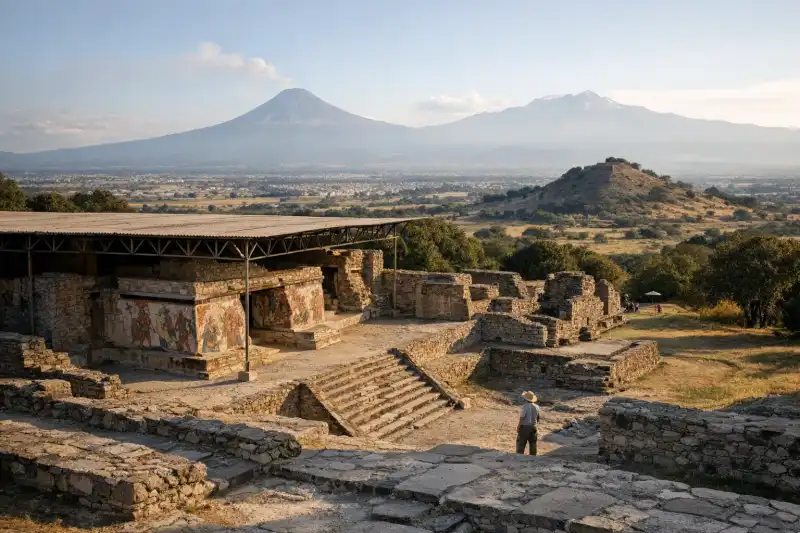
Cacaxtla
Olmeca-Xicalanca and broader Epiclassic Mesoamerican traditionsExplore Cacaxtla in Mexico, a hilltop archaeological site famed for vivid murals and Epiclassic hist...
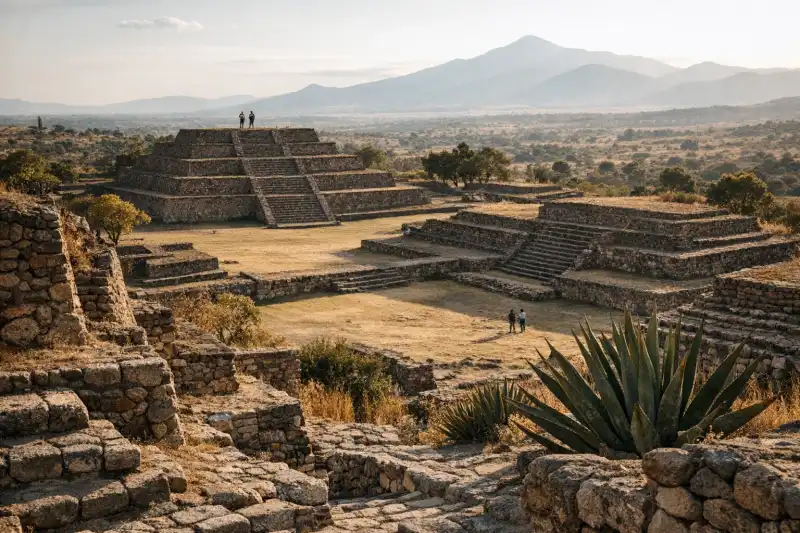
Cantona
MesoamericanExplore Cantona, a vast fortified archaeological city in Puebla, Mexico, known for its stone roads, ...
Chiapa de Corzo
Zoque and earlier Mesoamerican culturesExplore Chiapa de Corzo, Mexico, a major early Mesoamerican site beside the Grijalva River in Chiapa...