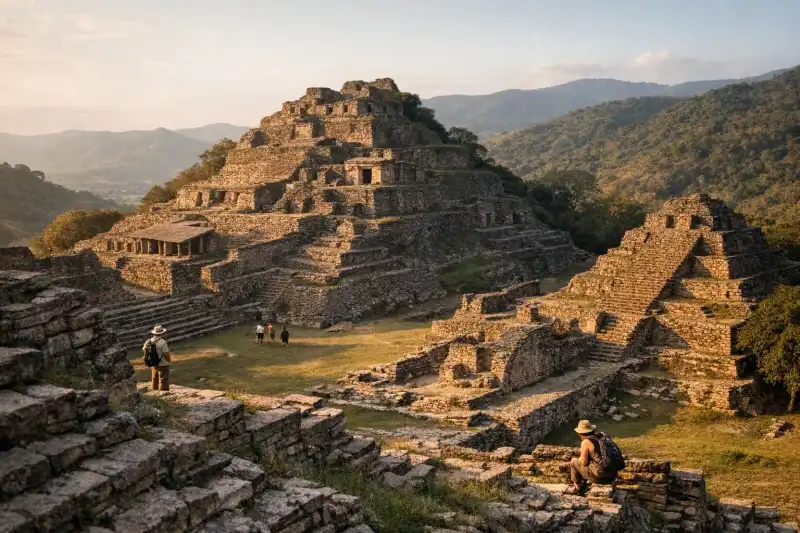
Quick Info
At a glance
Tonina in Mexico feels less like a ruin spread across a plain and more like a stone mountain shaped by royal ambition. Rising above the Ocosingo Valley in Chiapas, this ancient Maya city delivers one of the most dramatic first impressions in Mesoamerica: terraces stacked skyward, sculpted monuments half-emerging from grass and shade, and long stairways that pull your eye toward the summit. It is a place where geography and power worked together. Unlike the broad ceremonial layouts of many Maya centers, Tonina was built vertically, using a hillside to create a formidable acropolis that still dominates the landscape.
For travelers, that unusual design is part of the site’s enduring magic. You do not simply walk through Tonina; you ascend it, discovering plazas, temples, retaining walls, and carved stones in stages. Each level opens a new perspective over the valley and a deeper sense of how carefully the city was planned. The atmosphere is quieter than at some of Mexico’s best-known archaeological zones, which makes the experience feel more immediate. Birds cut across the terraces, clouds drift over the green hills, and the carved faces of rulers and captives seem to watch from another age. Tonina rewards both the casual visitor looking for a memorable day trip and the history-minded traveler eager to understand one of the Maya world’s most militarized and visually striking urban centers.
History
Early foundations and regional setting
Tonina developed in what is now the Mexican state of Chiapas, in a fertile valley that linked the highlands and lowlands of the broader Maya world. Its setting helped it grow into a strategic city, positioned to control movement, agricultural production, and political influence. Archaeological evidence suggests occupation in the area before the city’s major florescence, but Tonina’s most visible and consequential development took place during the Classic period, especially from the 6th to the 9th centuries CE.
The city’s builders transformed a natural hill into an engineered ceremonial and political complex. Rather than creating a city organized chiefly across a broad horizontal expanse, they carved, filled, and terraced the slope into a monumental acropolis. This made Tonina distinct even within the highly varied architectural traditions of the Maya. The result was not only visually impressive but symbolically potent: rulership literally elevated above the valley, framed by temples and public spaces that communicated dominance.
The rise of a military power
By the Late Classic period, Tonina had become a major regional force. Inscriptions recovered from monuments and carved sculptures show that it was deeply involved in warfare and dynastic competition. The site is especially noted for its martial imagery and references to victories over rival polities. This is one of the reasons Tonina often stands out in Maya studies: while many major cities projected sacred kingship, Tonina’s monuments make military power unusually explicit.
One of its most famous historical moments concerns its rivalry with Palenque, another great Maya center in Chiapas. Textual evidence indicates that Tonina captured a ruler of Palenque in the late 7th century, a major political statement in the highly competitive landscape of Classic Maya kingdoms. Such victories were not just battlefield achievements; they were ritualized events that reinforced legitimacy, celebrated royal power, and broadcast the city’s prestige to allies and enemies alike.
The rulers of Tonina sponsored the carving of stelae, panels, altars, and sculptures that tied military success to cosmic order. Captives, bound figures, and elaborate royal portraits all played a role in this messaging. Through architecture and inscription alike, the city represented itself as disciplined, powerful, and divinely sanctioned.
Monumental building and dynastic identity
As Tonina’s political importance grew, so did the scale of construction. The acropolis became a multi-level complex of temples, palaces, stairways, and plazas extending upward in dramatic succession. This building program likely unfolded over generations, with each ruler adding new structures, monuments, and ritual settings. The process was cumulative: later construction incorporated and reframed earlier sacred spaces, linking current power to ancestral authority.
Tonina also became known for rich sculptural production. Its monuments display some of the most vigorous stone carving in the Maya region, with energetic forms, layered symbolism, and dense hieroglyphic content. These works preserve royal names, dates, warfare narratives, and calendrical references. Together they allow archaeologists to reconstruct part of the city’s dynastic sequence and political history.
The city’s identity was expressed not only through public monuments but through its careful manipulation of topography. The ascent through Tonina was almost certainly ceremonial as well as practical. Movement upward may have reflected a symbolic journey through sacred space, with rulers occupying the highest and most restricted levels, literally above common activity and closer to the heavens.
Decline and rediscovery
Like many Maya centers, Tonina underwent change and eventual decline toward the end of the Classic era. Yet it appears to have remained active comparatively late, with evidence suggesting continuity into the Terminal Classic and perhaps beyond in some form. This has made Tonina important in discussions of how different Maya cities responded unevenly to the broader transformations often grouped under the label of “collapse.”
Its decline likely involved a combination of shifting trade patterns, political fragmentation, environmental pressures, and changing regional alliances. The exact sequence remains a subject of study, but by the time of the Spanish colonial era, the city had long ceased to function as an urban and dynastic capital.
Modern archaeological work has gradually brought Tonina back into view. Excavations, conservation, and monument study have revealed a site of exceptional significance, though one that remains less famous internationally than Chichen Itza or Palenque. That relative obscurity is part of its appeal today. Tonina still feels like a place of discovery, where the scale of the architecture and the intensity of its history surprise many first-time visitors.
Key Features
The first and most unforgettable feature of Tonina is its verticality. The acropolis climbs in a series of vast terraces, giving the site an almost fortress-like silhouette. From below, the stacked platforms appear to rise in layers toward the sky; from above, they frame expansive views over the Ocosingo Valley. This arrangement changes the rhythm of a visit. Instead of circling a central pyramid from flat ground, you move through levels of increasing elevation, each with a different relationship to light, breeze, and surrounding hills. The climb itself becomes part of the interpretation, helping visitors understand how architecture projected authority.
The terraces are not simply retaining walls supporting a summit temple. They contain a complex arrangement of ceremonial spaces, stairways, rooms, plazas, and structures integrated into the hillside. This makes Tonina feel architecturally dense. You can sense that every portion of the hill was carefully shaped to serve religious, administrative, and political functions. Some spaces are broad and open, designed for public display, while others feel more controlled and processional. The transitions between them create a powerful sense of movement through a planned sacred landscape.
Another major attraction is the site’s sculptural program. Tonina is renowned for carved monuments that include stelae, altars, captives, and richly detailed reliefs. Even when weathered, many retain remarkable force. Human figures are rendered with muscular energy, elaborate headdresses, and formal postures that communicate ritual and rank. Captive imagery in particular underscores the city’s warlike reputation. For visitors, these carvings provide a more intimate encounter with Tonina’s rulers than architecture alone can offer. They transform the city from an abstract ruin into a place populated by named kings, defeated enemies, and ceremonial actors.
Tonina’s ballcourt is also significant. As in many Maya cities, the ballgame carried ritual, political, and symbolic meaning far beyond sport. At Tonina, the court forms part of the larger ceremonial ensemble and helps demonstrate that the city participated in shared Maya institutions while expressing them in its own distinct architectural setting. The ballcourt also offers a useful contrast to the acropolis, reminding visitors that urban life here included public performance and structured communal ritual, not only elite display on the heights.
The site museum adds an important layer to the experience. While the ruins themselves deliver the emotional impact, the museum helps explain what visitors are seeing. Sculptures, fragments, and interpretive displays illuminate the iconography and chronology of the city. For anyone unfamiliar with Maya epigraphy or political history, stopping at the museum before or after climbing the acropolis can make the monuments in the field far easier to appreciate. It is especially helpful in understanding how inscriptions record rulers, dates, and military events.
One of Tonina’s subtler features is its setting within living rural Chiapas. Green hills, mist, birdsong, and cultivated land surround the ruins, so the site never feels detached from landscape. This matters because Maya cities were never isolated monuments; they were embedded in productive environments and regional networks. At Tonina, the valley context remains visible, helping modern visitors imagine the agricultural base and strategic value that supported the city’s power.
Finally, there is the atmosphere. Tonina is often less crowded than Mexico’s most famous archaeological zones, which allows for a more reflective visit. The terraces can feel almost theatrical in changing weather: brilliant in morning sun, moody under cloud, and especially vivid when the green vegetation contrasts with pale stone. For photographers, historians, and travelers simply looking for a memorable site in Chiapas, this combination of scale, artistry, and relative calm is hard to match.
Getting There
Tonina is located near Ocosingo in Chiapas, and most visitors reach it by road. The nearest practical base is Ocosingo, about 10 to 15 kilometers away depending on your route. From Ocosingo, a taxi to the archaeological zone is usually the easiest option and commonly costs around MXN 120 to 250 each way, depending on negotiation, time of day, and whether the driver waits. Shared local transport may sometimes be available, but it is less predictable for international visitors.
If you are coming from San Cristobal de las Casas, expect a drive of roughly 2.5 to 3.5 hours each way, depending on road conditions and traffic. A private driver or organized tour is the most comfortable choice, especially if you want to combine Tonina with stops in Ocosingo or other regional points of interest. Private transport from San Cristobal can range widely, but day-hire vehicles often start around MXN 2,500 to 4,500 for the car. Group tours, when available, may reduce the per-person cost.
Travelers with a rental car will find Tonina straightforward to visit as a day trip or overnight excursion. Roads in Chiapas can be winding, and journey times are often longer than map apps suggest, so an early departure is wise. Bring cash for tickets, snacks, and local transport, since card acceptance can be inconsistent outside major cities. Once onsite, allow time for walking and climbing; this is not a site best rushed in under an hour.
When to Visit
The best time to visit Tonina is generally during the dry season, from about November through April. During these months, paths and steps are usually easier to manage, skies are often clearer, and the views over the valley can be especially rewarding. Morning visits are ideal year-round. Starting early helps you avoid the strongest midday heat and gives you softer light for photography on the terraces and carved monuments.
The rainy season, typically from May to October, brings greener scenery and a more dramatic atmosphere, but also practical challenges. Showers can make stone steps slippery, humidity rises, and clouds may obscure distant views. That said, Tonina can be beautiful in wet-season conditions. The vegetation looks lush, the site feels intensely alive, and brief bursts of rain often alternate with bright intervals. If you visit during these months, wear shoes with good grip and carry water protection for electronics.
Temperature is another factor. Even when the air is not extreme by lowland tropical standards, climbing the terraces can feel strenuous. Shade is limited in some sections, so sun protection, water, and a steady pace are essential. The site is rewarding in almost any season, but visitors who want maximum comfort should aim for a dry-season weekday morning, ideally outside major holiday periods.
If your schedule allows, pair Tonina with one or two nights in the region rather than a rushed same-day circuit. That gives you flexibility to choose better weather windows and to experience the site without the pressure of a long return journey immediately afterward.
| Quick Facts | Details |
|---|---|
| Location | Near Ocosingo, Chiapas, Mexico |
| Civilization | Maya |
| Main period | Classic to Terminal Classic |
| Best known for | Massive terraced acropolis and carved monuments |
| Typical visit length | 2 to 3 hours |
| Terrain | Steep stairs, terraces, and uneven stone surfaces |
| Best time to go | November to April, especially mornings |
| Nearest town | Ocosingo |
| Good for | History lovers, photographers, Maya archaeology enthusiasts |
| Physical effort | Moderate to high due to climbing |
Guided tours: worth it?
A guide can be genuinely useful at Tonina, especially if you want help with transport, timing, tickets, or understanding a large site without losing half the day to logistics.
Best for
- First-time visitors who want context, not just photos
- Travelers who want transport, timing, or entry logistics handled
- Short visits where a planned route saves time
When to go self-guided
Go independently if you already have transport and tickets sorted, enjoy moving at your own pace, and are comfortable checking the latest official rules before you arrive.
What I’d avoid
Skip paid tours that bundle unrelated stops you do not actually want. The best option should either save meaningful planning time or add historical context you would miss on your own.
Tonina Chiapas
Useful when: you want to compare guided formats before deciding
Ocosingo and Tonina
Useful when: you want to compare guided formats before deciding
Maya ruins Chiapas
Useful when: you want to compare guided formats before deciding
Some tour links are affiliate links, which may earn Ancient Travel a small commission at no extra cost to you. I try to surface options that make practical sense for the site—not just anything bookable.
Frequently Asked Questions
Where is Tonina located?
Tonina is in the state of Chiapas in southern Mexico, near the town of Ocosingo in the Ocosingo Valley.
What is Tonina known for?
Tonina is famous for its steep, mountain-like acropolis, richly carved monuments, and its importance as a powerful Classic-period Maya city.
How much time should I plan for a visit?
Most visitors should allow 2 to 3 hours to explore the terraces, plazas, museum, and viewpoints at a comfortable pace.
Is Tonina difficult to climb?
Tonina involves many steep steps and elevated terraces, so it can be physically demanding, especially in heat or humidity.
Can I visit Tonina from San Cristobal de las Casas?
Yes, it is possible as a long day trip by car or organized tour, though many travelers combine it with Ocosingo or an overnight stay in the region.
When is the best time to visit Tonina?
The dry season from roughly November to April is generally the most comfortable, with clearer skies and easier walking conditions.
Nearby Ancient Sites
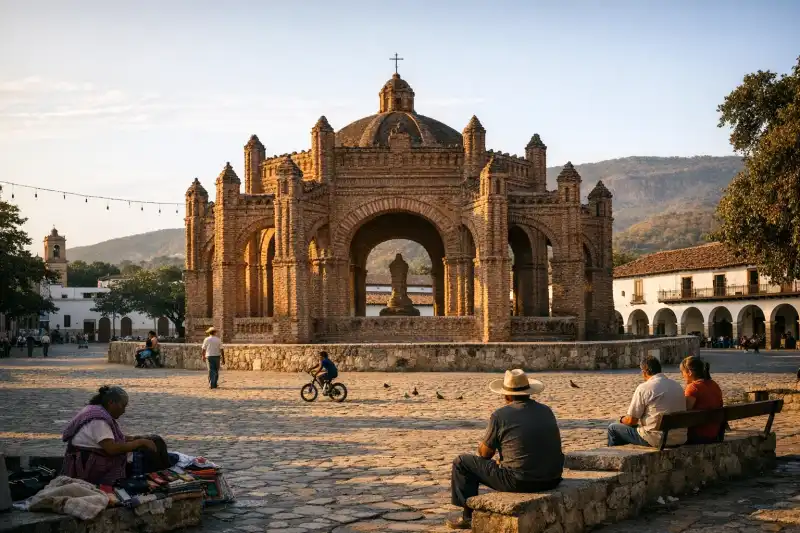
Chiapa de Corzo
Zoque and earlier Mesoamerican culturesExplore Chiapa de Corzo, Mexico, a major early Mesoamerican site beside the Grijalva River in Chiapa...
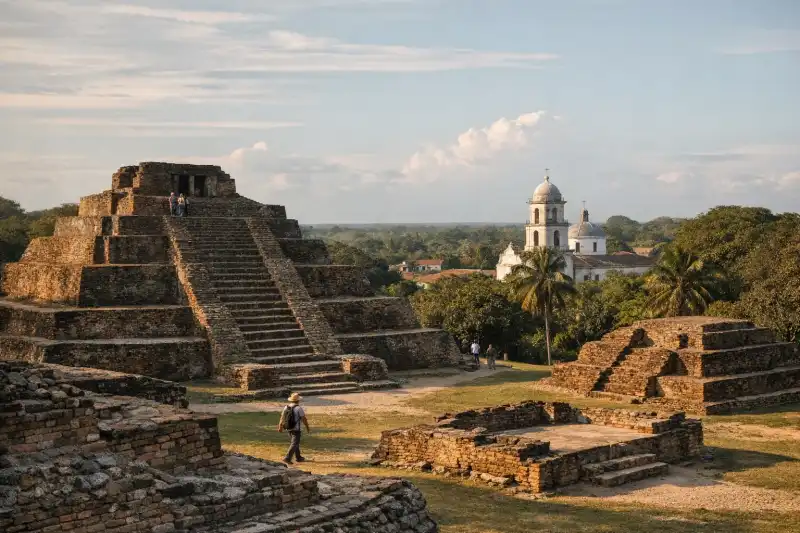
Comalcalco
MayaExplore Comalcalco, Mexico's distinctive Maya city built with brick, carved stucco, and rich Gulf Co...
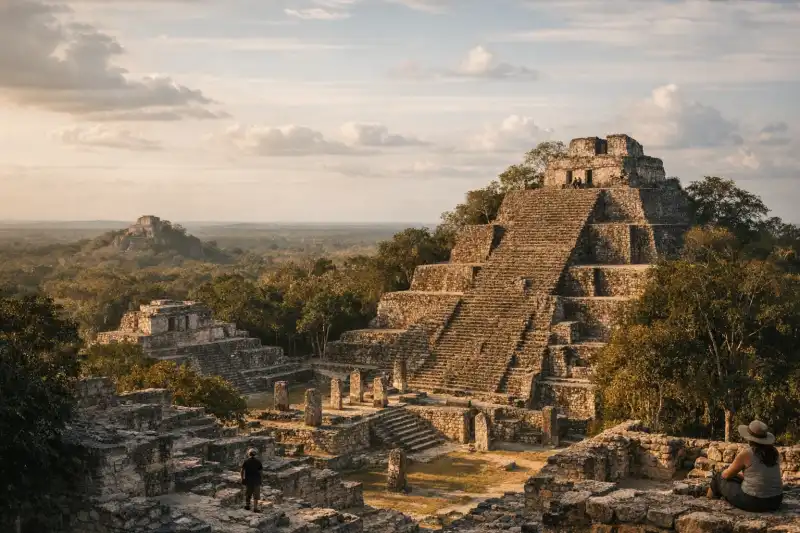
Calakmul
MayaExplore Calakmul, a vast Maya city deep in the forests of Campeche, Mexico, known for towering pyram...