Quick Info
Curated Experiences
Volterra Old Town and Roman Theatre Walking Tour
Tuscany Archaeology Day Trip: Volterra and San Gimignano
Volterra announces itself from a distance. The town sits on a high clay ridge visible for miles across the rolling Tuscan countryside, its medieval towers and stone walls breaking the skyline in a way that makes the defensive logic immediately obvious. This was a place built to see and to resist. The Etruscans understood that twenty-eight centuries ago, and every civilization since — Roman, Lombard, medieval commune — reinforced the same calculation: hold the high ground, control the valley.
What makes Volterra exceptional for travelers is that the evidence is all still here, compressed into a walkable hilltop town where you can pass through an Etruscan gate that predates Rome’s Republic, look down into a Roman theatre carved from the slope below the walls, and finish the afternoon in a museum whose Etruscan funerary urns constitute one of the finest collections of their kind anywhere. Most Italian hilltowns offer medieval charm and good views. Volterra offers that plus twenty-five centuries of readable archaeological depth.
If your Italy trip has been concentrated in Rome and Florence, Volterra recalibrates the picture. The peninsula was not Rome’s creation. It was a mosaic of independent cultures, and Volterra — ancient Velathri, later Volaterrae — was one of the most powerful pieces in that mosaic long before Roman legions arrived.
Historical Context
Volterra emerged as a major Etruscan city-state by the 7th century BCE, though settlement evidence reaches back to the Villanovan period of the 9th and 8th centuries. It was one of the twelve principal cities of the Etruscan League (the dodecapoli), a loose confederation of independent polities that dominated central Italy during the first millennium BCE. The city’s position on a naturally fortified ridge, roughly 530 meters above sea level, gave it control over rich mineral deposits (copper, lead, silver, and alabaster), agricultural territories in the Era and Cecina valleys, and overland trade routes connecting the Tyrrhenian coast to the Arno basin.
The city’s Etruscan-era fortification wall enclosed one of the largest urban perimeters in pre-Roman Italy — an estimated 7.3 kilometers, rivaling the circuit walls of Rome itself. This scale suggests a population and political importance that went far beyond a simple hilltop fortress. Volterra was a capital, controlling a territory that stretched from the coast near present-day Cecina to the valleys inland. Its wealth derived partly from metal extraction and partly from the alabaster deposits that have been quarried continuously for nearly three millennia and are still worked today by artisan workshops in the town center.
The Etruscan city’s prosperity is most vividly documented in its necropoleis. Thousands of carved alabaster and tufa funerary urns have been recovered from tombs around Volterra, depicting mythological scenes, battle episodes, processions, journey imagery, and daily life with a level of artistic sophistication that rivals contemporary Greek work. These urns — now concentrated in the Museo Etrusco Guarnacci — are not merely decorative. They constitute a visual archive of Etruscan beliefs about death, the afterlife, and social identity, created by a culture that left almost no written literature and must be understood primarily through its material remains.
Roman incorporation came in stages. Volterra allied with Rome during the 3rd century BCE and received Latin rights, but the relationship was not always smooth. During the Social War (91-88 BCE) and the subsequent civil conflicts between Marius and Sulla, Volterra backed the losing side. Sulla besieged the city for two years before it fell in 80 BCE, and his veterans were settled on confiscated Volterran land. The Roman layer visible today — the theatre, the bath complex, the civic reorganization — dates primarily to the 1st century BCE and 1st century CE, a period when Rome was stamping its architectural vocabulary onto conquered Etruscan centers while benefiting from their existing infrastructure and economic networks.
The medieval period saw Volterra maintain its hilltop identity as a fortified commune, and its alabaster-carving tradition continued into the Renaissance and beyond. Crucially for archaeology, the town never expanded dramatically beyond its ancient perimeter. The Etruscan walls, the Roman entertainment district below the medieval walls, and the burial grounds on the surrounding slopes all survived because the town above them stayed small enough not to destroy them.
The most dramatic ongoing geological process at Volterra is the Balze — a cliff face on the western edge of town where erosion is actively consuming the hillside, periodically swallowing ancient tombs, medieval buildings, and even a Camaldolese abbey that was partially lost to the cliff in the 19th century. The Balze is both an archaeological loss and a vivid demonstration that Volterra’s landscape is not static. The ground the Etruscans built on is still moving.
What to See
The Roman Theatre
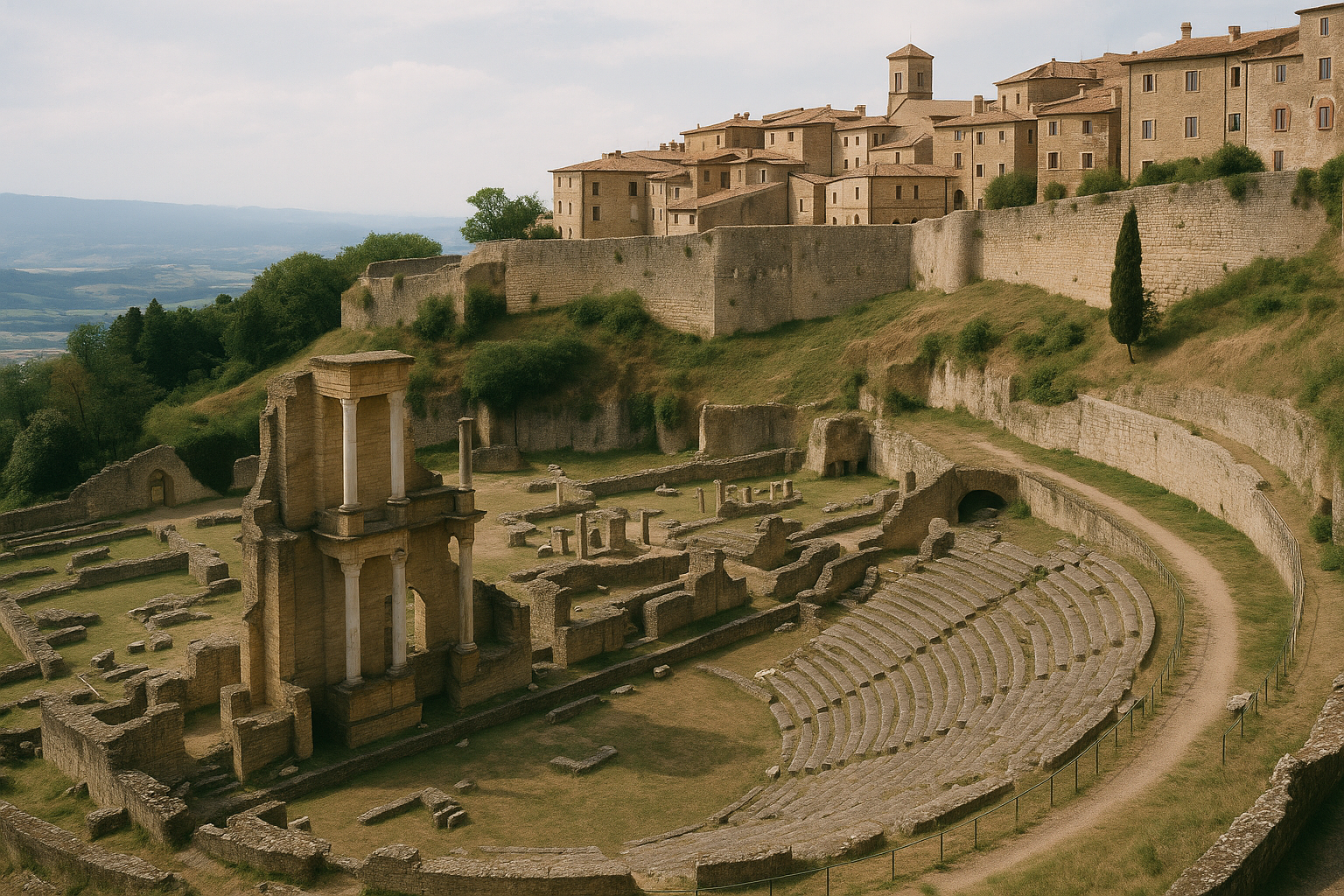
Volterra’s Roman theatre is one of the most rewarding ancient structures in Tuscany and arguably the best-preserved Roman theatre between Rome and northern Italy. Built into the hillside below the medieval city walls in the 1st century BCE, it was buried under centuries of fill and not rediscovered until systematic excavation in the 1950s. The result is a remarkably well-preserved entertainment complex that includes the semicircular cavea (seating area) with enough tiers surviving to seat roughly 2,000 spectators, the orchestra floor, and substantial fragments of the scaenae frons (the decorated stage building) including standing columns from the original facade.
The theatre’s position below and outside the main city walls is characteristic of Roman urban planning: entertainment facilities served civic purposes but were often placed at the urban periphery where they could accommodate crowds without disrupting the city center. Adjacent to the theatre, the remains of a Roman bath complex complete the picture of a provincial Roman leisure district, similar in concept (though much smaller in scale) to the entertainment and bathing zones of imperial Rome.
The excavation context is itself interesting. The theatre was buried so effectively that its survival is better than many comparable Italian examples. When archaeologists uncovered it, they found column drums, capitals, and decorative elements that had been protected by the fill for centuries, giving scholars an unusually clear picture of how a Roman provincial theatre was decorated and structured.
Practical tip: The best overview of the theatre is from the Via Lungo Le Mura viewpoint on the city wall above, where you can photograph the full cavea, orchestra, and stage building in a single frame with the Tuscan hills as backdrop. Descend to the site level for close-up study of the column fragments and stage building remains. The theatre is typically open 10:30 AM to 5:30 PM (seasonal variation applies), with an entry fee of approximately 5 EUR ($5.50 USD). Morning light is best for photography from above; late afternoon light is best from below.
Porta all’Arco
This is the structure that makes Volterra unique among Italian hilltowns. The Porta all’Arco is an Etruscan gate dating to the 4th-3rd century BCE, still standing, still functioning as a city entrance that you can walk through on your way to lunch. The arch is constructed from massive stone blocks, and three heavily weathered carved heads (possibly representing Etruscan deities or protective figures associated with the gate’s threshold function) project from the arch face. Their features have been nearly obliterated by twenty-four centuries of weather, but the sculptural forms are still visible and add an uncanny presence to the passageway.
The gate was incorporated into the later Roman and medieval wall circuits, which is why it survived — each subsequent civilization found it easier and more practical to keep the existing gate than to replace it. Walking through the Porta all’Arco is one of the most physically direct connections to the pre-Roman world available anywhere in Italy. You are passing through the same opening that Etruscan citizens used, that Roman soldiers marched through, and that medieval merchants drove their carts under.
During World War II, the retreating German army planned to demolish the gate and the surrounding walls to slow the Allied advance. Local residents reportedly blocked the gate with paving stones and rubble to make it appear already impassable, saving the structure from destruction. The story is part of local identity and adds yet another layer to the gate’s history of survival.
Practical tip: The gate is in the southern part of the old town center, freely accessible at any time. The carved heads are most visible in afternoon light when the sun hits the outer face. Pair this with a walk along the surviving Etruscan wall segments on either side, where the contrast between Etruscan polygonal masonry and later Roman and medieval construction is clearly visible.
Museo Etrusco Guarnacci
If you visit only one museum in Volterra, make it this one. The Guarnacci holds over 600 Etruscan funerary urns — the largest collection anywhere in the world — along with bronzes, ceramics, coins, and jewelry spanning the full chronological range of Etruscan Volterra. The star exhibit is the Ombra della Sera (Shadow of the Evening), an elongated bronze votive figure dating to the 3rd century BCE that looks startlingly modern, as if Giacometti had traveled back in time and left one of his sculptures behind. The figure’s nickname comes from its resemblance to a shadow stretched long by the setting sun.
The Urna degli Sposi (Urn of the Married Couple), showing an elderly couple reclining together on a funeral couch with expressions of weary tenderness, is equally compelling for its emotional directness. Most of the other urns depict mythological scenes — Odysseus, the Trojan War, Amazonomachies, voyages to the underworld — rendered in provincial but expressive style. Taken together, they compose a visual encyclopedia of what educated Etruscans thought about, feared, and hoped for regarding death and whatever came after it.
The museum transforms your understanding of Volterra from “old hilltop town” to “major Etruscan cultural center.” Without this stop, you are seeing architecture without civilization.
Practical tip: Entry is approximately 8 EUR ($9 USD), with combined tickets available that include the Roman theatre and the Pinacoteca (painting gallery). Allow 60-90 minutes for a thorough visit. The museum is located on Via Don Minzoni, a short walk from the main piazza. The urn galleries on the upper floors can feel repetitive — focus on the ground-floor highlights and the rooms with the best-known individual pieces.
The Etruscan Walls and Acropolis
Segments of Volterra’s Etruscan wall circuit survive at several points around the hill, built in the massive polygonal masonry that characterizes Etruscan fortification work. The most accessible sections are near the Porta all’Arco and along the Via di Porta Diana on the northern edge of town, where a second Etruscan gate (the Porta Diana) is partially preserved. The wall perimeter’s original extent — over 7 kilometers — is difficult to appreciate on foot, but even the surviving segments convey the scale of the Etruscan city’s ambition.
On the highest point of the ridge, the Acropolis archaeological area preserves foundations of Etruscan-era buildings (likely temples or public structures) and cisterns that supplied water to the hilltop settlement. The remains are fragmentary but important for understanding the layout of the original Etruscan city center. The value of the Acropolis is mainly topographic: standing here, you understand why the Etruscans chose this exact ridge and how its 360-degree elevation commanded every approach route and surrounding valley.
Practical tip: The Acropolis area is often less visited than the theatre and museum. Budget 20-30 minutes for a walk through. The views of the surrounding valleys and the distant Tyrrhenian coast (visible on clear days) are worth the short climb.
Le Balze (The Eroding Cliffs)
On the western edge of town, a dramatic cliff face of eroding clay and sandstone has been consuming buildings for centuries. The ruined Badia church teeters near the edge, and Etruscan tombs have periodically been exposed and destroyed by landslides. The erosion rate varies but is measurable: the cliff edge has retreated hundreds of meters since medieval times, and each year brings small collapses that occasionally reveal new archaeological material before destroying it.
The Balze is a sobering reminder that archaeological preservation is partly a matter of geological luck, and that Volterra’s visible remains represent only what the earth chose to hold onto. The Etruscan necropolis that once extended along this western slope has been almost entirely consumed, and with it an unknowable volume of funerary art and burial evidence.
Practical tip: Walk to the Balze from the town center (about 15 minutes along Via San Lino) for the geological spectacle and the long views westward across the Cecina valley. The cliff edge is unfenced in places — use obvious caution and stay behind any barriers. The best light for photography is in the late afternoon when the western exposure catches the warm sun.
Pinacoteca e Museo Civico
For visitors with extra time, the municipal art gallery on Via dei Sarti houses a small but remarkable painting collection, including Rosso Fiorentino’s Deposition from the Cross (1521), one of the masterpieces of Mannerist painting and reason enough for art-history travelers to add 30 minutes to their Volterra itinerary. The painting’s distorted colors and emotional intensity are even more striking in person than in reproduction. Luca Signorelli’s Annunciation and several fine Trecento panel paintings round out the collection.
Practical tip: Included in the combined Volterra Card. Allow 20-30 minutes.
Timing and Seasons
Best months: April through June and September through October. Temperatures range from 55-80°F (13-27°C), the Tuscan light is at its most painterly, and the town is busy but not overwhelmed. Early October is particularly good because the surrounding countryside takes on autumn color that frames the grey stone of the hilltop beautifully.
Summer (July-August): Hot (85-95°F / 30-35°C), particularly on the sun-exposed slopes around the Roman theatre and the Balze. The town center streets provide some shade, but the outdoor archaeological sites are punishing at midday. Arrive early or visit the theatre and Balze in the late afternoon when the western light is softer.
Winter (November-March): Cool to cold (35-55°F / 2-13°C), foggy on the ridge top, and very quiet. The atmospheric mist can make the Etruscan walls look genuinely ancient in a way that clear summer light does not, and the empty streets give the town a meditative quality. Check that the Roman theatre is open, as winter hours may be reduced.
Best time of day: Arrive by 9:30 AM to park easily and walk the town before the day-trip crowds from Florence and Siena arrive by late morning. The ideal sequence: museum at opening, then outdoor sites, finishing with lunch. Afternoon visitors contend with parking pressure and busier restaurant queues.
Tickets, Logistics and Getting There
Combined ticket: The Volterra Card (approximately 16-18 EUR / $18-20 USD) covers the Museo Etrusco Guarnacci, the Roman theatre, the Pinacoteca, the Acropolis area, and the Palazzo dei Priori tower. It is the best value if you plan to visit more than one attraction, and it is valid for 72 hours.
Individual tickets: Museo Guarnacci approximately 8 EUR ($9 USD). Roman theatre approximately 5 EUR ($5.50 USD). Acropolis area approximately 5 EUR ($5.50 USD). Pinacoteca approximately 8 EUR ($9 USD).
Hours: Most sites open at 10:00 or 10:30 AM and close between 5:00 and 6:00 PM, with extended hours (to 7:00 PM) in summer. Confirm before your visit, as schedules shift seasonally and some sites close on Monday or Tuesday in the off-season.
Getting there by car: Volterra is approximately 70 km southwest of Florence (1.5 hours), 50 km from Siena (1 hour), and 60 km from the coast at Cecina (45 minutes). The approach roads wind through classic Tuscan hill country and are scenic but slow — do not rely on GPS time estimates, which often understate the actual driving time on these roads. Park in the Piazza Martiri della Liberta lot (the largest, with a flat walk into town) or the underground Parcheggio di Docciola below the town center. Expect to walk uphill from any parking area.
By bus: CPT/Tiemme buses connect Volterra to the Saline di Volterra train station (30 minutes, approximately 2.50 EUR), which has rail connections to Cecina and the coastal line. Direct bus service from Florence or Siena is limited and infrequent; check current schedules at tifrfraseemme.it. For most visitors, a car is the practical choice.
By organized tour: Day trips from Florence combining Volterra with San Gimignano are widely available (100-130 EUR / $110-145 USD per person) and solve the transport logistics entirely. The trade-off is less time at each stop and less flexibility in pacing.
Practical Tips
- Wear sturdy shoes with good grip. The town streets are steep, cobbled, and slippery when wet. The Roman theatre site has uneven ground and gravel paths.
- Bring water and sun protection for outdoor sites. The Roman theatre, Acropolis, and Balze are fully exposed.
- Volterra’s alabaster workshops are genuine artisan operations with a history stretching back to the Etruscans, not tourist traps. A quick visit to a bottega (workshop) on Via Porta all’Arco or Via Matteotti adds cultural texture and takes only 10 minutes.
- The town’s restaurants are generally better than typical tourist-destination fare. Try pici (thick hand-rolled pasta) with wild boar ragu and the local pecorino cheese. L’Incontro on Via Matteotti is reliable for a quick lunch.
- If you are driving, fill your fuel tank before the approach roads. Petrol stations near Volterra are scarce and sometimes closed at midday.
- Cash is useful for smaller sites, parking meters, and some shops. ATMs are available on the main piazza.
- A 30-minute midday pause at a cafe on Piazza dei Priori (the main square) is time well spent. The medieval Palazzo dei Priori — the oldest continuously functioning town hall in Tuscany, dating to 1208 — faces the square and sets the scene for the town’s long civic history.
Suggested Itinerary
9:30 AM — Arrive and park in the Piazza Martiri lot or Docciola underground. Walk into the town center through the medieval gate.
10:00 AM — Begin at the Museo Etrusco Guarnacci when it opens. Spend 60-75 minutes with the funerary urns, the Ombra della Sera, the Urna degli Sposi, and the chronological displays.
11:15 AM — Walk to the Porta all’Arco. Pass through the gate, examine the carved heads and Etruscan masonry, and follow the wall segments on either side for the contrast between Etruscan, Roman, and medieval construction. Allow 15-20 minutes.
11:35 AM — Walk to the Roman theatre viewpoint on Via Lungo Le Mura for the full overhead panorama, then descend to the theatre site for close-up exploration of the seating, stage building, and column fragments. Allow 30-40 minutes.
12:15 PM — Walk to the Acropolis area for a brief exploration of the Etruscan building foundations and panoramic views. Allow 20 minutes.
12:35 PM — Return to the town center for lunch at a restaurant on or near Piazza dei Priori. Take the time to sit in the piazza and absorb the medieval atmosphere.
1:45 PM — After lunch, walk to Le Balze for the geological viewpoint and long western views across the Cecina valley. Allow 30 minutes for the round trip.
2:15 PM — Optional: visit the Pinacoteca for Rosso Fiorentino’s stunning Deposition (1521) or browse an alabaster workshop on the walk back through town. Allow 30-45 minutes.
3:00 PM — Depart Volterra. Total town time: approximately 5.5 hours.
Nearby Sites
Fiesole — The Etruscan-Roman hilltop above Florence, about 90 minutes northeast by car. Fiesole offers a smaller, more compact version of the Etruscan-to-Roman continuity that Volterra presents at larger scale. Visit both for the fullest picture of pre-Roman Tuscany.
Ostia Antica — Rome’s ancient port city, roughly 3 hours south by car (or train via Pisa and Rome). If Volterra shows you a provincial Etruscan-Roman hill town, Ostia shows you the commercial and logistical side of Roman urban life at full scale. The contrast between hilltop fortress and coastal trading port is instructive.
Hadrian’s Villa — The sprawling imperial retreat at Tivoli, east of Rome. Pair it with Volterra on a broader Italy archaeology route to see the spectrum from provincial Etruscan town to imperial pleasure palace — the full range of what ancient Italian civilization could produce.
San Gimignano — The iconic Tuscan tower-town, only 30 minutes from Volterra by car. Not an ancient site per se, but the medieval architecture sits on older foundations, and the day-trip pairing of Volterra plus San Gimignano is one of the most popular routes in Tuscany for good reason. Do Volterra first in the morning when the archaeological sites are open and uncrowded, then San Gimignano in the afternoon.
Final Take
Volterra earns its reputation through accumulation rather than spectacle. No single monument here competes with the Colosseum or the Parthenon for raw visual impact. Instead, the experience builds as you move through the town: the massive Etruscan gate stones that predate Roman civilization, the theatre carved into the hillside below medieval walls, the hundreds of funerary urns that give faces and stories to a culture that left no written literature, and the eroding cliffs that remind you how much has already been lost to time and gravity.
This is a place that rewards the traveler who wants to understand Italy before Rome, and who is willing to earn that understanding by walking steep streets, reading stone, and spending time in a small museum that contains more concentrated Etruscan civilization than anywhere else on earth. Give Volterra a full day. It is one of the most intellectually honest ancient sites in Italy, and one of the most beautiful.
Discover More Ancient Wonders
- Fiesole — Etruscan and Roman layers on a compact hilltop above Florence
- Ostia Antica — The remarkably preserved port city of ancient Rome
- Hadrian’s Villa — Imperial architectural ambition at Tivoli near Rome
- Trajan’s Market — Rome’s multi-level commercial and administrative complex
- Explore our full Italy Ancient Sites Guide for complete planning resources
Quick Facts
| Attribute | Details |
|---|---|
| Location | Volterra, Tuscany, Italy |
| Country | Italy |
| Region | Tuscany |
| Civilization | Etruscan and Roman |
| Historical Period | 8th century BCE to Imperial Roman era |
| Established | Etruscan phase from at least the 8th century BCE |
| Entry Fee | Volterra Card ~16-18 EUR ($18-20 USD) for all sites |
| Hours | 10:00-10:30 AM to 5:00-7:00 PM (seasonal) |
| Best Time | Morning arrival, Apr-Jun or Sep-Oct |
| Coordinates | 43.4025, 10.8614 |
Frequently Asked Questions
Is Volterra worth visiting if I've already seen Rome and Pompeii?
Yes. Volterra gives you a different lens on ancient Italy by foregrounding Etruscan urban identity and then showing how Roman structures were layered into that older hilltop settlement.
How much time do I need in Volterra for archaeology?
A strong first pass takes about 4 to 6 hours: Roman theatre and baths area, Etruscan gate and wall segments, and at least one museum stop for context.
Can I do Volterra as a day trip?
Yes, many travelers do. It works best with an early arrival and a fixed route so you do not spend too much time navigating steep streets and parking logistics.
What's the most important ancient site in Volterra?
The Roman theatre is the most visually immediate monument, but Porta all'Arco and surviving Etruscan wall fabric are equally important for understanding Volterra's deep chronology.
When is the best season to visit Volterra?
Spring and autumn are ideal for comfort and visibility. Summer can still work, but midday heat on exposed slopes makes pacing and hydration more important.
Nearby Ancient Sites
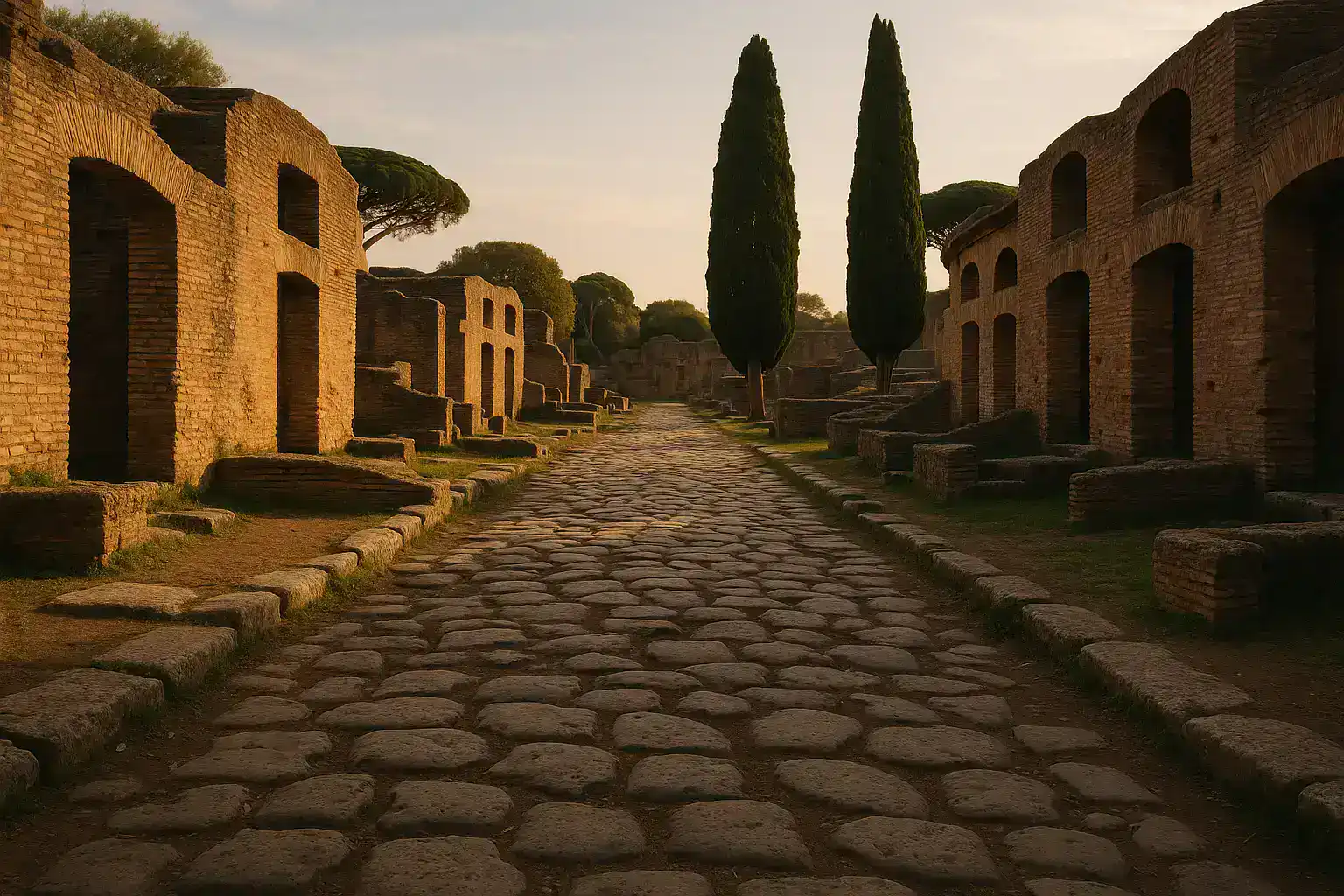
Ostia Antica Italy Travel Guide 2026: Rome's Ancient Port City
Roman EmpireExplore Ostia Antica, the best-preserved ancient Roman city after Pompeii. Walk intact streets, see ...
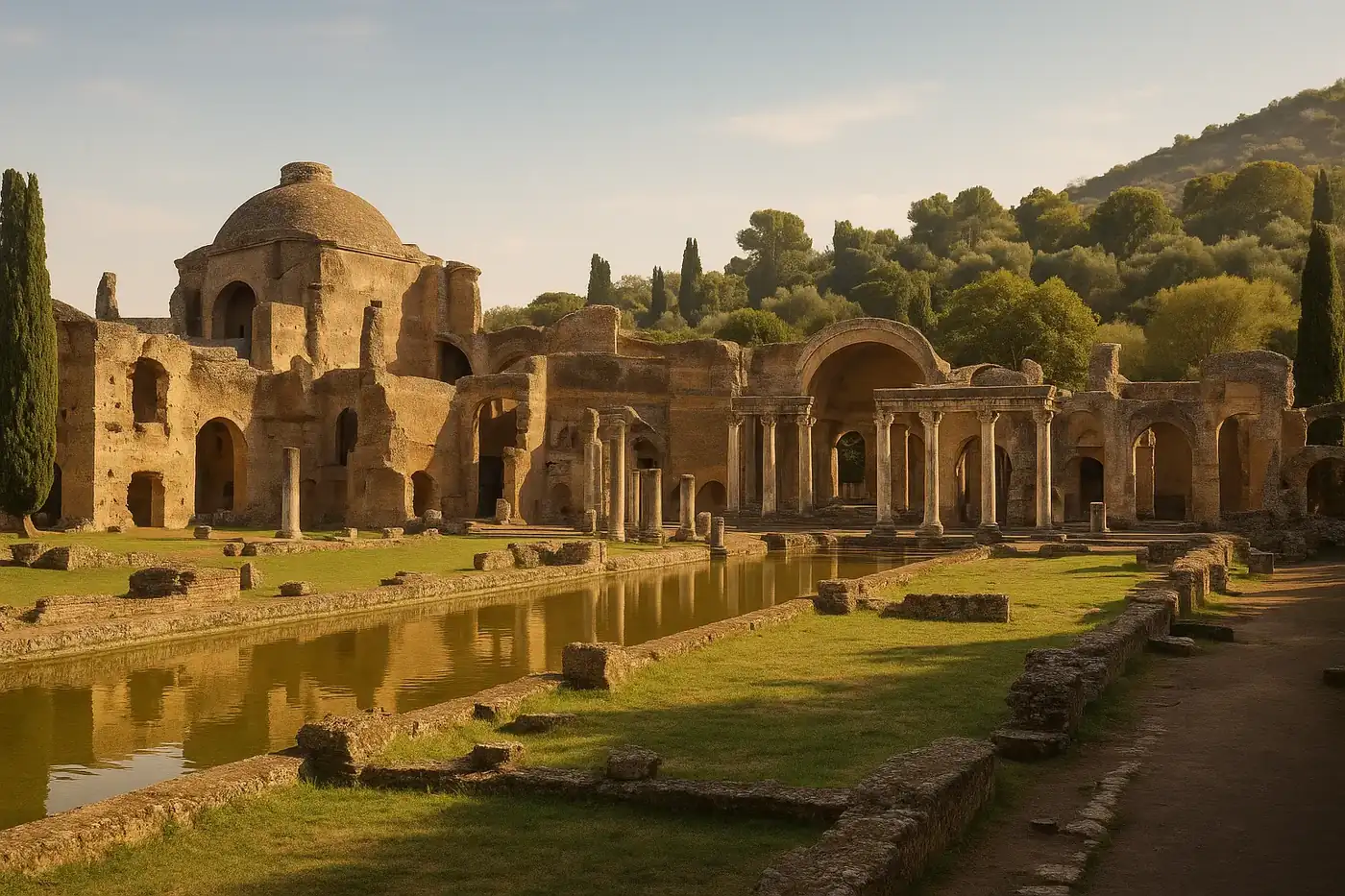
Hadrian’s Villa (Villa Adriana) Guide 2026: Tivoli’s Imperial City-Scale Estate
RomanPlan your visit to Hadrian’s Villa in Tivoli with practical advice on route planning, must-see zones...
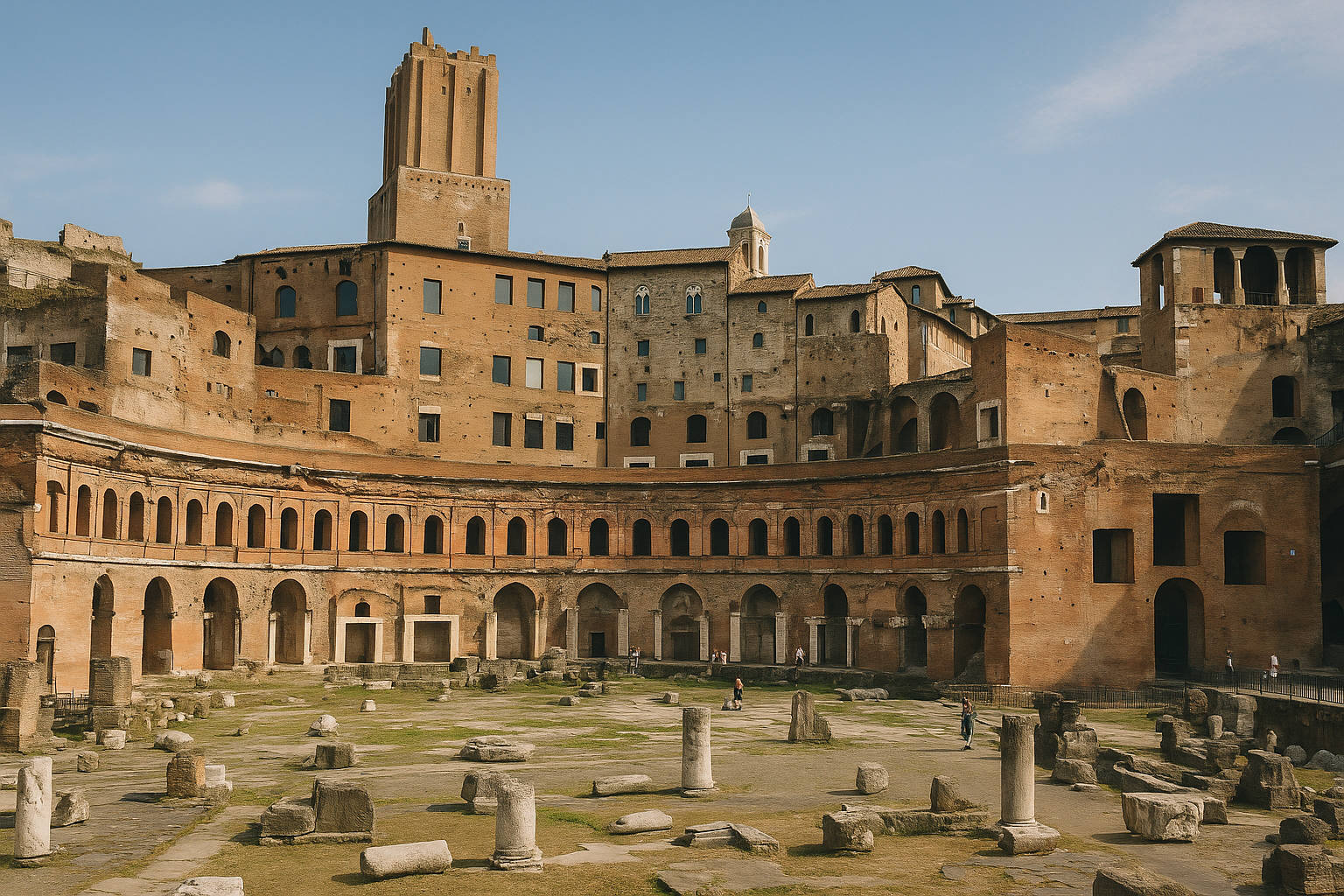
Trajan's Market Guide 2026: Visiting Rome's Multi-Level Imperial Complex
RomanPlan a smart visit to Trajan's Market in Rome with practical route strategy, what to prioritize in t...
Roman Forum Rome: Heart of Ancient Republic Guide
Roman Republic/EmpireNavigate the Roman Forum's temples, basilicas, triumphal arches. Complete layout, highlights, Palati...
Pantheon Rome: Ultimate Guide to Rome's Best-Preserved Ancient Temple
Roman EmpireMaster your Pantheon visit with history, dome engineering secrets, visiting tips, skip-the-line opti...
Palatine Hill Rome: Emperors' Palaces & Birthplace of Rome Guide
Roman EmpireExplore Palatine Hill, Rome's oldest neighborhood and imperial palace complex. Complete 2026 guide t...