Quick Info
At a glance
Xlapak, in Mexico’s Yucatán Peninsula, is one of those archaeological sites that rewards travelers who slow down. It does not overwhelm with towering pyramids or immense plazas. Instead, it impresses through proportion, craftsmanship, and atmosphere. Set amid low forest and the undulating limestone terrain of the Puuc hills, Xlapak feels intimate in a way that many larger Maya cities do not. The approach is quiet, the buildings emerge gradually, and the site’s decorated stonework invites close attention rather than hurried sightseeing. For visitors driving the Puuc Route from Mérida or combining several ruins in a single day, Xlapak often becomes an unexpected favorite precisely because it is smaller, calmer, and easier to absorb.
Its name is usually translated as something close to “old walls,” a fitting description for a place where masonry still carries the memory of elite residences, ceremonial spaces, and a refined regional style. Xlapak flourished during the Late Classic period, when the Puuc region saw the rise of architecturally sophisticated settlements linked by trade, ritual, and political rivalry. Today, the surviving structures reveal the signature features of Puuc architecture: smooth lower walls, intricate upper facades, geometric stone mosaics, masks associated with the rain god Chaac, and carefully framed doorways. Visiting Xlapak is not about checking off a famous landmark. It is about stepping into a quieter chapter of Maya urban life, where elegance, adaptation to landscape, and regional identity shaped one of Yucatán’s most appealing lesser-known ruins.
History
Early settlement in the Puuc hills
Xlapak developed in the Puuc region of southern Yucatán, an area distinguished by low hills, thin soils, and a relative scarcity of surface water. These environmental conditions shaped settlement patterns across the region. Unlike parts of the Maya lowlands with rivers, lakes, or broad bajos, the Puuc zone depended heavily on collecting and storing rainwater. Communities that prospered here became highly skilled at managing seasonal resources while building durable stone architecture on elevated terrain.
Archaeologists generally place Xlapak’s principal occupation in the Late Classic period, roughly between the 7th and 10th centuries CE. This was the era when the Puuc region experienced a remarkable florescence. Settlements such as Uxmal, Kabah, Sayil, Labná, and smaller centers like Xlapak developed complex civic-ceremonial cores and elite compounds marked by architectural innovation. Xlapak was not among the largest cities in the zone, but its buildings show that it participated fully in the shared aesthetic and social world of Puuc Maya culture.
Growth during the Late Classic peak
The site’s surviving monuments suggest that Xlapak reached its height between about 700 and 900 CE, when much of the region saw intensified construction. This was a period of increasing political complexity among Maya polities. Rather than a single unified kingdom controlling the entire Puuc area, the landscape likely consisted of interconnected centers with shifting alliances, influence networks, and local ruling groups. Xlapak may have functioned as a secondary center or elite settlement tied economically and ceremonially to larger neighboring cities.
Its architecture points to social investment in prestige. Decorative stone mosaic facades were labor-intensive and required both skilled artisans and organized labor. The care devoted to the surviving palace-like buildings indicates that local elites used architecture to display authority, lineage, and cultural refinement. As in other Maya communities, public and semi-public spaces would have supported ceremonies, political meetings, tribute arrangements, and social gatherings tied to the agricultural and ritual calendar.
The Puuc style itself reflects adaptation and regional confidence. Walls were often built with a plain lower zone and an ornate upper zone covered in cut-stone veneer. At Xlapak, this balance between structural clarity and decorative richness is especially visible. The site may never have been monumental in scale, but it was carefully composed, and that tells us much about the ambitions of those who built and occupied it.
Water, ritual, and regional life
No history of Xlapak can be separated from the environmental realities of the Puuc hills. Rainfall was seasonal, and the successful functioning of settlements depended on cisterns, chultuns, and other water-storage solutions. The repeated appearance of Chaac masks in Puuc architecture is often understood partly through this ecological lens. Chaac, the rain deity, had obvious importance in a zone where agricultural stability depended on the arrival and timing of rains.
Ritual life at Xlapak would have intertwined with politics and subsistence. Maya elites were not simply secular administrators; they occupied roles linked to sacred legitimacy. Ceremonies connected to fertility, rainfall, ancestors, and calendrical observances likely animated the site. Though many details remain unknown, the architecture preserves clues to a world in which buildings themselves were symbolic statements, reinforcing social order through form, orientation, and decoration.
Decline and abandonment
Like many Maya centers in the northern lowlands, Xlapak appears to have declined by the end of the Terminal Classic or shortly after, around the 10th century CE. The reasons were probably multiple rather than singular. Regional political shifts, changing trade patterns, environmental pressure, demographic contraction, and transformations in power centers all likely played roles. Larger Puuc cities also experienced decline, and Xlapak’s fate seems tied to that broader regional transition.
This was not necessarily a dramatic overnight collapse. More often, archaeological evidence points to gradual reduction in construction, maintenance, and elite occupation. Buildings fell out of use, facades weathered, and the surrounding forest slowly reclaimed the settlement. Over time, Xlapak became one of many ancient places in Yucatán remembered locally and later documented by travelers, explorers, and archaeologists.
Rediscovery, documentation, and preservation
In the 19th century, growing foreign and Mexican interest in Maya ruins brought attention to numerous sites across Yucatán, including those along the Puuc Route. Explorers, artists, and early scholars recorded facades, plans, and inscriptions where available, helping establish the architectural significance of the region. Xlapak’s elegant but compact buildings drew notice because they exemplified Puuc design in a concentrated form.
Modern archaeological work and conservation have stabilized parts of the site, allowing visitors to appreciate its surviving structures without losing the sense of being in a more secluded ruin. Today, Xlapak is valued less for monumental scale than for architectural quality and context. It remains an important stop for understanding the range of Maya urbanism in Yucatán: not only the major capitals, but also the smaller centers whose artistry and regional identity were every bit as distinctive.
Key Features
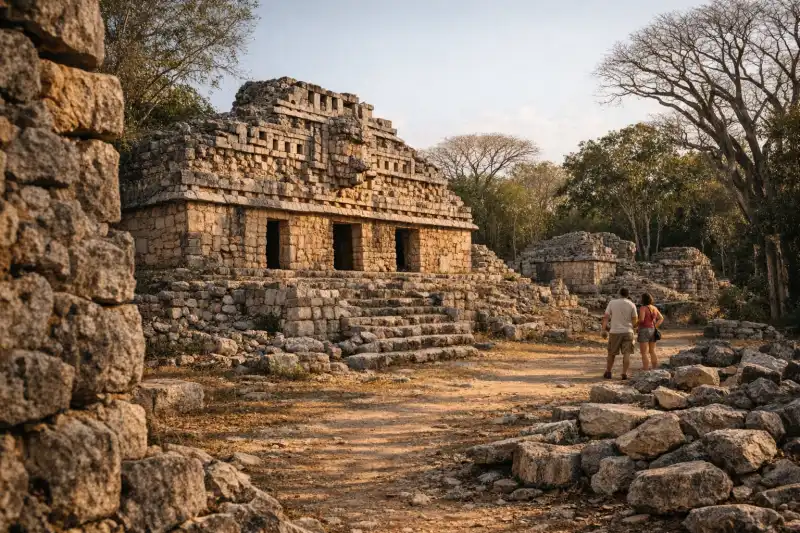
Xlapak’s greatest strength is its architecture. Even visitors who arrive after seeing larger ruins often find themselves lingering here because the details are so rewarding at close range. The best-known structure is often referred to as the Palace, a long building whose facade captures the classic Puuc preference for contrast between plain and ornate surfaces. The lower walls are relatively restrained, emphasizing geometry and mass, while the upper portions display decorative stonework that gives the structure rhythm and texture. Doorways punctuate the facade in measured intervals, suggesting both practical interior divisions and a carefully staged exterior appearance.
What makes this especially striking is the craftsmanship of the masonry. Puuc architecture relies on precisely cut stones assembled into mosaics that can seem almost textile-like from a distance. At Xlapak, these patterns are not merely ornamental. They communicate status, technical skill, and participation in a broader regional visual language. Repeated motifs, stepped forms, lattice designs, and mask elements turn the building face into a symbolic surface rather than a simple wall.
Another memorable feature is the presence of Chaac imagery. In the Puuc region, Chaac masks are among the most recognizable decorative elements, with their projecting noses and stylized features integrated into facades and corners. At Xlapak, these forms reinforce the site’s connection to the environmental and religious world of the Puuc hills. Rain was life, and architecture invoked divine power in visible, repeated ways. Even fragmentary masks still carry a surprising expressive force.
The site’s compactness is itself a defining feature. Xlapak is not spread across vast distances, so visitors can grasp its layout more easily than at many larger Maya centers. This helps bring the site to human scale. You are not simply looking at monumental remains from afar; you are moving through a built environment where rooms, thresholds, and sightlines still feel legible. Elite residential and administrative functions seem especially plausible here, and the experience of walking among the structures can feel more intimate than theatrical.
The surrounding landscape adds another layer. The low forest and limestone terrain of the Puuc zone frame the site in a way that enhances its quiet character. There is less visual drama than at ruins perched on cliffs or dominated by giant pyramids, but the mood is compelling. Birds, filtered light, and the sense of isolation create a strong contrast with busier tourist circuits. For travelers interested in photography, this often means softer compositions: facades partly framed by vegetation, stone textures in angled light, and architectural details that reward patient observation.
Xlapak also stands out as part of the larger Puuc Route experience. While the site can be appreciated on its own, it becomes even more meaningful when compared with nearby ruins such as Uxmal, Kabah, Sayil, and Labná. In that context, Xlapak shows how Puuc architectural principles were expressed at a smaller scale without losing sophistication. It helps visitors understand that Maya achievement in the region was not limited to a single capital, but distributed across a network of centers, each contributing something distinct.
Finally, there is the simple pleasure of encountering a site that still feels relatively uncrowded. That quality should not be underestimated. At Xlapak, it is often easier to hear the forest, to examine masonry without jostling for position, and to imagine the cadence of ancient life with fewer modern distractions. Its key features are therefore not only architectural but experiential: elegance, intimacy, and stillness.
Getting There
Xlapak is usually reached from Mérida, the main gateway city for the Puuc region. By car, the trip generally takes around 1.5 to 2 hours depending on traffic and your exact route. Most independent travelers rent a car in Mérida, where daily rental rates commonly start around MXN 700 to 1,400, with higher prices in peak season and additional insurance costs often applying. Driving is the easiest option because Xlapak is usually visited together with other Puuc sites on the same day.
If you are relying on public transport, the journey is possible but less straightforward. Buses or colectivos from Mérida toward towns such as Oxkutzcab are affordable, often in the range of MXN 80 to 180 depending on service type. From there, you may need to hire a taxi for the final stretch or negotiate a driver for multiple stops along the route. Taxi costs vary, but a short regional transfer can easily run from MXN 150 to 400 one way, and a half-day arrangement for several ruins may be considerably more.
Organized tours from Mérida offer the simplest no-stress option. Group day trips focused on Uxmal and the Puuc Route often include transport, guide services, and several archaeological stops. Prices typically begin around MXN 1,200 to 2,500 per person depending on inclusions, while private tours cost more but allow flexibility in how long you spend at quieter sites like Xlapak.
Bring water, a hat, and cash, since facilities can be limited and not every stop in the region reliably accepts cards.
When to Visit
The most comfortable time to visit Xlapak is during the dry season, roughly from November to April. During these months, skies are often clearer, humidity is lower than in midsummer, and walking the site is generally more pleasant. Temperatures can still be warm by late morning, so an early start remains the best strategy, especially if you are combining several ruins in one day.
From May through October, the rainy season brings greener landscapes and sometimes dramatic cloud cover that can be excellent for photography. However, heat and humidity are more intense, and afternoon showers are common. If you travel in this period, visit early, carry extra water, and expect the ground to be more slippery in shaded areas. The forest can feel especially lush then, which suits Xlapak’s quiet atmosphere, but weather disruptions are more likely.
Crowds at Xlapak are usually modest year-round compared with headline sites such as Chichén Itzá. Even so, Mexican holiday periods, Easter week, and peak Christmas travel can increase visitation across Yucatán. The advantage of Xlapak is that it rarely feels overrun, yet mornings still offer the calmest experience and the softest light on the facades.
If your main goal is comfort, choose the cooler months. If your priority is vivid greenery and a more tropical mood, the wet season has its appeal. In either case, avoid the hottest central hours of the day when possible. Xlapak is best appreciated slowly, and the climate rewards visitors who plan around the sun.
| Quick Facts | Details |
|---|---|
| Location | Puuc region, Yucatán, Mexico |
| Civilization | Maya |
| Main period | Late Classic, c. 600–1000 CE |
| Architectural style | Puuc |
| Best known for | Refined stone mosaics and intimate palace-like structures |
| Typical visit length | 30–60 minutes |
| Nearest useful base | Mérida or Oxkutzcab |
| Best combined with | Uxmal, Kabah, Sayil, and Labná |
| Best season | November to April |
| Access style | Best by rental car or guided day tour |
Xlapak may not be the most famous Maya ruin in Mexico, but that is part of its appeal. It offers a more focused encounter with the Puuc world: less spectacle, more detail; less scale, more intimacy. In a region rich with archaeological wonders, Xlapak shows how much can be expressed through a single well-composed facade, a carefully cut stone, or a quiet doorway opening into the remains of a vanished elite residence. For travelers who want to understand Yucatán beyond its biggest names, it is an essential stop.
Guided tours: worth it?
A guide can be genuinely useful at Xlapak, especially if you want help with transport, timing, tickets, or understanding a large site without losing half the day to logistics.
Best for
- Travelers who want transport, timing, or entry logistics handled
- Short visits where a planned route saves time
When to go self-guided
Go independently if you already have transport and tickets sorted, enjoy moving at your own pace, and are comfortable checking the latest official rules before you arrive.
What I’d avoid
Skip paid tours that bundle unrelated stops you do not actually want. The best option should either save meaningful planning time or add historical context you would miss on your own.
Puuc Route and Uxmal day tours
Useful when: you want to compare guided formats before deciding
Mérida to Uxmal and Kabah excursions
Useful when: you want to compare guided formats before deciding
Yucatán Maya ruins private tours
Useful when: you want flexible timing or a private guide
Some tour links are affiliate links, which may earn Ancient Travel a small commission at no extra cost to you. I try to surface options that make practical sense for the site—not just anything bookable.
Frequently Asked Questions
What is Xlapak known for?
Xlapak is known for its finely carved Puuc-style masonry, compact scale, and quiet atmosphere along Yucatán’s Puuc Route.
Where is Xlapak located?
Xlapak is in the state of Yucatán, Mexico, in the Puuc hills southeast of Mérida and near other archaeological sites such as Labná, Sayil, and Kabah.
How much time do you need at Xlapak?
Most visitors spend 30 to 60 minutes at Xlapak, though architecture enthusiasts may want longer to study the facades and explore the surrounding paths.
Can you visit Xlapak independently?
Yes. Many travelers visit Xlapak by rental car while following the Puuc Route, though guided day trips from Mérida are also available.
Is Xlapak suitable to combine with other ruins?
Yes. Xlapak is typically paired with Uxmal, Kabah, Sayil, and Labná on the same day because the sites are relatively close to one another.
What should you bring to Xlapak?
Bring water, sun protection, comfortable walking shoes, and cash for transport or services nearby, as facilities in the Puuc zone can be limited.
Nearby Ancient Sites
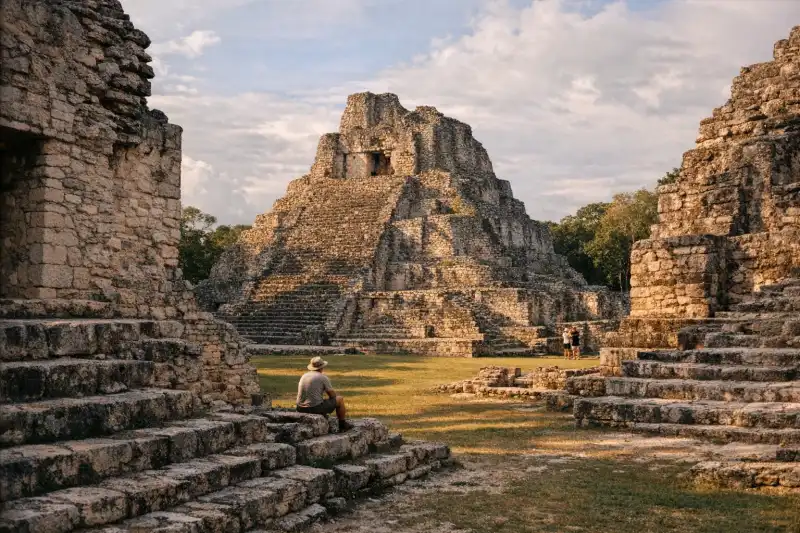
Becán
MayaExplore Becán, a moated Maya city in Campeche, Mexico, known for its causeways, temples, and forest ...
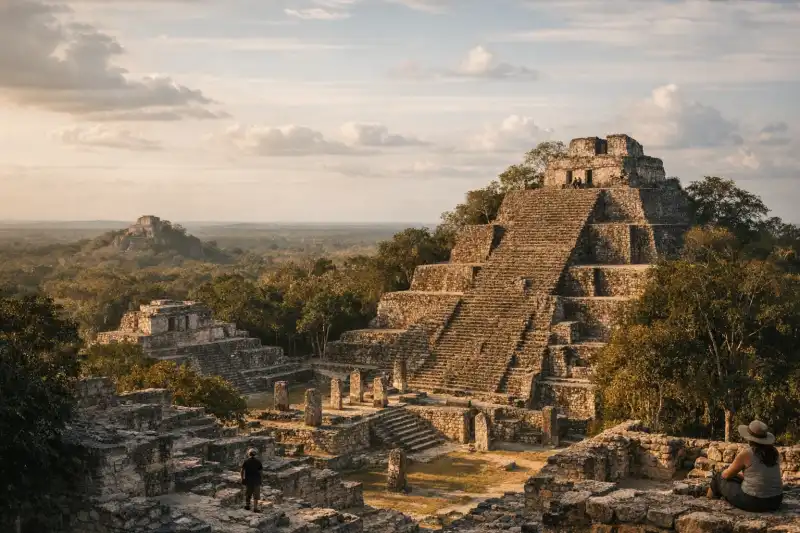
Calakmul
MayaExplore Calakmul, a vast Maya city deep in the forests of Campeche, Mexico, known for towering pyram...
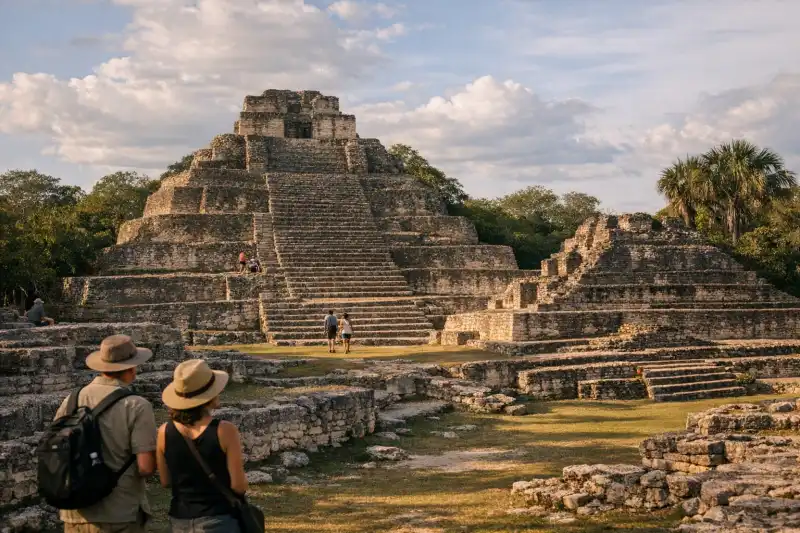
Chacchoben
MayaExplore Chacchoben, a serene Maya archaeological site in Mexico surrounded by jungle, lagoons, and i...