Quick Info
At a glance
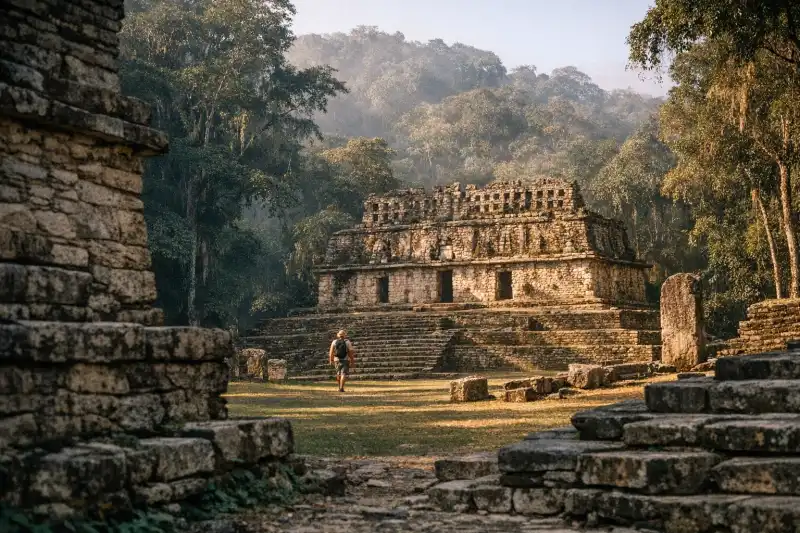
Yaxchilán in Mexico feels less like a conventional archaeological stop and more like an arrival into another world. Reached by boat through the humid green corridors of the Usumacinta River, the ancient Maya city appears slowly: stone temples rising above dense rainforest, howler monkeys calling overhead, and mist hanging over the water in the early morning. Even before you pass through its monumental architecture, the journey sets the tone. This is a site where landscape and history remain tightly fused, and where the isolation that once made Yaxchilán strategically powerful now gives it uncommon atmospheric power for modern visitors.
Unlike many major ruins that sit close to highways or urban centers, Yaxchilán preserves the sensation of discovery. The jungle still presses in on plazas and stairways, and wildlife is part of the experience rather than a backdrop. At the same time, the site is not important only for its scenery. It was one of the great cities of the Classic Maya world, known for royal dynasties, warfare, ritual performance, and some of the finest carved stone monuments in Mesoamerica. Its sculpted lintels, stelae, and hieroglyphic texts have made it essential to the reconstruction of Maya political history. For travelers interested in ancient cities, art, and dramatic settings, Yaxchilán offers one of the most memorable encounters in southern Mexico.
History
Early foundations and growth
Yaxchilán flourished in the heart of the Classic Maya period, though occupation in the area likely began earlier. Its position on a major bend of the Usumacinta River gave it both access and control. Rivers in the Maya world were arteries of trade, movement, and political communication, and Yaxchilán occupied a place of unusual strategic value along one of the most important waterways in the region.
By the early centuries of the first millennium CE, Yaxchilán had emerged as a significant center in what is now Chiapas. The city developed ceremonial architecture, elite residences, and public plazas that reflected an increasingly complex political order. Like other Maya cities, Yaxchilán was not an empire in the modern sense but an urban court embedded in a network of allied, rival, and subordinate polities. Its rulers sought prestige through architecture, ritual, dynastic marriage, and military success.
Archaeological and epigraphic evidence suggests that by the 5th century CE Yaxchilán was already participating in the highly competitive political landscape of the Usumacinta region. Its history becomes clearer in later centuries, thanks to inscriptions that preserve names, dates, and events with unusual richness.
Dynastic power and rivalry
The city’s greatest era came during the 7th and 8th centuries CE, when Yaxchilán expanded its influence and produced many of the monuments seen today. During this period, the city engaged in long-running rivalry with neighboring powers, especially Piedras Negras, located downstream in present-day Guatemala. The struggle between these cities was political, territorial, and symbolic. Captives, victories, alliances, and royal ceremonies were all recorded in stone, turning architecture into a durable medium of power.
One of Yaxchilán’s most famous rulers was Itzamnaaj B’alam II, often called Shield Jaguar the Great, who reigned in the 8th century and presided over an era of artistic and political brilliance. Under his rule, monumental building intensified and the city’s sculptural program reached extraordinary refinement. He commissioned temples, stairways, and carved lintels that celebrated military success and sacred kingship.
Equally important in Yaxchilán’s history is the visibility of royal women. The famous carved lintels associated with Lady K’ab’al Xook depict bloodletting rituals and visionary ceremonies, offering rare and powerful images of elite women as active participants in dynastic religion. These monuments have become central to scholarly understanding of gender, ritual, and authority in the Maya world.
Monumental art and political messaging
Yaxchilán’s inscriptions were not decorative additions; they were instruments of memory and legitimacy. Temples and doorways announced the deeds of rulers, the capture of enemies, accessions to power, and sacred rites linking dynasties to the supernatural realm. Some of the site’s best-known monuments come from Structures 23, 24, and 25, where lintels once stood over doorways and were seen by anyone entering elite ritual spaces.
These carvings combine technical precision with dramatic narrative. They present kings dressed for ceremony, nobles and captives arranged according to rank, and supernatural imagery that connected political rule to cosmic order. In a world where dynastic continuity mattered deeply, such monuments helped ensure that rulers would remain present long after their deaths.
The city’s architecture also communicated hierarchy. Elevated acropolises, temple pyramids, and restricted courts organized movement through space, distinguishing between public ritual zones and more exclusive elite environments. Yaxchilán was both a ceremonial city and a stage for controlled political display.
Decline, abandonment, and rediscovery
Like many Classic Maya centers, Yaxchilán declined during the 9th century CE. The reasons were likely complex: shifts in political alliances, environmental strain, trade disruption, internal instability, and the broader transformations that affected many lowland Maya cities. Monument erection slowed, inscriptions became fewer, and the organized court culture that had sustained the city eventually faded.
After abandonment, the rainforest gradually reclaimed the site. Temples remained standing, but vegetation covered plazas and stairways. Local knowledge of the ruins endured, yet for the outside world Yaxchilán entered a long period of obscurity.
In the 19th century, explorers and scholars began documenting the site, drawn by reports of ruins deep in the forest. Later expeditions mapped structures and recorded inscriptions, while excavations and conservation in the 20th century helped establish Yaxchilán as one of the key archaeological sites of the Maya region. Today, although remote, it is recognized not only for its beauty but for the quality of historical information preserved in its art and texts.
Key Features
What makes Yaxchilán exceptional is the way its architecture, sculpture, and setting work together. The site is not the largest Maya city in Mexico, and it is not the easiest to reach, but few places deliver such a complete sense of atmosphere. From the moment visitors step off the boat, the river remains part of the site’s identity. Ancient travelers likely approached from the same waterway, and modern visitors retrace that ceremonial arrival.
One of the most distinctive elements is the Labyrinth, a dark vaulted passage near the entrance that channels movement into the core of the city. Entering through it creates a dramatic transition from riverbank to sacred urban space. The route is more than practical; it feels choreographed, as though the city still controls how it should be encountered. Emerging from the passage into open plazas reinforces the sophistication of Yaxchilán’s design.
The Great Plaza spreads out beside the river and contains many of the monuments for which the city is famous. Here, stelae and sculpted stones once stood before temples and stairways, creating an environment dense with royal messages. While some original lintels are now in museums for preservation, the site still retains enough sculpture and architectural context to convey their importance. Even where pieces have been removed, the placement of buildings helps visitors understand how ceremony and political theater unfolded.
Structure 33 is often considered the architectural highlight of Yaxchilán. Standing high above the plaza, it is one of the most elegant buildings in the Maya world, with a roof comb and commanding views over the surrounding jungle and river. Its placement dramatizes height and authority, and climbing toward it reveals how carefully the city used elevation to create visual impact. From above, the landscape seems endless, emphasizing how isolated and strategic the city once was.
Structures 23, 24, and 25 are especially important for their association with the carved lintels of Shield Jaguar and Lady Xook. These buildings are central to the interpretation of Yaxchilán because their sculpture preserves ritual scenes of bloodletting, vision, and dynastic legitimation. Even if the original carvings are no longer all in place, these structures remain among the most meaningful stops on a visit. They are where art history, political history, and religious practice intersect most vividly.
The South Acropolis offers another dimension of the site. Here the city becomes more vertical and enclosed, with terraces and structures arranged in ways that suggest elite residential and ceremonial functions. The climb can be humid and tiring, especially in warm weather, but the reward is a broader sense of Yaxchilán as a layered city rather than a single plaza with temples. Different sectors reveal different rhythms of space: open public areas near the river, then more restricted and elevated compounds above.
The jungle itself is a feature, not merely scenery. Spider monkeys, howler monkeys, colorful birds, butterflies, and reptiles are commonly part of the experience. The sounds of the forest change the way the ruins are perceived. At Yaxchilán, silence is rare; the site feels alive, and that vitality helps visitors imagine how ancient Maya cities were embedded within tropical ecosystems rather than separated from them.
Finally, Yaxchilán is a site of writing. Even travelers who do not read Maya glyphs can appreciate how much information is carved into stone here. Dates, names, rituals, and victories survive in visual form, making the city unusually personal. It is possible to stand before a monument and know that it records a specific ruler, a precise event, and a deliberate act of remembrance. That combination of atmosphere and historical clarity is rare, and it is what gives Yaxchilán its lasting power.
Getting There
Reaching Yaxchilán requires planning, but the journey is part of the appeal. The usual base is Palenque, a major gateway city in Chiapas with hotels, restaurants, and transport services. From Palenque, travelers go by road to Frontera Corozal, the river community where boats depart for the site. The drive typically takes around 2.5 to 3.5 hours depending on road conditions and stops.
Shared or organized transport from Palenque to Frontera Corozal is commonly included in guided day tours, especially combined excursions to Yaxchilán and Bonampak. These tours often cost roughly MXN 1,200 to 2,500 per person depending on inclusions, group size, meals, and guide language. Private tours cost more but can make the long day more comfortable.
Independent travelers can hire a taxi or private driver from Palenque, though this is usually more expensive, often in the MXN 2,500 to 4,500 range for transport depending on negotiation, season, and whether waiting time is included. Once at Frontera Corozal, visitors take a motorboat along the Usumacinta River. Boat costs vary by group size, but a round-trip place on a shared launch often falls around MXN 300 to 600 per person. Private boats cost more.
There is generally also an entrance fee to the archaeological site, payable separately in cash. Bring enough Mexican pesos, as card facilities are unreliable in this remote area. Wear shoes with grip, pack water and insect repellent, and use a dry bag or waterproof cover for electronics during the boat ride. Early departures from Palenque are best, both for comfort and for softer light at the ruins.
When to Visit
Yaxchilán can be visited year-round, but the experience changes noticeably with weather, river conditions, and heat. The dry season, broadly from November to April, is the most comfortable period for many travelers. Trails are usually less muddy, humidity is somewhat more manageable, and boat travel is generally straightforward. This is also the best time for photography if you prefer clearer skies and brighter light filtering through the forest canopy.
The hottest months, especially March through May, can be intense. Even if rainfall is lower, the heat and humidity may make climbing through the upper sectors of the site tiring. If you visit then, start as early as possible and carry more water than you think you need. Lightweight clothing helps, but long sleeves can also be useful against insects and sun.
The rainy season, usually from late spring into autumn, makes the jungle feel especially lush and dramatic. For some visitors, this is the most beautiful time to see Yaxchilán. River landscapes can be greener and wildlife activity may be rewarding. However, heavy rain can complicate road access and make paths slick. Afternoon storms are common, so morning visits are usually the safest option.
If your main priority is comfort, visit between December and February. If your priority is atmosphere and you do not mind some humidity and mud, the shoulder months can be excellent. In all seasons, aim to arrive early. Yaxchilán is at its most memorable in the morning, when the river is calm, the jungle is loud with wildlife, and the ruins still feel half-hidden in shadow.
| Quick Facts | Details |
|---|---|
| Location | Chiapas, Mexico |
| Civilization | Maya |
| Main period | Classic Maya |
| Founded | c. 4th century CE |
| Best known for | Carved lintels, royal inscriptions, jungle river setting |
| Access | By boat from Frontera Corozal |
| Nearest travel base | Palenque |
| Recommended visit length | 2-3 hours on site, half day or full day total with transport |
| Combined visit | Often paired with Bonampak |
| What to bring | Cash, water, insect repellent, sun protection, sturdy shoes |
Guided tours: worth it?
A guide can be genuinely useful at Yaxchilán, especially if you want help with transport, timing, tickets, or understanding a large site without losing half the day to logistics.
Best for
- Travelers who want transport, timing, or entry logistics handled
- Short visits where a planned route saves time
When to go self-guided
Go independently if you already have transport and tickets sorted, enjoy moving at your own pace, and are comfortable checking the latest official rules before you arrive.
What I’d avoid
Skip paid tours that bundle unrelated stops you do not actually want. The best option should either save meaningful planning time or add historical context you would miss on your own.
Yaxchilán and Bonampak tours
Useful when: you want to compare guided formats before deciding
Chiapas Maya ruins day trips
Useful when: transport or pickup logistics matter
Palenque to Yaxchilán excursions
Useful when: you want to compare guided formats before deciding
Some tour links are affiliate links, which may earn Ancient Travel a small commission at no extra cost to you. I try to surface options that make practical sense for the site—not just anything bookable.
Frequently Asked Questions
Where is Yaxchilán located?
Yaxchilán is in the Mexican state of Chiapas, deep in the Lacandon rainforest on the banks of the Usumacinta River near the border with Guatemala.
How do you get to Yaxchilán?
Most visitors travel by road from Palenque to Frontera Corozal, then continue by long motorboat along the Usumacinta River to the site.
Is Yaxchilán worth visiting?
Yes. It is one of Mexico's most atmospheric Maya sites, combining important sculpture, riverside temples, and a dramatic jungle setting rich in wildlife.
How much time do you need at Yaxchilán?
Plan at least half a day including the boat trip, with around two to three hours on site for a comfortable visit.
Can you visit Yaxchilán without a guide?
Yes, independent visits are possible if you arrange transport, but many travelers choose a guided tour because the site is remote and often paired with Bonampak.
What should you bring to Yaxchilán?
Bring cash, passport or ID, water, insect repellent, sun protection, good walking shoes, and a waterproof bag for the river journey.
Nearby Ancient Sites
Bonampak
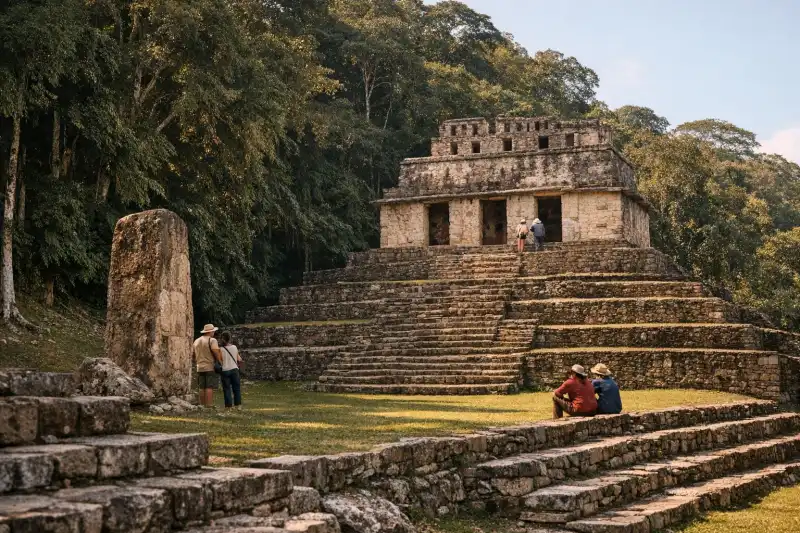
MayaBonampak in Mexico is a small Maya site famed for brilliantly preserved murals deep in the Lacandon ...
Chiapa de Corzo
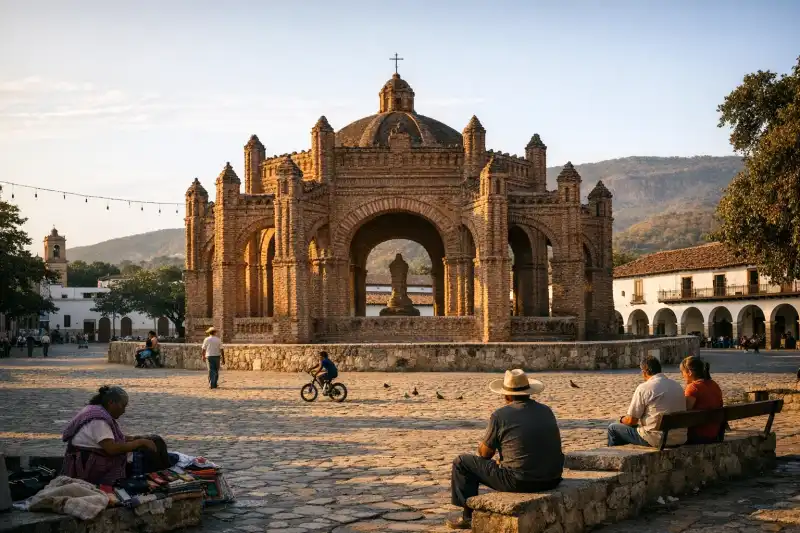
Zoque and earlier Mesoamerican culturesExplore Chiapa de Corzo, Mexico, a major early Mesoamerican site beside the Grijalva River in Chiapa...
Calakmul
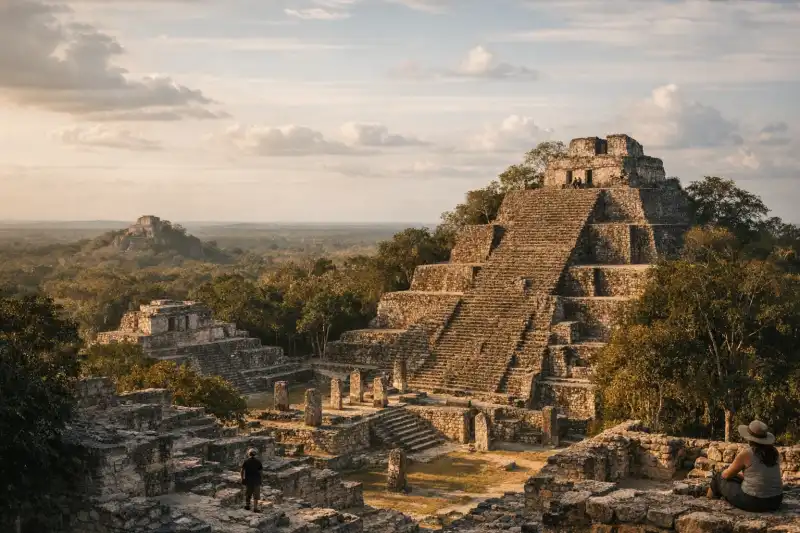
MayaExplore Calakmul, a vast Maya city deep in the forests of Campeche, Mexico, known for towering pyram...