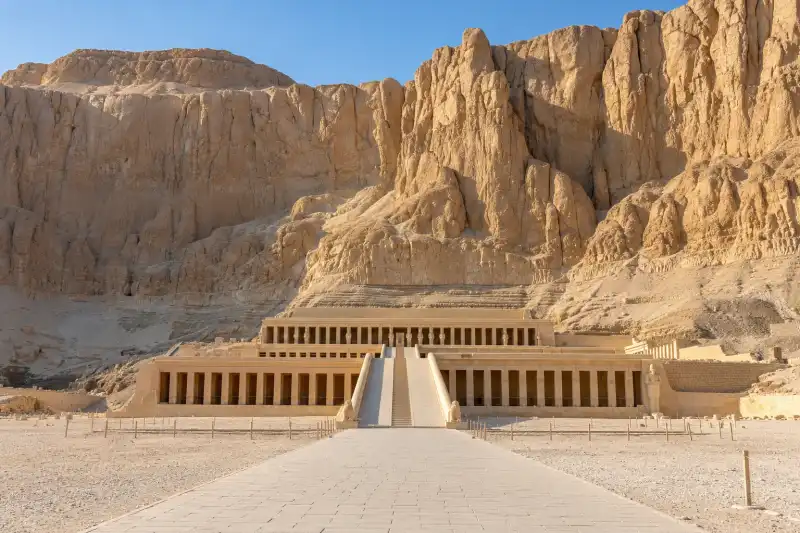
The West Bank of Luxor is not one attraction with a parking lot. It is a broad desert-edge landscape of valleys, tombs, villages, roads and mortuary temples. The right day is built around one or two clusters, not every famous name in the Theban catalogue.
UNESCO describes Ancient Thebes as a property that includes the East Bank temples of Karnak and Luxor and a large archaeological area on the West Bank. That distinction matters in practice. A morning at Karnak is not a warm-up for the West Bank. It is a different kind of visit with a different crossing, scale and rhythm.
Start with a single priority
For many visitors, the Valley of the Kings is the first choice. Its tombs are underground, close in atmosphere and subject to changing access, photography and conservation conditions. Decide which tombs matter to you only after checking current official rules. Do not arrive with a list copied from an old video and assume every name is open or included.
The Valley of the Queens makes more sense as a separate cluster than a hurried add-on. The Temple of Hatshepsut is a mortuary temple visit with a different spatial experience, while Deir el-Medina and the Tombs of the Nobles can be the better choice for travelers who want to look closely at domestic, administrative and workshop worlds around royal burial.
You can fit several of these into a full day. You cannot give all of them equal attention, especially when every entrance, vehicle move and water break has to happen in real time.
Make the route geographic, not alphabetical
A practical day often begins with the site that has the tightest current entry condition or the most exposed walking. Then move to one nearby complementary place. For example, a Valley of the Kings morning may pair with Hatshepsut if the heat and current access make that comfortable. A quieter day may center on Deir el-Medina and the Nobles’ tombs rather than trying to bolt them onto the royal valley.
Ask your driver, guide or hotel to confirm the exact drop-off and collection point. “West Bank” is not an address. Keep the provider’s contact, vehicle description and payment terms offline. If you use the public ferry or a local crossing, leave extra time for the East Bank approach and the onward road leg.
Protect the middle of the day
The West Bank can be hot and exposed. Start early if your confirmed ticket or transport allows it, carry water and sun protection, and keep one flexible pause in the plan. A temple forecourt and a tomb interior ask for different clothing and energy. Move carefully in confined tomb spaces and follow site staff instructions about photos, bags and barriers.
This is not medical advice, and it is not an argument for treating heat as a test of character. If you feel unwell, stop, cool down and seek help. A better itinerary can survive a skipped tomb. Your body will not be impressed by your ranking system.
A full-day framework
| Part of the day | Focus | Why it works |
|---|---|---|
| Early morning | One valley or timed tomb group | Uses cooler conditions and leaves room for current entry procedures |
| Late morning | Mortuary temple or a second nearby cluster | Changes the visual scale after enclosed tombs |
| Midday | Meal, shade and transport reset | Prevents a long exposed chain from becoming miserable |
| Afternoon | Nobles’ tombs, Deir el-Medina or a museum/East Bank alternative | Lets you choose a quieter finish instead of forcing another headline stop |
What to verify
Check official Egyptian tourism or antiquities information close to travel for current entry, tomb access, photography policy, payments and opening arrangements. This guide deliberately does not publish prices, hours, included tombs or guaranteed access. For the wider north-south route, see Nile Valley temples. For East Bank temple planning, keep Luxor Temple and Karnak on a different day if you want the West Bank to feel like more than a bus-window montage.
UNESCO’s Ancient Thebes record is the best starting point for the property’s geography and historical scope.