Quick route summary
This 10-day route starts in Beijing and ends at Jiayuguan, moving from imperial capitals to the desert edge of the Silk Road. The main bases are Beijing, Xi’an, Luoyang, Dunhuang, and Jiayuguan. The route style is fast but workable: three big city bases, one cave-temple base, and a final frontier stop.
You begin with the Forbidden City, the Temple of Heaven, and the Great Wall at Mutianyu. Then the route moves to Xi’an for the Terracotta Warriors and Xi’an City Wall, east to Luoyang for the Longmen Grottoes, and west to Dunhuang and Jiayuguan for Mogao Caves, Yulin Grottoes, and Jiayuguan Fort.
The pace is serious. It is not a lazy grand tour, and it should not be stuffed with every ancient site in northern China. The point is to follow power from palace city to tomb army to Buddhist cliff art to Ming frontier.
Who this itinerary is for
Use this itinerary if you want ancient China in a broad historical sweep and are comfortable with trains, flights, taxis, and a few early starts. It suits travelers who would rather spend an afternoon reading inscriptions and looking at cave murals than shopping or moving slowly through modern city neighborhoods.
It is not ideal for a first trip to China if you want long stays in each city. It is also not the right plan for anyone who dislikes transit days. Beijing to Xi’an is easy enough, Xi’an to Luoyang is straightforward, but reaching Dunhuang and Jiayuguan takes planning. The map is large, and the desert section does not forgive casual scheduling.
Route at a glance
- Day 1: Overnight in Beijing. Visit the Forbidden City, with a light arrival pace and metro or taxi logistics.
- Day 2: Overnight in Beijing. Pair the Temple of Heaven with the Summer Palace, using taxis or metro time carefully.
- Day 3: Overnight in Beijing. Day trip to Mutianyu Great Wall by driver, bus, or guided tour.
- Day 4: Overnight in Xi’an. Train or fly from Beijing, then walk or cycle the Xi’an City Wall.
- Day 5: Overnight in Xi’an. Visit the Terracotta Warriors and the First Emperor’s mausoleum zone east of the city.
- Day 6: Overnight in Luoyang. Take the high-speed train from Xi’an and make a first pass at Longmen if timing works.
- Day 7: Overnight in Luoyang. Give Longmen Grottoes a proper day beside the Yi River.
- Day 8: Overnight in Dunhuang. Fly west toward Dunhuang and keep the day deliberately light.
- Day 9: Overnight in Dunhuang. Visit Mogao Caves, with Yulin Grottoes as a long driver-based extension.
- Day 10: Overnight in Jiayuguan. Transfer to Jiayuguan and finish at the Ming frontier fort.
Practical logistics before you go
The best bases are simple: Beijing for the first three nights, Xi’an for two, Luoyang for two, Dunhuang for two, and Jiayuguan for the final night. Do not change hotels inside Beijing or Xi’an unless you have a strong reason. Packing and repacking will steal more energy than it saves.
High-speed rail works well between Beijing, Xi’an, and Luoyang. The western section is different. Dunhuang sits far out in Gansu, and flights can involve connections through Xi’an, Lanzhou, or other hubs depending on the season. Book the Dunhuang leg early and leave buffer time before your Mogao Caves ticket.
Guided tours make the most sense for Mutianyu, the Terracotta Warriors, and the Dunhuang cave sites. Independent travel is easy enough inside Beijing and Xi’an if you are comfortable with metro systems and taxis. For Yulin Grottoes and Jiayuguan, a driver can turn a difficult day into a manageable one.
Tickets matter. The Forbidden City and Mogao Caves are not places to treat casually. Reserve ahead, carry your passport, and check closure days before you build the trip around them. Beijing also rewards early starts. In summer, heat and crowds can turn a reasonable plan into a slow grind by midday.
The biggest warning: do not overpack the route. China has enough ancient sites to fill a month. This version intentionally skips Pingyao, Datong, Anyang, Tianshui, and many Sichuan sites so the core line does not collapse under its own ambition.
Day 1: Forbidden City and imperial Beijing
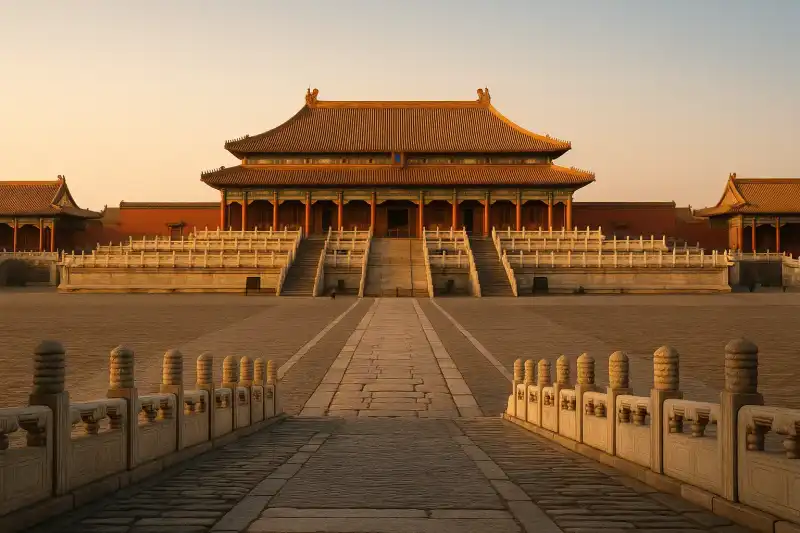
Start with the Forbidden City, but do not treat it as a quick palace visit. The complex served Ming and Qing emperors for roughly five centuries, and its layout is the point: gates, courtyards, throne halls, residential quarters, and gardens all teach you how imperial space controlled movement.
Enter early if you can. The central axis can feel formal and crowded, but the side halls reward slower wandering. Look for the way color and roof forms signal rank. The yellow glazed tiles were not just decoration. They marked imperial privilege in clay and glaze.
Logistics are straightforward but ticket-dependent. Use the metro or taxi, bring your passport, and check the current reservation rules before travel. If you arrive in Beijing that morning, do not add another major site. Palace fatigue is real, and the Forbidden City is better when you are not dragging luggage in your mind.
End the day near Jingshan Park or in a nearby historic neighborhood if you have energy. Keep it gentle. This route gets harder later.
Day 2: Temple of Heaven and the Summer Palace
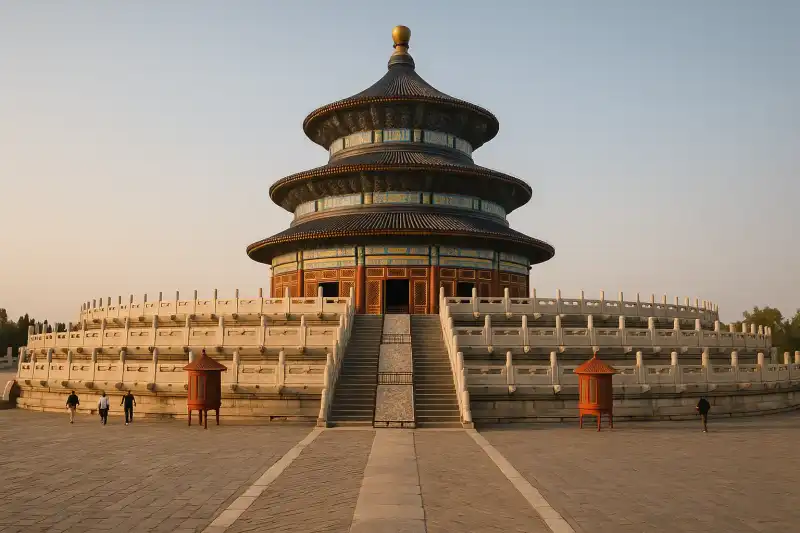
Begin at the Temple of Heaven, where Ming and Qing emperors performed state rituals tied to harvests and cosmic order. The Hall of Prayer for Good Harvests is the famous image, but the larger ritual landscape matters just as much. Circular and square forms, raised terraces, and processional routes all turn political authority into choreography.
This is a good morning site because the park is active early. You may see locals exercising, singing, or playing cards near architecture built for the most formal rituals of the empire. That contrast is one of Beijing’s quiet pleasures.
In the afternoon, cross the city to the Summer Palace. Do not underestimate the transfer. Beijing traffic can eat the middle of the day, so use the metro where it makes sense and avoid scheduling a fixed lunch far from either site. At the Summer Palace, focus on Longevity Hill, Kunming Lake, and the Long Corridor rather than trying to cover every corner.
The historical shift is useful. The Temple of Heaven shows imperial ritual at its most solemn. The Summer Palace shows court life, garden design, and late imperial leisure under pressure from a changing world. It is pretty, but not lightweight.
Day 3: Great Wall at Mutianyu
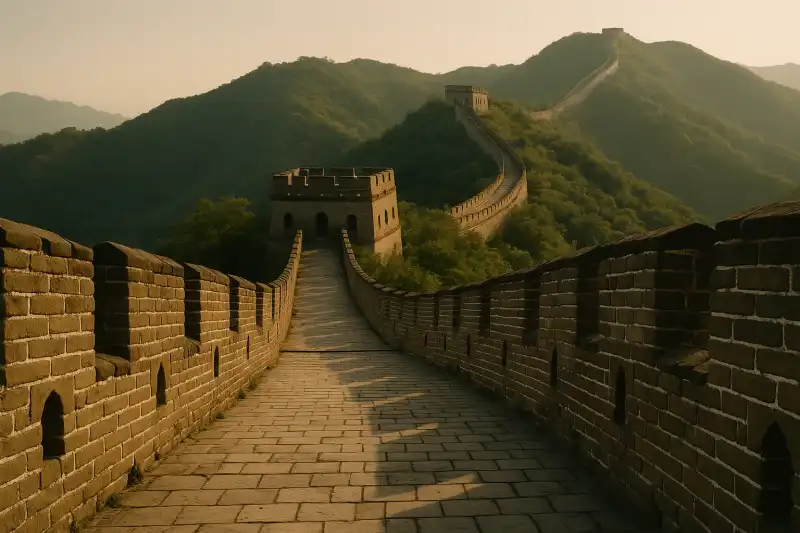
Use Day 3 for the Great Wall at Mutianyu. It is a restored Ming section northeast of Beijing, with watchtowers climbing across ridges in a way that makes the defensive logic easy to feel in your legs. The Wall was not one single line built at one moment. Mutianyu belongs mainly to the Ming frontier system, rebuilt and strengthened when northern defense again became a central concern.
Go early. The drive can take around 90 minutes or more each way depending on traffic, and the site gets busier as the day goes on. A Mutianyu Great Wall day trip from Beijing makes sense if you want transport handled without fuss.
Cable car access helps, but this is still a walking day. The steps vary, the slopes bite, and bad weather changes the mood quickly. Bring water and layers. If you are tempted to add the Ming Tombs in the same day, be honest about your energy. It can work with a driver, but it turns a strong Wall day into a checklist.
Return to Beijing for a final night. Pack for the Xi’an transfer before dinner so Day 4 starts cleanly.
Day 4: Beijing to Xi’an and the city wall
Take a morning high-speed train or flight to Xi’an. The train is often the more satisfying choice if the schedule works: city-center-ish stations, less airport friction, and a clear sense of crossing northern China by land. Still, a flight may save time depending on hotel locations and ticket availability.
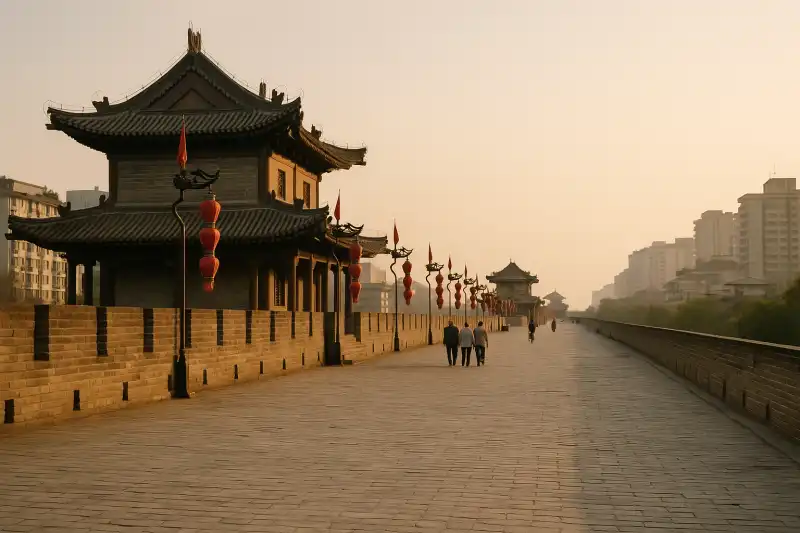
Keep the afternoon for Xi’an City Wall. The wall visible today is mostly Ming in form, built around an older urban core with much deeper capital history. Xi’an, ancient Chang’an, was the capital for several dynasties and one of the great urban nodes of the Tang world.
Walking a section is enough for most travelers. Cycling the wall can be fun, but do it only if weather and energy cooperate. The circuit is long, and the surface can feel rough after a transfer morning. This is not the day to add every Xi’an museum.
The wall helps reset the route. Beijing gave you late imperial space. Xi’an brings you back to Qin, Han, and Tang power, with a city that once faced west toward trade routes, envoys, monks, and armies.
Day 5: Terracotta Warriors and the First Emperor
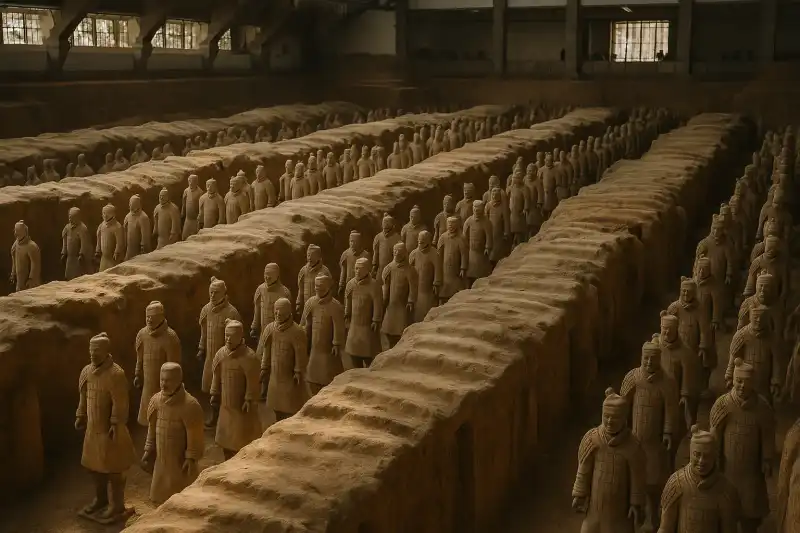
Visit the Terracotta Warriors early. The site sits east of Xi’an near Lintong, and the visit is easier with a driver, taxi, bus, or guided tour. A Terracotta Warriors tour from Xi’an is useful if you want help with transport and context.
The army guarded the burial world of Qin Shi Huang, the ruler who unified China in 221 BCE. Pit 1 gives the scale, but do not rush the smaller pits. They show different troop arrangements and the excavation process more clearly. The figures were once painted, which is easy to forget when you are staring at ranks of earth-colored soldiers.
Pair the warriors with the Mausoleum of the First Qin Emperor area, but keep expectations grounded. The central tomb mound has not been excavated, partly because preservation and safety questions remain. Ancient texts describe rivers of mercury in the emperor’s underground realm. Modern soil tests have found unusually high mercury levels nearby, which gives the old account an uncomfortable little edge.
Return to Xi’an and keep the evening open. This is a dense day, and the museum crowds can be tiring. If you want a food-focused evening inside the old city, keep it casual.
Day 6: Xi’an to Luoyang
Take the high-speed train from Xi’an to Luoyang. The ride is short enough that you can transfer and still salvage part of the day, but do not pretend it is a full sightseeing day. Hotel check-in, station transfers, luggage, and meals all take time.
If you arrive early, make a first visit to Longmen Grottoes. If not, save Longmen for Day 7 and use this afternoon for a slow orientation in Luoyang. That is not a failure. It is the kind of pacing choice that keeps a 10-day route from becoming grim.
Luoyang is one of China’s great ancient capitals, associated with Eastern Zhou, Han, Wei, Sui, Tang, and later periods. The city has moved, rebuilt, and changed across dynasties, so the ancient capital is not a single tidy ruin. Think of Luoyang as a political memory layered under a modern city.
This day is also a hinge. You are leaving the Qin and Tang weight of Xi’an and moving toward Buddhist carving on a monumental scale.
Day 7: Longmen Grottoes and the Yi River
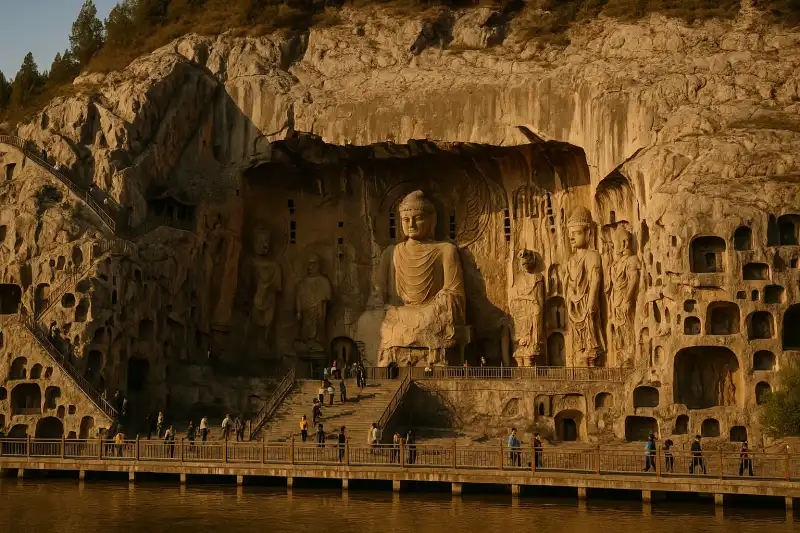
Give Longmen Grottoes most of the day. The caves stretch along limestone cliffs beside the Yi River, with thousands of Buddhist images carved over centuries. The most famous group is the Fengxian Temple, dominated by the large Vairocana Buddha associated with Tang imperial patronage and often linked to Empress Wu Zetian’s era.
The best visit is not just a march to the biggest statue. Look at scale changes: tiny devotional niches, weathered faces, missing heads, dense walls of small Buddhas, and large court-sponsored compositions. Longmen shows Buddhist art becoming both personal and imperial.
Logistically, this is easy compared with the western days. Use a taxi or local transport from Luoyang, arrive early, and wear good shoes. The riverside paths involve steady walking, and summer heat can slow you down. If your train on Day 6 was delayed, this full day protects the site that justifies the Luoyang stop.
Do not add Anyang or Shaolin unless you are cutting something else. Both are tempting. Both can wreck the pacing.
Day 8: Fly west to Dunhuang
Day 8 is a transfer day by design. Fly west toward Dunhuang, usually with routing that may involve Xi’an, Lanzhou, Zhengzhou, or another hub depending on schedules. This is where the itinerary stops being a capitals route and becomes a Silk Road route.
If you land early, resist the urge to squeeze in Mogao Caves unless your ticket timing is already secure and you are fresh enough to listen carefully. Mogao is not a site to see half-awake. Its murals, painted sculpture, cave chronology, and controlled entry system all reward attention.
Use the day for laundry, food, and confirming tomorrow’s logistics. Dunhuang sits at the edge of desert travel, where routes once connected China with Central Asia, India, and the wider Buddhist world. The oasis setting matters. Monks, merchants, officials, translators, and pilgrims all passed through this corridor, leaving art that feels both local and international.
This is the recovery day hidden inside the route. Take it seriously.
Day 9: Mogao Caves and Yulin Grottoes
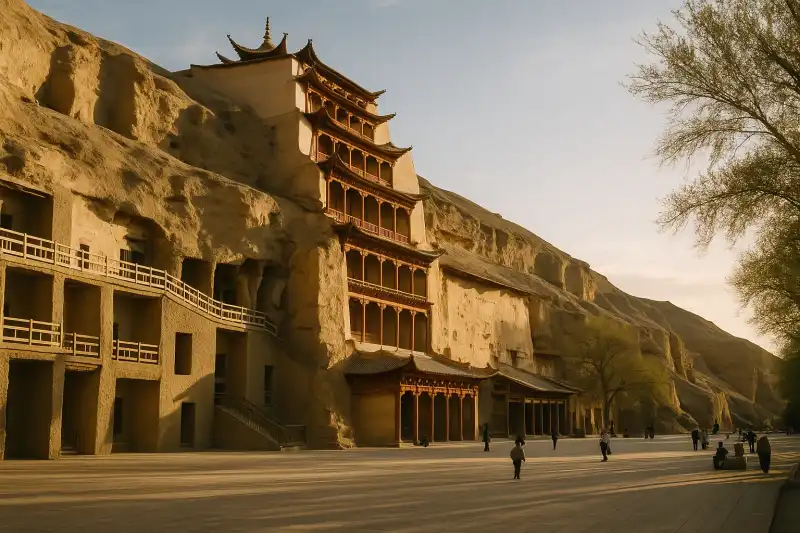
Visit Mogao Caves with advance tickets and timed entry. The cave complex preserves roughly a millennium of Buddhist painting and sculpture, with work spanning from the 4th century into the Yuan period. The famous Library Cave once held tens of thousands of manuscripts and paintings, many later dispersed to collections around the world. That story adds a complicated modern afterlife to the beauty of the site.
Listen closely to the guide system and do not expect to choose every cave yourself. Access is managed for preservation. That can frustrate independent travelers, but it is also why the murals survive at all. Low light, controlled groups, and no casual wandering are part of the bargain.
If you have strong energy and a driver, add Yulin Grottoes or the related Dunhuang Yulin Caves. Yulin sits away from the main Dunhuang circuit and has a quieter desert-ravine setting. It is excellent for travelers who want more Buddhist cave art without the heavier visitor flow of Mogao.
Be careful here. Mogao plus Yulin is a long day, not a neat pairing. A Dunhuang Mogao Caves and Yulin Grottoes tour or private driver can make the logistics sane. If you are tired, skip Yulin and let Mogao breathe.
Day 10: Jiayuguan Fort and the Ming frontier
Travel from Dunhuang to Jiayuguan by train, car, or a planned driver transfer. Check current schedules carefully, because this is not a casual suburban hop. If you prefer less stress, travel the evening before and sleep in Jiayuguan, then use Day 10 fully for the fort.
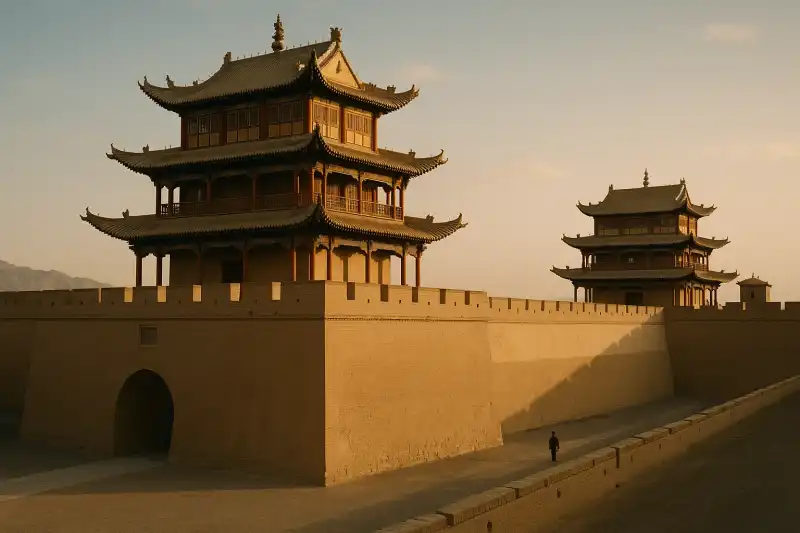
Jiayuguan Fort marked the western end of the Ming Great Wall defense system in Gansu. Its position feels theatrical for a reason: walls, gates, towers, and desert views all announce the edge between imperial control and the routes beyond. The phrase “last pass under Heaven” is often attached to Jiayuguan, and once you stand there, the drama is not hard to understand.
Give the fort enough time to walk the walls and look outward, not just inward. After Beijing’s palaces, Xi’an’s tomb army, Luoyang’s Buddhist cliffs, and Dunhuang’s cave temples, Jiayuguan brings the route back to state power in a harsher landscape. The stones are quiet now, but the message was not subtle.
End in Jiayuguan, or continue onward only if you have a clear plan. Lanzhou, Zhangye, or Xinjiang routes are possible, but they belong to another itinerary. Do not bolt them onto this one at the last minute.
The historical thread: capitals, cave temples, and the road west
This route works because it follows several versions of power. Beijing shows imperial order in courtyards, ritual altars, gardens, and frontier walls. Xi’an turns the story toward unification, burial politics, and Chang’an’s long role as a capital facing both inland China and the wider world. Luoyang adds Buddhist patronage on a monumental cliff face, where devotion and dynasty share the same stone.
Dunhuang changes the scale again. The caves there do not feel like capital architecture. They feel like an archive of movement: monks translating texts, patrons funding murals, travelers carrying images and ideas across desert corridors. Jiayuguan closes the trip with a fort at the Ming frontier, where the Chinese state tried to mark, guard, and define its western edge.
The route is not a simple march from old to new. It is more interesting than that. You see court ritual, military defense, tomb planning, Buddhist art, oasis religion, and frontier anxiety all in one line across northern China.
Transportation notes
Use high-speed rail for Beijing to Xi’an and Xi’an to Luoyang if the schedules fit. Book reserved seats and leave time for station security, taxi queues, and large station layouts. Chinese rail is efficient, but the stations can be enormous.
Fly for the Luoyang or Zhengzhou to Dunhuang leg unless you have extra days. Overland travel west is possible, but it will consume time that this 10-day version does not have. Treat Dunhuang flights as the fragile part of the itinerary and avoid booking Mogao for the same afternoon unless the timing is generous.
Do not self-drive this route unless you already know China driving rules, navigation systems, and language logistics. A driver makes sense for Mutianyu, the Terracotta Warriors if you want comfort, Yulin Grottoes, and possibly Dunhuang to Jiayuguan.
The route compression warning is simple: do not add Pingyao, Datong, Anyang, Maijishan, or Turpan without cutting something. They are all worthwhile. They are also how a strong 10-day route becomes a tired list of stations and missed meals.
Optional add-ons and swaps
Add the Ming Tombs if you want more Beijing imperial funerary history. The best swap is to pair them with a Great Wall day only if you have a driver and do not mind a long outing. Otherwise, remove the Summer Palace from Day 2 and keep the tombs as a separate Beijing day.
Add Maijishan Grottoes if Buddhist cave art is your main interest. This usually means cutting Jiayuguan or adding at least one extra day around Tianshui. Maijishan’s cliffside sculptures are worth the detour, but they do not fit neatly between Luoyang and Dunhuang in a 10-day plan.
Add Qianling Mausoleum from Xi’an if Tang dynasty burial landscapes interest you. Remove the Xi’an City Wall afternoon or add another Xi’an day. The Spirit Way and the headless stone envoys give the site a very different mood from the Qin army.
Add Yinxu Ruins if you want to push deeper into Shang dynasty history and oracle bone writing. The cleanest version is to cut Luoyang down or add a day between Beijing and Xi’an. Do not try to force Anyang into the Luoyang day unless you enjoy punishing train math.
Shorter and longer itinerary options
For a shorter version, use a 5-day Beijing and Xi’an route: three days in Beijing, then two in Xi’an for the city wall and Terracotta Warriors. That keeps the imperial and Qin material without the western flight logistics.
A 7-day version can add Luoyang: Beijing for three days, Xi’an for two, and Luoyang for two. That is the most balanced ancient-capitals route if you do not have time for Gansu.
For a longer version, add three to five days in Gansu and Xinjiang. Maijishan, Zhangye, Turpan, Bezeklik, and Kizil would turn this into a fuller Silk Road cave and oasis route. It would be better as a separate itinerary than a bloated extension of this one.
Related route-family pages will work best as they are published under /itineraries/, especially compact Beijing, Beijing plus Xi’an, and Beijing, Xi’an, Luoyang versions of this route.
Related ancient sites
- Badaling Great Wall
- Ming Tombs
- Zhoukoudian Caves
- Mount Huashan Ancient Temples
- Qianling Mausoleum
- Yinxu Ruins
- Maijishan Grottoes
- Bingling Temple Grottoes
- Bezeklik Thousand Buddha Caves
- Kizil Caves
FAQ
The most common planning questions for this route are answered below.