Quick route summary
This 5-day route starts in Izmir and ends around Selcuk or Kusadasi, using two practical bases for Turkey’s Aegean ancient sites. It begins with Pergamon and the northern Aegean road to Troy, then moves south for Ephesus, Priene, Miletus, and Didyma.
The pace is full, but it has a clean logic: hilltop kingdoms, layered Bronze Age memory, Roman provincial cities, gridded Ionian planning, ancient harbors, and a vast oracle sanctuary. The route works best with a rental car, driver, or guided day trips. It does not work well if you try to stitch every stop together by public transport without slack.
Who this itinerary is for
This itinerary is for travelers who want western Turkey as an ancient-sites route rather than a single Ephesus excursion. It suits people who can handle early starts, long road days, outdoor ruins, and a mix of famous sites and quieter archaeological landscapes.
It is not ideal if you want a beach-heavy Kusadasi stay, a no-driving trip, or a relaxed city break in Izmir. Those can be good trips, but this route is built around moving through the Aegean coast and understanding why these cities belonged to the same ancient world.
Route at a glance
- Day 1: Overnight in Izmir. Visit Pergamon by car, driver, or guided day trip, with time for the acropolis and steep site logistics.
- Day 2: Overnight in Izmir. Make a long northern Aegean day to Troy, adding Assos only if you are comfortable with extra road time.
- Day 3: Overnight in Selcuk. Move south and give Ephesus the main day, with the Terrace Houses if open and practical.
- Day 4: Overnight in Kusadasi or Selcuk. Use a driver, rental car, or focused tour for Priene, Miletus, and Didyma.
- Day 5: Overnight in Kusadasi. Choose Aphrodisias, Pamukkale and Hierapolis, or a slower local finish depending on onward travel.
Practical logistics before you go
Use Izmir for the northern half and Selcuk or Kusadasi for the southern half. Izmir works better for Pergamon and the Troy road. Selcuk is the most practical base for Ephesus. Kusadasi gives more hotels, restaurants, and cruise-port services, and it works well for the Priene, Miletus, and Didyma circuit.
A car or driver makes the route much smoother. Ephesus can be reached easily from Selcuk or Kusadasi, but Pergamon, Troy, Priene, Miletus, and Didyma become awkward if you rely only on buses and trains. Public transport can handle pieces of the route. It is not the right tool for the whole five days.
Guided tours make the most sense at Ephesus and on the Priene, Miletus, and Didyma day. Pergamon also benefits from context because the acropolis, theater, library tradition, sanctuary landscape, and later Roman city do not explain themselves neatly from one viewpoint.
Do not overpack the route with Bodrum, Pamukkale, Aphrodisias, and the Lycian coast in the same five days. Western Turkey looks compact on a planning map, but distances, heat, parking, and site size add up quickly.
Day 1: Izmir arrival and Pergamon
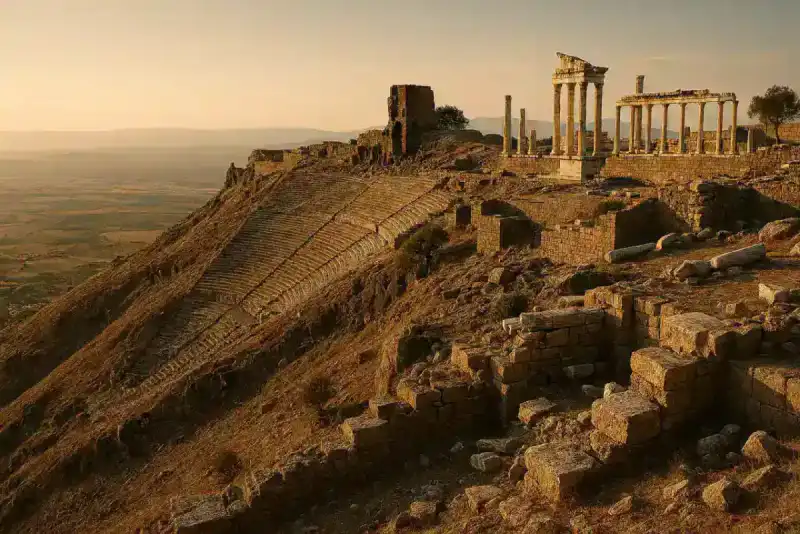
Start from Izmir and head north to Pergamon. The acropolis sits high above modern Bergama, and the setting matters. Pergamon was not trying to hide its power. Its theater drops sharply down the slope, its sanctuary spaces command the landscape, and its royal architecture made elevation part of the message.
A Pergamon day trip from Izmir is useful if you do not want to manage transport and site timing on arrival day. If you self-drive, start earlier than you think you need to, especially if you plan to see both the acropolis and lower-city zones.
Pergamon is associated with one of the great libraries of the ancient Mediterranean, a rival to Alexandria in later tradition. Even if the library itself survives only in traces and memory, the city still feels like a place built for intellectual and political display. This is a good first stop because it shows the Aegean route at royal scale before you move into city grids, harbors, and sanctuaries.
Return to Izmir for the night. Do not continue straight to Troy unless you are turning the day into a road grind.
Day 2: Troy and the northern Aegean road
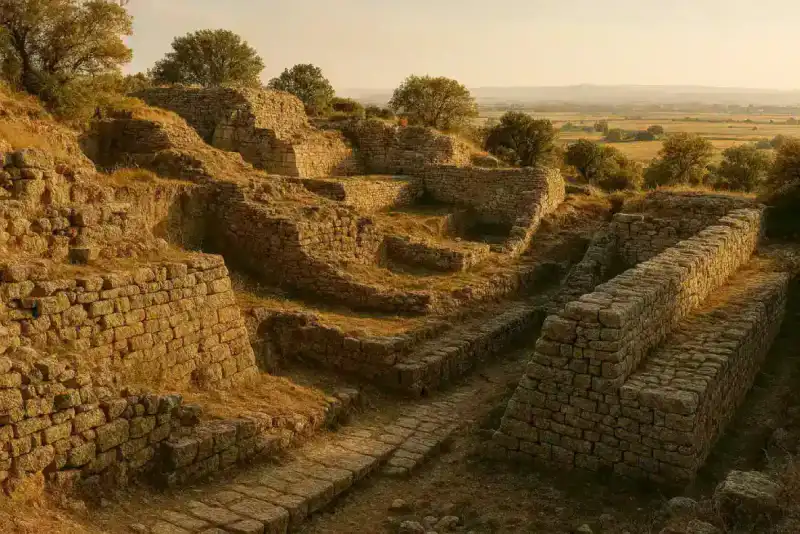
This is the hardest road day of the itinerary. Visit Troy from Izmir only if you are prepared for a long drive, or arrange a driver who understands that the day needs buffers. The site is not difficult to walk, but reaching it and returning south takes real time.
Troy rewards travelers who arrive with the right expectations. It is not a single Homeric city waiting in perfect outline. It is a layered mound with multiple settlements stacked over time, from Bronze Age fortifications through later Greek and Roman rebuilding. The pleasure is in seeing how archaeology complicates legend rather than simply proving it.
Give the site museum and mound enough time if your route allows. Without context, Troy can feel visually modest after Pergamon. With context, it becomes one of the most interesting stops on the coast because it forces you to hold myth, excavation history, warfare, trade routes, and later memory together.
If you add Assos, treat it as a major extension, not a casual extra. The Temple of Athena and acropolis setting are worth seeing, but pairing Assos and Troy from Izmir creates a very full day. Skip Assos if you need to protect stamina for Ephesus.
Day 3: Ephesus with the Terrace Houses
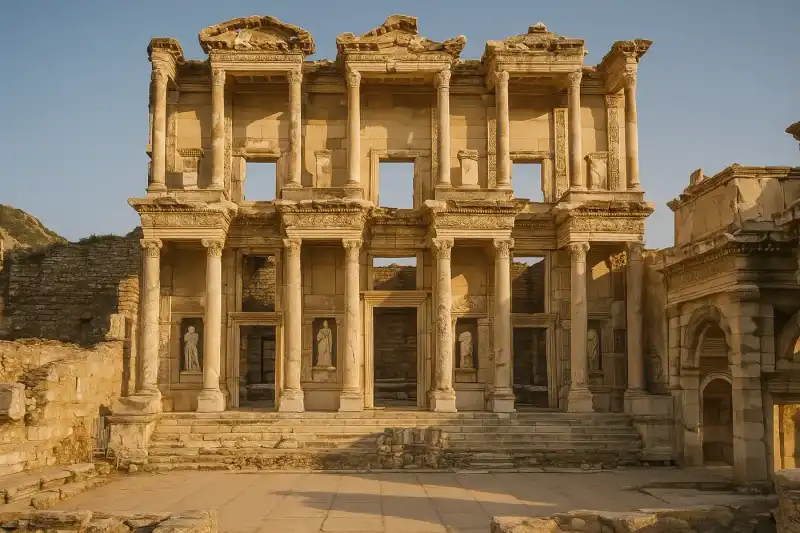
Move south to Selcuk or Kusadasi and give Ephesus the main day. Start early, especially if cruise ships are in port. Ephesus can feel crowded and theatrical at peak hours, but it is still one of the best places in Turkey to understand Roman urban life in Asia Minor.
A guided Ephesus tour from Kusadasi or Selcuk is a sensible choice here. The Library of Celsus, theater, Curetes Street, fountains, gates, latrines, and civic spaces are much better when someone can explain how they fit into a working provincial city.
If the Terrace Houses are open, make time for them. They shift the visit from public marble display to elite domestic life: mosaics, wall paintings, private rooms, and expensive urban households stacked into the slope. Ephesus was not only a city of monuments. It was a place where status operated in streets, houses, cult spaces, and public benefactions.
Keep the evening easy in Selcuk or Kusadasi. Tomorrow’s Priene, Miletus, and Didyma circuit is one of the best days of the route, but it needs an early start and clean transport.
Day 4: Priene, Miletus, and Didyma
Use a driver, rental car, or focused tour for Priene, Miletus, and Didyma. These three sites belong together historically, but they are not simple to connect by public transport. This is exactly where paying for logistics gives you a better ancient-history day.
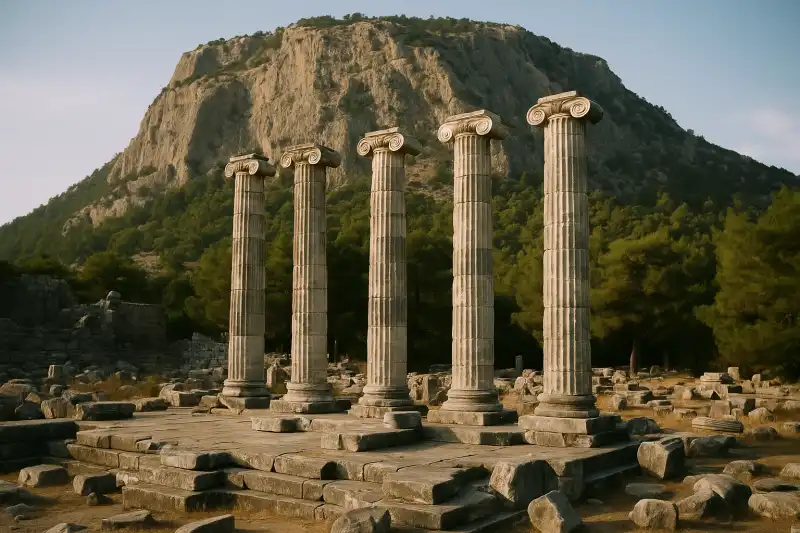
Start at Priene if possible. Its gridded plan, mountain setting, and Temple of Athena make urban design unusually readable. The city once related to a coastal and river landscape that has changed dramatically through silting. The missing sea is part of the point: ancient geography on this route is often not where the modern eye expects it.
Continue to Miletus. The theater is the main surviving anchor, but the city’s intellectual and maritime reputation matters too. Thales, Anaximander, and Anaximenes are associated with Miletus, which means this was a place where Greeks argued about nature, order, and what the world was made of. That is a different kind of monument.
End at Didyma and the Temple of Apollo. The scale is deliberate: huge columns, unfinished surfaces, and a sanctuary built around oracular authority. The sacred road linked Didyma with Miletus, so the day closes with city and sanctuary in conversation.
A Priene, Miletus, and Didyma day trip is one of the most useful tour options on the route. Do not add Ephesus to this same day unless you are accepting a rushed version of everything.
Day 5: Aphrodisias, Pamukkale, or a slower Kusadasi finish
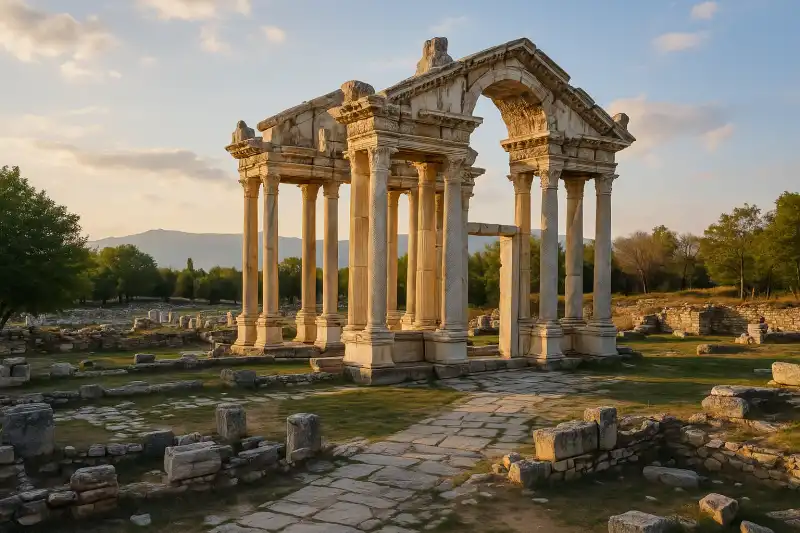
Use the final day according to your onward travel. The strongest archaeology choice is Aphrodisias, an inland site with a remarkable stadium, sculptural workshops, temple remains, and a museum that makes the city’s marble culture easier to understand. It is worth the effort, but it is not a small detour.
If your trip is heading inland, you can instead choose Pamukkale and Hierapolis. The travertine landscape and ancient spa city are memorable, but the day becomes more about distance. Start early, check driving times, and avoid scheduling a tight evening departure.
For a calmer finish, stay near Selcuk or Kusadasi. Revisit a museum, return to Ephesus at a different hour, or simply stop after four dense archaeology days. A slower final day is not wasted time. It may be the thing that lets the route settle in your head.
Do not try to add Aphrodisias, Pamukkale, and Hierapolis all as a casual final-day loop from the coast. That is a long logistics puzzle, not a thoughtful ancient-sites plan.
The historical thread: Aegean cities, old coastlines, and sacred ambition
This route follows western Turkey through several versions of ancient power. Troy gives you layered settlement and later mythic memory. Pergamon shows a Hellenistic kingdom using height, architecture, and culture to announce itself. Ephesus shifts the story to Roman Asia Minor, where civic display, trade, imperial cult, and elite houses filled a major provincial city.
Priene, Miletus, and Didyma bring the Ionian coast into sharper focus. Cities planned streets, argued about nature, built harbors, sent out colonies, and tied themselves to sanctuaries through ritual routes. The Maeander landscape also reminds you that coastlines move. Some places that feel inland now once belonged to a maritime world.
The route is most interesting when the sites start correcting each other. Ancient western Anatolia was not one culture frozen in stone. It was Greek, Anatolian, Persian, Hellenistic, Roman, local, coastal, inland, sacred, commercial, and stubbornly changeable.
Transportation notes
Use Izmir for the northern sites and Selcuk or Kusadasi for the southern sites. That base split keeps the route manageable. Staying in Kusadasi for all five days makes Troy and Pergamon too heavy. Staying in Izmir for all five days makes Ephesus and the Ionian circuit less pleasant than they need to be.
A rental car gives the most flexibility, but a driver can be better if you dislike navigation, rural roads, or long summer driving days. Day 2 to Troy and Day 4 to Priene, Miletus, and Didyma are the two days where transport planning matters most.
Do not rent a car only to leave it parked in difficult town centers without a plan. Choose hotels with parking advice, especially in Izmir, Selcuk, and Kusadasi. The ancient sites are the reason for the trip, not a nightly argument with parking.
Public transport is useful for some individual pieces, but it does not serve the full route well. If you are determined not to drive, combine guided day trips from Izmir and Kusadasi with intercity transfers.
Optional add-ons and swaps
If you want a shorter and tighter southern route, use the Selcuk/Kusadasi portion of 5 Days on Turkey’s Aegean Ancient Sites. It cuts Troy and Pergamon so the trip can stay focused around Ephesus, Priene, Miletus, and Didyma.
If you want a stronger inland finish, add Aphrodisias as a full day and remove Troy or the slower final option. It pairs well historically with Ephesus because both show Roman Asia Minor through city planning, elite display, and public architecture.
If you want thermal landscapes, add Pamukkale and Hierapolis after the Aegean coast. This works better with an extra night near Denizli. Remove Troy if you must keep the trip to five days.
If you want a quieter coastal detour, add Assos while visiting Troy. Remove the final inland day or accept a longer northern road day. Assos is beautiful and historically worthwhile, but it does not fit painlessly into a tight route.
Shorter and longer itinerary options
For a shorter route, use the Selcuk/Kusadasi portion of the 5 Days on Turkey’s Aegean Ancient Sites itinerary. It is the better choice if Ephesus and the Ionian sanctuary circuit are your main priorities.
For a broader western Turkey route, use 7 Days in Ancient Turkey: Istanbul, Troy, Pergamon, and Ephesus. That version gives more room to the northern route and arrival logistics.
For a deeper country route, the planned 10-day ancient Turkey itinerary adds the Aegean coast, Lycia, and early Anatolian sites such as Gobekli Tepe. Do not force that scale into five days.
Related ancient sites
FAQ
The most common planning questions for this route are answered below.