Quick Info
Curated Experiences
Sunken City Kekova, Demre and Myra Day Tour from Antalya
Demre, Myra and Kekova Boat Trip from Kemer
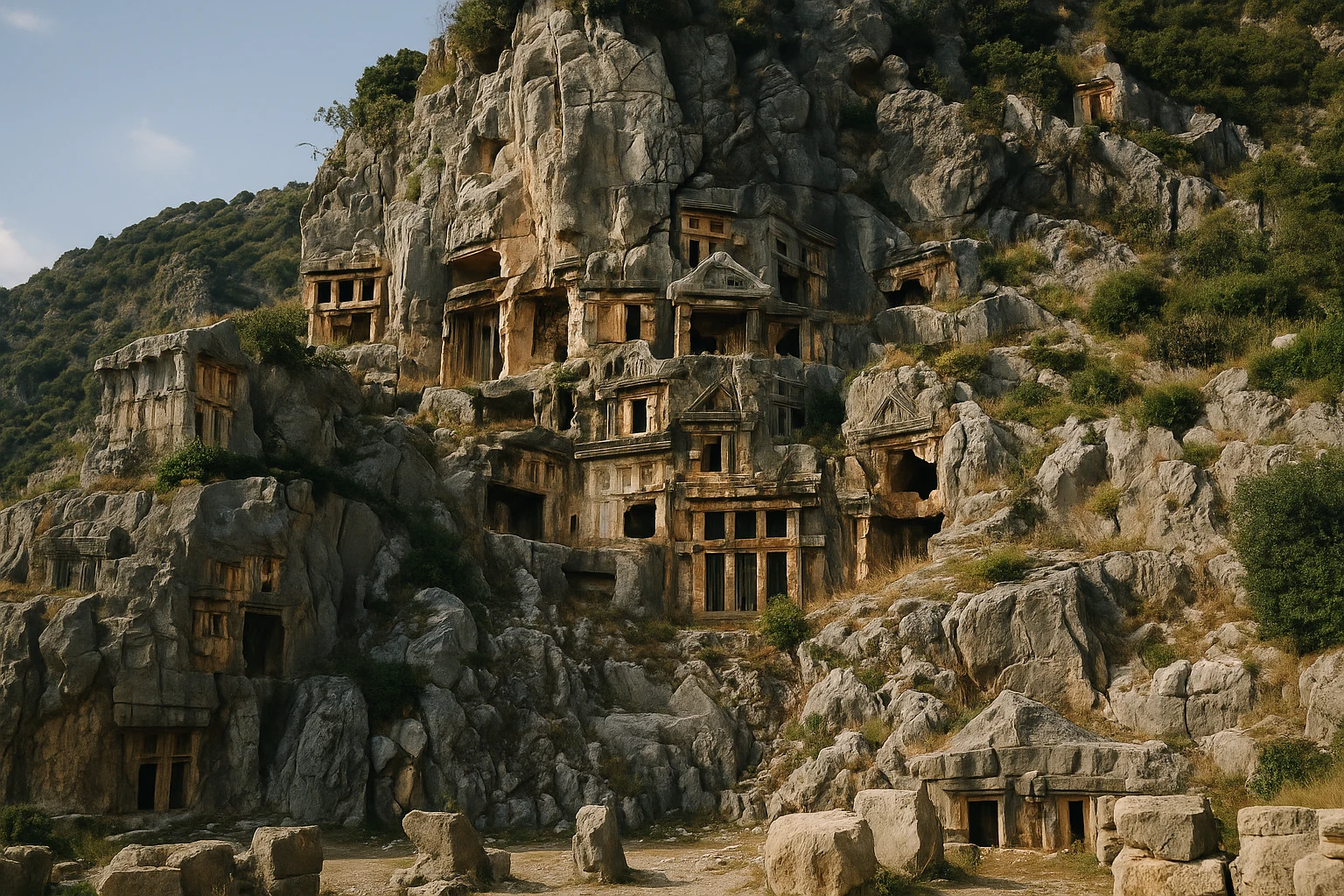
In this Myra Turkey travel guide, you arrive at one of the Mediterranean’s most striking archaeological scenes: a Roman theatre spread across the valley floor, while high above it a wall of Lycian tombs is carved directly into the cliff. Myra, in modern Demre on Turkey’s southwest coast, is not simply a quick excursion stop. It preserves three deeply different historical worlds in one compact place: independent Lycian identity, Roman civic architecture, and Byzantine religious memory tied to Saint Nicholas of Myra.
What makes the site exceptional is the way those layers remain readable without needing a long walk between them. The tomb facades speak of status, ancestry, and local tradition; the theatre reflects imperial-era public life; and nearby Demre adds the Christian chapter that later connected this town to global legend. At Ancient Travels, we recommend seeing Myra as both a standalone destination and a practical anchor for a larger day that can include St. Nicholas Church and a Kekova boat segment. This guide covers the site’s historical arc, key monuments, transport, admission and timing strategy, seasonal trade-offs, and how to combine everything without rushing.
History: A Lycian Capital Rewritten by Empires
Lycian foundations and regional influence (c. 5th-4th century BCE)
Before Rome reached this coast, Myra was already an important city of Lycia, the southwestern Anatolian region known for its league politics, maritime ties, and distinct funerary architecture. Myra sat inland from the coast but connected to the sea through the Andriake harbor area, allowing trade access with a safer defensive position. The famous rock-cut tombs began as statements of elite identity: families carved monumental facades into steep limestone to project rank, continuity, and civic belonging. Even in ruin, the necropolis still communicates that social memory in Myra was meant to be seen at distance and remembered across generations.
Hellenistic adaptation after Alexander (late 4th-1st century BCE)
After Alexander the Great transformed the political map of Anatolia, Myra entered the Hellenistic sphere. Greek language and administrative habits became more visible, but local traditions did not disappear. Instead, the city adapted selectively, keeping core Lycian identity while participating in wider regional diplomacy and exchange. Its role within the Lycian League placed it inside a sophisticated federal framework where cities shared representation and negotiated power collectively. This period laid foundations for later Roman prosperity by strengthening Myra’s regional connections without erasing its local character.
Roman urban growth and monument building (1st century BCE-3rd century CE)
Under Roman rule, Myra became more fully integrated into imperial networks of law, taxation, and infrastructure. Agricultural wealth and coastal trade supported major public works, including the theatre that dominates the site today. Rebuilt and expanded after seismic events, the theatre reflects both engineering ambition and civic display: it was a place for performance, but also for the politics of visibility, patronage, and belonging. What makes Myra unusual is that this Roman civic core sits directly below a Lycian funerary skyline. The result is a layered urban image where empire and local memory coexist rather than fully replacing one another.
Byzantine Myra and Saint Nicholas (4th-11th century CE)
As Christianity became central in the eastern empire, Myra gained importance as a bishopric. Its most famous bishop, Nicholas of Myra, lived in the 4th century CE and became known for acts of charity and protection. Over time, stories about him spread far beyond Anatolia, eventually feeding traditions that later shaped the Santa Claus figure in the West. Historically, however, Myra’s significance in this era was broader than one biography: it became a regional religious center with pilgrimage value and institutional continuity even as political pressures shifted around the eastern Mediterranean.
Archaeology, conservation, and modern visitation (19th century-present)
From the 19th century onward, travelers and scholars documented Myra’s tombs and theatre, but systematic excavation and conservation expanded significantly in the modern Turkish period. Ongoing work focuses on stabilization, drainage, visitor circulation, and careful restoration rather than heavy reconstruction. Earthquakes, weathering, and mass tourism continue to challenge preservation, so much of what you see today reflects active management choices as well as ancient remains. Myra’s current strength is this balance: it is accessible enough for broad travel itineraries, yet still authentic enough to show the fragility of stone monuments exposed to centuries of climate and seismic stress.
The Key Monuments: What to See at Myra
The Lycian rock-cut tombs
The cliff necropolis is Myra’s signature monument and one of the most recognizable funerary ensembles in Turkey. Tomb facades were cut directly into limestone and shaped to resemble timber-built houses, with pediments, framed openings, and decorative details translated into stone. This architectural language was not decorative excess; it encoded social rank and family memory in a public visual form. Placement mattered. Higher and larger tomb groups likely marked elite status, making the cliff itself a social map visible from the civic zone below.
You cannot freely enter most chambers, but the facades alone reward careful study. Craftsmen worked at hazardous heights and on irregular rock faces, yet achieved a coherent composition that still reads as a monumental “city of the dead.” Morning light tends to reveal carved detail most clearly, while late-afternoon side light creates deeper contrast and dramatic shadow. If photography matters to you, bring both a wide lens for context and a zoom for relief features.
The Roman theatre
At the base of the necropolis sits Myra’s large Roman theatre, one of Lycia’s standout civic monuments. Significant seating tiers survive, and stage-building fragments still suggest the ornamental scale the structure once carried. Like most Roman theatres, it served more than entertainment. It was an urban institution where public identity, hierarchy, and civic ritual became visible through architecture. The seating design, circulation passages, and relationship between orchestra and stage all reflect practical solutions for managing large audiences while preserving acoustic and visual impact.
What makes this theatre memorable is its dialogue with the tomb cliff above. In one frame you see public life and ancestral memory layered together: spectacle below, funerary monument above. Few Mediterranean sites offer that composition so directly. For photography, start from the lower seating and angle upward to include both theatre curvature and necropolis facade.
The Roman-period city fabric and agora zone
Beyond the headline monuments, scattered walls, foundations, and reused blocks mark Myra’s broader urban core. These remains are less theatrical but essential for understanding scale. They show that Myra was a functioning city with market activity, administrative routines, and movement corridors linking civic and religious spaces. Later reuse and sedimentation obscured parts of the plan, but masonry differences and alignments still reveal multiple building phases tied to repair, adaptation, and changing priorities.
Travelers often move quickly through this area, yet it is where the city becomes real rather than iconic. Slow down, compare stonework, and note how open and enclosed zones were organized. If your interest goes beyond “best photo spots,” this is where Myra’s everyday Roman life becomes most legible.
The hillside setting and defensive logic
Myra’s topography helps explain its long life. Elevated ground, controlled approaches, and visibility across the plain offered strategic advantages even when walls were repaired or reconfigured over time. You may not see complete fortifications everywhere, but the landscape still shows how movement could be observed and managed. The city was planned not just for ceremony but for resilience, with burial, civic, and religious zones distributed across a defensible terrain.
Walking short perimeter paths adds this missing context. Without it, Myra can feel like only two disconnected attractions. With it, the site reads as an integrated urban system shaped by geography as much as by empire.
St. Nicholas context in Demre
The Church of St. Nicholas is in modern Demre rather than inside the archaeological core, but historically it belongs to the same story. Myra’s late antique identity was inseparable from its bishopric role, and visiting the church after the ruins gives chronological closure to the day. You move from Lycian and Roman stone into Byzantine devotional space and see how the city’s meaning shifted across centuries.
The church itself reflects many phases of repair and rebuilding, so treat it as a layered monument, not a frozen snapshot of the 4th century. The strongest sequence is Myra first, church second: civic and funerary foundations first, religious transformation afterward.
Getting There: Transportation and Access
Myra is easy to plan if you treat distances realistically and build in transfer time.
From Antalya
From central Antalya, expect about 2.5-3.5 hours each way by road, depending on traffic and seasonal congestion.
- Rental car: Best flexibility for combining stops; fuel and related costs often land around 900-1,800 TRY ($28-56 USD), depending on vehicle and current prices.
- Intercity bus + local transfer: Bus to Demre from Antalya Otogar, then local taxi or dolmuş to the site; usually 350-700 TRY ($11-22 USD) total per person, with longer travel time.
- Organized day tour: A practical option if you want Myra, St. Nicholas Church, and Kekova in one package; commonly around 1,800-3,500 TRY ($56-109 USD), based on inclusions.
From Kaş or Kalkan
For travelers based west along the Lycian coast, Myra is far more manageable as a half-day or day excursion.
- Taxi/private transfer: Around 45-70 minutes from Kaş, 70-100 minutes from Kalkan; often 1,200-2,500 TRY ($37-78 USD).
- Dolmuş/local bus: Budget-friendly but frequency varies; often 150-350 TRY ($5-11 USD), plus potential waits.
- Rental car: Ideal if you want to add Andriake, coastal lookouts, or flexible meal stops.
From Fethiye or Dalaman area
Myra can work as part of an eastbound transfer day rather than an out-and-back excursion.
- Private transfer: Usually 3-4.5 hours, commonly 3,500-6,500 TRY ($109-203 USD).
- Public transport: Possible but slow and change-heavy, better for flexible itineraries.
- Self-drive: Scenic and practical if you’re comfortable with long coastal stretches.
Admission and Hours
Myra generally follows seasonal opening patterns with longer summer hours and shorter winter hours, but exact schedules can change yearly. A practical planning baseline is early opening and late-afternoon winter closure. Ticketing is usually straightforward at the gate; card acceptance is improving but not universal, so carry backup cash in TRY. If you intend to use a museum pass, verify current inclusion at the entrance because pass policies shift over time. For both comfort and photography, aim for the first 90 minutes after opening or the final 90 minutes before closing.
When to Visit: Seasonal Considerations
Spring (March-May)
Spring is usually the best overall season, with many days around 16-27°C (61-81°F). Hillsides are greener, visibility is often clear, and heat stress is lower than summer. Visitor numbers rise during holiday periods, but mornings remain manageable.
Summer (June-August)
Summer can be intense, often reaching 30-38°C (86-100°F) by midday. Shade is limited and stone reflects heat. Crowd levels are highest in this period, especially with bus tours. Start early, hydrate aggressively, and avoid treating noon as prime exploration time.
Autumn (September-November)
Autumn is an excellent alternative to spring, with early-season warmth around 20-32°C (68-90°F) and gradually cooler conditions later. Crowds typically ease after peak summer, and late-afternoon light can be excellent for tomb facade texture.
Winter (December-February)
Winter is quieter and often atmospheric, usually 10-18°C (50-64°F) in daytime. Rain is intermittent, so surfaces may be slick. The trade-off is worthwhile for travelers who prefer space, calmer pacing, and easier photo composition.
Combining Myra with Demre and Kekova
A strong one-day sequence begins at Myra by 8:30 AM, before heat and group traffic build. Spend about 90 minutes on the core archaeological zone: first the theatre, then the necropolis facade, then a short perimeter walk to understand the wider urban setting. By 10:15 AM, continue to St. Nicholas Church in Demre for 45-60 minutes, enough to add the Byzantine chapter without rushing.
If you want the full regional experience, continue toward the Kekova boat departure points and aim to board around 12:30 PM-1:00 PM. A 1.5-2.5 hour cruise over the coastal and sunken-city landscape adds maritime context to what you saw inland at Myra. After disembarking, take a late lunch in a harbor village and then return.
This sequence is comfortable for travelers based in Kaş and still feasible from Antalya if you accept an early start and late finish. If time is tight, prioritize Myra plus St. Nicholas and skip the boat. The key is pacing: Myra is most rewarding when treated as the intellectual center of the day, not a quick stop between transfers.
Practical Information
What to bring
- Sun protection: Hat, sunscreen, and sunglasses are essential.
- Water: Carry 1 liter per person in shoulder season, 1.5-2 liters in summer.
- Footwear: Grippy shoes for uneven paths and loose gravel.
- Camera setup: Wide lens for theatre context, zoom for tomb details.
- Cash backup: Keep some TRY for parking, snacks, or card-machine issues.
Dress code and etiquette
Myra is an open archaeological site without strict dress enforcement, but respectful clothing is smart in Demre’s local setting. If you also visit churches or other religious spaces, covering shoulders and knees is a safe default. Avoid climbing fragile masonry for photos, and assume drone flights may require permission.
Accessibility
The theatre-adjacent circulation routes are manageable for many travelers, but uneven surfaces and limited shade can be challenging for mobility-limited visitors. Closer tomb viewpoints may require rougher walking. Early visits and shorter loops help families and older travelers keep the experience comfortable.
Why Myra Matters
Myra matters because it resists single-label history. It is not only Lycian, not only Roman, not only Byzantine. Each era left visible structure without fully erasing the previous one. The tomb cliff preserves older ideas about ancestry and status; the theatre records Roman civic order; the Demre church tradition marks the city’s later religious transformation.
For travelers, that continuity is the real value. You are not viewing disconnected ruins but reading a long argument about memory, power, and belonging in one physical landscape. Stand in the theatre late in the day, when warm light climbs the tomb facades above, and Myra feels less like a dead city than a living archive of how societies build on top of their own past.
Quick Facts
| Attribute | Details |
|---|---|
| Location | Demre, Antalya Province, Turkey |
| Ancient Name | Myra (in Lycia) |
| UNESCO Status | Not individually inscribed; part of Turkey’s protected archaeological heritage |
| Established | c. 5th century BCE urban center |
| Distance from nearest hub | About 2.5 km from Demre center; ~145 km from Antalya |
| Entry Fee | Seasonal official pricing; verify current TRY rate at ticket office |
| Hours | Seasonal schedule, typically longer in summer and shorter in winter |
| Best Time | Spring and autumn, or early morning in summer |
| Suggested Stay | 1.5-2.5 hours on site (full day with Demre + Kekova) |
| Top Highlights | Lycian cliff tombs, Roman theatre, St. Nicholas context in Demre |
Explore More Turkey
- Perge: A vast Roman city plan near Antalya with colonnaded avenues, baths, and stadium remains.
- Side: A coastal ancient city where Roman monuments stand beside the Mediterranean.
- Hierapolis: A major Greco-Roman spa city above Pamukkale’s travertine terraces.
Plan your wider journey through classical Anatolia with our Turkey ancient sites hub and pair coastal archaeology with practical planning from our Turkey travel guides.
Frequently Asked Questions
How much time should I plan at Myra?
Most travelers should budget 1.5-2.5 hours for the archaeological site itself, including the Roman theatre and the rock-cut tomb facade. If you also want to visit St. Nicholas Church in Demre and take a Kekova boat trip, turn it into a full-day plan. Arriving early keeps your pace comfortable and avoids mid-afternoon heat.
What is the best time to visit Myra?
Spring (April-May) and autumn (late September-October) are usually ideal, with warm but manageable temperatures and clearer light for photos. In summer, visit right at opening time to avoid the hottest part of the day. Winter can be peaceful and green, but occasional rain is common along this coast.
Do I need a museum pass for Myra?
Myra is part of Turkey's museum system, and entry conditions can change season to season. If you are visiting multiple archaeological sites and museums in Turkey, a Müze Kart option can offer strong value. Always check the latest rules at the official ticket booth or Ministry of Culture channels before your visit.
How do I get to Myra from Antalya?
From Antalya, the simplest options are a rental car (about 2.5-3.5 hours depending on traffic) or an organized day tour that bundles transport with Kekova and Demre. Public buses run toward Demre from Antalya's main otogar, then a short taxi or dolmuş connection gets you to the site. Private transfers are also common for small groups.
What are the main highlights at Myra?
The two major highlights are the dramatic Lycian rock-cut necropolis carved into the cliff and one of the best-preserved Roman theatres in Lycia. You'll also see traces of the Roman city fabric and later Byzantine-era occupation in the surrounding landscape. The visual contrast between funerary tomb architecture and public entertainment architecture is what makes Myra distinctive.
Is Myra suitable for families and older travelers?
Yes, many travelers of different ages visit comfortably, but expect uneven stone surfaces and limited shade. The main theatre zone is relatively straightforward, while access closer to tomb viewpoints can involve more walking over rough ground. Bring water, sun protection, and stable footwear, and move slowly in hot weather.