Quick Info
At a glance
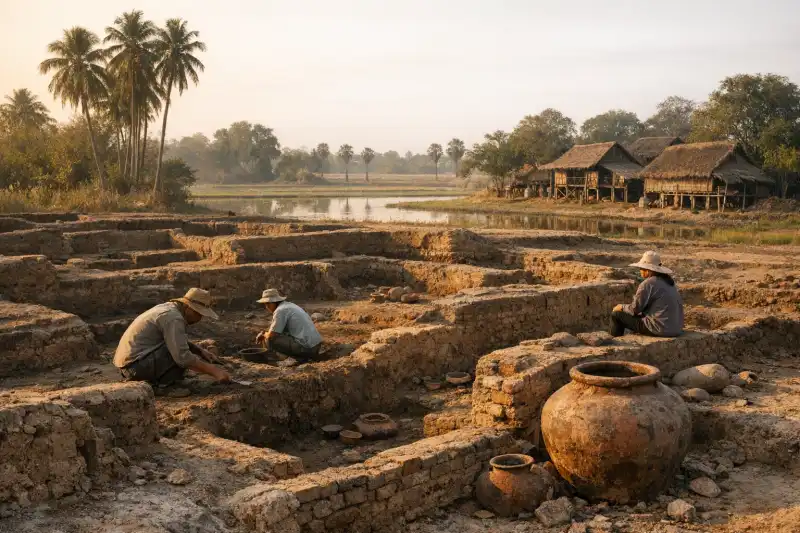
Non Ban Jak in Thailand is not the kind of ancient destination that overwhelms visitors with towering stone monuments or long ceremonial avenues. Its power is quieter. Set within the plains of northeastern Thailand, in a region shaped by rivers, agriculture, and long human settlement, the site opens a window onto a prehistoric world that once thrived behind earthen embankments and moats. Here, archaeologists have uncovered houses, burials, industrial traces, and the layered rhythms of daily life from the Iron Age, revealing a community that was neither isolated nor simple. Instead, Non Ban Jak speaks of planning, craft, ritual, and social change.
For travelers interested in ancient Southeast Asia beyond the best-known temple cities, this site offers something rare: a close encounter with the evidence of ordinary and extraordinary lives preserved in the soil. The remains may appear modest at first glance, but their significance is considerable. Excavations at Non Ban Jak have helped scholars understand how communities in the Mun Valley evolved, how they organized domestic space, how they buried their dead, and how they connected to broader regional networks. Visiting the area is less about spectacle and more about imagination—standing in a landscape where moats once marked social boundaries, where elevated houses sheltered families, and where material traces now illuminate one of Thailand’s most important prehistoric chapters.
History
Early settlement in the Mun Valley
Non Ban Jak belongs to the wider cultural landscape of northeastern Thailand, particularly the Mun River basin, one of the richest archaeological regions in mainland Southeast Asia. Long before the rise of the great historical kingdoms associated with inscriptions and stone architecture, farming communities occupied these plains. They cultivated rice, managed water, raised animals, and developed villages that became increasingly permanent and complex over time.
By the late prehistoric period, especially during the Iron Age, communities in this region were no longer small or loosely organized hamlets. Archaeological evidence from sites across the Khorat Plateau shows growing social differentiation, expanded exchange networks, and technological changes that influenced agriculture, craft production, and status display. Non Ban Jak emerged in this environment as part of a network of settled communities linked by shared traditions and local variations.
Its location in Nakhon Ratchasima Province placed it within a fertile zone where seasonal water and arable land could support long-term occupation. The settlement’s moated character also suggests a degree of planning. While moats may have had practical functions related to drainage or water control, they also marked community space in visible ways. In the wider region, moated settlements are often associated with increasing social organization, and Non Ban Jak fits into that broader pattern.
Iron Age development and community life
The main importance of Non Ban Jak lies in its Iron Age occupation, broadly spanning the last centuries before and after the beginning of the Common Era. During this period, the settlement developed features that indicate substantial and structured community life. Archaeologists have identified evidence for houses, lanes, activity areas, and burials, helping reconstruct how people lived within the moated enclosure.
The remains suggest that domestic architecture at Non Ban Jak was not improvised. Some excavated structures point to elevated wooden houses, likely built on posts above the ground. Such buildings would have suited the climate and landscape, offering ventilation and some protection from water, insects, and mud during wet seasons. The arrangement of occupation areas indicates that residents organized space for living, storage, and craft activity with some consistency.
Non Ban Jak also offers significant mortuary evidence. Burials found within or near domestic areas reveal beliefs about death and ancestry while also shedding light on social differences. Grave goods, burial treatment, and spatial relationships can indicate rank, kinship, or community identity. In Iron Age northeast Thailand, burial practices often show increasing complexity, and Non Ban Jak contributes important details to this picture. The dead were not simply removed from the living landscape; they remained embedded in it.
Artifacts from the site show links to broader economic and cultural currents. Pottery, metal objects, ornaments, and other material remains suggest both local production and wider interaction. Iron technology, in particular, changed tools and perhaps agricultural efficiency, while ornaments of shell, glass, or semi-precious materials could reflect long-distance exchange. Such finds help place Non Ban Jak within interconnected prehistoric systems that extended far beyond a single village.
Excavation and modern archaeological significance
Non Ban Jak gained wider scholarly attention through systematic excavations in the 21st century, especially through research connected with the broader study of prehistoric northeast Thailand. These excavations were important not simply because they recovered artifacts, but because they exposed whole areas of settlement, allowing archaeologists to examine houses, burials, pathways, and occupation layers together. That context is what makes the site especially valuable.
Instead of treating prehistory as a sequence of isolated objects in museum cases, Non Ban Jak has allowed researchers to understand lived environments. The site has informed debates about how and when social inequality developed in Southeast Asia, how moated communities functioned, and how households participated in economic production and ritual life. It has also helped bridge the gap between cemetery archaeology and settlement archaeology, since both domestic and funerary evidence are present.
Today, Non Ban Jak remains more important to archaeology than to mass tourism, and that is part of its character. It is a site where interpretation comes from careful excavation rather than standing monuments. For visitors, that means approaching it as a place of discovery and context. For scholars, it is one of the key Iron Age sites helping explain how complex societies took shape in the region before the full emergence of historically documented states.
Key Features
What makes Non Ban Jak compelling is the way it preserves an ancient settlement as a lived space rather than a ceremonial ruin. Many famous archaeological destinations are dominated by temples, palaces, or royal art. Non Ban Jak instead reveals the infrastructure of community life: where people built houses, moved through shared areas, buried relatives, made and used objects, and adapted to their environment. This everyday quality is exactly what gives the site its weight.
One of the most notable features is its moated setting. In the plains of northeast Thailand, moated sites stand out as markers of organized occupation. Even when the earthworks are subtle today, they hint at a boundary between inside and outside, community and landscape. At Non Ban Jak, the moated enclosure forms part of a broader archaeological grammar seen across the region, yet each site has its own pattern of use. Here, the moats are not just defensive or symbolic abstractions; they belong to a settlement system shaped by water, seasonality, and long-term residence.
Another key feature is the excavated domestic architecture. Evidence for post-built houses offers a rare and vivid picture of prehistoric living arrangements. These were not stone dwellings destined to survive intact for millennia, so the traces that remain—postholes, floors, associated debris, and spatial organization—must be read carefully. Yet from these traces emerges an image of raised houses and planned household zones. This helps visitors imagine a village of wooden structures standing above the ground, connected by pathways, with work areas and social spaces arranged around them.
The burials are equally significant. At many sites, settlements and cemeteries are separated in interpretation, but Non Ban Jak allows a more integrated reading of life and death. Burials found in association with domestic spaces suggest that ancestors remained present within the lived environment. Grave goods and burial form provide clues about identity, memory, and perhaps hierarchy. For travelers interested in ancient belief systems, this is one of the most evocative aspects of the site. The dead here were part of household and community history, not distant abstractions.
Artifacts recovered from Non Ban Jak deepen the picture. Pottery fragments reveal choices in style, use, and storage. Metal finds point to the adoption of iron and its practical implications. Beads and ornaments suggest adornment, trade, and social meaning. Even small finds, when considered together, reveal a community involved in production, exchange, and symbolic life. The site therefore rewards a slow archaeological imagination: a sherd is not just a broken vessel, but evidence of cooking, serving, storing, and daily routine.
The surrounding landscape is also part of the experience. Non Ban Jak cannot be fully understood without the plains, fields, and waterways of the Khorat Plateau. Ancient communities did not exist in isolation from their environment; they relied on rice agriculture, seasonal cycles, and regional mobility. Visiting today, you still sense how broad and open the land is. That physical setting helps explain why moated settlements mattered and why communities developed where they did.
Finally, Non Ban Jak’s greatest feature may be interpretive rather than visual: it tells the story of complexity emerging without monumental stone architecture. It reminds visitors that social change, trade, technology, and ritual can be traced in houses, graves, soil layers, and ordinary objects. For anyone trying to understand the deeper past of Thailand, that makes the site exceptionally valuable.
Getting There
Non Ban Jak is best approached from Nakhon Ratchasima, often called Korat, the main gateway city to this part of northeastern Thailand. From Bangkok, regular trains to Nakhon Ratchasima usually cost about THB 80 to THB 300 depending on class and service, while intercity buses commonly range from THB 200 to THB 350. Driving from Bangkok takes roughly 3.5 to 4.5 hours depending on traffic.
Once in Nakhon Ratchasima, the easiest way to reach Non Ban Jak is by private car or hired driver, since rural archaeological sites in the region are not always well served by direct public transport. A full-day car hire with driver in the Korat area often starts around THB 1,800 to THB 3,500 depending on distance, waiting time, and vehicle type. This is the most practical option if you want to combine Non Ban Jak with nearby prehistoric sites such as Ban Prasat.
Local buses or songthaews may connect larger district centers with villages near the site, but schedules can be limited and not always traveler-friendly. If using public transport, expect low fares—often THB 20 to THB 80 for short regional routes—but also allow extra time and flexibility. Ride-hailing coverage becomes less reliable outside urban areas.
Because on-site facilities and signage may be modest, it is wise to confirm access locally before setting out. Bringing water, sun protection, and offline maps is recommended. Many visitors find that the best strategy is to treat Non Ban Jak as part of a wider archaeological day trip through the Mun Valley cultural landscape.
When to Visit
The best time to visit Non Ban Jak is generally the cool and dry season, from November to February. During these months, temperatures are more comfortable, skies are often clearer, and walking around exposed archaeological areas is easier. Daytime highs in northeastern Thailand can still be warm, but mornings and late afternoons are usually pleasant. This season is especially good for travelers combining several outdoor heritage stops in the Korat region.
The hot season, from March to May, can be challenging. Temperatures frequently climb above 35°C, and exposed sites with little shade can feel intense by midday. If you visit during this period, aim to arrive early in the morning, carry plenty of water, and avoid the hottest hours. The advantage is that roads are usually dry and rural travel is straightforward.
The rainy season, typically from June to October, transforms the surrounding landscape into a greener and more atmospheric setting. Fields fill out, the countryside looks lush, and the relationship between settlement and water becomes easier to appreciate. However, heavy showers, muddy ground, and occasional flooding or slippery access roads can complicate visits, especially at less developed archaeological locations. If you travel at this time, flexible planning is essential.
For photography, the soft light of early morning or late afternoon works best, especially when trying to capture the contours of the land and excavation areas. For interpretation, visiting after reading a little about Iron Age Thailand makes a major difference; Non Ban Jak is a place that rewards context. It is less about dramatic ruins and more about understanding how ancient communities lived within the seasonal rhythms of northeastern Thailand.
| Quick Facts | Details |
|---|---|
| Location | Nakhon Ratchasima Province, Thailand |
| Historical Period | Iron Age |
| Dates | Approx. 300 BCE-500 CE |
| Site Type | Moated settlement and burial site |
| Significance | Major prehistoric settlement showing houses, burials, craft activity, and social development |
| Best Base | Nakhon Ratchasima (Korat) |
| Best Time to Visit | November to February |
| Typical Visit Length | 1-2 hours |
| Ideal For | Archaeology enthusiasts, history travelers, students of prehistoric Southeast Asia |
| Combined Trip Options | Ban Prasat Archaeological Site and other heritage stops in the Korat region |
Non Ban Jak may not be the most famous ancient destination in Thailand, but it is one of the most revealing. Its importance lies in the details: the postholes of houses, the placement of burials, the shape of a moat, the remnants of pottery and metalwork, and the wider agricultural plain that sustained an Iron Age community. Together, these traces show a society in transition—organized, connected, and far more complex than older stereotypes of prehistory once allowed.
For travelers, the reward of visiting is intellectual as much as visual. This is a site that sharpens the eye and deepens the sense of time. It asks you to imagine timber buildings where only subtle traces remain, to read the landscape as an archaeological document, and to see ancient Thailand not only through later temples and kingdoms but through the communities that came before them. In that sense, Non Ban Jak is essential: a quieter destination, but one that speaks with unusual clarity about the deep past of mainland Southeast Asia.
Guided tours: worth it?
A guide can be genuinely useful at Non Ban Jak, especially if you want help with transport, timing, tickets, or understanding a large site without losing half the day to logistics.
Best for
- Travelers who want transport, timing, or entry logistics handled
- Short visits where a planned route saves time
When to go self-guided
Go independently if you already have transport and tickets sorted, enjoy moving at your own pace, and are comfortable checking the latest official rules before you arrive.
What I’d avoid
Skip paid tours that bundle unrelated stops you do not actually want. The best option should either save meaningful planning time or add historical context you would miss on your own.
Nakhon Ratchasima Archaeology and Culture Tours
Useful when: you want to compare guided formats before deciding
Korat Historical Sites Day Trips
Useful when: transport or pickup logistics matter
Thailand Isan Cultural Tours
Useful when: you want to compare guided formats before deciding
Some tour links are affiliate links, which may earn Ancient Travel a small commission at no extra cost to you. I try to surface options that make practical sense for the site—not just anything bookable.
Frequently Asked Questions
What is Non Ban Jak?
Non Ban Jak is an Iron Age archaeological site in Nakhon Ratchasima Province, Thailand, known for its moated settlement, house remains, burials, and evidence of changing social life in late prehistoric northeast Thailand.
Where is Non Ban Jak located?
The site lies in northeastern Thailand in Nakhon Ratchasima Province, within the Mun River cultural landscape and not far from other important prehistoric sites such as Ban Prasat.
Can visitors freely walk around Non Ban Jak?
Access conditions can change depending on excavation schedules, preservation work, and local management. Many travelers view the broader archaeological landscape rather than expecting a large fully developed park.
Why is Non Ban Jak important?
It provides unusually detailed evidence for Iron Age settlement planning, domestic architecture, mortuary practices, craft production, and the emergence of more complex communities in mainland Southeast Asia.
How much time should I allow for a visit?
Allow around 1 to 2 hours for the site itself, and longer if you plan to combine it with nearby prehistoric destinations or museums in the Korat region.
Is Non Ban Jak suitable for families?
Yes, especially for families interested in archaeology and history, though interpretation may be limited on site and the experience is best for visitors comfortable with rural travel.
Nearby Ancient Sites
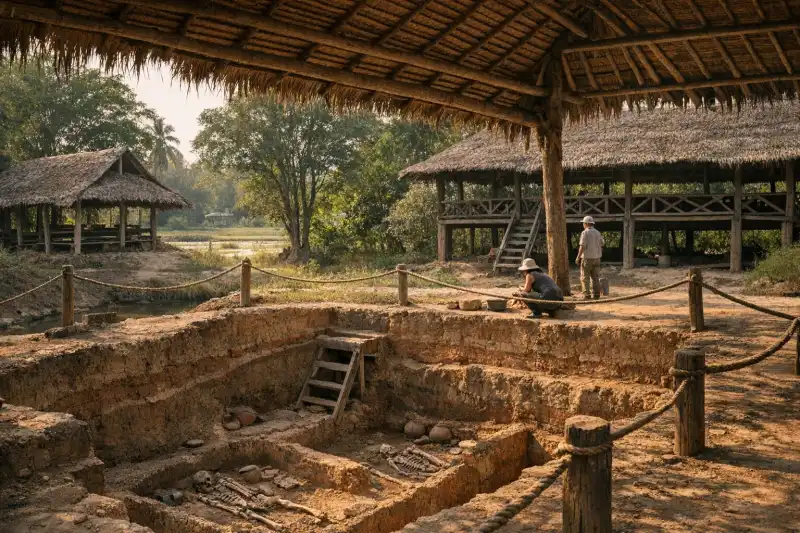
Ban Prasat Archaeological Site
Prehistoric communities of the Mun River basinExplore Ban Prasat Archaeological Site, a prehistoric burial and settlement site in Thailand’s Nakho...
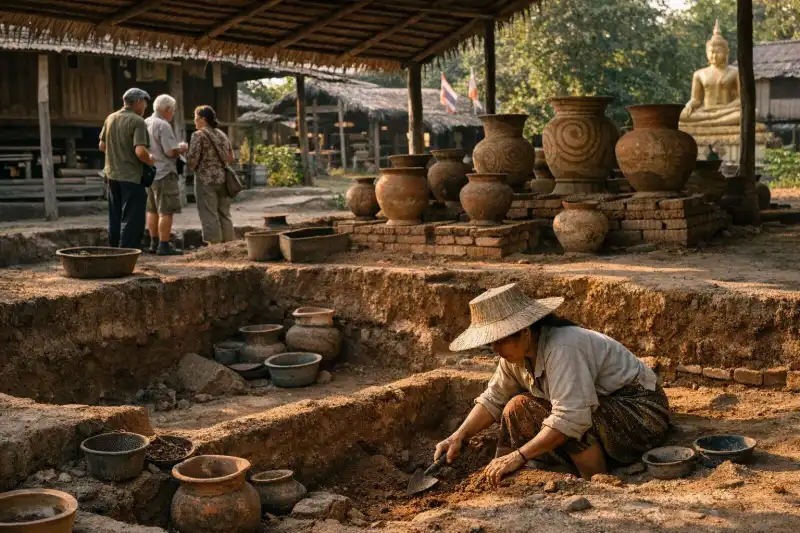
Ban Chiang
Prehistoric cultures of Northeast ThailandExplore Ban Chiang in Thailand, a remarkable prehistoric archaeological site known for early metallu...
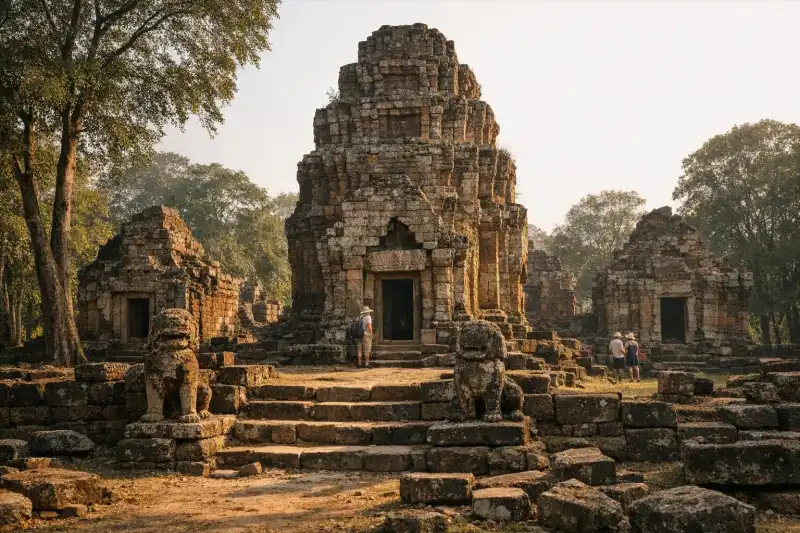
Ku Phra Kona
KhmerAn early Khmer sanctuary in northeastern Thailand, Ku Phra Kona preserves brick towers, carvings, an...

Ku Kaew Chaiyaram
KhmerExplore Ku Kaew Chaiyaram, a Khmer-era sanctuary in Thailand’s northeast known for laterite ruins an...