Quick Info
Curated Experiences
Discover Lycian Civilization: Tlos, Xanthos and Patara Tour
Saklikent Gorge, Tlos and Patara Small-Group Day Tour
Private Lycian Coast Heritage Tour from Fethiye
Patara Turkey travel guide pages often promise one thing and deliver another: either a beach article with a few ruins at the edge, or a classical archaeology summary that forgets the landscape that made the city powerful in the first place. Patara itself never had that luxury. This was a port, a parliament city, a religious center, and a logistical hinge on the southwest Anatolian coast, all at once. You feel it the moment you walk in. A Roman theater rises from scrub and low stone walls, a monumental avenue runs toward what was once a harbor basin, and the wind pushes across the plain from the dune fields as if the sea still touched every structure.
Ancient Patara in Turkey rewards travelers who like layered places rather than single monuments. You are not visiting one surviving temple here; you are walking the footprint of a civic machine that handled diplomacy, trade, and movement across Lycia for centuries. The city mattered to the Lycian League, then to Rome, and later to Byzantine administrators trying to keep coast and hinterland connected in a changing Mediterranean world. This guide covers that long arc, then gives you practical details for transport, timing, admission, and combining Patara with nearby sites such as Xanthos and the coastal towns around Kaş and Kalkan.
History: A Port City That Governed More Than It Traded
Lycian beginnings and regional identity (c. 8th century BCE-4th century BCE)
Patara emerged as one of Lycia’s principal coastal settlements by the first millennium BCE, drawing wealth from maritime access and fertile hinterland routes that linked inland valleys to the sea. In local tradition, the city carried deep mythic associations, but archaeology points to something even more interesting: a settlement that matured early as a political node, not only a commercial harbor. By the Classical period, Patara was tied to the confederated world of Lycian city-states, where local elites and civic institutions developed in conversation with, but not fully controlled by, outside empires.
Hellenistic pressures and adaptation (4th century BCE-1st century BCE)
After Alexander’s campaigns transformed power in Anatolia, Patara navigated the familiar Hellenistic pattern of shifting alliances, military pressure, and administrative experimentation. Like other Lycian cities, it absorbed Greek urban language and monumental form while retaining regional political habits. This era laid the groundwork for Patara’s later fame as a constitutional center: urban planning tightened, public spaces were formalized, and civic elites learned to negotiate with larger imperial systems without disappearing into them. By the late Hellenistic period, Patara had become both symbol and instrument of Lycian cooperation.
Roman integration and monumental growth (1st century BCE-4th century CE)
Under Rome, Patara became a fully connected provincial city with expanded infrastructure, stronger harbor administration, and monumental architecture on an ambitious scale. The theater, baths, ceremonial gates, and long urban avenues visible today belong largely to this period of investment. The city is especially significant because of its association with the Lycian League’s assembly traditions, often cited as an early model of representative federal governance in the ancient Mediterranean. Roman rule did not erase local identity; it amplified the city through roads, taxation systems, and port logistics that made Patara indispensable on this coast.
Byzantine continuity and changing coastlines (4th century CE-12th century CE)
As imperial centers shifted and maritime networks changed, Patara did not vanish overnight. It transitioned into the Byzantine world, where ecclesiastical and regional administrative roles persisted even as long-distance trade patterns altered the city’s economic base. One of the slow but decisive forces was environmental: siltation and shoreline change gradually affected harbor utility, reducing the strategic maritime advantage that had sustained Patara for centuries. Urban life contracted, reoriented, and eventually thinned, leaving a wide archaeological field that preserves multiple phases rather than a single final destruction layer.
Modern rediscovery and archaeological work (19th century-present)
European travelers documented Patara’s remains in the 19th century, but systematic Turkish archaeology and conservation in the late 20th and early 21st centuries transformed understanding of the site. Excavations clarified the scale of Roman civic planning and refined knowledge of Lycian political institutions linked to Patara. Ongoing work has focused on stabilizing major structures, reading stratigraphy across administrative zones, and interpreting the city’s relationship to its paleo-harbor and dune environment. What visitors see now is a site still actively yielding information, not a closed museum piece.
The Key Monuments: What to See at Patara
The Roman theater
Patara’s Roman theater is the monument that most clearly announces the city’s status. Built into a natural rise and expanded in the imperial period, it offered capacity for large civic audiences and likely hosted both staged performances and public events with political overtones. Surviving seating, cavea geometry, and stage-front fragments reveal a substantial design meant for a regional capital, not a secondary town. Even in ruin, the theater frames the plain and wind in a way modern visitors immediately notice: this is architecture that uses landscape as part of its spectacle.
Walk the lower seating first, then climb carefully for perspective over the site grid. The best photos come when sunlight hits side-on rather than overhead, because relief and masonry texture read better in angled light.
The Lycian League assembly zone
Patara is deeply associated with the Lycian League, and the assembly-related remains are one of the strongest reasons historians keep returning to this city. While the site requires imagination in places, the political significance is concrete: this was part of a federal civic tradition in which multiple cities coordinated governance through representative mechanisms that later observers, including Enlightenment thinkers, found striking. The architecture is less about theatrical grandeur than about institutional function, but that is exactly why it matters. You are looking at built space designed for decision-making across a region.
Give this area time instead of rushing to the beach corridor. Read the layout as civic infrastructure, not just broken stone, and the site’s identity becomes clearer.
The colonnaded street and harbor approach
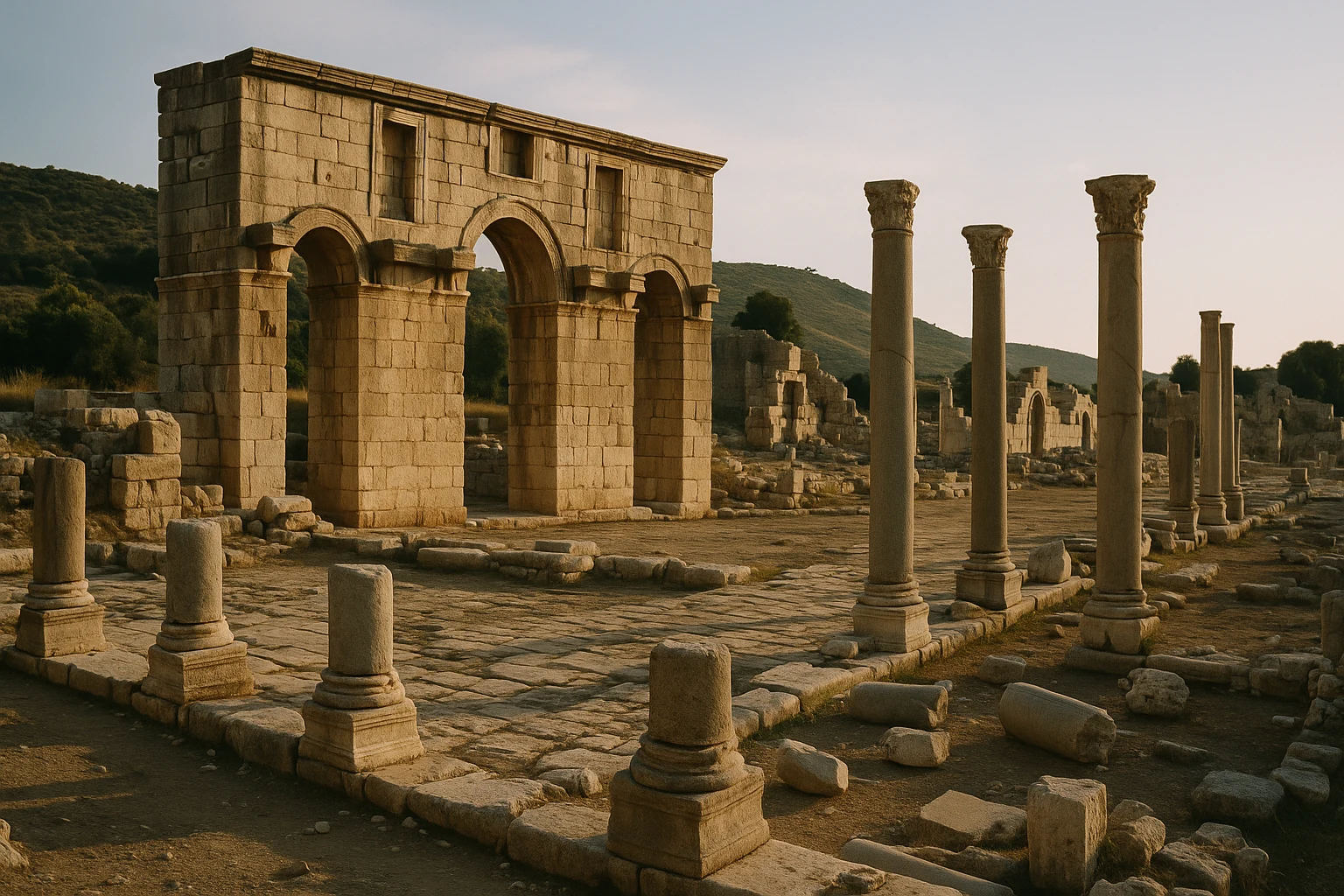
Patara’s broad urban axis, often called its monumental or colonnaded street, once guided movement from inland civic areas toward the harbor zone. Today, columns, paving traces, and foundation lines survive in enough sequence to reconstruct the rhythm of a processional and commercial corridor. In Roman terms, this was an organizing spine where officials, merchants, locals, and travelers crossed paths daily. Its scale reflects confidence: Patara expected traffic, ceremony, and administrative business in the same spaces.
Photography works best here with wide framing that includes horizon and dune line, showing how urban form opened toward maritime geography.
The granary of Hadrian
Near the old harbor sector stands the Roman granary traditionally linked to Emperor Hadrian’s era, a structure that captures Patara’s practical intelligence better than many decorative monuments. Granaries are logistical architecture: they represent storage, supply control, and state planning. In a port city, that means grain movement for troops, ships, and urban populations across wider circuits. Even as walls and rooflines are fragmentary, the building’s footprint and masonry style communicate heavy-duty intent. This is infrastructure built to endure pressure, weather, and administrative demand.
If you are interested in how empires functioned day to day, this is one of Patara’s most valuable stops, not just an optional add-on after the theater.
Baths, gates, and the civic fabric
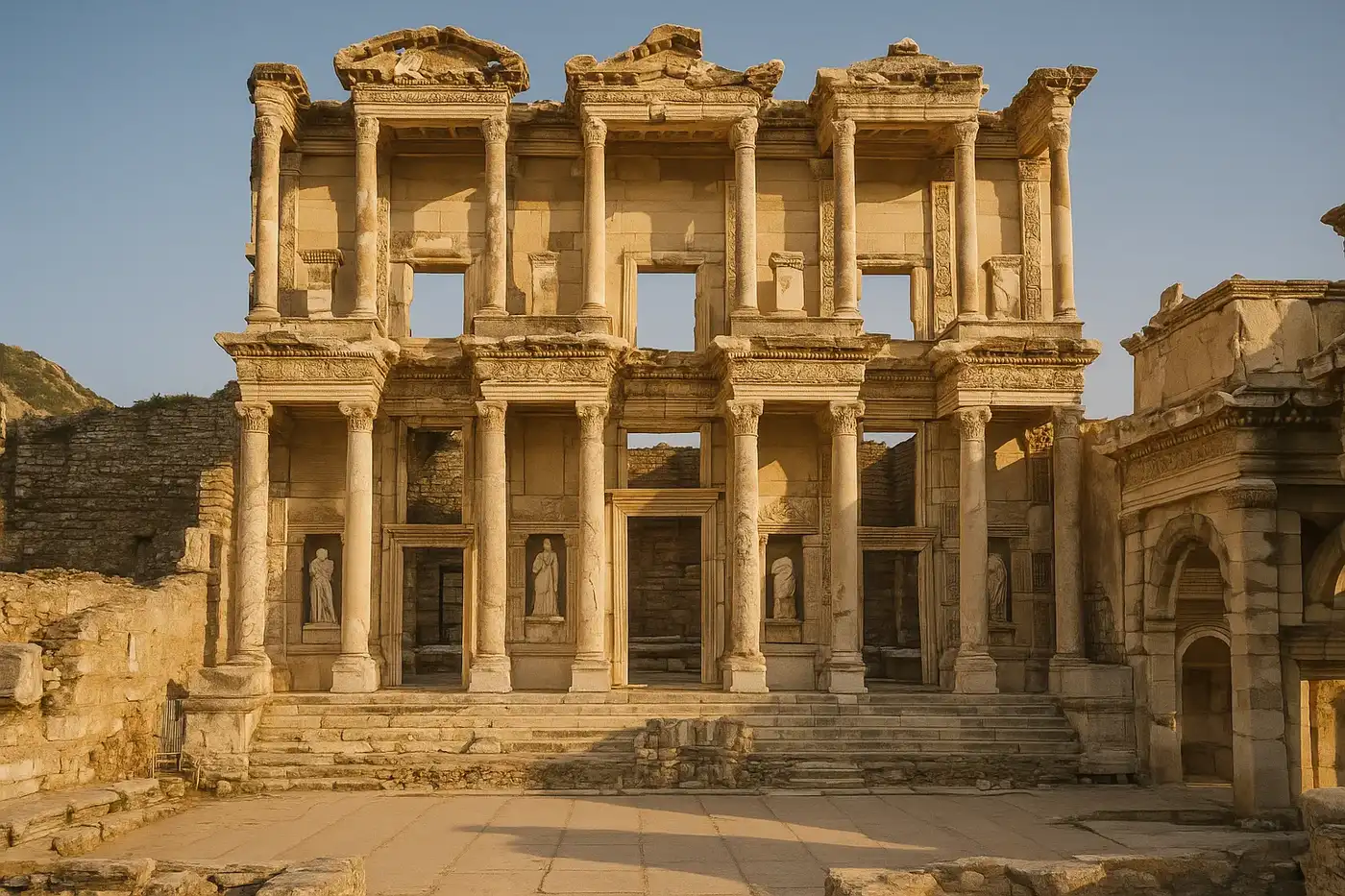
Patara’s bath complexes and gate remains complete the picture of a high-capacity city. Roman baths here are not isolated luxury features; they are markers of social routine, engineering investment, and urban hierarchy. Heating systems, water management traces, and room sequencing indicate substantial public use. Monumental gate architecture, meanwhile, announces thresholds between civic zones and ceremonial movement routes. Together these elements show that Patara was designed as a lived administrative center, not a ceremonial shell.
For visitors, the practical tip is pacing: short pauses between clusters help you read the site as an integrated plan instead of scattered ruins.
Getting There: Transportation and Access
Patara is straightforward to reach on the Turquoise Coast if you treat Gelemiş village as your access hub and plan around summer heat.
From Kaş
Kaş is the easiest independent base for many travelers because of regular regional transport and manageable distance. The journey typically runs along the D400 corridor toward Kalkan and Gelemiş, then continues to the archaeological entrance area.
- Dolmuş/minibus: Common regional option via Kalkan-Gelemiş routes; usually 60-90 TRY ($2-3 USD) total depending on transfers, about 45-70 minutes.
- Taxi: Door-to-gate convenience from central Kaş; roughly 900-1400 TRY ($28-44 USD), usually 40-50 minutes.
- Rental car: Most flexible for combining Patara with Xanthos or Kaputaş viewpoints; parking near the site zone is generally simple outside peak afternoons.
From Fethiye
Fethiye is farther but still practical, especially if Patara is part of a full Lycian civilization day itinerary with multiple ruins.
- Intercity bus + local transfer: Fethiye to Kalkan/Gelemiş connections, then local continuation; about 120-180 TRY ($4-6 USD), usually 1.5-2 hours.
- Guided day tour: Useful if you want historical narration plus bundled logistics; many include Patara with Xanthos and Tlos.
- Private transfer/rental car: Faster and simpler for families or photography-focused trips; around 1.5 hours each way depending on traffic and stops.
Admission and Hours
Patara uses standard archaeological-site ticketing in Turkish lira, and prices can change seasonally, so verify at the gate or official museum channels before departure. As a practical benchmark, expect an entry fee around 15-20 EUR equivalent in TRY (roughly 525-700 TRY, $16-22 USD), with possible reductions for eligible pass holders. Museum Pass coverage can improve value if Patara is part of a multi-site week.
Opening windows are generally longer in summer and shorter in winter; assume an early start and check final-entry cutoff times, which may precede closing by 30-60 minutes. Card payment is often available, but carrying cash is smart in case of outages. For comfort and photography, aim for opening hour or the last two hours of light.
When to Visit: Seasonal Considerations
Spring (March-May)
Spring is usually the ideal season for Patara: mild air, greener margins around the ruins, and manageable visitor flow before peak beach traffic arrives. Typical daytime temperatures run 17-26°C (63-79°F). You can comfortably complete the full archaeological circuit without heat fatigue, then continue to nearby villages. Bring a light layer for breezy mornings.
Summer (June-August)
Summer delivers long days and clear skies but also serious midday exposure. Expect 30-38°C (86-100°F), with reflective glare from stone and sand amplifying perceived heat. Crowds rise, especially where archaeology and beach visits overlap. Start as close to opening as possible, carry more water than you think you need, and schedule shade breaks between monument clusters.
Autumn (September-November)
Autumn is excellent for travelers who want warm conditions without July-August intensity. Temperatures often sit between 20-31°C (68-88°F) in early autumn, cooling later in the season. Light is especially good for photography, and coastal humidity usually feels less oppressive. This is a strong second-best season after spring for balanced comfort and color.
Winter (December-February)
Winter is quieter and can be deeply rewarding if you prefer reflective, low-crowd visits. Typical ranges are 10-18°C (50-64°F), but rain and wind can roll in quickly. Some services in surrounding beach-oriented areas reduce frequency. Wear windproof layers and shoes with grip, and check weather before committing to long exposed walks.
Combining Patara with the Lycian Coast
Patara works best as part of a deliberate half-day or full-day sequence rather than an isolated stop squeezed between beach plans. A reliable pattern starts with arrival by 8:30 AM, when the theater and civic axis are still cool enough for unhurried exploration. Spend your first 90 minutes in the main monumental core, then continue by 10:15 AM toward the granary and harbor-side sectors while light is still angled enough for texture-rich photos.
By 11:30 AM, many travelers transition to Xanthos (roughly 20-30 minutes by car depending on route) to complete the political story of Lycia: Patara’s federal institutions and Xanthos’ dynastic and funerary identity read brilliantly together in one day. After Xanthos, continue by 1:30 PM to Kalkan or back toward Gelemiş for lunch. In Kalkan, harbor-front restaurants offer a comfortable reset before afternoon coastal viewpoints.
If you prefer slower pacing, keep Patara as the anchor and shift to dunes and beach later in the day. Arrive at the sand by 4:30 PM, when heat softens and the landscape becomes the final chapter of the archaeological experience rather than a separate excursion. In this version, Patara feels less like a checklist and more like a complete narrative: governance, trade, ritual, and environment in one continuous walk. Total time for this slower sequence is about 6-7 hours including transfers and meal break.
Practical Information
What to bring
- Sun protection: Wide-brim hat, sunscreen, and sunglasses are essential; shade is limited across open sections.
- Water: At least 1 liter per person in spring/autumn and 1.5-2 liters in summer.
- Footwear: Stable shoes for uneven stone, sandy edges, and occasional loose gravel.
- Cash and card: Card systems often work, but backup cash in TRY prevents delays.
- Camera setup: Wide lens for urban axes, mid-range lens for architectural details and inscriptions.
Dress code and etiquette
Patara is an open archaeological landscape rather than an active religious monument, so dress expectations are practical more than ceremonial. Lightweight, breathable clothing is best, but avoid overly minimal outfits if you’re continuing through conservative local towns on the same day. Respect restricted zones and rope barriers, especially where conservation work is active.
Accessibility
Accessibility is mixed. Major paths are relatively open, but surfaces vary between hardpack, uneven stone, and sandy stretches, and some viewing points require slope navigation. Visitors with mobility concerns can still enjoy key highlights near the main approach, but full-site coverage may need assistance or selective routing.
Why Patara Matters
Patara matters because it shows that ancient power was rarely just military or monumental. It was administrative, environmental, and infrastructural. Here, on a coastal plain shaped by shifting water and wind, a federation experimented with shared governance, Rome embedded that world into imperial logistics, and later societies adapted until geography itself changed the terms of survival. The ruins are beautiful, yes, but beauty is not the whole story.
What stays with you is scale of function: theater for civic gathering, assembly spaces for regional decisions, granary for supply, streets for movement, harbor access for exchange. Patara is a city built to connect people and systems, not just impress visitors. Standing in the late light with dunes behind broken walls, you can feel how fragile and persistent those systems are. That is why Patara is worth the journey: it makes ancient history feel structural, not distant.
Quick Facts
| Attribute | Details |
|---|---|
| Location | Gelemiş area, Antalya Province, Turkey |
| Ancient Name | Patara (Lycian: Pttara) |
| UNESCO Status | Part of the Xanthos-Letoon UNESCO World Heritage landscape context (inscribed 1988) |
| Established | c. 8th century BCE port settlement |
| Distance from nearest hub | ~43 km from Kaş (about 45-60 minutes by road) |
| Entry Fee | Typically around 525-700 TRY ($16-22 USD), check latest posted rates |
| Hours | Longer summer schedule, shorter winter schedule; verify same-day at gate |
| Best Time | Spring and autumn mornings or late afternoons |
| Suggested Stay | 2-3 hours (4-6 with dunes/beach and nearby pairings) |
Explore More Turkey
- Perge: A major Roman city near Antalya with impressive streets, baths, and stadium remains.
- Side: Coastal ruins where temples and theaters sit inside a still-active resort town.
- Ephesus: One of the Mediterranean’s most complete Roman urban archaeological experiences.
Plan your wider route with our Turkey ancient sites hub. For practical planning, see our guide to visiting archaeological sites in summer heat.
Frequently Asked Questions
How much time should I plan for Patara?
Most travelers need 2-3 hours for the core ruins, including the theater, parliament building area, granary, and baths. Add another 1-2 hours if you also want unhurried beach time or dune walks. If you're combining Patara with Xanthos, treat it as a full half-day at minimum.
What is the best time of day to visit Patara?
Early morning and late afternoon are best for softer light, lower temperatures, and cleaner photos inside the theater and colonnaded areas. Midday sun can be intense from May to September because shade is limited on open ground. Sunset is especially rewarding if you continue toward the dunes.
Do I need a pass, or can I buy a normal ticket?
You can buy a standard entry ticket at the site entrance, and many visitors do. The Turkey Museum Pass can be better value if you're visiting multiple archaeological sites in a short trip. Carry a card and a little cash in case payment systems are intermittent.
How do I get to Patara from Kaş or Fethiye?
From Kaş, the easiest route is dolmuş or taxi toward Gelemiş, then a short local transfer or walk to the gate. From Fethiye, buses toward Kalkan/Kaş and organized day tours are common, with travel time typically around 1.5-2 hours depending on stops. Rental cars are straightforward and useful if you want to pair Patara with Xanthos.
What are the main highlights inside Patara?
Key highlights are the large Roman theater, the broad harbor street, the granary linked to Emperor Hadrian, bath complexes, and the Lycian League assembly area associated with early federal political history. The surrounding dunes and long beach add a rare landscape dimension to the ruins.
Is Patara suitable for families and first-time visitors to Turkey?
Yes. Paths are generally manageable, the site layout is open and intuitive, and the nearby village area has simple food options. In summer, prioritize hats, water, and breaks because heat and glare are the main challenge rather than technical terrain.