Quick Info
At a glance
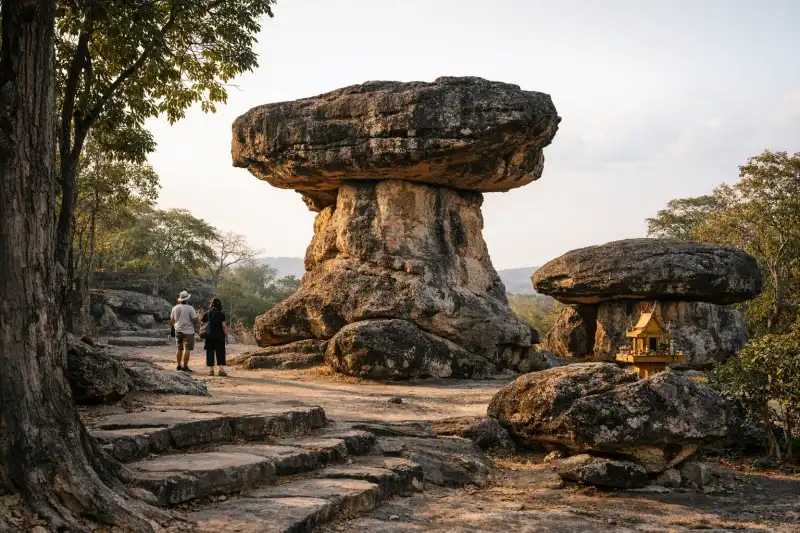
Phu Phra Bat Historical Park in Thailand feels unlike almost any other archaeological landscape in Southeast Asia. Set among forested hills in Udon Thani Province, the site combines weathered sandstone pillars, giant mushroom-like boulders, prehistoric imagery, and traces of Buddhist devotion into a single cultural landscape that is both scenic and deeply layered. The first impression is geological drama: massive rocks balanced improbably on narrow bases, natural shelters opening beneath cliffs, and winding paths that lead from one surprising formation to the next. Yet the more time you spend here, the more it becomes clear that nature alone does not define the place. For centuries, and likely for millennia, people have moved through these outcrops, painting on rock surfaces, marking sacred spaces, and attaching stories to the terrain.
Today, visitors come to Phu Phra Bat Historical Park for several reasons at once. Some are drawn by its archaeological significance, especially the evidence of prehistoric occupation and ritual activity. Others arrive for the Buddhist remains, including sema stones that connect the area to the spread of religion across northeastern Thailand. Many simply come for the atmosphere: a quiet upland setting where folklore, archaeology, and unusual rock architecture merge. Unlike monumental temple cities built in brick or stone from a single era, Phu Phra Bat is a landscape of continuity. It preserves the way different communities reused the same natural features over long spans of time, giving the park a sense of mystery that lingers long after the visit ends.
History
Prehistoric use of the sandstone landscape
The earliest chapter of Phu Phra Bat’s story begins long before organized states emerged in the region. The park’s sandstone outcrops created natural shelters that offered shade, defensible positions, and dry surfaces suitable for painting. Archaeologists have identified prehistoric rock art in several locations, indicating that communities used this upland zone not merely as a temporary camp but also as a place invested with meaning. These paintings, though often faint and vulnerable to weathering, are among the clearest signs that human groups recognized the site as special.
The natural formations may have shaped ritual behavior from the very beginning. Caves, overhangs, and isolated pillars often acquire symbolic significance in ancient societies, and Phu Phra Bat’s dramatic geology would have made it especially memorable. In a region where seasonal patterns governed movement and subsistence, such landmark-rich terrain could also function as a meeting ground, orientation point, or ceremonial area. Even when precise dates remain debated, the evidence suggests long-term interaction between people and place extending deep into prehistory.
Early Buddhist influence and sacred markers
By the early historic period, the plateau was no longer only a prehistoric landscape. It had become tied to Buddhist religious practice, especially through the installation of sema stones. These carved boundary markers are characteristic of northeastern Thailand and are strongly associated with Buddhist monastic spaces, particularly in areas influenced by Dvaravati cultural traditions. At Phu Phra Bat, sema stones indicate that communities adapted natural rock shelters and elevated spaces into sanctified locations.
This stage of the site’s history is especially important because it reveals how later populations did not erase earlier meanings. Instead, they reused the same formations, transforming them through new rituals and interpretations. A rock shelter that may once have served as a gathering place or ceremonial point could later become part of a Buddhist sacred zone. This layered use is one of the defining features of Phu Phra Bat. Rather than a city planned all at once, it is a landscape that accumulated religious and cultural significance gradually.
The sema stones themselves offer evidence of artistic and spiritual development in the wider region. Their presence links Phu Phra Bat to broader networks of belief and exchange across what is now northeastern Thailand and Laos. While the site may feel remote today, it was clearly connected to larger patterns of religious movement and local adaptation.
Folklore, local memory, and reinterpretation
As centuries passed, the rock formations of Phu Phra Bat gathered legends. Many individual stones and shelters acquired names and stories tied to local folklore, especially tales of kings, hermits, princesses, and supernatural events. These narratives are not merely decorative additions for modern tourism. They are part of the historical life of the site, showing how communities continued to explain unusual natural forms through storytelling.
This process of reinterpretation is common at ancient sacred places. When the original functions of structures or markers become less clear, later generations often preserve the place through myth. At Phu Phra Bat, folklore helped maintain cultural value even when formal religious or administrative systems changed. The stories transformed boulders into remembered landmarks and allowed the park to remain meaningful across different historical periods.
In this sense, local legend is itself a kind of heritage. It records the ongoing relationship between villagers and the landscape. A visitor walking through the park is therefore encountering not only prehistoric traces and Buddhist remains, but also centuries of oral tradition layered over the stone.
Modern preservation and recognition
In the modern era, Phu Phra Bat came to be recognized as an important historical and archaeological site deserving protection. Scholars, heritage authorities, and local communities all played roles in documenting the rock art, sema stones, and ritual remains spread across the area. As archaeological understanding improved, the site’s value became clearer: it was not simply a scenic park with curious rocks, but a cultural landscape illustrating continuity from prehistoric times into Buddhist history.
Official protection as a historical park helped preserve both the monuments and their surrounding environment. This matters greatly at a place like Phu Phra Bat, where natural and cultural features are inseparable. A single formation may be geologically striking, archaeologically important, and locally sacred all at once. Preservation therefore involves trails, visitor management, interpretation, and environmental care as much as monument conservation.
For travelers today, this modern recognition means the site is easier to explore and understand than in the past. Signage, pathways, and park facilities provide access, but the essential character remains intact. Phu Phra Bat still feels like a landscape discovered by walking rather than a museum arranged in straight lines. That quality is part of its enduring power.
Key Features
What makes Phu Phra Bat Historical Park memorable is the interplay between natural stone forms and human imagination. The sandstone formations are the visual anchors of the site. Some stand like giant pedestals topped by wider slabs, while others resemble mushroom caps, gateways, or balancing stones that seem to defy gravity. Erosion over immense spans of time carved these shapes, but human activity gave them names, meanings, and ritual uses. This blending of geology and culture is the park’s defining feature.
Among the most significant elements are the natural rock shelters that preserve traces of prehistoric painting. These are not grand mural galleries on the scale of famous cave-art sites elsewhere in the world, but they are powerful precisely because they remain embedded in the landscape where they were created. Looking at a faint painted surface beneath an overhang, you can imagine ancient people choosing that exact spot for visibility, shelter, or ceremony. The art is subtle, and visitors should not expect vivid, freshly preserved images. Instead, the experience lies in recognizing fragility and deep time.
The Buddhist remains add a second layer of interest. Sema stones, often placed in relation to sheltered or elevated spaces, mark the religious transformation of the site during the early historic period. These stones may appear modest compared with towering temple architecture elsewhere in Thailand, yet they are historically important. They reveal how Buddhism adapted to local landscapes instead of always reshaping them through monumental construction. At Phu Phra Bat, sacredness often came from identifying a natural formation as spiritually potent rather than replacing it entirely.
Another striking feature is the sense of movement through the park. Paths wind between trees, rock gardens, and open viewpoints, creating a sequence of discoveries rather than a single focal monument. This makes the visit feel exploratory. One formation may be associated with a legend, another with visible archaeological remains, and another simply with the uncanny beauty of stone balanced against sky. Because the park unfolds gradually, it rewards those who walk slowly and pause often.
Scenic atmosphere is also central to the experience. The upland setting gives the park a quieter, less urbanized character than many major heritage sites. Birdsong, shifting light, and shade beneath the rocks contribute to a mood that can feel contemplative, especially in the morning. Unlike enclosed museums, Phu Phra Bat is best appreciated as an environmental whole. The trees, pathways, sandstone, and open air are not a backdrop to the heritage; they are part of it.
Local legends attached to specific formations enrich the visit further. Even when the archaeological explanation of a rock shelter is known, the folklore linked to it often continues to shape visitor perception. This dual reading is one of the park’s strengths. A single boulder can be understood as an erosional feature, an ancient ritual space, and a legendary landmark at the same time. Few destinations allow that kind of layered interpretation so naturally.
Photography is another highlight, though the park rewards restraint as much as wide-angle enthusiasm. Early or late daylight brings out texture on the sandstone and gives the formations stronger depth. The site is less about grand skyline panoramas than about details: the curve of a shelter wall, the contrast between red-brown stone and green vegetation, or the way a sema stone sits quietly in a natural clearing.
Ultimately, Phu Phra Bat’s key feature is not one monument but a relationship: the long conversation between human belief and unusual terrain. That is what distinguishes it from temple complexes built according to a single architectural plan. Here, nature provided the forms, and generations of people turned them into places of memory.
Getting There
Phu Phra Bat Historical Park is most easily reached from Udon Thani, the main transport hub in the region. Udon Thani has an airport with frequent domestic flights from Bangkok, and flights often range from about THB 1,200 to 3,000 one way depending on season and booking time. From Udon Thani city, the park lies roughly 65 to 80 kilometers away, usually taking around 1.5 hours by road.
The simplest option is to rent a car in Udon Thani. Daily rental rates commonly start around THB 900 to 1,500 for a basic vehicle, not including fuel. This is the best choice for flexibility, especially if you want to combine the park with other provincial attractions. Roads are generally manageable, and parking at the park is straightforward.
A taxi or private car hire from Udon Thani is another practical option. Expect a one-way fare in the range of THB 1,000 to 1,800, while a round-trip with waiting time or a half-day private arrangement may cost THB 2,000 to 3,500 depending on negotiation, vehicle type, and language services. For small groups, this can be good value.
Public transport is possible but less convenient. Buses or vans toward Ban Phue may cost roughly THB 50 to 100, but you will likely still need a songthaew, local ride, or motorcycle taxi for the final stretch. Because schedules can be irregular, public transport works best for patient travelers with flexible timing. Most international visitors find a rental car or private driver much easier.
When to Visit
The best time to visit Phu Phra Bat Historical Park is during Thailand’s cooler dry season, generally from November to February. At this time, temperatures are more comfortable for walking, skies are often clearer, and the park’s trails are easier to enjoy in the open air. Morning visits during these months are especially pleasant, with softer light and less heat radiating from the stone surfaces.
March to May is the hottest period. Northeastern Thailand can become intensely warm, with midday temperatures making exposed walking tiring. If you visit then, arrive early, carry plenty of water, and plan for a shorter circuit with breaks in shaded areas. The rock formations remain impressive year-round, but the climate can affect how much of the park you comfortably explore.
The rainy season, usually from May or June through October, brings greener scenery and fewer visitors. The landscape can feel especially atmospheric after rain, with fresh vegetation softening the sandstone terrain. However, trails may be slippery, humidity can be high, and sudden downpours may interrupt your visit. Good footwear becomes more important in these months.
For photography, early morning and late afternoon are the best times regardless of season. The angled light adds texture to the rock formations and creates a calmer mood than the harsher midday sun. If your schedule allows, weekdays are usually quieter than weekends and public holidays. Since the park is about atmosphere as much as archaeology, a less crowded visit can make a real difference.
| Quick Facts | Details |
|---|---|
| Location | Ban Phue District, Udon Thani Province, Thailand |
| Country | Thailand |
| Type | Historical park with prehistoric rock art, sema stones, and sacred rock formations |
| Best Base | Udon Thani |
| Ideal Visit Length | 2–4 hours |
| Best Season | November to February |
| Main Appeal | Layered cultural landscape combining geology, archaeology, and folklore |
| Access | Best reached by rental car, taxi, or private driver from Udon Thani |
| Terrain | Walking paths, uneven natural surfaces, exposed areas |
| What to Bring | Water, sun protection, sturdy shoes, camera |
Guided tours: worth it?
Most travelers can visit Phu Phra Bat Historical Park independently. Compare a tour only if you want a tighter history-focused visit, easier logistics, or a guide who can answer questions on the spot.
Best for
- Short visits where a planned route saves time
When to go self-guided
Go independently if you prefer setting your own pace, reading as you go, and checking official hours or ticket rules directly before you arrive.
What I’d avoid
Skip paid tours that bundle unrelated stops you do not actually want. The best option should either save meaningful planning time or add historical context you would miss on your own.
Udon Thani Cultural and Historical Sites Tours
Useful when: you want to compare guided formats before deciding
Ban Chiang and Udon Thani Heritage Tours
Useful when: you want to compare guided formats before deciding
Northeast Thailand Private Day Tours
Useful when: you want flexible timing or a private guide
Some tour links are affiliate links, which may earn Ancient Travel a small commission at no extra cost to you. I try to surface options that make practical sense for the site—not just anything bookable.
Frequently Asked Questions
Where is Phu Phra Bat Historical Park located?
Phu Phra Bat Historical Park is in Ban Phue District, Udon Thani Province, in northeastern Thailand, roughly 65 to 80 kilometers from Udon Thani city depending on route.
Why is Phu Phra Bat Historical Park important?
The park is important for its unusual sandstone formations, prehistoric rock paintings, and sacred Buddhist boundary markers known as sema stones, which show long-term ritual use of the landscape.
How much time should I spend at Phu Phra Bat Historical Park?
Most visitors need two to four hours to see the main rock formations, shrines, and walking trails at a relaxed pace.
Is Phu Phra Bat Historical Park suitable for families?
Yes, it can suit families, but some paths are uneven and exposed to heat, so sturdy shoes, water, and sun protection are important.
What is the best time of year to visit Phu Phra Bat Historical Park?
The coolest and most comfortable period is from November to February, when temperatures are lower and walking conditions are better.
Can I visit Phu Phra Bat Historical Park on a day trip from Udon Thani?
Yes, it is commonly visited as a day trip from Udon Thani by rental car, taxi, or private driver.
Nearby Ancient Sites
Ban Chiang
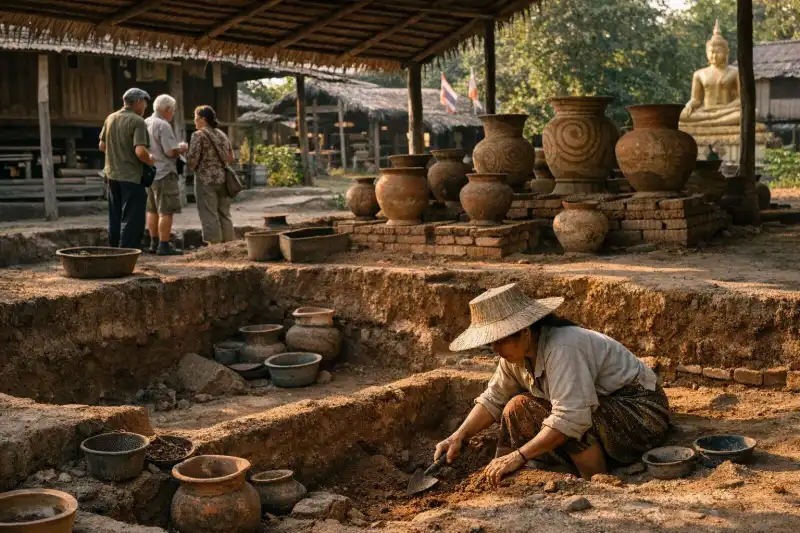
Prehistoric cultures of Northeast ThailandExplore Ban Chiang in Thailand, a remarkable prehistoric archaeological site known for early metallu...
Phimai Historical Park
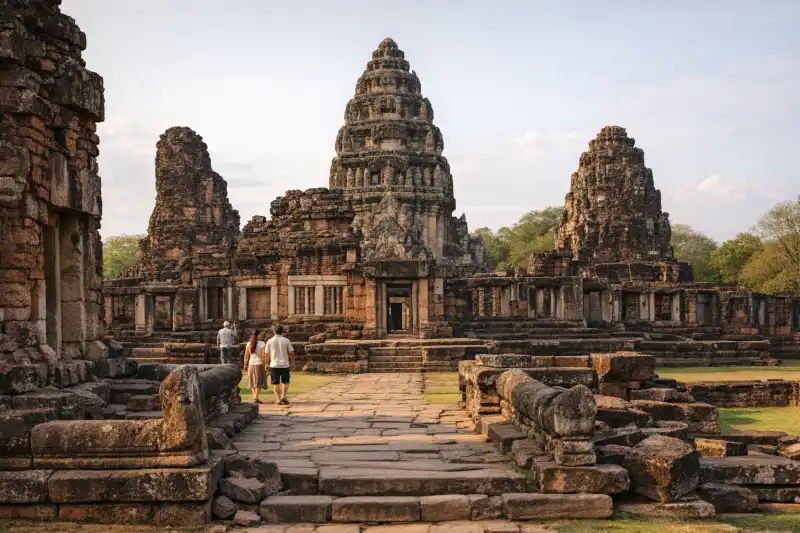
Khmer EmpireExplore Phimai Historical Park, a remarkable Khmer temple complex in northeastern Thailand famed for...
Phimai Sanctuary
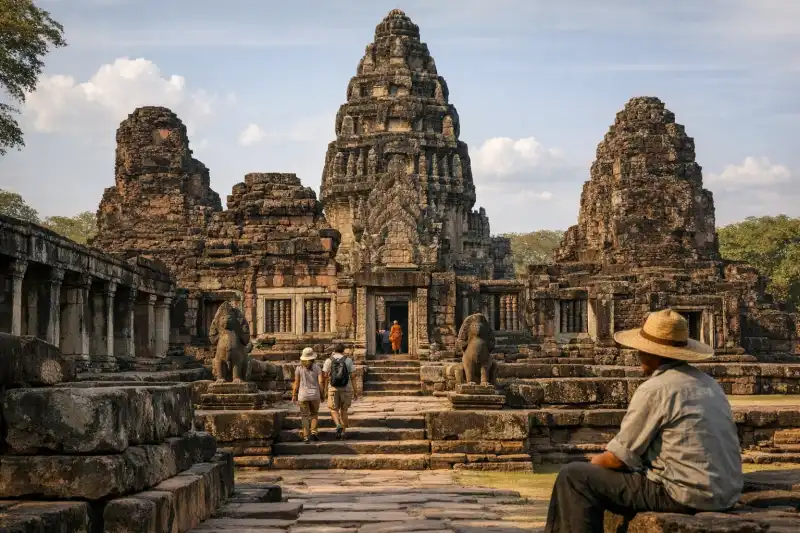
Khmer EmpireExplore Phimai Sanctuary, a grand Khmer temple complex in Thailand known for elegant stone carvings ...
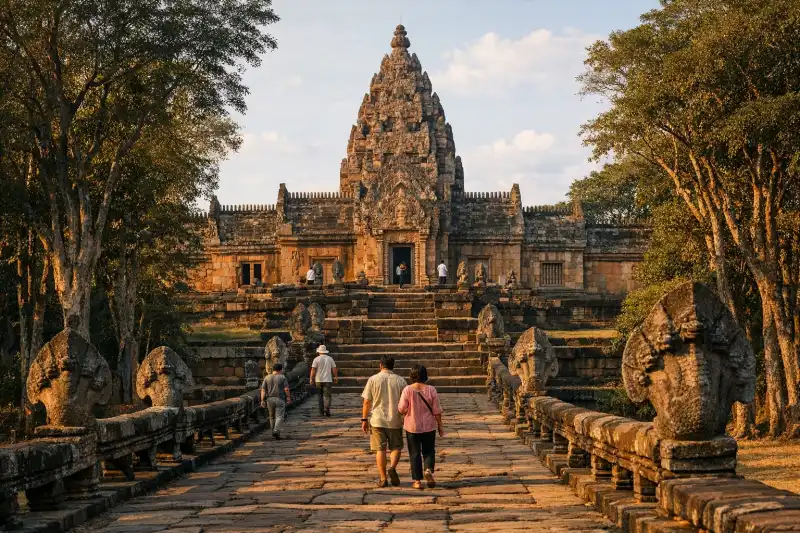
Phanom Rung
Khmer EmpireA dramatic Khmer hilltop temple in Thailand, Phanom Rung is famed for its sandstone carvings and sun...