Quick Info
At a glance
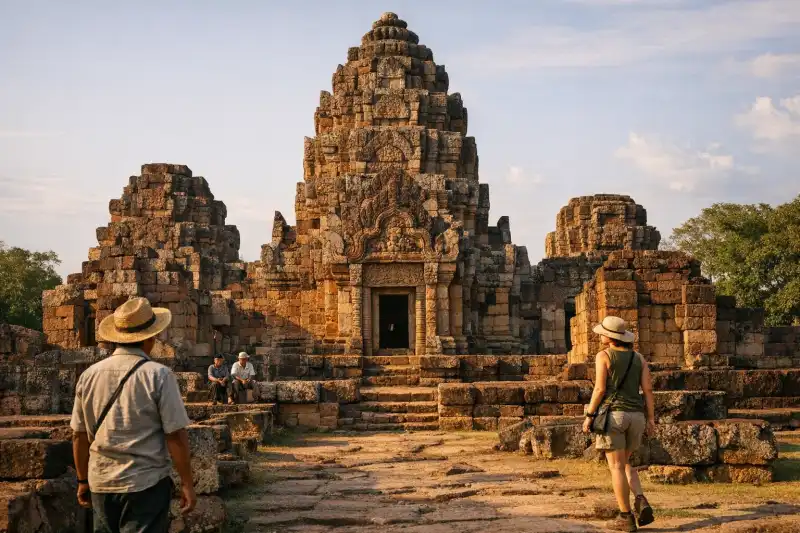
Prasat Pueai Noi in Thailand is the kind of ancient site that rewards travelers who leave the main circuit behind. Set amid the open landscapes of Khon Kaen Province in the country’s northeastern Isan region, this Khmer sanctuary does not overwhelm with scale. Instead, it captivates through balance, texture, and atmosphere: worn sandstone blocks glowing in late light, laterite walls softened by age, and sacred architecture rising unexpectedly from a quiet rural setting.
For many visitors, Thailand’s ancient past is first encountered at better-known places such as Ayutthaya or the grand Khmer monuments near the Cambodian border. Prasat Pueai Noi offers something different. Here, the experience is slower and more intimate. You can stand close to the surviving sanctuaries, examine carved details without crowds pressing around you, and appreciate how a once-formal religious complex still anchors the landscape centuries after its original ritual life faded. The monument reflects a time when Khmer cultural influence extended far across mainland Southeast Asia, shaping temple building, religious expression, and political geography in what is now northeastern Thailand.
Although smaller than the great imperial centers, Prasat Pueai Noi remains deeply significant. It preserves evidence of regional devotion, craftsmanship, and connectivity, linking Khon Kaen to the wider Khmer world. For travelers interested in archaeology, architecture, or the layered history of Thailand beyond its modern capitals and beaches, this understated sanctuary is one of Isan’s most memorable historic stops.
History
Early Khmer influence in northeastern Thailand
Prasat Pueai Noi emerged during the period when the Khmer Empire projected political and cultural power across much of mainland Southeast Asia. Between the 11th and 12th centuries CE, the territories of present-day northeastern Thailand were closely tied to Khmer networks of administration, religion, and road systems radiating from Angkor. These frontier and provincial zones were not marginal in a cultural sense; they were active landscapes where imperial ideas were interpreted through local conditions.
The temple at Pueai Noi was likely established as a Hindu sanctuary, with architecture and ornament showing strong ties to Khmer sacred building traditions. In this era, temples were not only religious spaces but also statements of order and authority. A sanctuary aligned with sacred directions, enclosed by walls, and carefully ornamented in stone expressed more than devotion. It marked a place within a cosmological and political system in which kingship, deities, and territory were symbolically linked.
The materials used at Prasat Pueai Noi reflect common Khmer building practice in the region. Laterite, a durable iron-rich material available locally, formed much of the structural mass, while sandstone was reserved for doorframes, lintels, decorative elements, and architecturally significant points. This contrast gave the complex both strength and refinement, and it still defines the visual character of the site today.
Construction and religious purpose
Like many Khmer sanctuaries outside Angkor proper, Prasat Pueai Noi appears to have been built as a regional temple complex rather than an imperial capital monument. Its plan includes multiple towers and enclosure elements that suggest a carefully organized sacred precinct. Scholars generally place it within a period when Shaivite and Vaishnavite forms of Hindu worship were prominent, although religious use in Khmer territories could evolve over time and sometimes incorporate Buddhist elements later on.
The central structures would have housed sacred images or symbolic representations of deities. Ritual specialists likely oversaw offerings, seasonal observances, and acts of merit tied to both local communities and the wider Khmer state. Temples like this one often stood near routes that linked settlements and administrative centers, helping bind provincial landscapes to broader patterns of economic and cultural exchange.
The carved lintels and architectural fragments surviving at Prasat Pueai Noi provide clues to this ritual world. In Khmer temple architecture, decorative carving was never purely ornamental. Mythic scenes, vegetal motifs, and divine imagery carried symbolic meaning, reinforcing the temple’s role as a sacred microcosm.
Decline, transformation, and survival
As Khmer political authority shifted and eventually receded from the region, many provincial temples lost their original institutional support. Religious practices changed, trade and communication routes moved, and the maintenance required to preserve masonry monuments diminished. Over time, Prasat Pueai Noi, like countless other Southeast Asian sanctuaries, became less a center of active royal religion and more a historical remnant within an inhabited countryside.
Yet abandonment was rarely absolute. Even when formal ritual use declined, local communities often retained awareness of such sites as spiritually charged places. Stones might be repurposed, vegetation might encroach, and structures might collapse, but memory persisted. This continuity of local recognition is one reason so many ancient monuments in Thailand survived at all.
Weathering and time inevitably damaged the complex. Roof sections and upper elements were especially vulnerable, and some structures were reduced to partial walls or foundations. Even so, enough of the temple endured to preserve its overall character and reveal its significance within the Khmer architectural tradition.
Modern preservation and interpretation
In the modern era, Thai archaeological and heritage authorities recognized Prasat Pueai Noi as one of the important Khmer monuments of Isan. Conservation efforts have aimed to stabilize the remains, clear vegetation, and make the site accessible to visitors without erasing its historic fabric. The goal at places like this is usually not to recreate a pristine original form, but to protect what survives and help the public understand it.
Today, Prasat Pueai Noi occupies an important place in regional heritage tourism. It introduces visitors to a chapter of Thai history that is often overshadowed by later kingdoms. The temple shows how fluid historical borders were and how artistic and religious traditions crossed what are now national boundaries. In that sense, the site is not only a local monument in Khon Kaen Province but also part of the wider story of the Khmer world and its enduring legacy in Thailand.
Key Features
What makes Prasat Pueai Noi so compelling is the harmony between its architecture and its rural surroundings. Unlike monumental temple mountains or heavily urbanized ruins, this sanctuary feels proportionate to the land around it. The open sky, the clipped grass, and the relative quiet let the forms of the temple stand out clearly. You can understand the layout almost at a glance, yet the details reward close attention.
The central sanctuary group is the heart of the complex. Though not fully intact, the surviving towers and structural remnants convey the formal dignity of Khmer sacred design. The arrangement of the buildings suggests ritual hierarchy, with the principal structure occupying the most important position and subsidiary elements supporting the ceremonial whole. Even in ruin, the architecture communicates order. Doorways, axial lines, and surviving bases guide the eye inward, as if still directing movement toward a sacred center.
One of the most striking aspects of the site is the interplay of laterite and sandstone. Laterite gives the walls and foundations a dark, earthy solidity. Sandstone, by contrast, appears smoother and lighter, especially where carved elements survive. This material contrast is aesthetically pleasing, but it also reflects the technical logic of Khmer building. Structural masses were built from durable local stone, while fine-grained sandstone allowed sculptors to produce refined decorative work around entrances and key ceremonial zones.
The carved lintels are among the site’s most important features. Although weathering has softened some motifs, the surviving relief work still offers a sense of the temple’s original richness. Floral scrolls, geometric framing, and traces of divine iconography demonstrate the high level of craftsmanship that reached even regional sanctuaries. These carvings would once have framed thresholds not merely as architectural openings but as symbolic passages into sacred space.
Another notable feature is the enclosure system, which helps visitors understand how Khmer temples functioned as bounded ritual environments. The walls defined a sacred precinct, separating the temple realm from the ordinary world outside. Passing into such an enclosure was not simply a physical act; it represented entry into an ordered, sanctified domain. Even where sections are fragmentary, the perimeter still shapes how the site is experienced.
The temple’s scale is also part of its appeal. Because Prasat Pueai Noi is manageable on foot, visitors can appreciate relationships between structures without exhaustion or confusion. It is easy to circle the remains, examine foundations, and pause at different angles to see how light changes the textures of stone. Morning and late afternoon are especially attractive, when shadows emphasize relief carving and the warm sun deepens the red-brown tones of the masonry.
Interpretive signs and landscaped grounds typically make the site approachable for non-specialists. This matters because a smaller temple can otherwise be difficult to read if you are unfamiliar with Khmer architecture. Here, the surviving remains are clear enough that even casual visitors can start to distinguish sanctuary towers, courtyards, and decorative elements. For travelers with deeper archaeological interests, the site also offers valuable insight into how Khmer religious architecture was adapted beyond the empire’s core zones.
Finally, there is the atmosphere. Prasat Pueai Noi does not rely on spectacle. Its power lies in stillness. Birds move through the trees, village life continues quietly beyond the grounds, and the stones seem to hold a slower timescale than the roads that brought you there. That sense of calm gives the temple emotional weight. You are not just looking at a ruin; you are entering a place where architecture, ritual memory, and landscape still feel connected.
Getting There
Prasat Pueai Noi is usually approached from Khon Kaen city, the main transport hub of the province. From central Khon Kaen, the drive takes roughly 1.5 to 2 hours depending on traffic and your exact route. Renting a car is the most convenient option, especially if you want flexibility to combine the visit with other rural attractions in Isan. Daily car rentals in Khon Kaen often start around THB 900 to 1,500, with fuel extra.
A hired taxi or private driver is another practical choice. For a round trip from Khon Kaen city to Prasat Pueai Noi with waiting time, expect approximately THB 2,000 to 3,500 depending on negotiation, vehicle type, and duration. If you prefer app-based transport, availability may be better in the city than for the return journey from the temple, so arrange your ride back in advance.
Public transport is possible but less straightforward. Local buses or vans toward district towns in the region may reduce the cost, often in the THB 50 to 120 range per leg, but schedules can be infrequent and the final stretch may require a motorcycle taxi or songthaew if available. Because rural connections are not always reliable, independent travelers should confirm routes locally before setting out.
The nearest major gateway is Khon Kaen Airport, with flights from Bangkok and other Thai cities. From the airport, a taxi into town usually costs around THB 150 to 250, after which you can continue by rental car or private transfer. If you are building a broader Isan itinerary, it can also make sense to visit Prasat Pueai Noi as part of a road trip through northeastern Thailand’s Khmer and archaeological sites.
When to Visit
The best time to visit Prasat Pueai Noi is generally the cool and dry season, from November to February. During these months, temperatures in northeastern Thailand are more comfortable, skies are often clearer, and exploring exposed temple grounds is much easier than in the hotter part of the year. Mornings can be especially pleasant, with softer light for photography and less heat radiating from the stone.
From March to May, the region becomes significantly hotter. Midday visits can feel intense, especially because shade around ancient sites is often limited. If you travel at this time, arrive early in the morning or later in the afternoon, carry plenty of water, and wear a hat and sunscreen. The dry landscape can still be beautiful, but comfort becomes more of a factor.
The rainy season, typically from May or June through October, brings greener scenery and fewer visitors. The grounds can look lush and atmospheric after rain, and the darker stone often appears especially dramatic under overcast skies. However, showers may interrupt your visit, and some rural roads in the wider region can be less convenient during heavy weather. If you travel in these months, flexible timing is helpful.
In practical terms, the ideal visit is on a dry-season weekday morning. You are more likely to experience the site in near silence, with good lighting and manageable temperatures. For photographers, early light can bring out the textures of sandstone carving, while late afternoon offers warmer tones and longer shadows. Either way, avoiding the midday heat will make the visit far more rewarding. Because this is a rural heritage stop rather than a major urban attraction, it is wise to check opening hours locally before setting out, particularly around public holidays.
| Quick Facts | Details |
|---|---|
| Location | Pueai Noi District, Khon Kaen Province, Thailand |
| Historical culture | Khmer |
| Approximate date | 11th-12th century CE |
| Main materials | Laterite and sandstone |
| Original religious use | Hindu sanctuary, likely linked to Khmer state religion |
| Best base city | Khon Kaen |
| Recommended visit length | 45 minutes to 1.5 hours |
| Best season | November to February |
| Ideal transport | Rental car or private driver |
| Atmosphere | Quiet rural archaeological site with light crowds |
Prasat Pueai Noi is not the largest ancient monument in Thailand, but that is precisely why it lingers in the memory. It offers a close, readable encounter with Khmer architecture in a setting that remains rural and unhurried. Here, history is not packaged as spectacle. It is present in weathered stone, in the geometry of the surviving sanctuaries, and in the continued dignity of a sacred place that has outlasted the political world that created it.
For travelers interested in the deeper historical map of Thailand, this temple broadens the story. It reminds you that the country’s past was shaped by many cultural currents, including the reach of the Khmer world into Isan. And for anyone who values archaeological sites that can still be experienced in quiet reflection, Prasat Pueai Noi stands out as one of northeastern Thailand’s most rewarding destinations.
Guided tours: worth it?
Self-guided works here, but a guide can add real value if you want the ruins explained as a living place rather than just a sequence of monuments.
Best for
- First-time visitors who want context, not just photos
- Short visits where a planned route saves time
When to go self-guided
Go independently if you prefer setting your own pace, reading as you go, and checking official hours or ticket rules directly before you arrive.
What I’d avoid
Skip paid tours that bundle unrelated stops you do not actually want. The best option should either save meaningful planning time or add historical context you would miss on your own.
Khon Kaen temples and cultural sites
Useful when: you want to compare guided formats before deciding
Isan heritage day trips
Useful when: transport or pickup logistics matter
Thailand Khmer ruins tours
Useful when: you want to compare guided formats before deciding
Some tour links are affiliate links, which may earn Ancient Travel a small commission at no extra cost to you. I try to surface options that make practical sense for the site—not just anything bookable.
Frequently Asked Questions
Where is Prasat Pueai Noi located?
Prasat Pueai Noi is in Pueai Noi District, Khon Kaen Province, in northeastern Thailand. It stands in a rural part of the Isan region and is usually reached by road from Khon Kaen city.
What is Prasat Pueai Noi known for?
The site is known for being one of northeastern Thailand’s important Khmer-era temples, with laterite and sandstone structures, surviving lintels, and a peaceful countryside atmosphere.
How much time do you need at Prasat Pueai Noi?
Most visitors spend 45 minutes to 1.5 hours exploring the temple grounds, reading interpretive signs, and walking around the surrounding enclosure and lawns.
Is there an entrance fee?
Entrance policies can change, but the site is generally inexpensive to visit and may sometimes be free for Thai nationals or low-cost for foreign visitors. Bring small cash just in case.
Can you visit Prasat Pueai Noi without a guide?
Yes. The temple is straightforward to explore independently, though having your own transport or a local driver is helpful because public transport options are limited.
What should you wear to Prasat Pueai Noi?
Light, modest clothing, a hat, and comfortable walking shoes are best. Northeastern Thailand can be hot, so sun protection and water are important.
Nearby Ancient Sites
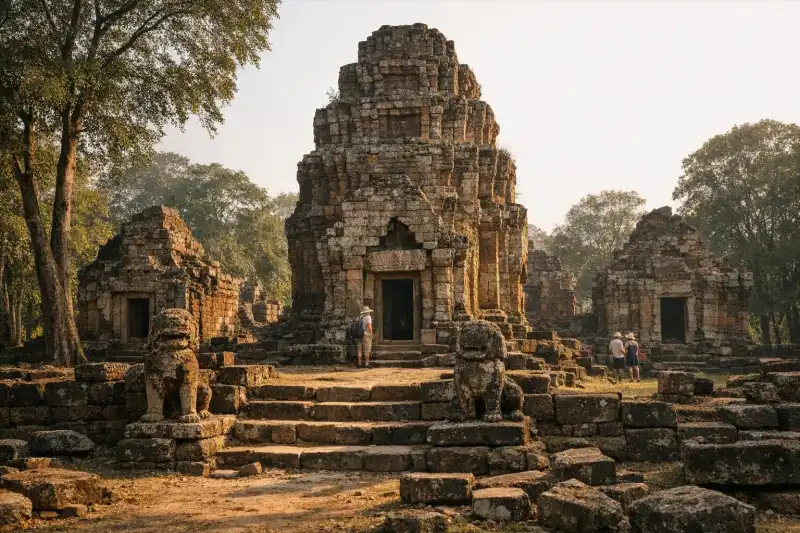
Ku Phra Kona
KhmerAn early Khmer sanctuary in northeastern Thailand, Ku Phra Kona preserves brick towers, carvings, an...
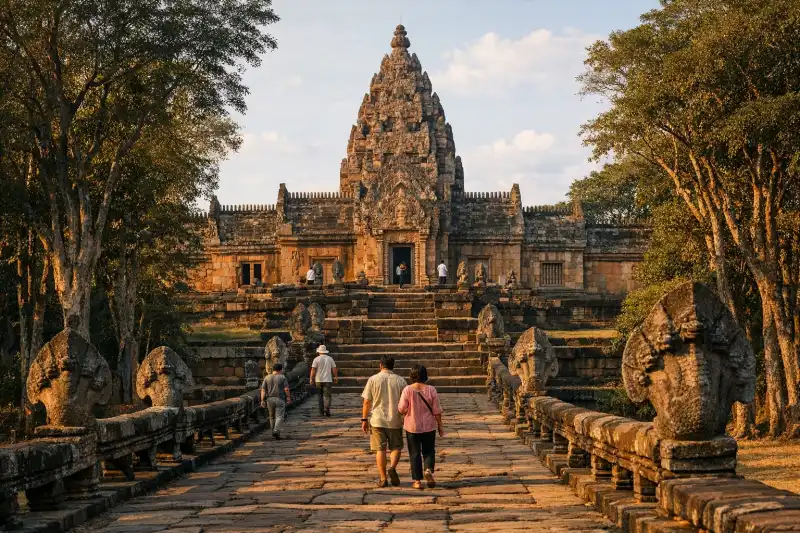
Phanom Rung
Khmer EmpireA dramatic Khmer hilltop temple in Thailand, Phanom Rung is famed for its sandstone carvings and sun...
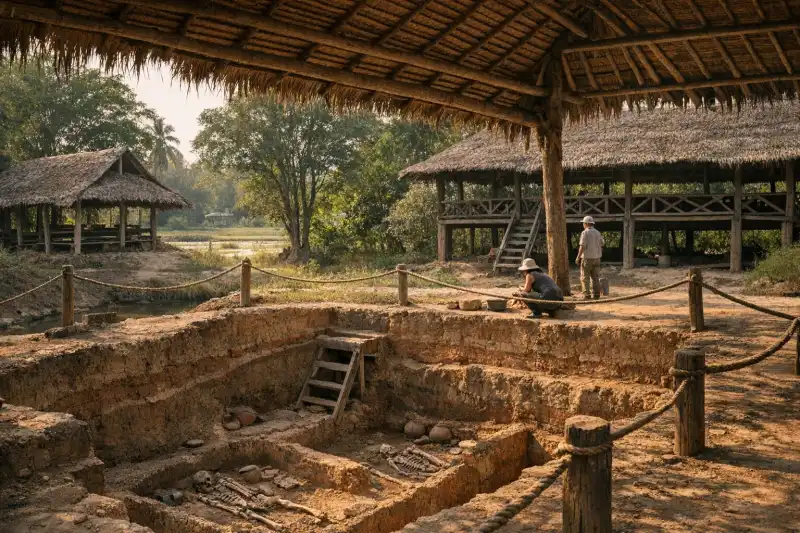
Ban Prasat Archaeological Site
Prehistoric communities of the Mun River basinExplore Ban Prasat Archaeological Site, a prehistoric burial and settlement site in Thailand’s Nakho...
Khao Phra Viharn
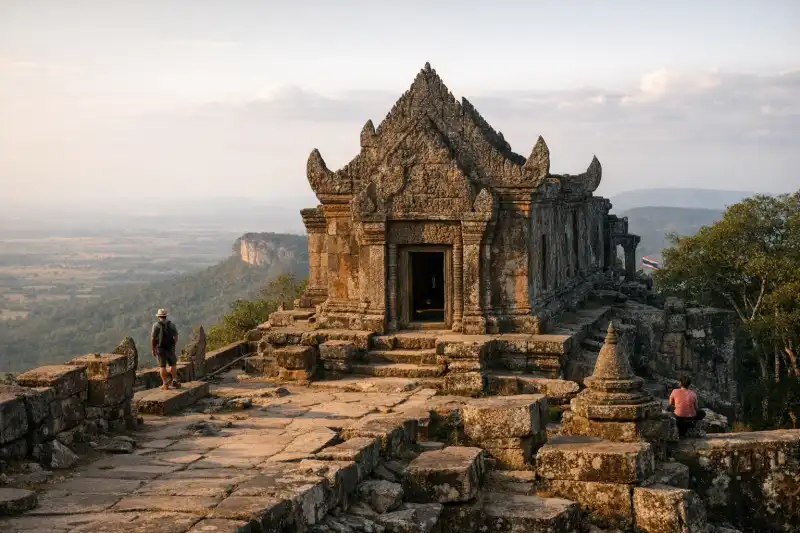
Khmer EmpireA dramatic Khmer temple on Thailand’s frontier, Khao Phra Viharn crowns a cliff with sweeping views ...