Quick Info
At a glance
Timgad, Algeria, rises from the high plains near the Aurès Mountains with a clarity that still surprises first-time visitors. Unlike many ancient cities known only through scattered fragments, Timgad presents itself as a complete Roman idea made stone: straight streets, ordered blocks, public monuments, and the remains of civic life laid out beneath a bright North African sky. Founded at the edge of empire and shaped by imperial ambition, it feels at once monumental and intimate. You can walk along paving stones worn by centuries, pass the bases of columns that once framed colonnaded avenues, and stand in spaces where citizens gathered for trade, worship, law, and entertainment.
What makes Timgad especially compelling is not only the beauty of its ruins but the legibility of its design. This is a place where the Roman city plan can be understood almost instantly by eye. The broad east-west and north-south axes still structure the site, and the forum, theater, baths, temples, houses, and market areas remain readable enough to imagine daily rhythms within them. Yet Timgad is more than an archaeological diagram. It was a living colonial town, a veteran settlement, a regional hub, and eventually a city transformed by prosperity, Christianity, pressure on imperial frontiers, and changing patterns of life in late antiquity. Today, standing among its honey-colored stone remains, you encounter both Rome’s confidence and its vulnerability, preserved in one of Algeria’s most remarkable ancient landscapes.
History
Founding under Trajan
Timgad, known in antiquity as Thamugadi, was founded around 100 CE during the reign of the Roman emperor Trajan. It began as a colonia for military veterans, especially former soldiers from Roman legions who had served the empire and were rewarded with land and settlement rights. This was a practical as well as political act. Rome often placed veteran colonies in strategic areas, using them to secure territory, promote Roman administration, and spread urban culture into frontier or semi-frontier regions.
The location was carefully chosen. Set near the Aurès Mountains in what is now Batna Province, the city occupied a position where agricultural land, routes across inland North Africa, and imperial oversight could intersect. The original plan of Timgad reflects the Roman preference for order and control. Surveyors laid out a near-perfect grid, with the cardo maximus running north-south and the decumanus maximus east-west. From the beginning, Timgad expressed Roman ideals in physical form: regularity, hierarchy, and civic organization.
Growth and urban prosperity
Over the 2nd and 3rd centuries CE, Timgad prospered. What likely began as a relatively compact colony expanded beyond its initial walls as population and economic activity increased. The city developed the full set of amenities expected of a flourishing Roman town. Public baths, a forum, temples, markets, libraries, and a theater all appeared or grew during this period. Wealthy inhabitants commissioned houses with courtyards, mosaics, and decorative architectural elements, while public inscriptions recorded local officials, benefactors, and imperial connections.
Timgad’s prosperity came from more than military origins. It became integrated into wider networks of trade and administration in Roman North Africa, one of the empire’s most productive regions. Grain, olive oil, and other agricultural products contributed to regional wealth, and towns like Timgad benefited from circulation of goods, taxation, and local patronage. The city’s urban form also evolved beyond its original neat square. As success brought pressure for more space, suburbs and later additions expanded outward, proving that real life rarely stayed within the limits of ideal planning.
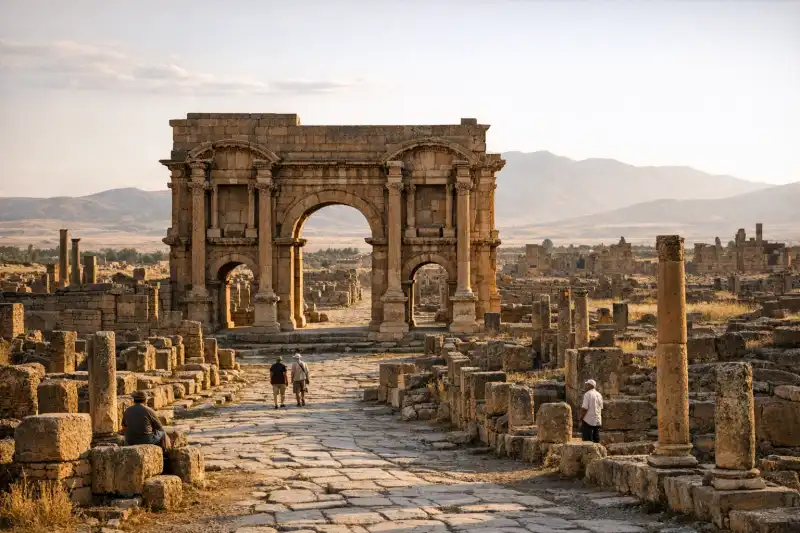
One of the most recognizable monuments, Trajan’s Arch, dates from the early 2nd century and symbolizes the city’s connection to imperial power. Though often treated as a grand entrance in modern photography, it also represented status, celebration, and Roman identity in stone. The city by this stage was no longer just a veteran outpost; it was a mature urban center.
Late Roman and Christian Timgad
By the 4th century, Timgad had become part of a changing Roman world. Political instability, shifting military pressures, and religious transformation affected cities across North Africa, and Timgad was no exception. Christianity took root in the region, and the city acquired Christian buildings and communities that altered its spiritual landscape. The urban fabric that had once centered almost exclusively on classical civic and pagan religious institutions now included churches and new forms of local authority.
Despite this adaptation, the late antique period was not entirely stable. Economic changes and insecurity along the frontiers challenged urban life. Like many Roman towns, Timgad endured cycles of maintenance, decline, and reinvention rather than a single abrupt fall. Some parts remained active while others deteriorated or were repurposed. The city’s continued existence in late antiquity shows resilience, but it also reveals the difficulty of sustaining the monumental urban model created in Rome’s high imperial age.
Decline, burial, and rediscovery
Timgad suffered during the turbulent centuries that followed, including incursions and disruptions associated with the weakening of Roman control in North Africa. The city declined and was gradually abandoned. Over time, sand and soil helped bury large portions of the ruins. This natural covering, while obscuring the site, also protected it. Buildings collapsed, but the ground preserved street layouts and architectural remains with unusual clarity.
Modern archaeological interest intensified under French colonial administration in the 19th and early 20th centuries, when systematic excavations revealed the extraordinary survival of the Roman town plan. Scholars and visitors were struck by how completely Timgad illustrated Roman urbanism. Excavation exposed streets, monuments, houses, baths, inscriptions, and religious structures, allowing the city to emerge again as one of the finest examples of Roman colonial planning anywhere in the former empire.
Its importance was recognized internationally when UNESCO inscribed Timgad as a World Heritage Site in 1982. Today, the ruins remain one of Algeria’s greatest archaeological treasures, valued not just for monumental architecture but for the insight they offer into how Rome projected itself into North Africa and how that vision changed over centuries.
Key Features
The defining feature of Timgad is its plan. Even before you focus on individual buildings, you notice the logic of the whole place. The broad main streets still cut decisively across the site, lined in parts by colonnades and flanked by the remains of urban blocks. This geometric order is one reason Timgad is so often cited in discussions of Roman city planning. It is one thing to read about the cardo and decumanus in a textbook; it is another to stand where they intersect and see how an imperial city was organized for movement, administration, and spectacle.
The forum formed the civic heart of Timgad. Here, public life concentrated around politics, commerce, law, and ceremony. Though the surrounding structures survive in partial form, the space still conveys the role such squares played in Roman urban life. Nearby stood key institutions including basilicas and temples, the kinds of buildings that made a city visibly Roman. These remains invite close reading: column drums, carved fragments, pavement outlines, and thresholds all help reconstruct how people used the space.
Trajan’s Arch is the site’s most iconic monument and often the image travelers remember best. Its proportions, decorative details, and commanding placement make it an ideal symbol of Timgad’s Roman character. Approached on foot, the arch works not only as an isolated ruin but as part of a wider urban composition. It once framed movement into an expanded district of the city and announced prestige to anyone entering. In the clear light of the Algerian plateau, its warm stone can look especially dramatic in morning or late afternoon.
The theater is another highlight. Built into a natural slope, it reflects the Roman talent for adapting architecture to terrain while preserving the expected arrangement of seating, stage, and performance space. Even in ruin, the theater remains easy to read. You can imagine crowds gathering for drama, public display, and civic celebration, with the city spread around them. Compared with more fragmentary theaters elsewhere, Timgad’s has a particularly immediate presence.
The residential quarters add another layer to the experience. Timgad is not only a city of monuments but also of houses, side streets, workshops, and neighborhood patterns. Walking these quieter sections gives a better sense of ordinary urban life. Some houses preserve traces of courtyards and rooms organized around domestic centers; others reveal later modifications and encroachments. Together they show that planned cities quickly become lived-in cities, shaped by practical needs and local habits.
Bath complexes at Timgad remind visitors how central bathing was to Roman social life. These were not simply places to wash. They were environments for exercise, conversation, negotiation, and leisure. The remains of heated rooms, pools, service areas, and circulation spaces suggest the sophistication of Roman engineering in a provincial context. Even where walls stand only waist-high, the arrangement still speaks clearly.
Religious diversity is also visible across the site. Pagan temples and later Christian remains testify to the changing beliefs of the city’s inhabitants. This transition matters because it turns Timgad from a static Roman showcase into a record of historical change. You can trace the city’s movement from imperial colony to late antique community through its architecture.
Many visitors also appreciate the archaeological museum near the site, where mosaics, inscriptions, sculptures, and smaller finds provide context that the open ruins alone cannot. After walking the streets, the museum helps put names, dates, and decoration back into the urban picture. Together, the site and museum make Timgad one of the most instructive ancient destinations in North Africa.
Getting There
Most travelers reach Timgad from Batna, the nearest major city, located roughly 35 kilometers to the west. Batna is well connected within northeastern Algeria by road and can be reached by intercity bus, shared taxi, or private car from cities such as Constantine, Sétif, and Algiers. If coming from Algiers, long-distance buses typically cost around 1,500 to 2,500 DZD depending on operator and comfort level, while domestic flights to Batna or nearby regional airports may sometimes be available seasonally or through indirect routings.
From Batna to Timgad, the simplest option is a taxi. A private taxi for the one-way journey usually falls in the range of 1,500 to 3,000 DZD depending on negotiation, time of day, and whether the driver waits for your return. Shared taxis can be cheaper if available, often from about 300 to 600 DZD per seat. Car rental offers the most flexibility, especially if you plan to combine Timgad with other sites in the Aurès region, but driving requires confidence with local roads and signage.
Some visitors arrange a guided day trip through a local hotel, driver, or travel agency in Batna. This is often the easiest approach if you want historical commentary and door-to-door logistics. Expect a tailored private excursion to cost more, commonly from 6,000 DZD upward depending on inclusions.
Once at the site, wear sturdy shoes and bring water, sun protection, and cash for tickets or small local purchases. Facilities can be limited, and the open archaeological terrain means you will spend much of your time exposed to the elements.
When to Visit
The best times to visit Timgad are spring and autumn, when temperatures are generally mild and walking across the exposed ruins is more comfortable. From March to May, the surrounding high plain can be green after winter rains, and the light is often excellent for photography. September through November is similarly pleasant, with warm days that are less intense than the height of summer. These shoulder seasons offer the best balance between comfort and clear conditions.
Summer, especially June through August, can be very hot in the daytime. Because Timgad is an open site with limited shade, midday visits in peak summer can be tiring and dehydrating. If you travel then, start as early as possible, carry plenty of water, and plan rest breaks. The advantage of summer is long daylight and generally dry weather, but the heat can reduce how much of the site you enjoy at a measured pace.
Winter visits are possible and can be rewarding for travelers who prefer quieter conditions. Days may be cool to cold, particularly in the morning, given the site’s upland setting near the Aurès region. Rain is not usually constant, but weather can be changeable, and a jacket is useful. Winter sunlight can also be beautiful on the stone ruins, especially when the air is crisp and visibility is high.
If your schedule is flexible, aim to arrive either shortly after opening or in the later afternoon. The lower angle of the sun brings out architectural texture, improves photography, and makes the site feel more atmospheric. It is also simply more pleasant to explore Timgad when the heat is gentler and the crowds thinner.
| Quick Facts | Details |
|---|---|
| Site name | Timgad |
| Ancient name | Thamugadi |
| Location | Near Batna, Batna Province, Algeria |
| Civilization | Roman |
| Founded | c. 100 CE under Emperor Trajan |
| UNESCO status | World Heritage Site since 1982 |
| Best known for | Roman grid plan, forum, theater, and Trajan’s Arch |
| Recommended visit length | 2 to 4 hours |
| Nearest major city | Batna |
| Best seasons | Spring and autumn |
Timgad rewards travelers who enjoy both beauty and clarity. Some ancient sites overwhelm with scale, while others intrigue through mystery; Timgad does something rarer by making the structure of an ancient city visible almost at once. Its straight avenues, monumental arch, public spaces, and quieter residential quarters together reveal how Rome imagined urban life on the North African frontier. Yet the city is not merely a frozen imperial blueprint. Its later Christian layers, signs of expansion, and evidence of decline remind you that every planned city becomes a historical organism, shaped by changing faiths, economies, and pressures.
For visitors to Algeria, Timgad is one of the country’s essential archaeological experiences. It combines accessibility from Batna with exceptional preservation and a setting that intensifies the impact of the ruins. Whether you come as a specialist in Roman history, a UNESCO site collector, or simply a curious traveler, Timgad offers something unusually tangible: the chance to walk through an ancient city and understand it not as an abstraction, but as a place where people once lived, governed, worshipped, traded, and watched performances under the same vast sky that stretches over the site today.
Guided tours: worth it?
A guide can be genuinely useful at Timgad, especially if you want help with transport, timing, tickets, or understanding a large site without losing half the day to logistics.
Best for
- First-time visitors who want context, not just photos
- Travelers who want transport, timing, or entry logistics handled
- Short visits where a planned route saves time
When to go self-guided
Go independently if you already have transport and tickets sorted, enjoy moving at your own pace, and are comfortable checking the latest official rules before you arrive.
What I’d avoid
Skip paid tours that bundle unrelated stops you do not actually want. The best option should either save meaningful planning time or add historical context you would miss on your own.
Timgad tours
Useful when: you want to compare guided formats before deciding
Batna and Timgad day trips
Useful when: transport or pickup logistics matter
Roman ruins in Algeria tours
Useful when: you want to compare guided formats before deciding
Some tour links are affiliate links, which may earn Ancient Travel a small commission at no extra cost to you. I try to surface options that make practical sense for the site—not just anything bookable.
Frequently Asked Questions
Where is Timgad located?
Timgad is in northeastern Algeria in Batna Province, near the Aurès Mountains and about 35 kilometers east of Batna.
What is Timgad famous for?
Timgad is famous for being one of the best-preserved Roman colonial towns in North Africa, especially for its clear street grid, forum, theater, and Trajan’s Arch.
Is Timgad a UNESCO World Heritage Site?
Yes. Timgad was inscribed as a UNESCO World Heritage Site in 1982 for its outstanding Roman urban planning and preservation.
How much time do you need to visit Timgad?
Most travelers should allow at least 2 to 4 hours to explore the main ruins, and longer if combining the archaeological museum and nearby sites.
What is the best time of year to visit Timgad?
Spring and autumn are generally the best times to visit, with milder temperatures and clearer conditions for walking through the open-air ruins.
Can you visit Timgad independently?
Yes. Many visitors reach Timgad independently from Batna by taxi or car, though a guide can add valuable historical context.
Nearby Ancient Sites
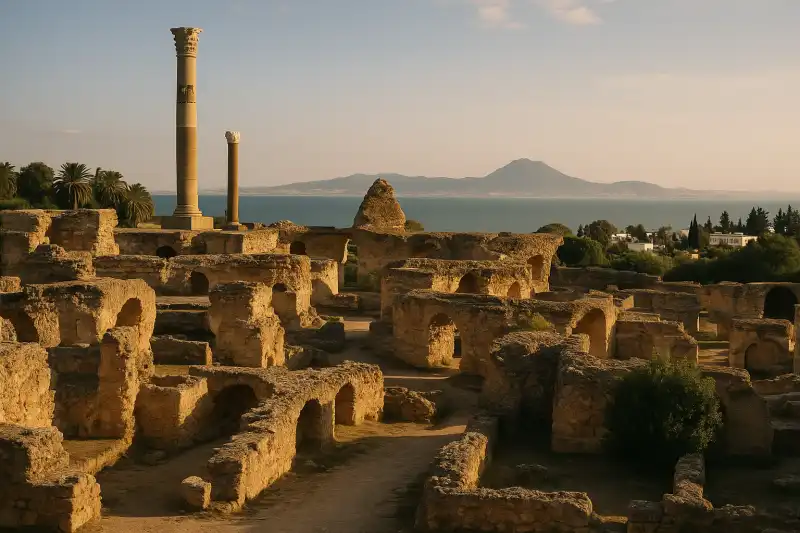
Carthage
Phoenician / Carthaginian / RomanCarthage in Tunisia preserves the ruins of a once-mighty Phoenician empire and Roman provincial capi...
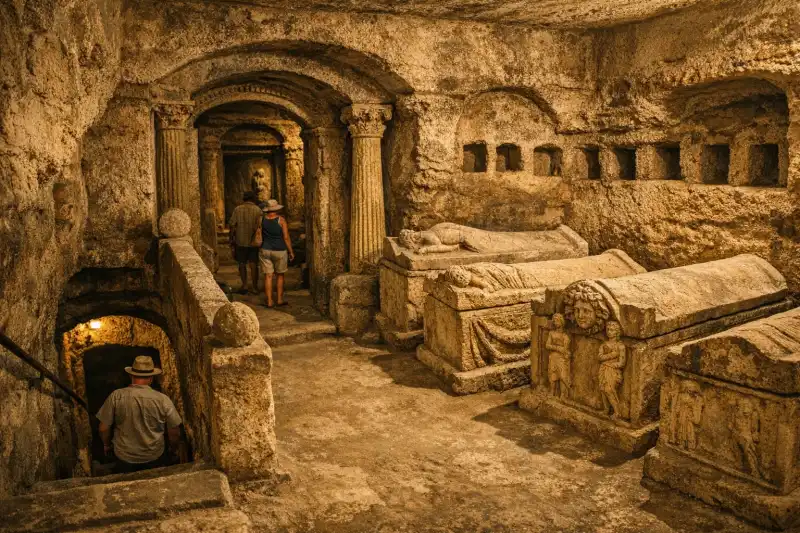
Alexandria Catacombs
Greco-Roman EgyptExplore Alexandria Catacombs in Egypt, a remarkable Roman-era underground necropolis blending Egypti...
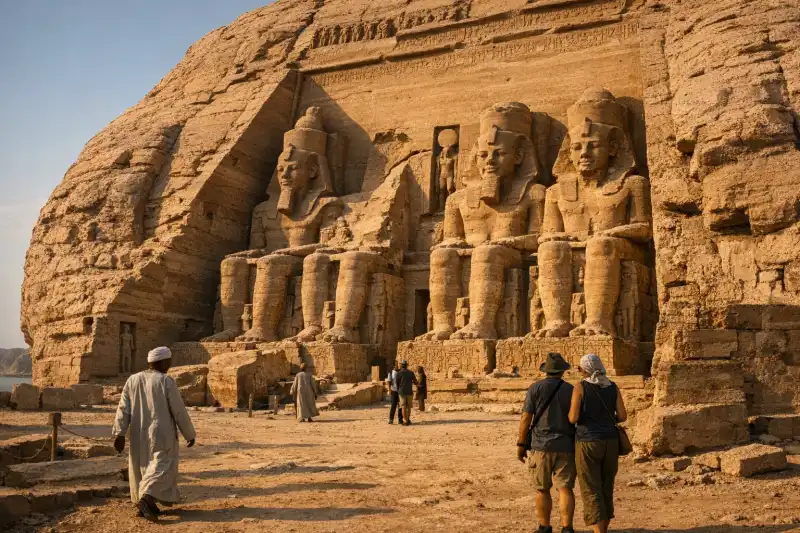
Abu Simbel
Ancient EgyptianDiscover Abu Simbel in Egypt, where colossal rock-cut temples of Ramses II rise above Lake Nasser ne...