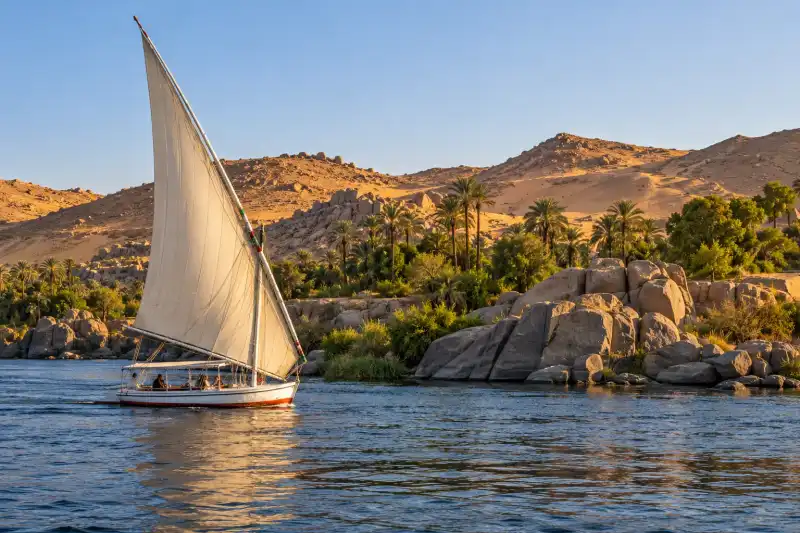
Aswan changes the scale of Egypt. The river narrows between granite, islands interrupt the view, and the desert comes close enough to make every boat crossing feel deliberate. This is not a place to tick off temples between airport transfers. Let the Nile organize the visit.
Make Philae the first anchor
Philae is best understood as both a temple complex and a conservation story. UNESCO’s Nubian Monuments listing describes the stretch from Aswan toward the Sudanese border as an archaeological landscape with monuments from the New Kingdom through Ptolemaic and Roman periods, alongside early Coptic sites and villages. The rescue of monuments threatened by the High Dam is part of what visitors are seeing, not a footnote.
Set aside a full half-day for the journey, the boat component, and unhurried time on site. Check the official operator’s current route, access conditions, ticket process, and boat arrangements close to travel. Do not assume an old departure time, price, or inclusion remains true.
Read the river locally
Elephantine Island gives a different scale: settlement history, the river’s working geography, and a chance to see Aswan as more than a staging post. Pair it with a slow Nile crossing or a walk through the city rather than a second remote monument. A boat is transport here, but it is also a way to understand why islands, cataracts, and shorelines mattered.
The Temple of Kalabsha adds another chapter in the relocated Nubian landscape. It is a separate logistical commitment, so decide in advance whether it is your second anchor or whether the day belongs to Elephantine and the city.
Abu Simbel needs its own decision
Abu Simbel is extraordinary, but it should not turn an Aswan stay into a pre-dawn blur by default. Treat it as a dedicated extension or carefully verified day journey. Confirm the current transport and site access directly with official providers, carry water and sun protection, and leave a recovery window afterward. The temples’ rescue and relocation form one of the defining episodes of modern heritage conservation.
A calm three-day shape
Day one: arrive, orient yourself by the river, and keep the afternoon flexible. Day two: Philae as the anchor, with time for the waterfront later. Day three: Elephantine and the city, Kalabsha, or an onward move. Add a separate night if Abu Simbel is a priority. This is not timid planning. It is what lets Aswan feel like a place rather than an airport lounge with palm trees.
Respect the setting
Dress for sun and uneven ground, carry water, and follow local guidance around boat landings and protected structures. Ask before photographing people, particularly in neighborhoods and working river spaces. At monuments, barriers and restricted paths are part of conservation, not a challenge coin for tourists.
For a longer route, connect Aswan with Kom Ombo, Edfu, Luxor Temple, and the Luxor and Nile temples itinerary.