Quick route summary
This 7-day route starts on Mykonos for Delos, crosses to Santorini for Akrotiri and Ancient Thera, then continues to Rhodes for Lindos, the Acropolis of Lindos, and Ancient Kamiros. It ends on Kos at the Asklepieion of Kos.
The route style is island-hopping with archaeology as the reason for the movement. It is rewarding, but not relaxed. The ancient sites are spread across four islands, and the ferries do not care about your neat day-by-day plan. Build slack where you can, especially between Santorini, Rhodes, and Kos.
Who this itinerary is for
This itinerary is for travelers who want the Aegean as an ancient cultural map, not just a beach circuit. It works best if you are comfortable with ferries, early starts, taxi transfers, and the occasional schedule change.
It is not ideal for travelers who want one base, lazy mornings, or a no-planning island trip. It also skips mainland Greece on purpose. You will not see Athens, Delphi, Mycenae, or Olympia here. The focus is the island world: sanctuaries, Bronze Age towns, Hellenistic cities, harbor networks, and healing cults.
Route at a glance
- Day 1: Overnight in Mykonos. Boat to Delos for the sanctuary of Apollo and the old commercial quarter.
- Day 2: Overnight in Santorini. Ferry from Mykonos to Santorini, then visit Akrotiri if the day lines up.
- Day 3: Overnight in Santorini. Climb or drive up to Ancient Thera, then keep the afternoon light.
- Day 4: Overnight in Rhodes. Transfer from Santorini to Rhodes, then use the old town and Palace area as a low-friction first stop.
- Day 5: Overnight in Rhodes. Day trip to Lindos and its acropolis, with a careful eye on heat and crowds.
- Day 6: Overnight in Kos. Visit Ancient Kamiros, then transfer onward to Kos by ferry when schedules allow.
- Day 7: Overnight in Kos. Visit the Asklepieion of Kos and finish with a slower day around Kos Town.
Practical logistics before you go
The best bases are Mykonos, Santorini, Rhodes Town, and Kos Town. Mykonos is mainly a launch point for Delos. Santorini gives you Akrotiri and Ancient Thera. Rhodes Town is the practical base for Lindos, Kamiros, and the old city. Kos Town keeps the Asklepieion easy.
Transit is the hard part. Ferries across the Cyclades and Dodecanese can be seasonal, weather-affected, and less direct than the map suggests. If the Santorini to Rhodes connection is poor, fly via Athens rather than sacrificing a full ancient-site day. That is not as romantic, but it is often the sane choice.
Guided tours make the most sense on Delos, at Akrotiri, and on Rhodes day trips where transport eats time. Independent travel is perfectly possible, but the island route rewards people who plan transfers before booking hotels.
Expect sun, wind, uneven stone, and more uphill walking than the word “island” implies. Delos has little shade. Ancient Thera sits high above the coast. Lindos looks close from the village until you start climbing.
Day 1: Mykonos arrival and Delos by boat
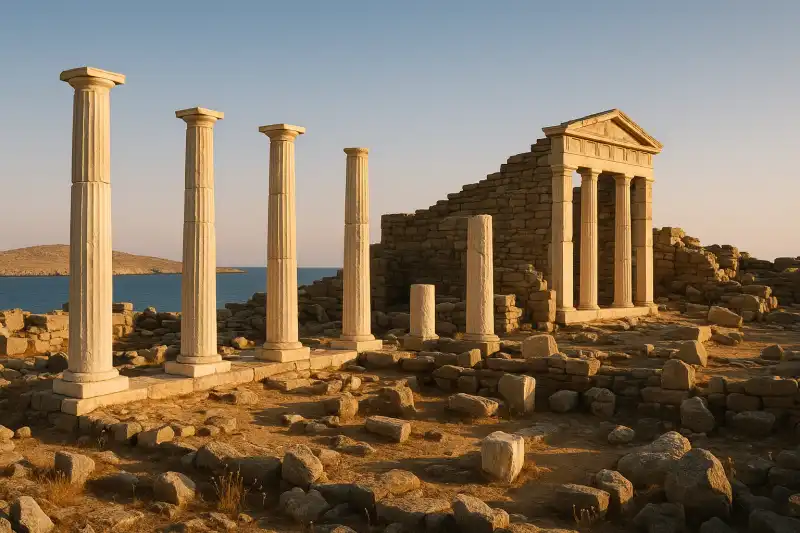
Use Mykonos as your base, but give the day to Delos. Boats usually leave from Mykonos Old Port, and the return timing matters because Delos is uninhabited. Do not treat this like a casual wander where you can stay as long as you like.
Delos was one of the most sacred islands in the Greek world, remembered as the birthplace of Apollo and Artemis. That myth helped turn a small, rocky island into a major sanctuary. Later, especially in the Hellenistic and Roman periods, Delos became a busy commercial port where merchants, bankers, freedmen, and worshippers left their marks in houses, mosaics, statues, and dedications.
Give the site more time than the map suggests. The Terrace of the Lions is famous, but the better travel day comes from seeing the sanctuary, theater quarter, houses, harbor edges, and sacred lake area as parts of one crowded island economy. The stones are quiet now, but ancient Delos was not a quiet place.
A guided visit can help here because the site is large and signage may not carry the whole story. If you want a structured first day, book a Delos archaeological site tour from Mykonos. If you go independently, bring water, sun protection, and a clear plan for the return boat.
Day 2: Ferry to Santorini and Akrotiri
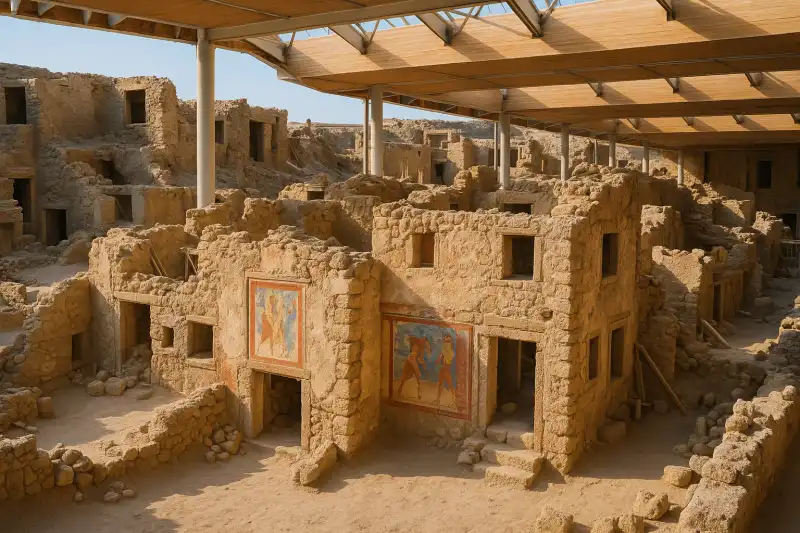
Take the ferry from Mykonos to Santorini and keep your expectations flexible. If you arrive early enough, go straight to Akrotiri. If the ferry is delayed or lands late, move Akrotiri to the next morning and do not force the day. This route works only if you respect transport fatigue.
Akrotiri is one of the great archaeological surprises of the Aegean. The Bronze Age town was buried by the Thera eruption in the second millennium BCE, preserving streets, multi-story buildings, drainage systems, storage spaces, and wall-painting fragments. It is not “Greek” in the later Classical sense. It belongs to the Minoan-connected world of Bronze Age trade, ships, frescoes, and island networks.
The covered site is easier on the body than many ruins, which makes it a good match for a transfer day. Walk slowly enough to notice the urban planning. This was not a scatter of huts under ash. It was a complex settlement plugged into Aegean commerce before the eruption changed Santorini’s landscape and memory.
A guide is genuinely useful at Akrotiri because the remains are subtle without context. A Santorini Akrotiri archaeological site tour can help connect the ruins with the frescoes, volcanic event, and wider Bronze Age Aegean.
Day 3: Ancient Thera above the sea
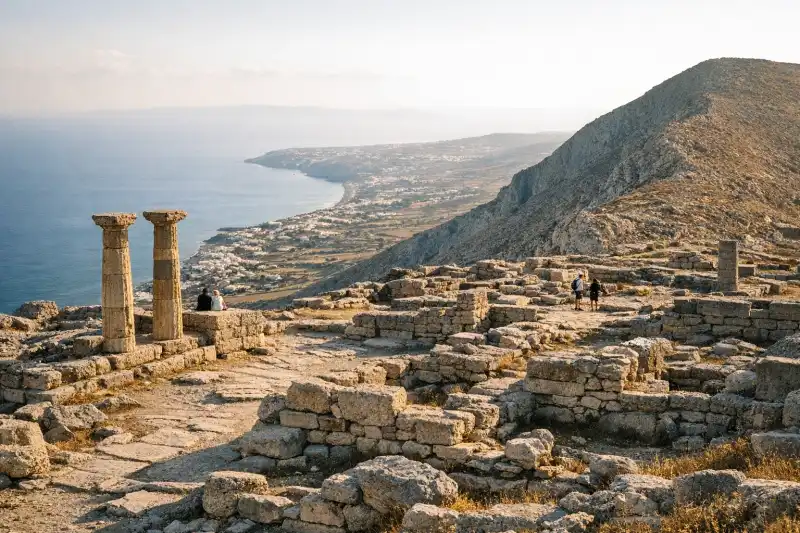
Spend the morning at Ancient Thera, high on Mesa Vouno between Kamari and Perissa. The approach is part of the experience. You can drive, take a taxi partway depending on conditions, or combine local transport with a steep walk. Do not schedule this for the hottest part of the day.
Ancient Thera shifts the island’s story forward from Bronze Age Akrotiri to the Greek, Hellenistic, Roman, and Byzantine periods. The city’s ridge-top position makes political and defensive sense once you stand there. Streets, sanctuaries, houses, public spaces, and inscriptions all sit with enormous views over the sea routes that made the island valuable.
One small pleasure of the site is how different it feels from Akrotiri. Akrotiri is enclosed, preserved by disaster, and urban in a Bronze Age way. Ancient Thera is exposed, wind-scoured, and much more obviously tied to later Greek civic life. Seeing both keeps Santorini from becoming a one-eruption story.
Keep the afternoon light. Swim, rest, or visit a museum if your energy holds. The mistake is pairing Ancient Thera with too many scenic Santorini obligations. The climb and sun take more out of you than the site list admits.
Day 4: Transfer to Rhodes and the medieval city
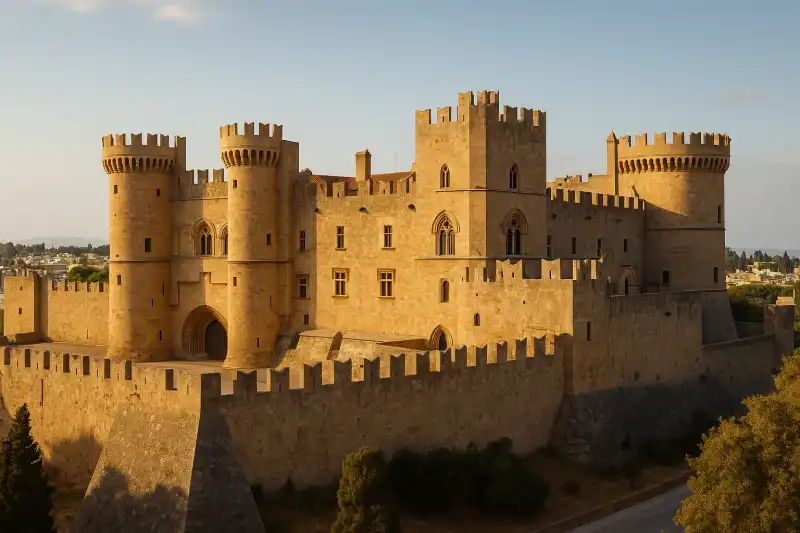
This is the awkward logistics day, so plan it before you book the rest of the route. If there is a workable ferry from Santorini to Rhodes, take it. If not, fly via Athens. It may feel strange to leave the island chain by air, but losing a full day to a bad connection is worse.
Once on Rhodes, stay in or near Rhodes Town. Keep the archaeology gentle and visit the Palace of the Grand Master of the Knights of Rhodes. It is medieval rather than ancient Greek, but it belongs in this route because Rhodes is layered. Ancient city, Hellenistic harbor power, crusader fortress, Ottoman town, Italian restoration, and modern tourism all sit on top of each other.
The palace also gives you a useful reset after ferry math. The Knights Hospitaller turned Rhodes into one of the great fortified strongholds of the eastern Mediterranean. Some restoration choices are modern and debatable, but the scale still tells you how much Rhodes mattered to people controlling sea routes.
Do not add Lindos today unless your transfer was unusually easy. Walk the old town, eat well, and prepare for two more serious site days. Rhodes rewards patience.
Day 5: Lindos and its acropolis
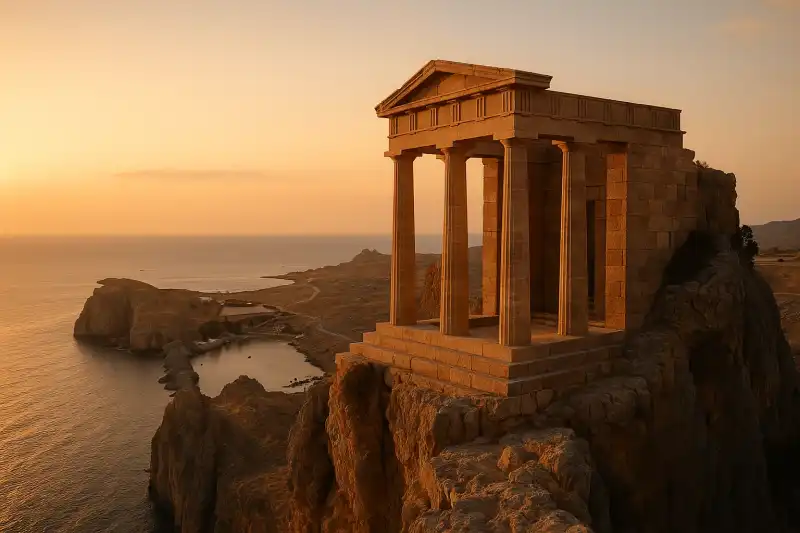
Go early to Lindos. From Rhodes Town, you can use a bus, rental car, taxi, or guided day trip. The village is beautiful, but the ancient reason to come is the Acropolis of Lindos, perched above the sea on a limestone headland.
The sanctuary of Athena Lindia was important long before the medieval walls made the skyline even more dramatic. The Doric stoa, temple remains, stairways, inscriptions, and cliff-edge setting make Lindos feel like a place where religion, maritime identity, and civic pride all wanted the same view. This is a good day for people who like their sanctuaries theatrical.
The climb is exposed and can be slow when cruise crowds arrive. Wear shoes with grip and start before the heat hardens. If you are visiting in summer, the ancient site should come before lunch, not after.
A guided Rhodes day tour can make sense if you do not want to manage transport, especially one that combines Lindos with wider island context. Use a Rhodes Lindos and ancient sites day tour only if the timing gives Lindos enough room. A rushed acropolis visit misses the point.
Day 6: Ancient Kamiros and onward to Kos
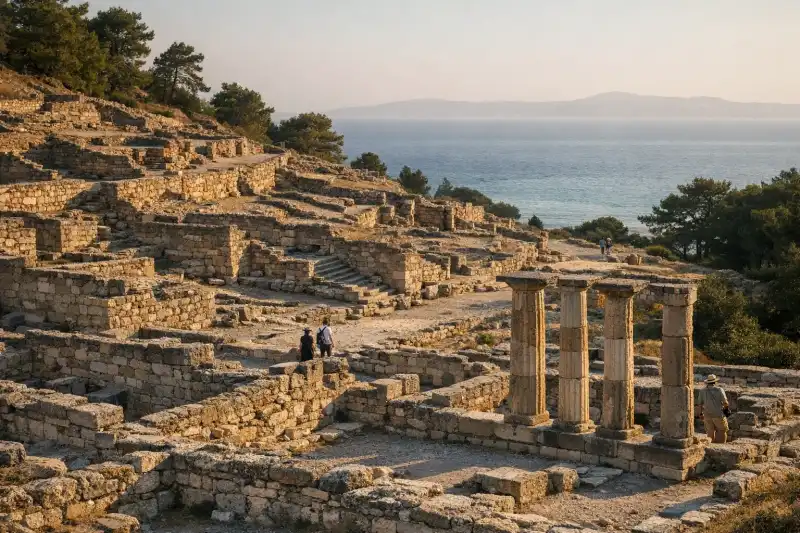
Visit Ancient Kamiros before leaving Rhodes if ferry timing allows. Kamiros is quieter than Lindos and less visually dramatic at first glance, but it may be the better city-planning day. The Hellenistic town spreads across terraces with houses, public spaces, water systems, and a clear sense of civic order.
Kamiros was one of the three ancient cities of Rhodes, along with Lindos and Ialysos. When the unified city of Rhodes was founded in 408 BCE, power shifted, but Kamiros remained an important settlement. Walking its terraces helps you see the island as more than one famous acropolis and one medieval town.
The logistics are the catch. Kamiros sits on the west side of Rhodes, and Kos is a separate island with ferry schedules that vary. If the connection is clean, visit Kamiros in the morning and transfer to Kos later. If not, swap Kamiros to Day 5 and use this as a dedicated travel day. That is less elegant on paper, but much better in real life.
End the day in Kos Town. Do not plan the Asklepieion on arrival unless your ferry lands early and you are unusually fresh. Ancient sites are better when you are not watching the clock.
Day 7: The Asklepieion of Kos
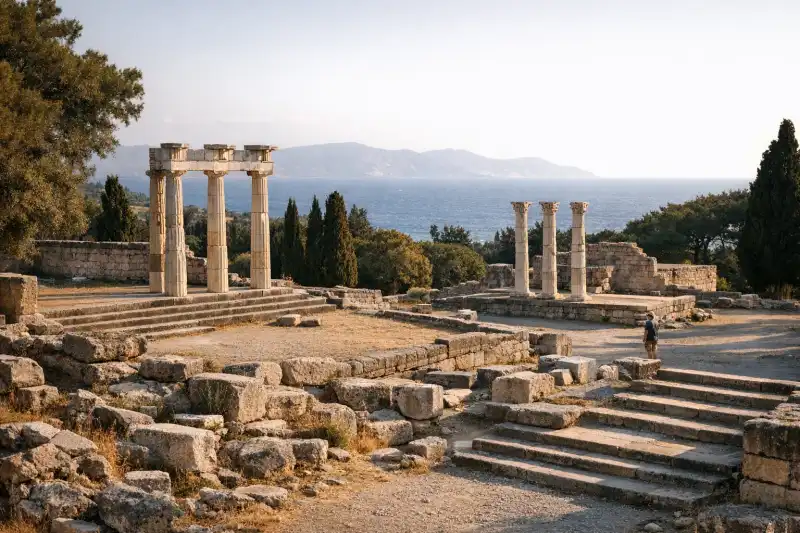
Finish at the Asklepieion of Kos, a healing sanctuary set on terraces above Kos Town. You can reach it by taxi, local bus, bicycle if you are comfortable with the route, or an organized tour. Go in the morning for better light and less heat.
The site is associated with Asklepios, the god of healing, and with the island’s medical tradition linked to Hippocrates. The sanctuary developed over time, especially in the Hellenistic period, with terraces, temples, altars, and spaces where medicine, ritual, reputation, and landscape worked together. Ancient healing was not modern medicine in sandals. It mixed observation, diet, dreams, divine appeal, and institutional prestige.
The terraced layout is the thing to notice. Patients and worshippers moved upward through the sanctuary, and the views toward the coast are not incidental. The setting helps explain why healing sanctuaries often feel carefully staged. Calm was part of the architecture.
Keep the rest of the day slow. Kos Town has enough ancient fragments and harbor atmosphere for a gentle finish, but the Asklepieion should be the main historical endpoint. After Delos, Santorini, and Rhodes, this final day brings the route down to the human body: illness, hope, ritual, and the old desire to be made well.
The historical thread: sacred islands, sea routes, and civic ambition
This route works because the Aegean was never just a pretty sea between islands. It was a network. Delos drew worshippers, merchants, and political attention into one sacred-commercial island. Santorini preserves two very different ancient stories: the Bronze Age town at Akrotiri and the later city of Thera watching the sea from its ridge. Rhodes shows how island cities turned harbors, sanctuaries, acropoleis, and fortifications into power. Kos ends the route with healing, reputation, and pilgrimage.
The variety is the point. You are not following one empire or one dynasty. You are watching island communities use sanctuaries, trade, myth, urban planning, and strategic geography to matter far beyond their size.
Transportation notes
Book this itinerary around transport first and hotels second. Delos boats, Cyclades ferries, Dodecanese ferries, and inter-island flights do not line up perfectly every day.
The easiest structure is Mykonos for Delos, ferry to Santorini, fly or ferry to Rhodes, then ferry to Kos. If Santorini to Rhodes is messy, fly via Athens. That adds airport time, but it can save the route.
Do not self-drive on every island by default. A rental car helps on Santorini and Rhodes if you are confident, but taxis, buses, and guided tours may be easier for single-site days. On Rhodes, a car is useful for Lindos and Kamiros, but parking and old-town access can be annoying.
Avoid compressing the route into six days unless you remove an island. The weak point is the Rhodes to Kos transition. If ferries are limited, protect Delos, Akrotiri, Lindos, and the Asklepieion, then treat Kamiros as the flexible cut.
Optional add-ons and swaps
If you want more time on Santorini, add Ancient Akrotiri as a deeper planning variant for the Akrotiri day and give the site a full morning. Remove the attempt to visit anything major on arrival day.
If you want a second Santorini high-place day, use Thera as your alternate planning page for the ancient city and spend more time around Mesa Vouno. Remove a beach or winery plan rather than cutting historical time.
If Rhodes is your main interest, add a second pass at the Acropolis of Lindos or more time in Rhodes Town around the Palace of the Grand Master of the Knights of Rhodes. Remove Kos only if ferry schedules are poor and you prefer a tighter Rhodes-focused trip.
If you need to cut one ancient site, cut Kamiros before Delos, Akrotiri, Lindos, or the Asklepieion. Kamiros is excellent, but it is the easiest loss logistically.
Shorter and longer itinerary options
For a shorter 5-day version, choose either the Cyclades or the Dodecanese. A sensible Cyclades plan is Mykonos for Delos plus Santorini for Akrotiri and Ancient Thera. A sensible Dodecanese plan is Rhodes plus Kos.
For a longer 10-day version, slow the same route down rather than adding more islands. Add one extra night on Santorini, one on Rhodes, and one on Kos. That gives you weather backup, museum time, and fewer transfer-day compromises.
For a mainland extension, connect through Athens and add ancient Attica or the Peloponnese on a separate itinerary. Do not bolt Delphi, Mycenae, and Olympia onto this week unless you enjoy turning good sites into a transport spreadsheet.
Related ancient sites
- Delos
- Akrotiri
- Ancient Akrotiri (Santorini)
- Ancient Thera
- Thera
- Lindos
- Acropolis of Lindos
- Ancient Kamiros
- Palace of the Grand Master of the Knights of Rhodes
- Asklepieion of Kos
FAQ
The most common planning questions for this ancient Greek islands route are answered below.