Quick Info
At a glance
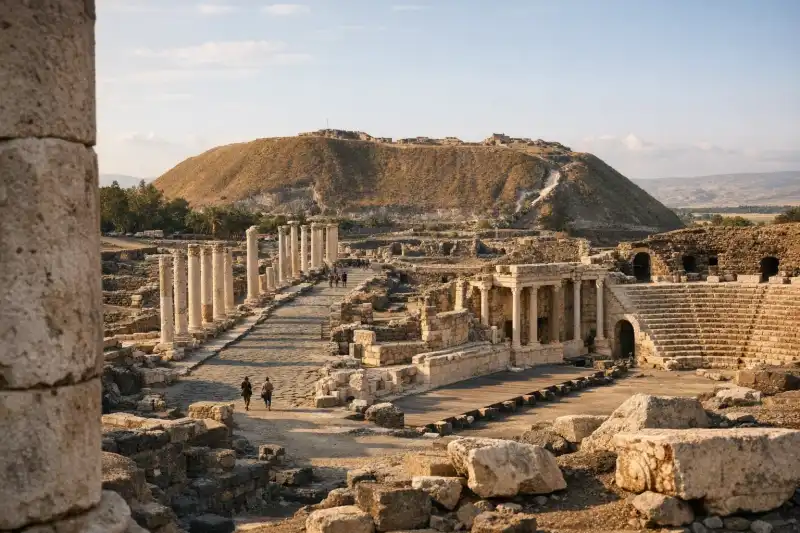
Beth She’an in Israel is one of those ancient places that feels theatrical before you even reach the theater. The broad Jordan Valley opens around it, the light is sharp, and the ruined city spreads below a steep mound that preserves layer upon layer of earlier settlement. What first appears as a scattering of columns quickly resolves into something far grander: a planned Roman city, with streets, baths, temples, shops, and civic spaces still legible enough to imagine daily life in surprising detail.
For many visitors, Beth She’an is memorable because it offers two cities at once. Rising above the classical ruins is the tell, the ancient mound where people lived for millennia before the Romans reshaped the lower city into a provincial showpiece. At ground level, you walk through the remains of a place built for display and movement, where processions, trade, entertainment, and public ritual were all part of the urban experience. From above, on the tell, the site becomes a longer historical story, reaching back to Canaanite, Egyptian, Israelite, and Hellenistic eras.
The result is one of the most rewarding archaeological destinations in Israel. Beth She’an is not simply a collection of ruins but an unusually readable urban landscape. Even if you have visited other Roman sites, there is something distinctive here: the dramatic topography, the hot valley setting, and the sense of continuity between biblical antiquity and the later classical city. It is a place where chronology is visible in stone.
History
Bronze and Iron Age origins
Long before Beth She’an became a Roman showpiece, it was already an important settlement because of its strategic position near the junction of the Jezreel Valley and the Jordan Valley. This location linked inland routes with fertile agricultural land and made the site valuable for regional powers. Archaeological evidence shows occupation from the Bronze Age, when the city emerged as a significant Canaanite center. Its prominence drew the attention of ancient Egypt, and during the Late Bronze Age Beth She’an became one of the key Egyptian-administered sites in Canaan.
Excavations have revealed Egyptian inscriptions, administrative remains, and material culture that point to strong imperial involvement. The city functioned not simply as a local town but as part of a broader political network extending into the Levant. This period gave Beth She’an a long-standing reputation as a place of authority, trade, and military relevance.
During the Iron Age, the site continued to matter in the shifting landscape of local kingdoms and regional conflict. Beth She’an appears in biblical tradition and is especially associated with the account of King Saul, whose body was said to have been displayed on the walls of the city after the battle of Mount Gilboa. Whether approached as history, tradition, or memory, this association deepened the site’s enduring cultural significance.
Hellenistic transformation
After the conquests of Alexander the Great, Beth She’an entered the Hellenistic world and was gradually reshaped by Greek urban culture. It became known as Scythopolis, the name by which it was famous in the classical period. This was an era of political reorganization, cultural blending, and urban development across the eastern Mediterranean, and Beth She’an was no exception.
The city’s position made it useful to successive Hellenistic rulers, including the Ptolemies and Seleucids. Greek language, institutions, and architectural forms became more visible, though the site’s older Near Eastern past never fully disappeared. Instead, Beth She’an became a layered city, where new public life was built over much earlier foundations. This blending of traditions helps explain why the site today feels so historically deep: the Roman city that dominates the visible ruins did not emerge from emptiness but from centuries of continuity and adaptation.
Roman prosperity
Beth She’an reached its most monumental phase under Roman rule. As Scythopolis, it became one of the cities of the Decapolis, a regional group of Hellenistic-Roman urban centers known for their civic institutions and classical architecture. This status helped elevate the city’s profile and encouraged major investment in public works.
The lower city was extensively developed with colonnaded streets, a theater, bathhouses, temples, fountains, and administrative buildings. These were not merely decorative structures. They expressed the values of Roman civic life: order, spectacle, health, commerce, and public identity. The theater hosted performances and assemblies. Broad streets organized movement through the city. Baths created social spaces. Monumental gateways and colonnades projected wealth and confidence.
Beth She’an also benefited from trade and agricultural production in the fertile surrounding region. Goods, people, and ideas moved through the city, helping sustain its prosperity. Earthquakes, a recurring factor in the Levant, periodically damaged the site, but rebuilding continued, and the city remained important through the Roman era.
Byzantine city and decline
In the Byzantine period, Beth She’an remained a major urban center and adapted to the Christianized empire. Churches were added, older structures were reused, and the city continued to flourish economically. Mosaic pavements and later architectural phases testify to sustained prosperity. Far from being a brief Roman episode, the classical city had a long afterlife in late antiquity.
The turning point came in 749 CE, when a devastating earthquake struck the region. Like many cities in the Jordan Valley and beyond, Beth She’an suffered extensive destruction. Although some activity continued, the urban center never fully recovered its previous scale and importance. Over time, settlement shifted, ruins collapsed, and sediment accumulated over the abandoned city.
This abrupt end is one reason the site is so valuable today. The earthquake froze much of the urban fabric in place, preserving streets and buildings in a form that allows archaeologists and visitors alike to trace the city plan with unusual clarity. Modern excavation has gradually revealed this buried landscape, turning Beth She’an into one of Israel’s most impressive archaeological parks.
Key Features
What makes Beth She’an exceptional is not a single monument but the coherence of the entire site. The lower city is broad and open, and as you move through it, the relationship between buildings becomes clear. This is a place best understood by walking: the spaces unfold one after another, and the city starts to feel organized rather than fragmentary.
The Roman theater is usually the first great visual anchor. Set against the valley landscape, it preserves rows of seating and enough structural form to convey its original scale. Even in partial ruin, it communicates the public life of the city with remarkable directness. You can stand where crowds once gathered for drama, music, speeches, or civic occasions and feel how central performance was to urban identity. Unlike isolated theaters elsewhere, this one belongs to a fully developed city around it, which makes it more meaningful.
Equally striking are the colonnaded streets, especially the main thoroughfares that once guided people through the commercial and ceremonial heart of Scythopolis. Their paving stones, column bases, and long sight lines create some of the most evocative views in the park. These streets were practical arteries, but they were also statements of civic sophistication. Walking them today, you can still sense the choreography of movement they imposed: traffic flowing between shops, public buildings, fountains, and gathering points.
The bathhouses reveal another layer of urban culture. Roman baths were not only places to wash but social institutions where routines of health, business, and conversation unfolded. At Beth She’an, the surviving remains help visitors picture heated rooms, pools, service spaces, and systems of water management. In a hot valley environment, the presence of sophisticated bathing complexes also speaks to the city’s wealth and technical organization.
The tell rising above the classical city adds a dimension that many archaeological parks lack. From the lower ruins, it functions as a dramatic backdrop; from the summit, it becomes a viewpoint and a historical key. Climbing it shifts your perspective from the Roman and Byzantine city to the much older settlement mound. The upper area preserves traces of earlier periods and helps explain why people chose this location in the first place. It also offers sweeping views over the valley, making the geography of the city easier to understand.
Another memorable feature is the way earthquake destruction is visible in the site’s fallen stone. Columns collapsed where they stood, masonry shifted, and architectural fragments lie in patterns that recall sudden catastrophe rather than gradual decay. This gives Beth She’an a distinctive texture. The ruins do not feel smoothed by time alone; they feel interrupted. For visitors, that creates a powerful connection between the city’s prosperity and its abrupt vulnerability.
There are also smaller details worth noticing throughout the park: carved stones, drainage systems, street layouts, and the remains of shops and civic spaces that show how ordinary urban life worked. Beth She’an rewards both broad impressions and close attention. You can appreciate it as an impressive ruin on first glance, but the longer you stay, the more intelligible it becomes as a functioning city.
Getting There
Beth She’an is located in northern Israel, near the modern city of Beit She’an, and is easiest to reach by car. Driving from Tiberias usually takes about 50 to 60 minutes, from Nazareth around 1.5 hours, from Haifa roughly 1.5 to 2 hours, and from Jerusalem around 2 to 2.5 hours depending on traffic. Rental cars are the most convenient option because they allow flexibility for combining Beth She’an with nearby sites such as Tel Megiddo or the Sea of Galilee region. Parking at the national park is generally straightforward.
Public transport is possible but requires more planning. Israel Railways operates service to Beit She’an from Haifa with connections through the broader rail network. A one-way train fare from Haifa is often in the range of ₪25-40 depending on route and ticket type. From the Beit She’an station, local buses or taxis can take you to the site; taxi fares are typically around ₪25-40 for the short ride. Intercity buses also connect Beit She’an with cities such as Tiberias, Afula, and Jerusalem, with fares commonly around ₪15-50 depending on distance.
Guided day tours are another good option, especially if you are staying in Jerusalem or Tel Aviv and want historical context without navigating transfers. Group tours vary widely in price, but many full-day northern Israel excursions begin around $90-150 per person. If you travel independently, bring water and check opening hours before setting out, as the site is large and best enjoyed with enough time to explore.
When to Visit
The best time to visit Beth She’an is in spring or autumn, when temperatures are warm but usually manageable. Because the site lies in a low valley, summers can be intensely hot, often making midday exploration tiring. In April, May, October, and November, the light is excellent for photography, the ruins are easier to explore on foot, and the climb up the tell feels far more comfortable than it does in peak summer.
Winter can also be a pleasant season, especially for travelers who prefer quieter conditions and softer light. Temperatures are cooler and walking is easier, though occasional rain may affect footing on some surfaces. On clear winter days, the surrounding landscape can look especially vivid, and the contrast between green fields and pale stone is striking.
If you visit in summer, arrive as early as possible. Morning is by far the most comfortable time to walk through the lower city and ascend the tell. Late afternoon can also be attractive, especially when shadows lengthen across the columns and theater. Midday, by contrast, can feel exposed, with little shade in many parts of the site.
Allow extra time if you are interested in photography or archaeology. Beth She’an is not a place to rush. Seasonal timing matters because the site rewards slow movement, repeated viewpoints, and moments of pause. Whatever month you choose, sun protection, water, and sturdy shoes are essential. The best visit is one paced to the climate.
| Quick Facts | Details |
|---|---|
| Location | Beit She’an Valley, Northern District, Israel |
| Ancient Name | Scythopolis |
| Main Periods Visible | Roman and Byzantine, with earlier remains on the tell |
| Earliest Occupation | Bronze Age |
| Notable Civilizations | Canaanite, Egyptian, Hellenistic, Roman, Byzantine |
| Best Known For | Theater, colonnaded streets, bathhouses, and the tell |
| Typical Visit Length | 2-4 hours |
| Best Seasons | Spring and autumn |
| Access | Easiest by car; possible by train, bus, or taxi |
| Terrain | Open archaeological park with uneven stone surfaces and a hill climb |
Beth She’an stands apart because it combines scale, clarity, and historical depth in one place. Some ancient sites impress through a single surviving monument; others through their long chronology. Here, you get both. The monumental lower city offers one of the clearest experiences of Roman and Byzantine urbanism in Israel, while the tell reminds you that this prominence was earned over thousands of years. The site’s geography, biblical resonance, classical architecture, and visible earthquake destruction all contribute to its unusual power.
For travelers interested in the ancient Near East, Roman provincial cities, or the deep continuity of settlement in the Levant, Beth She’an is one of the most rewarding places to visit in Israel. It is large enough to feel immersive, legible enough to be understood without specialist training, and layered enough to hold the attention of serious history enthusiasts. Above all, it offers a rare chance to walk through an ancient city that still feels like a city.
Guided tours: worth it?
Self-guided works here, but a guide can add real value if you want the ruins explained as a living place rather than just a sequence of monuments.
Best for
- First-time visitors who want context, not just photos
- Short visits where a planned route saves time
When to go self-guided
Go independently if you prefer setting your own pace, reading as you go, and checking official hours or ticket rules directly before you arrive.
What I’d avoid
Skip paid tours that bundle unrelated stops you do not actually want. The best option should either save meaningful planning time or add historical context you would miss on your own.
Beth She'an Day Tours
Useful when: you want to compare guided formats before deciding
Northern Israel Archaeology Tours
Useful when: you want to compare guided formats before deciding
Galilee and Beth She'an Tours
Useful when: you want to compare guided formats before deciding
Some tour links are affiliate links, which may earn Ancient Travel a small commission at no extra cost to you. I try to surface options that make practical sense for the site—not just anything bookable.
Frequently Asked Questions
What is Beth She'an famous for?
Beth She'an is famous for its exceptionally preserved Roman and Byzantine ruins, including a theater, colonnaded streets, bathhouses, temples, and a hilltop tell with much earlier remains.
Is Beth She'an worth visiting?
Yes. It is one of Israel’s most impressive archaeological parks and offers a vivid sense of what a major classical city looked like, with monumental public architecture and broad open views.
How much time do you need at Beth She'an?
Most visitors need two to four hours to explore the main Roman and Byzantine city and the tell. History enthusiasts may want longer, especially in cooler weather.
Can you visit Beth She'an as a day trip?
Yes. Beth She'an can be visited on a day trip from Tiberias, Nazareth, Haifa, or Jerusalem, though travel times are shortest from northern Israel.
What should I bring to Beth She'an?
Bring water, sun protection, sturdy walking shoes, and a hat. The site is expansive and can be very hot, especially from late spring through early autumn.
Is Beth She'an connected to biblical history?
Yes. Beth She'an appears in the Hebrew Bible and was an important settlement long before the Roman period, making it significant for both biblical and classical history.
Nearby Ancient Sites
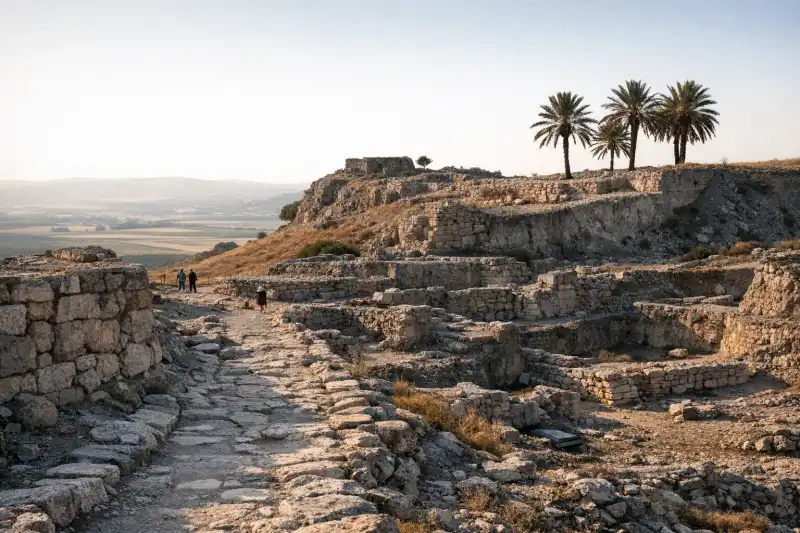
Tel Megiddo
Canaanite, Israelite, Assyrian, Persian, Hellenistic, RomanExplore Tel Megiddo in Israel, an ancient mound with monumental gates, water systems, and layers of ...
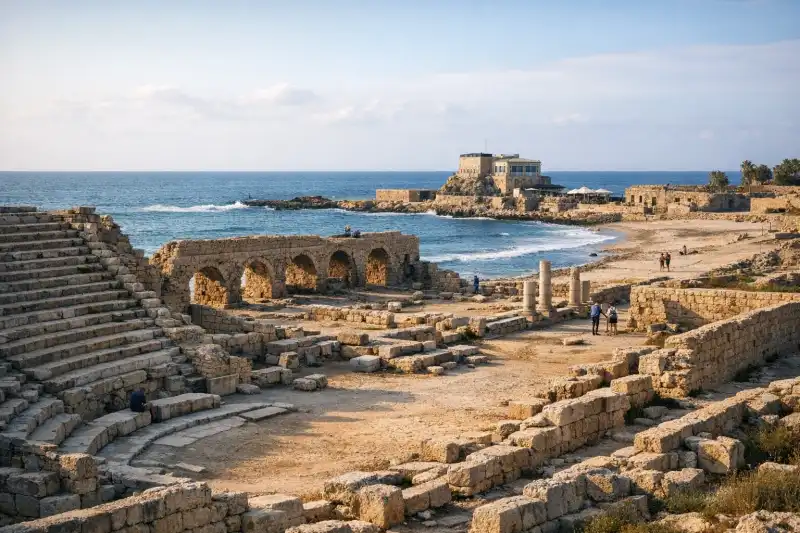
Caesarea Maritima
Herodian, Roman, and ByzantineExplore Israel’s Caesarea Maritima, a grand Herodian port city of harbors, theaters, aqueducts, and ...
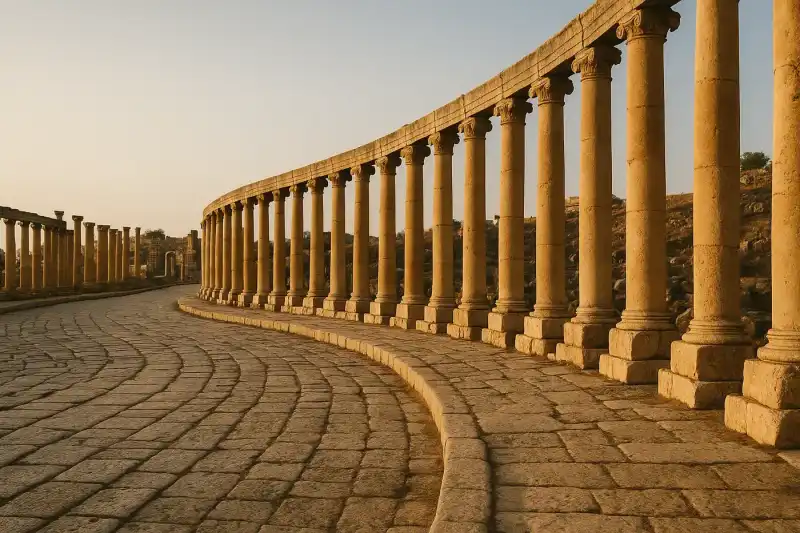
Jerash: The Pompeii of the East and Jordan's Best-Preserved
Roman / NabataeanDiscover Jerash, Jordan's remarkable Roman ruins. Walk the colonnaded streets of ancient Gerasa, exp...