Quick route summary
This 5-day Jordan route starts in Amman and ends in Wadi Musa, the town beside Petra. It uses three bases: Amman for the capital and Jerash, Madaba for the mosaic and biblical landscape, and Wadi Musa for Petra.
The route links the Amman Citadel, the Roman Theater in Amman, Jerash, Madaba, Mount Nebo, and Petra. The pace is active but sane. You will move most days, but you are not trying to turn Jordan into a checklist of every famous place between breakfast and sunset.
Historically, this is a satisfying route because it does not treat Petra as a lone grand finale. You see Amman’s layered hilltop, a Roman city that still has its street grid, Byzantine mosaic craft in Madaba, a biblical viewpoint at Mount Nebo, and then the Nabataean capital carved into sandstone.
Who this itinerary is for
This itinerary is for first-time Jordan travelers who want ancient sites more than resort time. It works well if you can handle early starts, short city transfers, one long southbound travel day, and a lot of walking at Petra.
It is not ideal if you want one hotel for the full trip or if you dislike hiring drivers, taking taxis, or making practical decisions on the move. Jordan rewards flexible travelers. The distances are manageable, but the country is not best experienced by pretending every site is just a quick stop.
If Petra is your main reason for coming, this route protects one full day there. If Roman cities are your thing, you may wish you had more time in the north, especially for Umm Qais or Pella. That is a good problem, not a failure of the route.
Route at a glance
- Day 1: Overnight in Amman. Visit the Amman Citadel and Roman Theater by taxi or rideshare, keeping the day light if you arrive by air.
- Day 2: Overnight in Amman. Drive north to Jerash for a full Roman city day, then return to Amman.
- Day 3: Overnight in Madaba. Transfer to Madaba, visit the mosaic churches, and continue to Mount Nebo with a driver or taxi.
- Day 4: Overnight in Wadi Musa. Travel south toward Petra, using the day mostly for the road and arrival rather than squeezing in too much.
- Day 5: Overnight in Wadi Musa. Start early at Petra and walk from the Siq to the Treasury, then farther into the city if time and energy allow.
Practical logistics before you go
Amman, Madaba, and Wadi Musa are the best bases for this route. Amman gives you airport access, restaurants, and an easy start for Jerash. Madaba is calmer than Amman and well placed for Mount Nebo and the road south. Wadi Musa is the practical base for Petra. Do not stay far from Petra and assume the morning transfer will be painless.
Transit is the main planning reality. You can do this route with a rental car, private drivers, or a mix of taxis and tours. Public buses exist, but they are not efficient enough for a tight ancient-sites itinerary unless you have more time and a high tolerance for schedule friction.
A guide makes the most sense at Jerash and Petra. Jerash is readable on your own, but the city opens up when someone explains the Cardo, the oval plaza, the theaters, and how a Decapolis city worked under Rome. Petra is even more layered: Nabataean water control, tomb facades, Roman annexation, Byzantine churches, and Bedouin life all sit in the same landscape.
Book Petra tickets or use the Jordan Pass if it fits your visa and sightseeing plans. Check current rules before buying anything, since Jordan Pass terms and site access can change. For Petra, start as early as you can. Heat, crowds, and distance matter. The Treasury is not the finish line. It is near the beginning of the ancient city.
A useful guided option is a Jerash day trip from Amman, especially if you do not want to rent a car for a single northern excursion.
Day 1: Amman Citadel and the Roman Theater
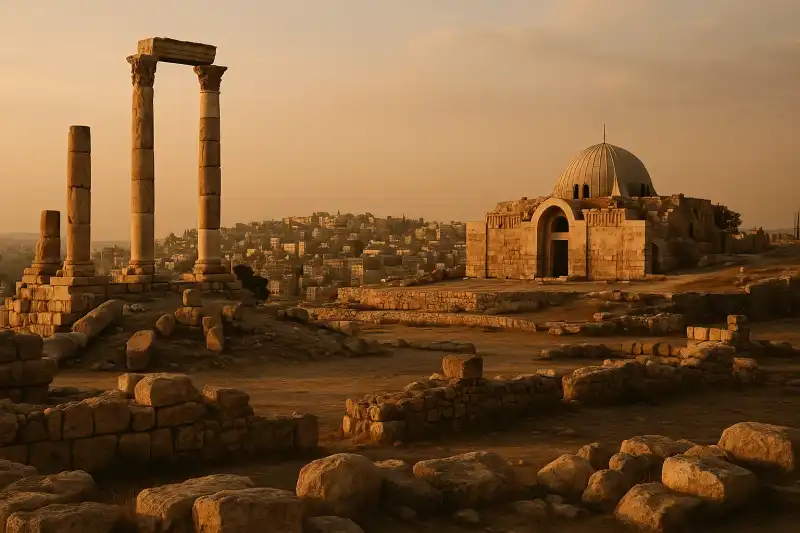
Start at the Amman Citadel, the hilltop that explains why Amman has been occupied and reoccupied for so long. This was ancient Rabbath Ammon before it became Philadelphia under Hellenistic and Roman rule. Later, the Umayyads built a palace complex here, so the site does not sit neatly inside one period. That messiness is part of its appeal.
Give the Citadel time for its geography. The Temple of Hercules is the obvious landmark, but the real lesson is the hill itself. You can see how ancient settlement, modern traffic, and Amman’s steep neighborhoods fold around each other. The Archaeological Museum is small, but it helps anchor the site if you want a quick sweep of Jordan’s deep chronology.
Continue downhill or take a short taxi to the Roman Theater in Amman. Built into the hillside in the 2nd century CE, the theater once belonged to Roman Philadelphia. Sit for a few minutes rather than treating it as a photo stop. The seating bowl still makes Roman urban planning feel practical, not abstract.
Keep the day simple. Amman traffic can be tiring, and many travelers land in Jordan with more ambition than energy. Use taxis or rideshare between neighborhoods, drink water, and save the heavy walking for Jerash and Petra. If you have extra time, downtown Amman is worth a wander, but do not turn arrival day into a forced march.
Day 2: Jerash day trip from Amman
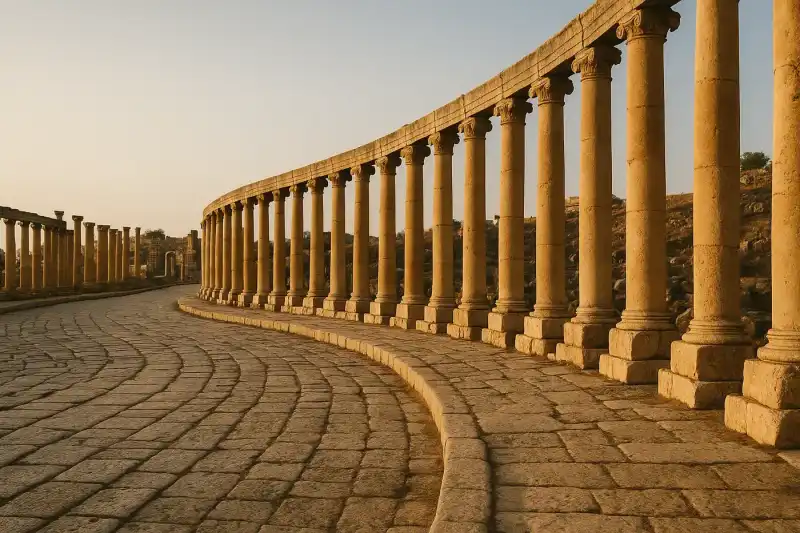
Spend today at Jerash, ancient Gerasa, one of the easiest Roman cities in the eastern Mediterranean to understand on foot. The drive north from Amman usually takes about an hour, but leave early so you are walking the site before the day heats up.
Jerash is not just a collection of monuments. It still has the bones of a city: gates, theaters, temples, baths, a nymphaeum, a long colonnaded street, and that wonderfully theatrical oval plaza near the south end. The plaza is unusual because it mediates between the street grid and the sanctuary approach, a piece of urban design that feels almost too elegant for a busy provincial city.
The Temple of Artemis is worth lingering over. Artemis was the patron deity of Gerasa, and the sanctuary reminds you that Roman urban life was not only roads and theaters. It was also civic religion, local identity, procession, and prestige. The stones are quiet now, but the city’s ambition was not shy.
A guide is useful here if you like context, though independent travelers can manage with a map and patience. The main mistake is rushing. Jerash looks compact at the entrance, then stretches farther than expected. Wear decent shoes, carry water, and do not plan a second major ruin afterward.
Return to Amman for the night. If you want a structured day, book a guided Jerash day trip from Amman. It solves the transport cleanly and can add the historical scaffolding that makes the site more than a long walk through columns.
Day 3: Madaba mosaics and Mount Nebo
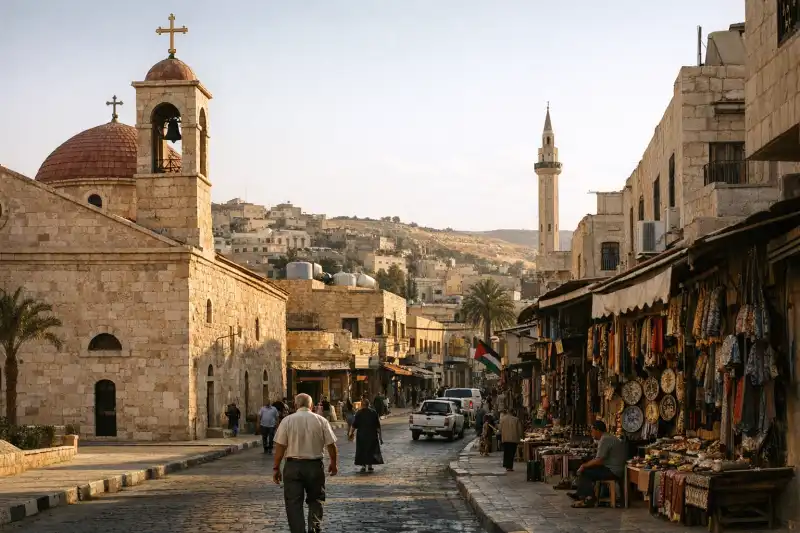
Transfer from Amman to Madaba and make it your base for the night. Madaba is easier to handle than Amman, and its ancient appeal is quieter: churches, mosaic floors, local streets, and a town that rewards a slower eye.
The famous Madaba Map, preserved in the floor of St. George’s Church, is the anchor. It dates to the 6th century CE and shows the Holy Land in mosaic form, with Jerusalem drawn in striking detail. The map is not a modern map in ancient clothing. It is a Byzantine Christian way of organizing sacred geography, which makes it both practical and devotional.
Do not stop with one church if time allows. Madaba’s mosaics show how much late antique craft survived in this region: animals, cities, vines, inscriptions, geometric borders, and religious scenes made from small stone tesserae. It is a good day for noticing details rather than chasing scale.
In the afternoon, take a taxi or driver to Mount Nebo. The site is associated with Moses viewing the Promised Land, and on a clear day the landscape makes the story feel spatial. The views stretch toward the Jordan Valley, the Dead Sea, and beyond. The modern memorial church also preserves mosaics, so the day links biblical memory with Byzantine craft rather neatly.
Overnight in Madaba. This avoids backtracking to Amman and puts you in a better position for the southbound road tomorrow. If you are tired, cut the extra Madaba stops and keep the focus on the map and Mount Nebo. This is a better choice than arriving in Wadi Musa late and cranky.
Day 4: The King’s Highway to Petra
Today is about getting to Petra without pretending the transfer is nothing. Leave Madaba after breakfast and travel south toward Wadi Musa. With a private driver or rental car, you can choose between faster roads and the more scenic King’s Highway. The scenic route can be rewarding, but it takes longer and should not be overloaded.
If you want a stop, choose one carefully. Kerak or Shobak can fit some versions of this day, but adding too much turns the road into a blur. For a clean 5-day route, I would rather arrive in Wadi Musa with enough energy for an early Petra start tomorrow.
Once in Wadi Musa, orient yourself around the Petra Visitor Center and settle in. If you arrive early and have a ticket that allows it, you can take a short first look at the entrance area, but do not burn yourself out. Petra is not a single monument. It is a city landscape spread through sandstone valleys, with tombs, temples, water channels, stairways, high places, and later Roman and Byzantine traces.
The historical shift today is noticeable. Amman, Jerash, Madaba, and Mount Nebo gave you hilltops, Roman streets, and Byzantine mosaic worlds. Petra belongs to the Nabataeans, an Arab kingdom that grew wealthy from trade routes and mastered water management in a dry landscape. The drama is visual, but the engineering is just as interesting.
Sleep in Wadi Musa. This is one of the simplest and best logistics decisions in Jordan.
Day 5: Petra from the Siq to the Monastery
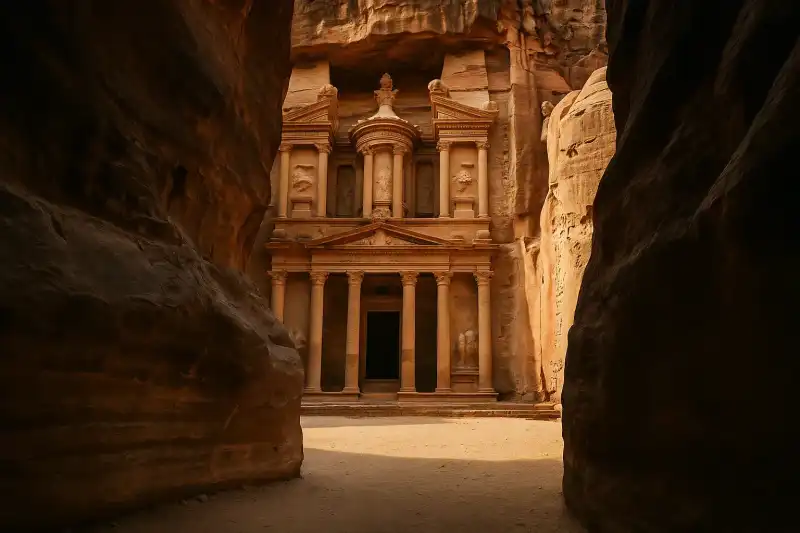
Start early at Petra. Walk through the Siq slowly enough to notice the water channels cut along the gorge. They are easy to miss because everyone is waiting for the Treasury reveal, but they are one of the best clues to how Nabataean Petra worked. The city was not merely carved into rock. It was managed, supplied, and engineered.
The Treasury is the famous moment, and yes, it earns attention. Its facade was probably carved in the 1st century BCE or 1st century CE, when Nabataean elites were using Hellenistic architectural language in a local sandstone world. But do not let the Treasury become the endpoint. Continue into the Street of Facades, the theater area, the Royal Tombs, and the main basin.
If you have the stamina, climb to the Monastery. Be honest with yourself before starting. The path involves many steps, sun exposure, and a real energy cost. The payoff is strong, but Petra punishes people who treat distances casually. If the Monastery feels like too much, spend more time around the Royal Tombs and the lower city instead. That is not a failed visit.
A Petra guided walking tour can be worthwhile for the first half of the day, especially if you want help reading the tombs, water systems, and Nabataean-Roman transition. Afterward, independent wandering is part of the pleasure.
End in Wadi Musa. If your onward travel is the same evening, keep it late and flexible. Better still, sleep one more night and leave the next morning.
The historical thread: cities, sacred maps, and desert power
This route works because it follows several Jordans at once. Amman shows the long occupation of a defensible hill, from ancient Rabbath Ammon through Roman Philadelphia and into the Umayyad period. Jerash shows the Roman city as a machine of streets, temples, theaters, water, and public display.
Madaba and Mount Nebo shift the lens to late antique Christianity and biblical geography. The Madaba Map is not just pretty mosaic work. It shows how Byzantine communities pictured sacred space, with Jerusalem and the Holy Land made visible underfoot.
Petra changes the materials and the mood. The Nabataeans used sandstone cliffs, caravan wealth, hydraulic skill, and borrowed architectural forms to build a city that feels unlike Jerash but belongs to the same connected world. By the end, Jordan should feel less like a set of isolated famous stops and more like a crossroads where empires, local kingdoms, pilgrims, merchants, and craftspeople kept reusing the same landscapes.
Transportation notes
Use Amman for the first two nights, Madaba for the third, and Wadi Musa for the final two. That sequence reduces backtracking and keeps Petra from becoming a rushed day trip.
For Amman city sights, taxis and rideshare are easiest. For Jerash, use a rental car, private driver, or guided tour. For Madaba and Mount Nebo, taxis or a driver work well. For the transfer to Wadi Musa, a private driver is the smoothest option, while a rental car gives you more control over stops.
Self-driving in Jordan is common, but it is not for everyone. Amman traffic can be stressful, rural roads require attention, and night driving is best avoided if you are unfamiliar with the route. If you rent a car, use it most confidently outside central Amman.
Do not compress Petra into a same-day return from Amman on this itinerary. It is possible on paper and miserable in practice. The overnight in Wadi Musa is what makes the route feel like a trip rather than a transport exercise.
Optional add-ons and swaps
If you want more Nabataean context, add Little Petra on the afternoon of Day 4 or the morning after Day 5. It is close to Wadi Musa and gives a quieter look at rock-cut spaces linked to Petra’s wider landscape. Remove any long stop on the King’s Highway to make room.
For earlier settlement history, add Beidha near Little Petra. Its Neolithic village remains pull the story far earlier than the Nabataeans, which is fascinating if you like deep time. Swap it for a second Petra hike rather than trying to do everything.
If mosaics are your main interest, add Umm ar-Rasas from Madaba. Its Byzantine churches and mosaic floors make a strong companion to Madaba, but you should remove Mount Nebo or accept a fuller Day 3.
If you want a Crusader layer, add Kerak Castle on the southbound route. It is a serious stop, not a quick photo break. To include it well, leave Madaba early and skip other detours before Wadi Musa.
Shorter and longer itinerary options
For a shorter version, use 3 Days in Ancient Jordan from Amman. That route should stay north and focus on Amman, Jerash, and one or two day trips rather than forcing Petra into a rushed schedule.
For a longer trip, 7 Days in Ancient Jordan: Decapolis, Biblical Sites, Petra, and Wadi Rum gives you room for more northern sites, more biblical geography, and a better southern finish.
The deepest version is 10 Days in Jordan’s Ancient and Biblical Sites. That is the better choice if you want the Desert Castles, Kerak, Shobak, Little Petra, and the north without making every day feel like a race.
Related ancient sites
- Ain Ghazal
- Iraq al-Amir
- Qasr al-Abd
- Umm Qais
- Pella
- Bethany Beyond the Jordan
- Umm ar-Rasas
- Little Petra
- Beidha
- Kerak Castle
FAQ
The most common planning questions for this route are answered below.