Quick route summary
This 10-day route starts in Amman and ends in Wadi Rum, with overnight bases in Amman, Madaba, Petra, and Wadi Rum. It is a country route built for travelers who want Jordan’s ancient and biblical sites in one coherent loop rather than a Petra-only trip.
The route begins with the Amman Citadel and the Roman Theater in Amman, then moves through the Umayyad Desert Castles, the Roman city of Jerash, the Decapolis views at Umm Qais, the mosaic city of Madaba, Crusader strongholds, Petra, Little Petra, and the ancient inscriptions of Wadi Rum.
The pace is full but not reckless. Jordan looks compact on a map, but many of the best sites sit on winding highland roads, desert loops, or rural tracks. Do not add another major stop every day just because the distance seems short.
Who this itinerary is for
This itinerary is for travelers who care about ancient cities, biblical landscapes, frontier forts, mosaics, caravan routes, and the strange political geography of Jordan. It works especially well if you want Petra in context: not as a single famous monument, but as one point in a long chain of Nabataean, Roman, Byzantine, Umayyad, and medieval routes.
It is not ideal if you want a beach-heavy Jordan trip, a very slow holiday, or a no-driving plan based entirely on public transport. You can adapt pieces of it with tours, but the full route is much smoother with a rental car and confident driver, or with private drivers arranged for the harder days.
Route at a glance
- Day 1: Overnight in Amman. Arrive, visit the Amman Citadel and Roman Theater, and keep the city day light.
- Day 2: Overnight in Amman. Drive the eastern Desert Castles loop, including Qasr Amra, Qasr Kharana, Qasr al-Azraq, and Qasr al-Hallabat.
- Day 3: Overnight in Amman. Visit Jerash, then add Ajloun Castle if time and energy hold.
- Day 4: Overnight in Amman. Make a northern Decapolis day to Umm Qais, Gadara Theater, and Pella.
- Day 5: Overnight in Madaba. Transfer south to Madaba, Mount Nebo, and Tell Hesban.
- Day 6: Overnight in Madaba. Visit Bethany Beyond the Jordan, Machaerus, and Umm ar-Rasas with a driver.
- Day 7: Overnight in Petra. Follow the King’s Highway south via Dhiban and Kerak Castle.
- Day 8: Overnight in Petra. Use a lighter day for Shobak Castle, Little Petra, and Beidha.
- Day 9: Overnight in Petra. Spend the full day inside Petra, from the Siq to the Monastery if your legs agree.
- Day 10: Overnight in Wadi Rum. Transfer to Wadi Rum for ancient inscriptions, desert tracks, and a quieter finish.
Practical logistics before you go
The best bases are Amman for the north and east, Madaba for the biblical and central plateau sites, Petra for the Nabataean south, and Wadi Rum for the desert finish. Changing hotels this many times is slightly annoying, but it saves backtracking and keeps the longest days from becoming absurd.
A rental car gives the most freedom. Jordan’s main highways are manageable for many visitors, but city driving in Amman can be stressful, rural signage is uneven, and desert castle or Wadi Rum access is easier with local knowledge. If you do not want to self-drive, use Amman-based day tours for the first four days, then private transfers south.
Guided tours make the most sense at Jerash, the Desert Castles, and Petra. Jerash is large enough that context changes the visit. The Desert Castles are spread across a landscape where the connections are not obvious at first glance. Petra can be visited independently, but a good guide on the first half day helps you read facades, water channels, tomb types, and the site’s Nabataean logic.
Heat matters. So does fatigue. Petra and Jerash are walking days, Kerak and Shobak involve stairs and uneven stone, and Wadi Rum adds sand, sun, and vehicle time. Build in early starts, simple lunches, and one lighter day before Petra. This itinerary already does that on Day 8. Resist the urge to fill it with another long detour.
Day 1: Amman Citadel, Roman Theater, and ancient Rabbah
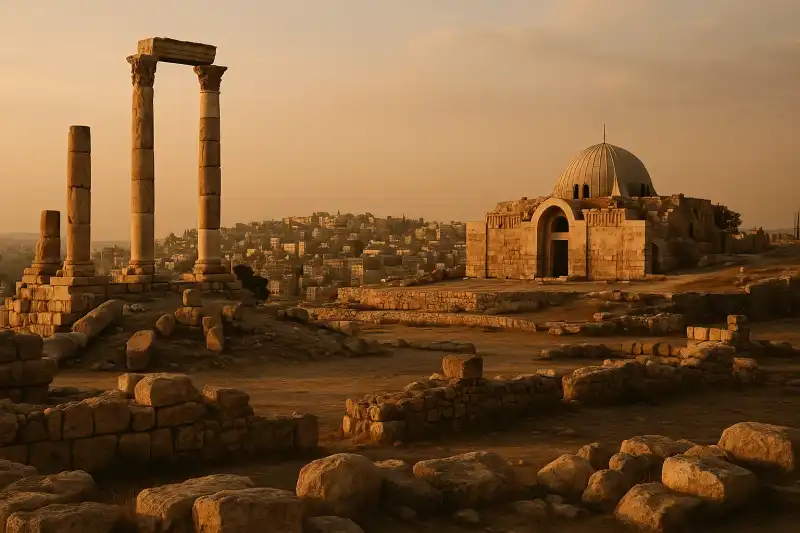
Start at the Amman Citadel, which sits on Jabal al-Qal’a above the modern city. This hill was ancient Rabbath Ammon before it became Hellenistic Philadelphia and later part of the Roman and Umayyad urban landscape. That layering is the point of the visit. You are not seeing one frozen city. You are seeing a hill that kept being reused because power liked the view.
The Temple of Hercules gives the Roman period its most photogenic footprint, but do not rush past the Umayyad palace complex. Its audience hall and surrounding structures show how early Islamic rule adapted older urban centers rather than simply abandoning them. The stones are quiet now, but the political message was not shy.
Continue down to the Roman Theater in Amman if your arrival timing allows. Built into the slope of the city, it is a good reminder that Roman Philadelphia was not a minor provincial afterthought. The theater also makes the vertical shape of Amman easier to understand: hills, stairs, traffic, and neighborhoods stacked on top of older neighborhoods.
Use taxis or rideshare today. Do not start the trip by wrestling with Amman driving if you are tired from a flight. Keep dinner close to your hotel and sleep early. The next few days ask more of you.
Day 2: Desert Castles east of Amman
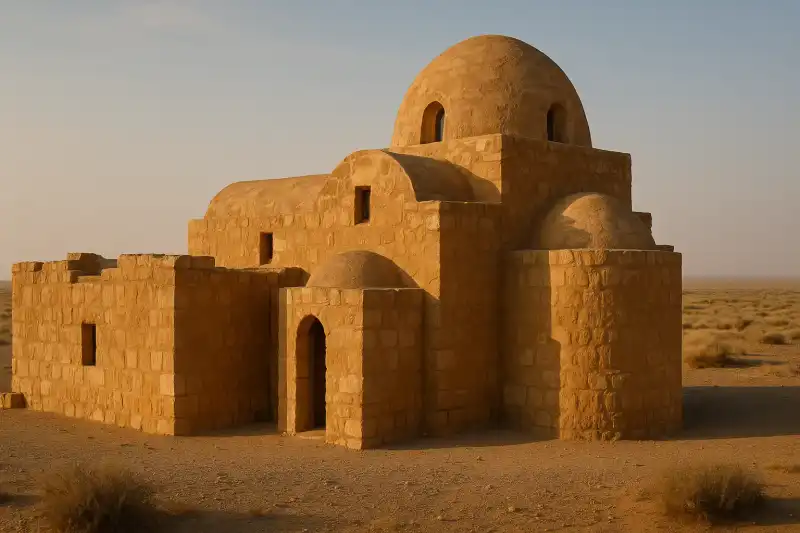
This is a full driving loop, and it works best with a private driver, rental car, or a focused Jordan Desert Castles day tour from Amman. Public transport is the wrong tool here. The sites are scattered across the eastern steppe, and the value of the day comes from seeing how Roman frontier routes, Umayyad patronage, hunting estates, baths, and water control all fit the landscape.
Begin with Qasr Amra, the small UNESCO-listed bath complex whose 8th-century frescoes are unlike almost anything else on this route. The painted scenes include rulers, hunting, bathing, and an astronomical dome. Early Islamic art is often introduced through mosques and manuscripts, but Qasr Amra gives you something more intimate and frankly stranger: elite leisure painted onto plaster in the desert.
Pair it with Qasr Kharana, a blocky early Islamic building that looks defensive but probably had a more complex social or administrative function. Its rooms and courtyard feel almost stage-set in their preservation. Then continue to Qasr al-Azraq, built of black basalt and tied to Roman frontier use, later Islamic phases, and T. E. Lawrence during the Arab Revolt.
If time allows, add Qasr al-Hallabat. Its Roman roots and Umayyad rebuilding make it especially useful for seeing continuity rather than a clean break between empires. Do not overpack the day with every minor desert ruin east of Amman. Four sites are plenty if you want to arrive back before the drive becomes a blur.
Day 3: Jerash and Ajloun
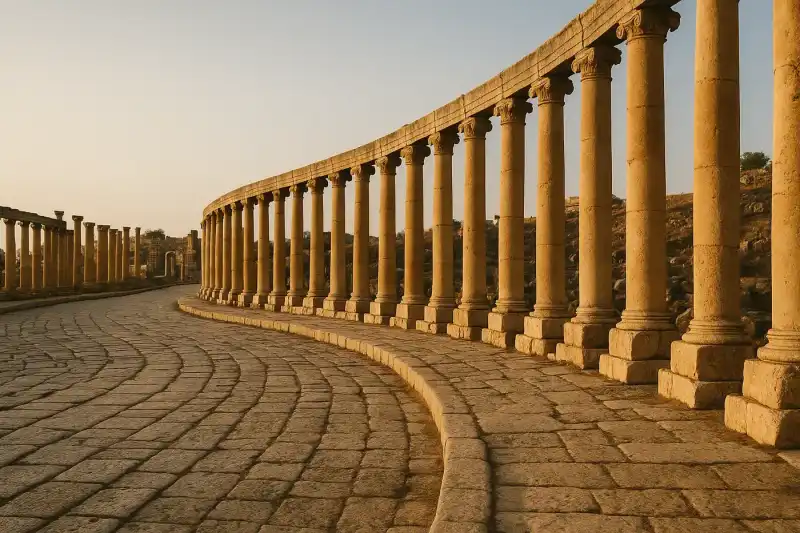
Give Jerash the respect of time. It is one of the best-preserved Roman cityscapes in the eastern Mediterranean, and the pleasure is not only in the famous colonnaded street. Walk the oval plaza, theaters, temples, gates, nymphaeum, and cardo with enough patience to feel how Gerasa worked as a city.
Jerash was part of the Decapolis, a loose group of Greco-Roman cities in the region rather than a tidy political league in the modern sense. That matters because it helps explain the mix of local, Greek, Roman, and Near Eastern urban habits. The city’s colonnades are Roman in language, but the hills, sanctuaries, and trade setting are very much northern Jordan.
A guide can be useful here, or you can book a Jerash and Ajloun day tour from Amman if you do not want to manage transport. If you self-drive, start early and avoid treating Jerash as a quick stop on the way to somewhere else.
Add Ajloun Castle only after Jerash, not before. The 12th-century fortress was built in the age of Saladin’s campaigns and watched routes through the hills north of Amman. It shifts the day from Roman urban confidence to medieval military geography. That contrast is satisfying, but only if you still have energy.
Day 4: Umm Qais, Gadara, and the northern Decapolis
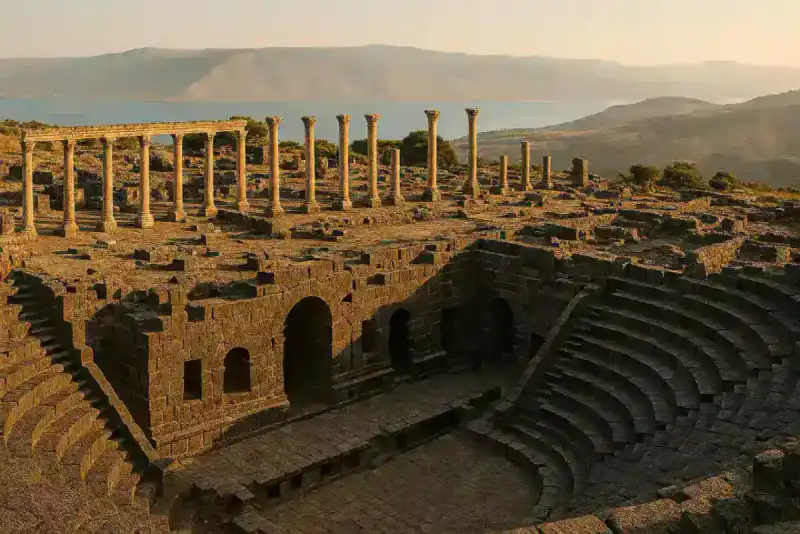
Drive north for Umm Qais, ancient Gadara, one of Jordan’s most atmospheric Decapolis sites. The setting is half the point. From the ridge, the land drops toward the Jordan Valley, the Sea of Galilee, and the Golan Heights. Few ancient sites make regional geography this legible.
The black basalt architecture gives Gadara a different mood from limestone Jerash. Visit the Gadara Theater at Umm Qais and take time with the terraces, streets, and reused Ottoman village structures. Gadara was known in antiquity for intellectual life as well as urban display, including associations with poets and philosophers. The view is lovely, but the city was not just a lookout point.
If you want a deeper Decapolis day, add Pella on the return route. Pella is less polished than Jerash and Umm Qais, but it has a long settlement history, with Bronze Age, Hellenistic, Roman, Byzantine, and early Islamic layers. It rewards travelers who like archaeological texture more than neat monuments.
This is a long day from Amman. Bring snacks, keep lunch flexible, and do not add Abila unless you are deliberately making the day more archaeology-heavy. Northern Jordan has enough ruins to tempt you into bad pacing.
Day 5: Madaba, Mount Nebo, and the biblical plateau
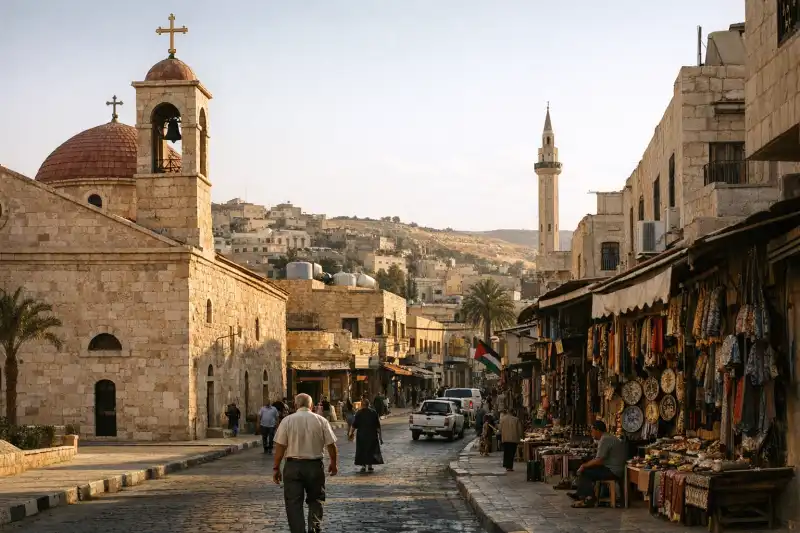
Leave Amman and move your base to Madaba. This is one of the smartest overnight choices in Jordan if your route cares about biblical and Byzantine sites. It is calmer than Amman, close to Mount Nebo, and well placed for the central plateau.
Madaba is famous for the Byzantine mosaic map in the Church of Saint George, a 6th-century floor mosaic that preserves a remarkable view of the Holy Land, including Jerusalem. It is not a modern map in the strict sense. It is a theological and geographic image made in stone tesserae, which is exactly why it feels so alive.
Continue to Mount Nebo, traditionally linked with Moses viewing the Promised Land. The site combines pilgrimage memory, Byzantine church remains, mosaics, and a wide view toward the Jordan Valley. On a clear day, the geography helps you understand why this plateau carries so much religious weight.
If you have time, add Tell Hesban, a layered mound linked with biblical Heshbon and later Roman and Byzantine occupation. It is not as visually tidy as Madaba or Mount Nebo, but it adds the kind of settlement depth that prevents the day from becoming only churches and viewpoints.
Day 6: Bethany, Machaerus, and the Dead Sea edge
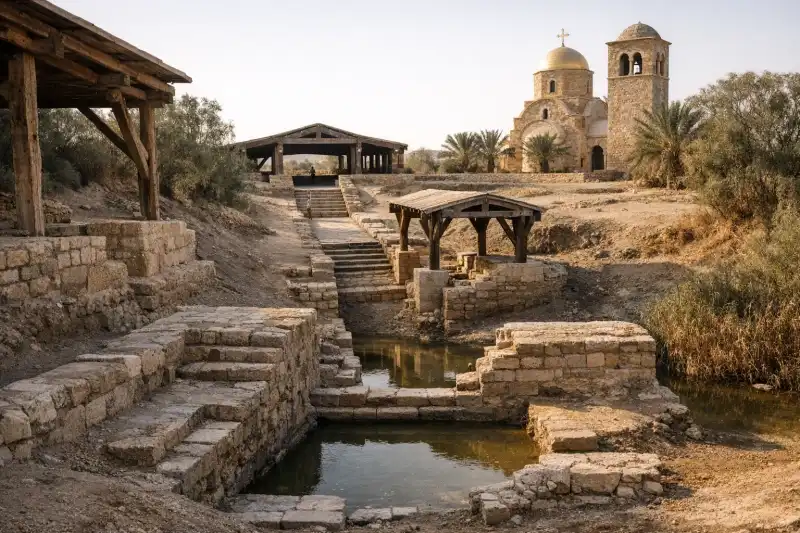
Use a driver today unless you are very comfortable with rural road planning. Start at Bethany Beyond the Jordan, the baptism site on the east bank of the Jordan River. The visit is structured and sensitive because of the border zone, so check timing in advance and do not treat it as a casual roadside stop.
The site’s power is not monumental in the Jerash or Petra sense. It is a landscape of water, pilgrimage, archaeology, and memory. Byzantine churches, baptismal pools, and later devotional layers sit near a river that is physically modest but historically enormous.
Continue to Machaerus, the hilltop fortress associated with Herod Antipas and the death of John the Baptist. The ruins are sparse compared with Kerak or Shobak, but the position above the Dead Sea is severe and memorable. Herodian power liked difficult hilltops, and Machaerus makes that taste for controlled height very clear.
If the day is going smoothly, add Umm ar-Rasas, a UNESCO-listed site known for Byzantine churches, mosaics, and a strange standing tower that may have belonged to a stylite monk. This is a lot for one day. If you are tired, cut Umm ar-Rasas and protect the drive. Jordan rewards restraint.
Day 7: Kerak Castle, Dhiban, and the King’s Highway
Today is the classic King’s Highway move south, and it should not be rushed. Start from Madaba and stop at Dhiban, ancient Dibon, linked to the Moabite kingdom and the Mesha Stele. The stele itself is in the Louvre, but the site still matters because it places Moabite history back in its highland setting rather than leaving it as a museum object.
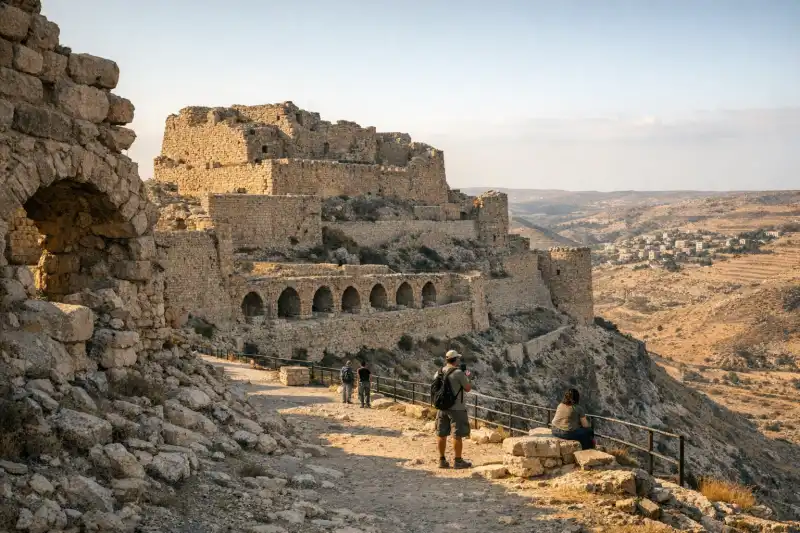
Continue to Kerak Castle, one of Jordan’s great Crusader fortresses. Kerak was a 12th-century stronghold of the Kingdom of Jerusalem, later taken by Saladin’s forces after a long conflict. The tunnels, halls, and defensive spaces are atmospheric, but bring a little imagination. Medieval castles in Jordan are about routes and pressure as much as walls.
The drive south to Petra is longer and slower than the Desert Highway, but this is the right road for the itinerary. It follows an older north-south logic through highland towns, biblical landscapes, and fortress sites. That continuity is the reason to take it.
Do not add Dana today unless you are cutting something else or staying overnight there. It is tempting, but Kerak plus Dhiban plus the drive to Petra is already a full route day.
Day 8: Shobak, Little Petra, and Beidha
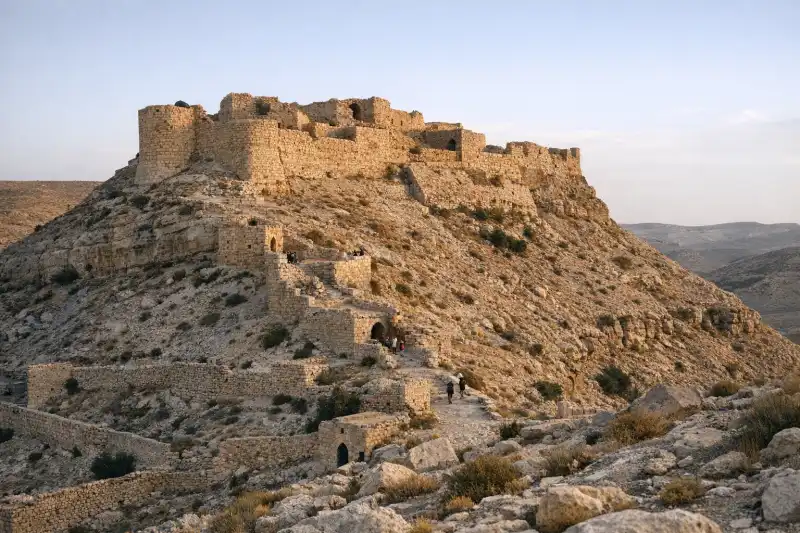
Use Petra as your base, but do not enter the main site yet. This day is deliberately lighter so you reach Petra with functioning legs. Begin at Shobak Castle or nearby Montreal Castle, the Crusader fortress built in the early 12th century to control routes between the Dead Sea, Petra, and the Red Sea approaches.
Shobak is rougher and quieter than Kerak. That is part of the appeal. It feels less like a monument polished for visitors and more like a highland stronghold that has been left to weather. Watch your footing and do not underestimate the wind and sun.
In the afternoon, visit Little Petra, also known as Siq al-Barid. Its rock-cut spaces, narrow gorge, dining rooms, and painted remains make it a useful prelude to Petra. The site likely served caravan and hospitality functions tied to the wider Nabataean network. It is small, but it helps Petra feel less isolated.
Add Beidha if time allows. This Neolithic village near Petra pulls the route much further back in time, into early farming, stone houses, and settled life long before the Nabataeans carved their facades. It is a small site with a big chronological punch. End early, eat well, and save the ambition for tomorrow.
Day 9: Petra from the Siq to the Monastery
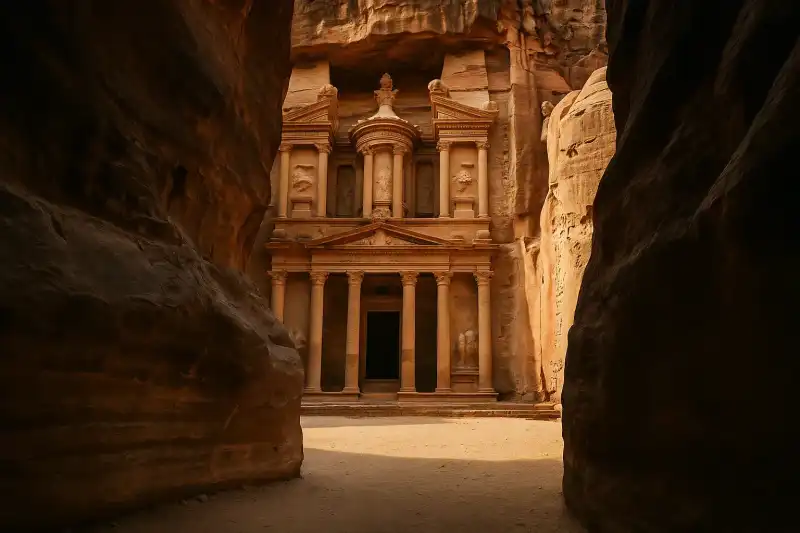
Start at Petra as early as you can. Walk the Siq slowly, even if everyone around you is rushing toward the Treasury. The gorge is not just an entrance corridor. It is part of Petra’s drama, with water channels, niches, and controlled movement through stone.
The Treasury gets the attention, but Petra is not one monument. It is a Nabataean city of tombs, temples, water systems, processional spaces, domestic areas, and later Roman and Byzantine layers. The Nabataeans grew powerful by controlling trade across Arabia, the Levant, and the desert routes, and Petra’s architecture turns that wealth into sandstone theater.
If you have the stamina, continue toward the Monastery. The climb is not technical, but it is long, exposed, and better done with water, sun protection, and honest pacing. A Petra guided tour can be useful for the first half of the day, especially if you want help understanding tomb types, water engineering, and how Nabataean, Hellenistic, Roman, and local styles mix.
Do not combine this day with Wadi Rum transfer unless you have no choice. Petra deserves a full day and a quiet evening afterward. The best part may not be the famous facade. It may be the moment, several hours in, when the city stops being a photo and starts becoming a landscape.
Day 10: Wadi Rum inscriptions and desert finish
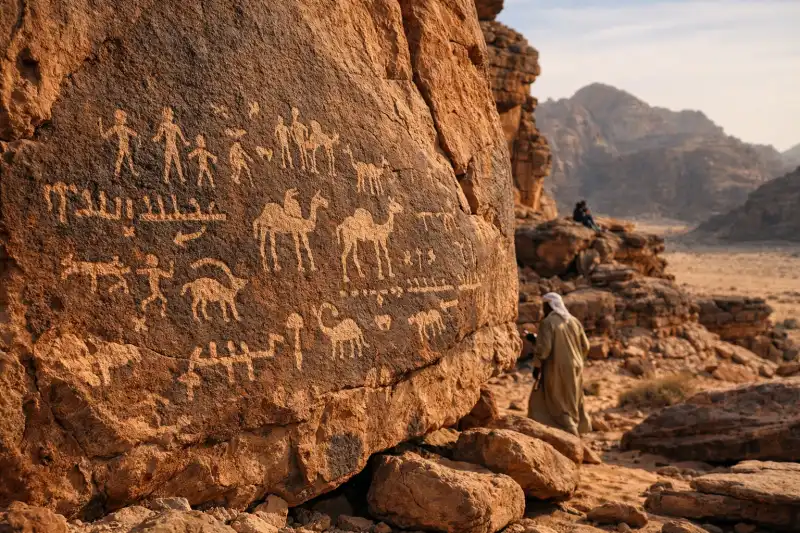
Transfer from Petra to Wadi Rum and switch mental gears. The final day is not about a dense archaeological city. It is about movement through a desert landscape where people left marks across millennia: petroglyphs, Thamudic and Nabataean inscriptions, tribal routes, water points, and memory scratched into stone.
Use local arrangements for the Wadi Rum ancient inscriptions. This is not a place to wander randomly in a rental car. The protected area is managed through local communities, and a jeep route with a knowledgeable guide is the practical way to see inscriptions without damaging fragile surfaces or wasting hours on sand tracks.
The historical payoff is quieter than Petra but very real. Wadi Rum reminds you that ancient Jordan was not only cities and castles. It was also movement: caravans, herders, pilgrims, soldiers, traders, and families crossing difficult country with enough regularity to leave names, animals, signs, and prayers on the rocks.
End the itinerary with a desert camp if that fits your budget and comfort level. Keep expectations grounded. Camps range from basic to very polished, and not every “ancient inscriptions” stop is interpreted well. Ask in advance what your route includes, then let the day be slower. After nine days of ruins, your brain will appreciate the space.
The historical thread: routes, frontiers, and sacred landscapes
Jordan’s ancient sites make the most sense when you stop treating them as isolated attractions. This route follows roads, ridges, valleys, and desert tracks that linked empires and communities across a compact but complicated country.
Amman and Jerash show urban power under Hellenistic, Roman, Byzantine, and early Islamic rule. Umm Qais and Pella widen the story into the Decapolis and the northern valleys. Madaba, Mount Nebo, Bethany, and Machaerus bring biblical memory into physical geography. Kerak and Shobak reveal how medieval powers fought over movement through the highlands. Petra and Little Petra show Nabataean wealth built from caravan control. Wadi Rum strips the story back to mobility, inscription, and survival.
The route is full because Jordan’s history is full. The trick is not to see everything. It is to keep enough space between stops that the connections have time to land.
Transportation notes
A rental car is the most flexible option for this itinerary, especially from Day 2 onward. Roads between major towns are generally usable, but Amman traffic can be tiring, the King’s Highway is slow, and some archaeological stops require careful navigation. If that sounds stressful, use a mix of day tours, private drivers, and transfers.
Do not rely on public transport for the full route. It can work between Amman, Madaba, Petra, and Aqaba with planning, but it does not solve the Desert Castles, Machaerus, Umm ar-Rasas, Shobak, Beidha, or Wadi Rum inscription logistics.
The biggest compression mistake is trying to combine northern Jordan, Desert Castles, Madaba, and Petra in too few days. Another common mistake is treating Petra as a half-day stop between road transfers. Avoid both. The itinerary is already packed, and the lighter Day 8 is there for a reason.
If you self-drive, avoid night driving outside cities when possible. Rural roads, speed bumps, animals, and unfamiliar turns can turn an easy-looking transfer into a tiring one. Start early, finish transfers before dark, and keep fuel stops boringly conservative.
Optional add-ons and swaps
If you want more early history near Amman, add Ain Ghazal and remove either Ajloun Castle or Tell Hesban. Ain Ghazal is tied to Neolithic settlement and famous plaster statues, which pushes the route thousands of years before the Romans and Nabataeans.
For a quieter Hellenistic valley visit, add Iraq al-Amir and Qasr al-Abd from Amman or Madaba. Remove Pella or one Desert Castle stop to make room. Qasr al-Abd’s huge stone blocks and carved animal details feel completely different from Jordan’s Roman and Nabataean showpieces.
If you want nature with history, add Dana Village between Kerak and Petra. Remove Day 6’s Umm ar-Rasas add-on or cut the Shobak stop. Dana is worth time, not a photo stop, and it works better with an overnight if you want hiking.
For a southern archaeological extension, add Humayma between Petra and Wadi Rum or after Wadi Rum. Remove one northern Decapolis stop if you must keep the route to 10 days. Humayma connects Nabataean, Roman, Byzantine, and early Islamic phases in a desert settlement that most rushed itineraries miss.
Shorter and longer itinerary options
For a compact trip, use the planned 3 Days in Ancient Jordan from Amman route. That version should focus on Amman, Jerash, Umm Qais or Pella, and one Desert Castles day.
For a first-timer route with less driving, use the planned 5 Days in Jordan: Amman, Jerash, Madaba, and Petra. It gives you the essentials, but it cannot do justice to the Desert Castles, Machaerus, Shobak, Little Petra, and Wadi Rum.
The planned 7 Days in Ancient Jordan: Decapolis, Biblical Sites, Petra, and Wadi Rum is the better middle ground. It should keep Jerash, Madaba, Petra, and Wadi Rum while trimming the more remote northern and eastern stops.
For a longer trip, add a second full day at Petra, an overnight in Dana, and a slower Dead Sea day. Do not lengthen the route by adding more and more ruins without recovery time. Jordan’s ancient sites are better when you can still notice the details.
Related ancient sites
- Ain Ghazal
- Qasr al-Abd
- Iraq al-Amir
- Qasr al-Mshatta
- Qasr Hammam As Sarah
- Abila
- Quweilbeh
- Umm el-Jimal
- Dana Village
- Humayma
- Lot’s Cave
- Khirbet ed-Dharih
FAQ
The most common planning questions for this Jordan route are answered below.