Quick Info
At a glance
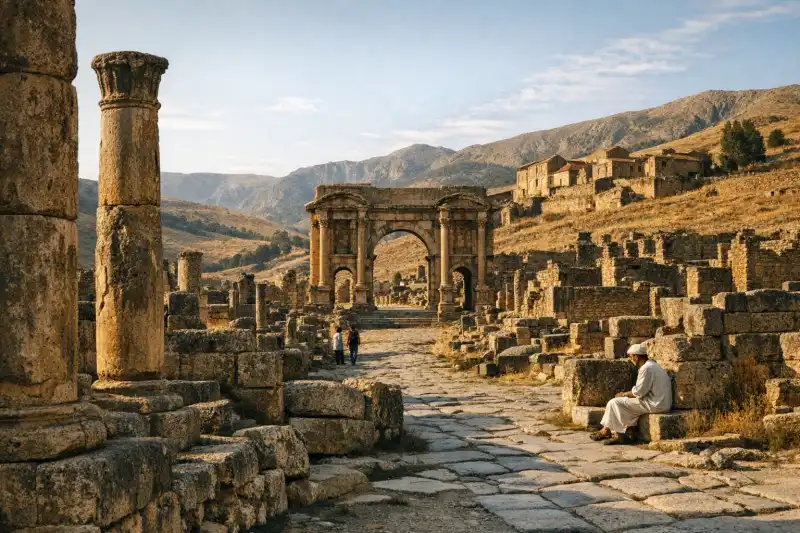
Djémila, Algeria, rises from a high valley like a stone mirage: colonnades, arches, temples, and broad paved streets laid out by Roman planners and softened by mountain light. Known in antiquity as Cuicul, this extraordinary archaeological site sits far from the sea and major imperial capitals, yet it preserves one of the clearest pictures of how Rome planted urban life into the landscapes of North Africa. The setting is part of its power. Unlike many Roman sites on flat plains, Djémila occupies a rugged plateau ringed by hills, where the ruins seem both orderly and dramatic, disciplined by geometry but animated by terrain.
Walking here, you move through a city that still feels legible. The stones suggest not only public grandeur but daily rhythm: citizens crossing the forum, traders under porticoes, processions passing temples, magistrates entering civic buildings, and Christian communities reshaping older spaces in late antiquity. There is grandeur, but there is also intimacy. Djémila is not a single monument but a complete urban world, spread across slopes and connected by streets that still pull the eye forward. For travelers interested in Roman North Africa, it offers something rare: a city whose plan, architecture, and atmosphere remain coherent enough to imagine life unfolding across centuries. Its beauty lies not just in survival, but in the clarity with which it reveals the ambitions of an empire and the local realities that shaped it.
History
Roman foundation as Cuicul
Djémila began as the Roman colony of Cuicul, founded in the late 1st century CE, probably under Emperor Nerva or during the early years of Trajan’s reign. Like other Roman colonial towns in North Africa, it was established to consolidate imperial authority, settle veterans, and project Roman urban culture into the provinces. Its location may seem unexpected at first glance: the site stands in mountainous country rather than on a major coastal route. Yet that choice reflected Roman confidence and strategic planning. The colony controlled inland communications and helped organize agricultural and administrative life in the region.
From the beginning, Cuicul was designed according to Roman principles, though adapted to difficult topography. Streets, public spaces, and monumental buildings were fitted into a narrow triangle of land between two wadis. This meant that the city never became a perfect grid in the abstract sense, but its planning still expressed Roman order. The original core included a forum, capitol, basilica, temples, baths, and residential quarters. These were the essential components of Roman civic identity, and their presence signaled that Cuicul was meant to be more than a military outpost. It was intended as a proper urban community with political, religious, and commercial life.
Expansion and prosperity in the High Empire
During the 2nd and early 3rd centuries CE, Cuicul prospered. This was the great age of Roman Africa, when the region became one of the empire’s richest provinces through grain, olive oil, and trade. The city grew beyond its initial limits, and new public buildings reflected increasing confidence and wealth. Expansion was especially important because the original site was cramped. As the town flourished, a “new forum” and associated structures were developed outside the earliest nucleus, allowing the urban fabric to spread in a more ambitious way.
One of the most striking monuments associated with this period is the Arch of Caracalla, erected in the early 3rd century CE. Triumphal arches in Roman cities did more than celebrate emperors; they marked civic identity and inserted local communities into the wider symbolic world of the empire. At Cuicul, the arch announced both imperial loyalty and local distinction. The same era saw continued investment in temples, baths, and elite houses with decorative programs that included mosaics. The city’s inhabitants were participating in a Roman cultural system while also expressing the specific character of provincial North Africa.
The urban landscape of Cuicul demonstrates the layered nature of Romanization. Latin institutions, imperial cults, and classical architectural forms were prominent, but they existed within a society shaped by older Berber traditions and regional realities. The city’s prosperity therefore belonged to both Rome and Africa. Djémila is so compelling because it preserves this fusion in stone.
Late antiquity and Christian transformation
Like many cities of the Roman world, Cuicul changed rather than simply collapsed in late antiquity. From the 4th century onward, Christianity became increasingly visible in the city’s public life. Churches, baptisteries, and Christian buildings emerged alongside or atop older pagan structures, reflecting broad transformations across the empire. Djémila is particularly important for understanding this phase because its Christian quarter is among the most significant in Roman North Africa.
The large Christian basilica complex, with associated baptistery and ecclesiastical buildings, shows that the city remained active and organized in the late Roman and early Byzantine periods. These structures are not marginal additions; they indicate a major redirection of urban life. Public religion changed, civic priorities evolved, and architectural patronage followed suit. The old pagan city was not erased overnight, but its meanings were steadily reinterpreted.
At the same time, wider political pressures affected the region. The Roman Empire faced internal crises, changing frontiers, and shifting administrative systems. North African cities were resilient, but they were not immune to disruption. Cuicul persisted for centuries, though its role and scale changed.
Decline, abandonment, and rediscovery
By the early medieval period, the classical city had largely faded. As political centers shifted and patterns of settlement changed, Cuicul was gradually abandoned. Its mountain setting, once a challenge to builders, became a protection for the ruins. Without continuous large-scale occupation, many of its streets and monuments remained legible beneath accumulated debris.
French archaeological work in the 19th and 20th centuries brought the site back into scholarly and public view. Excavation revealed an exceptionally complete Roman city, including major civic monuments and an important museum collection of mosaics and inscriptions. The modern name, Djémila, derives from Arabic and is often said to mean “beautiful,” a fitting description for a place where architecture and landscape reinforce one another so naturally.
UNESCO later recognized Djémila as a World Heritage Site, affirming its value as one of the finest surviving examples of Roman urbanism in North Africa. Today it stands not as a frozen relic of a single moment, but as a layered city where foundation, growth, transformation, and long silence can all be read in the same terrain.
Key Features
Djémila’s greatest feature is its overall urban coherence. Many ancient sites preserve isolated highlights—a theater here, a temple there—but Djémila still feels like a city. The streets guide you between distinct quarters, and the surrounding ridges frame the ruins so that every walk through the site feels spatially intelligible. The topography forced Roman planners to be inventive, and that tension between ideal order and real ground gives the city much of its character. You do not simply view monuments; you move through a carefully structured environment.
The original forum is one of the most evocative spaces. Compact yet monumental, it was the civic heart of early Cuicul. Nearby stand the capitol and basilica, essential institutions of Roman urban life. The capitol embodied the religious and political symbolism of Rome, while the basilica served judicial and administrative functions. Together they demonstrate how Roman civic authority was staged in architecture. Even in ruin, the alignment of columns, steps, and foundations makes the logic of the space easy to grasp.
The expansion area beyond the early core reveals the city’s growth in later centuries. The new forum is larger and more open, a sign that Cuicul had outgrown its initial plan. This district speaks to prosperity, ambition, and adaptation. Rather than being constrained permanently by the first settlement’s limited footprint, the inhabitants invested in a broader monumental zone. It is here that you feel the city’s confidence at its height.
Among the most photogenic monuments is the Arch of Caracalla. Set against the sky and mountain backdrop, it has a theatrical quality that many triumphal arches gain only in heavily restored settings. At Djémila, the arch still belongs to a living landscape of ruins. It is not merely decorative; it helps articulate movement through the site and marks the imperial presence within the local cityscape. Standing beneath it, you sense how architecture was used to frame civic life and proclaim status.
The temples at Djémila add another layer to the experience. Roman religion was public and architectural, and the temple remains here preserve something of that ceremonial atmosphere. Their surviving podiums, columns, and plans make clear how sacred buildings were integrated into the city rather than isolated from it. Worship, politics, and urban identity overlapped constantly in Roman life, and Djémila illustrates that relationship particularly well.
The Christian quarter is equally important, though often appreciated differently. If the earlier civic buildings reflect Roman municipal order, the Christian basilica complex reveals a changing world. The basilica, baptistery, and associated structures are among the site’s most significant late antique remains. Their scale suggests an established Christian community with resources and organization. For visitors, this part of Djémila offers a powerful reminder that Roman cities did not simply end; they evolved. The transition from pagan to Christian urban landscapes can be traced here with unusual clarity.
The houses and mosaics deepen the story. Although walls survive only in part, domestic spaces still indicate how people lived beyond official monuments. The on-site museum is especially valuable because it gathers mosaics and artifacts that might otherwise be difficult to interpret in the open air. These works bring color and refinement back into the picture. Roman cities were not originally monochrome fields of weathered stone. They were decorated, inhabited, and visually rich. The museum helps restore that lost dimension.
Finally, the setting itself is a key feature, not merely a backdrop. Djémila’s elevation and mountain environment distinguish it from many other Roman sites in North Africa. Light changes quickly here, and the ruins can appear austere, golden, or almost silver depending on the hour and season. The terrain also shapes the emotional experience of the visit. There is grandeur, certainly, but also a striking sense of remoteness. Djémila feels discovered rather than consumed, a place where the ancient city still dominates the landscape rather than being overwhelmed by the modern one.
Getting There
Djémila is most commonly reached from Sétif, which is about 50 kilometers away by road. The simplest and most practical option is a private taxi or hired driver. From Sétif, a return taxi arrangement typically costs around 4,000 to 7,000 Algerian dinars depending on season, waiting time, and negotiation. This is often the best choice for travelers who want flexibility, especially if they plan to spend several hours on site and include the museum.
Driving yourself is also feasible if you have a rental car in Algeria. Roads from Sétif are generally manageable, and the journey usually takes about 1 to 1.5 hours depending on traffic and road conditions. Parking near the archaeological area is usually straightforward. From Constantine, the trip is longer—roughly 2.5 to 3.5 hours by car—and a private transfer may cost approximately 10,000 to 18,000 dinars for the day.
Public transport exists but can be less convenient. Shared taxis and local buses may connect Sétif with nearby towns in the Djémila area, but schedules are not always easy for short-term visitors to confirm, and return options can be limited later in the day. If using public transport, leave early and allow for delays.
Entrance fees can change, but visitors should budget a modest site ticket plus a small amount for the museum if charged separately. Carry cash in dinars, as card payment may not be available. Bringing water, sun protection, and sturdy shoes is wise, since the site is extensive and walking surfaces are uneven.
When to Visit
The best times to visit Djémila are spring and autumn, when temperatures are pleasant and the mountain landscape is at its most inviting. From March to May, the surrounding hills often look greener, wildflowers may appear, and the air is usually cool enough for long walks among the ruins. This is an ideal season for photography as well, since changing light and clearer skies can give extra definition to the columns, arches, and paving.
Autumn, especially September through November, is another excellent window. Summer heat begins to ease, but the days are still long enough for an unhurried visit. The lower sun can make the stone glow warmly in late afternoon, and the site tends to feel especially atmospheric at that hour. For many travelers, autumn offers the most comfortable balance between accessibility and fewer climatic extremes.
Summer is certainly possible, but midday heat can make extended exploration tiring. Even though Djémila is elevated, sun exposure across the open ruins can be intense. If visiting between June and August, aim to arrive early in the morning or later in the afternoon, bring plenty of water, and wear a hat. Winter visits can be rewarding for those who enjoy quiet conditions and dramatic skies, but temperatures may be cold, and rain can make paths slippery.
If your schedule allows, try to visit on a clear weekday morning. You will have softer light, better walking conditions, and more space to appreciate the site’s remarkable silence. Djémila rewards patience. It is not only a checklist destination but a place where weather, season, and time of day meaningfully shape what you see.
| Quick Facts | Details |
|---|---|
| Ancient name | Cuicul |
| Modern name | Djémila |
| Country | Algeria |
| Region | Sétif Province |
| Civilization | Roman, later Christian late antique |
| Founded | Late 1st century CE |
| UNESCO status | World Heritage Site |
| Best base | Sétif |
| Suggested visit length | 2–4 hours |
| Highlights | Forum, capitol, basilica, Arch of Caracalla, Christian quarter, museum |
Djémila offers one of the most rewarding encounters with the Roman world anywhere in Africa. It combines the intellectual satisfaction of a site that is easy to read with the emotional power of a landscape that heightens every ruin. Here, Roman urbanism was not imposed on an empty abstract surface but negotiated with slopes, rivers, distance, and time. That is why the city remains so memorable. You see empire in its formal architecture, but you also see adaptation, continuity, and change.
For travelers willing to venture beyond Algeria’s better-known urban centers, Djémila feels like a revelation. It is grand without being overwhelming, scholarly without being dry, and beautiful without needing embellishment. Whether you come for Roman history, archaeology, photography, or the sheer pleasure of walking through an ancient city under open mountain sky, Djémila rewards attention at every turn.
Guided tours: worth it?
A guide can be genuinely useful at Djémila, especially if you want help with transport, timing, tickets, or understanding a large site without losing half the day to logistics.
Best for
- First-time visitors who want context, not just photos
- Travelers who want transport, timing, or entry logistics handled
- Short visits where a planned route saves time
When to go self-guided
Go independently if you already have transport and tickets sorted, enjoy moving at your own pace, and are comfortable checking the latest official rules before you arrive.
What I’d avoid
Skip paid tours that bundle unrelated stops you do not actually want. The best option should either save meaningful planning time or add historical context you would miss on your own.
Algeria Roman Ruins Tours
Useful when: you want to compare guided formats before deciding
Setif and Djémila Day Trips
Useful when: transport or pickup logistics matter
Constantine to Djémila Excursions
Useful when: you want to compare guided formats before deciding
Some tour links are affiliate links, which may earn Ancient Travel a small commission at no extra cost to you. I try to surface options that make practical sense for the site—not just anything bookable.
Frequently Asked Questions
Where is Djémila located?
Djémila is in northeastern Algeria, in Sétif Province, about 50 kilometers northeast of Sétif in a mountainous region.
Why is Djémila important?
Djémila is one of the best-preserved Roman colonial towns in North Africa, famous for its street plan, monumental arches, forums, temples, basilicas, and mosaics.
Is Djémila a UNESCO World Heritage Site?
Yes. Djémila was inscribed on the UNESCO World Heritage List for its exceptional Roman urban remains adapted to a mountain setting.
How much time do you need at Djémila?
Most visitors should allow at least two to three hours to see the main ruins and museum, though history enthusiasts can easily spend half a day.
What is the best way to visit Djémila?
The easiest way is by private car, taxi, or organized excursion from Sétif or Constantine, since public transport connections can be limited and less predictable.
Can you visit Djémila and Timgad on the same trip?
Yes, many travelers include both Roman sites in a broader northeastern Algeria itinerary, though visiting both comfortably usually requires more than one day.
Nearby Ancient Sites
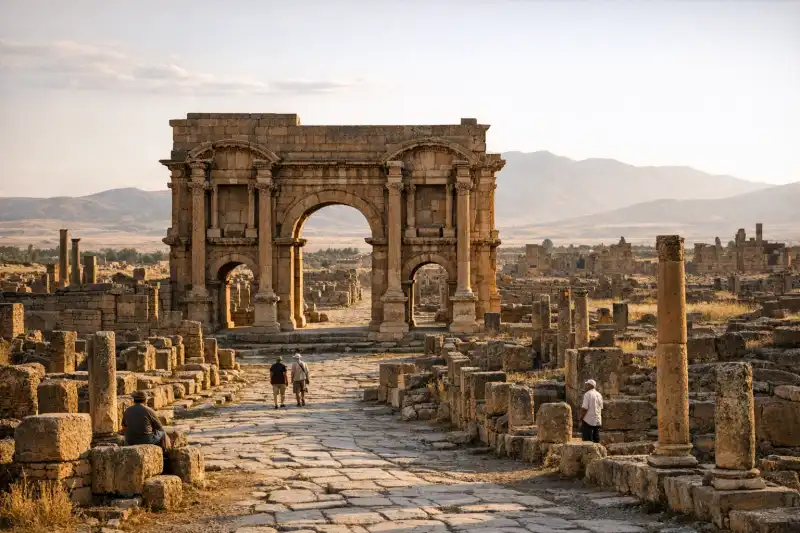
Timgad
RomanExplore Timgad, Algeria’s remarkably preserved Roman colonial city, famed for its grid plan, arch, f...
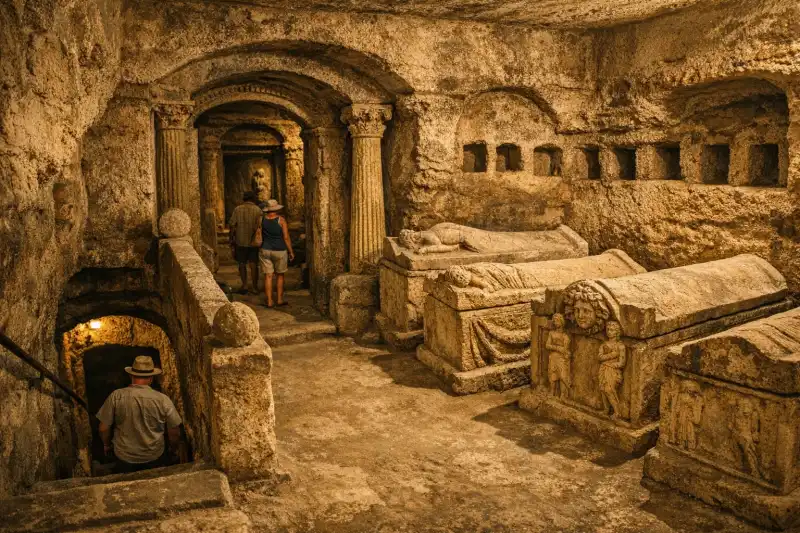
Alexandria Catacombs
Greco-Roman EgyptExplore Alexandria Catacombs in Egypt, a remarkable Roman-era underground necropolis blending Egypti...
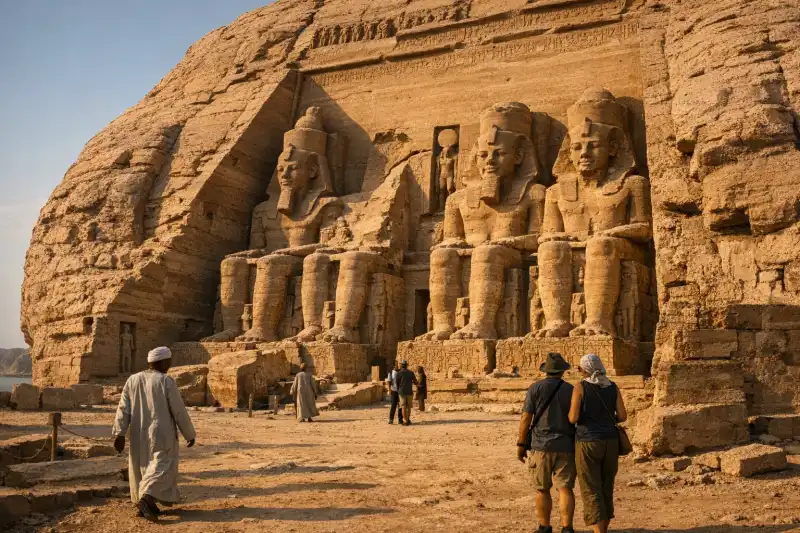
Abu Simbel
Ancient EgyptianDiscover Abu Simbel in Egypt, where colossal rock-cut temples of Ramses II rise above Lake Nasser ne...