Quick route summary
This 7-day route starts in Rome and ends in Naples, using two bases instead of changing hotels every night. The first half stays in Rome for the Colosseum, Roman Forum, Palatine Hill, imperial monuments, and Ostia Antica. The second half moves south to Naples for Herculaneum, Pompeii, Paestum, Cumae, and Baia Archaeological Park.
The pace is busy, but it has a sensible spine: capital, port, buried Vesuvian cities, Greek temples, then the strange volcanic coast where Romans built villas, baths, tunnels, and naval towns. What it skips is just as important. Do not add Florence, Venice, Sicily, Capri, and the Amalfi Coast to this same week. Ancient Italy is generous, but your knees and train schedule are not.
Who this itinerary is for
This itinerary is for travelers who want ancient Italy beyond the standard Rome and Pompeii pairing. It works well if you like walking, trains, early starts, site museums, and the occasional day where logistics matter as much as the ruins.
It is not the best plan if you want a slow Rome-only week, a beach trip, or a first Italy itinerary built around food, shopping, and easy evenings. Naples is lively and rewarding, but the Campania days require planning. Pompeii, Paestum, and the Phlegraean Fields are not casual one-hour stops if you want them to make historical sense.
Route at a glance
- Day 1: Overnight in Rome. Visit the Colosseum, Roman Forum, Palatine Hill, and Arch of Constantine on foot with timed-entry planning.
- Day 2: Overnight in Rome. Link the Pantheon, Trajan’s Market area, Circus Maximus views, and Baths of Caracalla with taxis or short transit hops.
- Day 3: Overnight in Rome. Take the train to Ostia Antica and spend the day reading Rome’s port city at street level.
- Day 4: Overnight in Naples. Train from Rome to Naples, then visit Herculaneum in the afternoon if your arrival timing is sane.
- Day 5: Overnight in Naples. Give Pompeii the main day, with Oplontis only as an optional add-on for high-energy travelers.
- Day 6: Overnight in Naples. Travel south to Paestum for Greek temples and the museum, with the Heraion at Foce del Sele only if you have transport.
- Day 7: Overnight in Naples. Visit Cumae and Baia with a driver, rental car, or carefully planned local route through the Phlegraean Fields.
Practical logistics before you go
Use Rome and Naples as the two bases. Rome handles the ancient capital and Ostia Antica. Naples handles the Vesuvian sites, Paestum, Cumae, and Baia. Moving to Sorrento looks tempting for atmosphere, but it usually adds friction for Paestum and the Phlegraean Fields.
Book timed tickets for the Colosseum complex before you arrive. The Colosseum, Forum, and Palatine Hill are physically connected but mentally dense, and the ticket rules can change. Do not schedule the Vatican, Appian Way, and a long dinner walk after that first ancient Rome day. You will be tired.
Trains are useful on this route. Rome to Naples is easy by high-speed train. Ostia Antica works by suburban rail. Herculaneum and Pompeii work from Naples by local train, though the Circumvesuviana can be crowded and plain about its discomforts. Paestum can be reached by train, but check return times before you commit.
Guided tours make the most sense at the Colosseum and Forum, Pompeii, and the Cumae and Baia day. Pompeii in particular is large enough that a guide can save you from wandering between famous houses without understanding the city plan.
Summer heat is a real planning factor. Rome’s stone zones, Pompeii’s exposed streets, and Paestum’s open temple field all punish midday ambition. Start early, carry water, and let one museum or shaded lunch become part of the strategy rather than a failure of stamina.
Day 1: Colosseum, Forum, and Palatine Hill
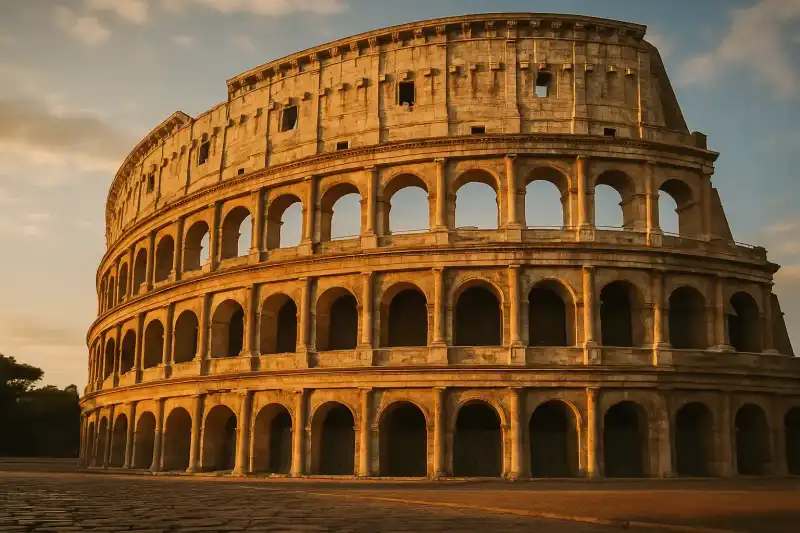
Start with the Colosseum on a timed entry. It is easy to treat the amphitheater as a photo stop, but the building rewards a slower look at movement: entrances, seating hierarchy, service corridors, arena mechanics, and the way a crowd could be sorted by status before the spectacle even began.
A Colosseum, Roman Forum, and Palatine Hill guided tour is useful here because the three areas blur together without context. A good guide can explain why an amphitheater, a political forum, and an imperial hill belong in the same day.
Continue to the Roman Forum and Palatine Hill. The Forum was not a tidy plaza. It was a crowded civic landscape of temples, basilicas, speaker platforms, honorific monuments, and memory layered over memory. On the Palatine, the story shifts toward elite houses and imperial palaces. Rome’s rulers did not just govern the city. They lived above its origin stories.
Pause by the Arch of Constantine before or after the Colosseum visit. Its reused sculptural panels are a good reminder that late Roman monuments often borrowed from earlier imperial imagery. Even triumphal display could be an act of editing the past.
Keep the evening simple. Ancient Rome’s core is compact on a map and exhausting underfoot.
Day 2: Pantheon, imperial Rome, and the Baths of Caracalla
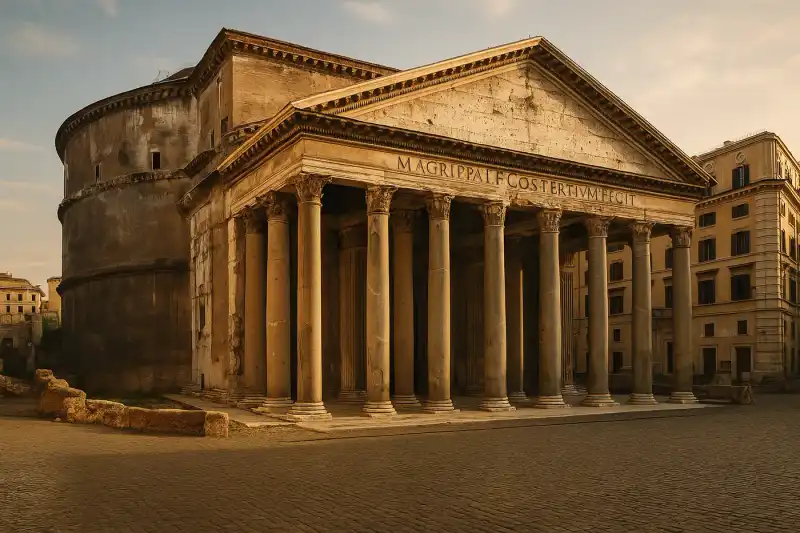
Begin at the Pantheon before the heaviest crowds settle in. The building survives so well because it kept being used, but its ancient engineering still feels direct. The concrete dome, oculus, thick drum, and carefully managed interior space make the room do the work. You do not need much ornament to feel the design.
From there, walk or taxi toward the imperial forum zone and Trajan’s Market. The multi-level brick complex helps widen the Rome story beyond marble temples. Administration, shops, streets, terraces, and imperial planning were part of how the city functioned. Ancient Rome was not only ceremony. It was logistics, money, offices, food supply, and crowd control.
Later, head toward the Circus Maximus and the Baths of Caracalla. The Circus Maximus is mostly a long open form today, but its scale still explains the Roman appetite for public spectacle. The Baths of Caracalla are better preserved as mass and volume: walls, vaults, service spaces, and the remains of a bathing complex that was also social infrastructure.
Use taxis without guilt today. Rome rewards walking, but crossing the city repeatedly can drain the day. Save your energy for the places where standing still and looking carefully matters.
Day 3: Ostia Antica and Rome’s port world
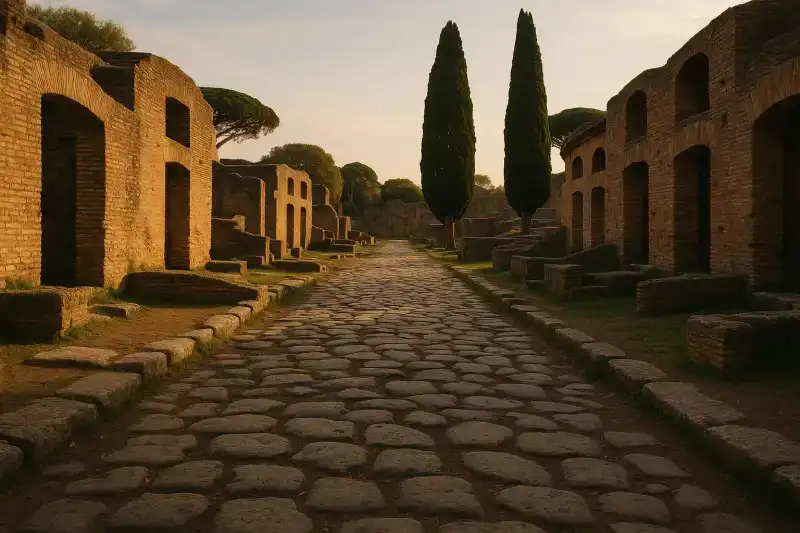
Take the train to Ostia Antica and give it most of the day. Ostia was Rome’s port city, tied to grain supply, trade, warehouses, apartment blocks, baths, temples, guild offices, and river traffic. If the Forum shows Rome talking about power, Ostia shows Rome being fed and supplied.
The site is one of the best places to understand ordinary urban texture near Rome. Walk the streets slowly enough to notice thresholds, shopfronts, staircases, latrines, taverns, mosaics, and apartment buildings. The famous theater and Piazzale delle Corporazioni are only part of the reward. The best moments often come when the city starts feeling lived in rather than displayed.
Bring water and check food options before you go deep into the site. Ostia is easier than Pompeii in some ways, but it is still a large archaeological park. Do not plan a major Rome museum afterward unless you are unusually fresh.
Return to Rome for the night. Pack before bed if you are taking the morning train to Naples.
Day 4: Rome to Naples and Herculaneum
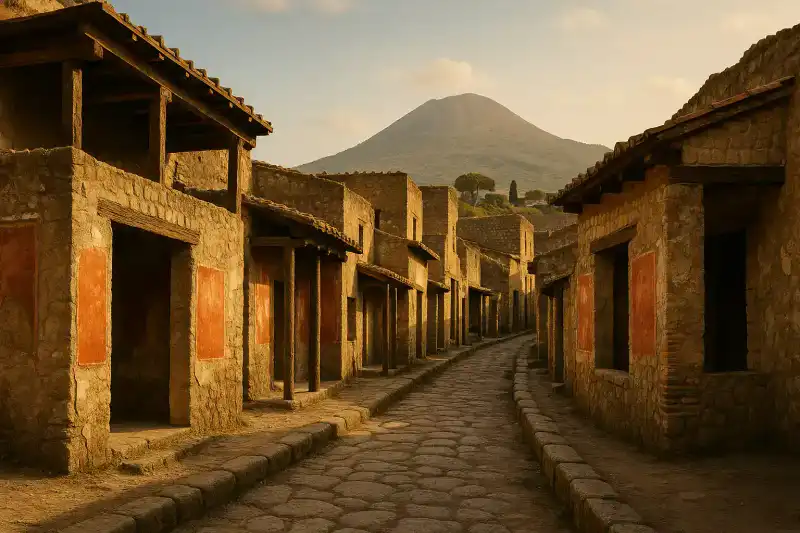
Take a morning train from Rome to Naples. Drop your bags before going to Herculaneum. This is not the day to haul luggage through a local train station and pretend that is efficient travel.
Herculaneum is smaller than Pompeii, but its preservation can feel more intimate. The eruption of 79 CE buried it differently, preserving carbonized wood, upper floors, furniture traces, frescoes, and domestic spaces in ways Pompeii often cannot. You can stand in rooms where door frames, shelves, and wall decoration make Roman private life feel oddly close.
Because the site is compact, it pairs well with a travel day. Still, do not rush it. Herculaneum rewards close looking: the changing floor levels, the boat houses by the ancient shoreline, the painted interiors, the shopfronts, and the sense of a wealthy town caught between sea, slope, and volcano.
Return to Naples for the evening. Stay near good transit rather than choosing a romantic base that makes every archaeology day harder.
Day 5: Pompeii with time to read the city
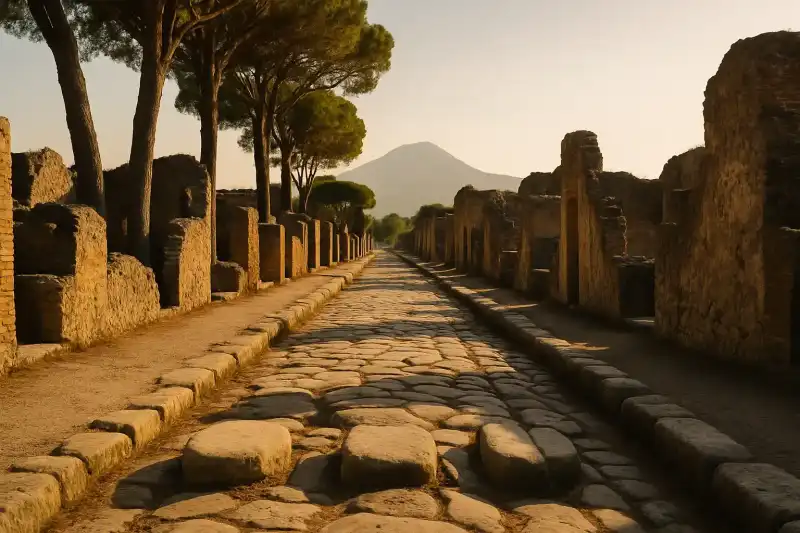
Give Pompeii the main day. It is too large and too famous for its own good. Many visitors arrive with a short list of houses and leave with a blur of streets. A better strategy is to choose a route, accept that you will not see everything, and pay attention to how the city works: gates, streets, water fountains, shops, houses, baths, theaters, and political graffiti.
A Pompeii or Pompeii and Herculaneum day trip from Naples can solve the guiding problem if you want context without planning every route turn yourself. Since this itinerary separates Herculaneum and Pompeii, choose a Pompeii-focused option if available.
Historically, Pompeii matters not because it is frozen in a neat domestic snapshot, but because it preserves a working Roman town with all its noise and unevenness. Election notices, bakeries, thermopolia, atrium houses, workshops, shrines, and street wear make the city feel less like a ruin and more like interrupted urban life.
If you still have energy, consider Oplontis for Villa Poppaea and its frescoed elite setting. Be honest with yourself, though. Pompeii can fill a whole day. Oplontis is a good add-on only if you start early and know when to stop.
Day 6: Paestum and Greek Italy
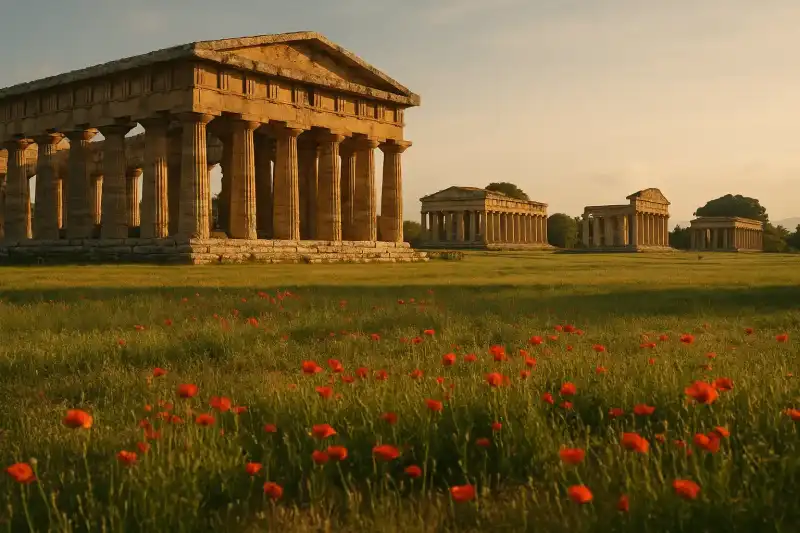
Travel south to Paestum. The temples are the obvious reason to come, but the site is more interesting when you remember that this was Greek Poseidonia before it became Roman Paestum. Southern Italy was part of the Greek colonial world, and this day shifts the itinerary away from Rome’s capital and toward Magna Graecia.
Give the temples and museum enough time. The so-called Basilica, Temple of Neptune, and Temple of Athena show Greek architecture with a physical clarity that can surprise travelers coming from Rome’s brick, concrete, and layered urban ruins. The Tomb of the Diver in the museum adds a different note: a painted burial scene from around 480 BCE that still feels personal and strange.
Paestum is possible by train from Naples, but check schedules carefully, especially for the return. A driver gives more flexibility and may allow a visit to the Heraion at Foce del Sele, a sanctuary tied to the Greek religious landscape around the Sele River. Without a car or driver, do not force the Heraion. Paestum itself is enough.
Return to Naples for the night. This is a long day, so avoid stacking a major dinner reservation immediately after the train back.
Day 7: Cumae and Baia on the Bay of Naples
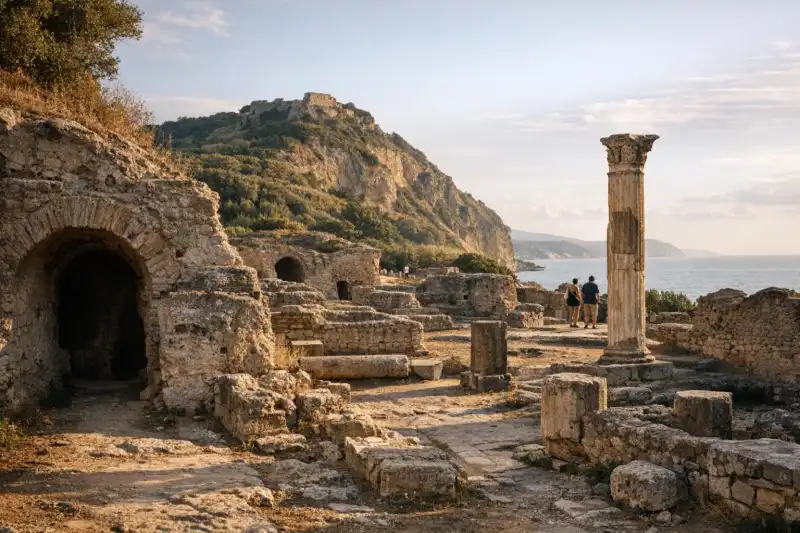
End with the Phlegraean Fields, west of Naples. Start at Cumae, often described as Italy’s oldest Greek colony. The acropolis, sanctuary areas, and cave traditionally linked with the Sibyl connect Greek settlement, Roman literary memory, and the volcanic landscape around the Bay of Naples. This is a good day for people who like their ruins a little uncanny.
Continue to Baia Archaeological Park. Baia was famous in antiquity for thermal waters, elite villas, pleasure, politics, and imperial presence. Some of the ancient landscape now sits underwater because of bradyseism, the slow rising and falling of the volcanic ground. That one geological fact changes how you read the whole coast.
A Cumae and Baia private day trip from Naples is one of the more defensible tour choices on this route. Public transport can work, but pairing the sites cleanly takes patience, and a driver helps you spend the day on archaeology rather than transfers.
Do not add Capri today unless you remove Cumae or Baia. The Bay of Naples looks compact, but the logistics are not. Finish in Naples and give yourself a final evening without a second ancient site squeezed into it.
The historical thread: Rome, buried cities, and Greek Italy
The route starts with Rome’s public power: amphitheater, forum, palace hill, baths, port, and imperial urban planning. Then it moves south into the Bay of Naples, where Roman life survives in a different register. Herculaneum and Pompeii preserve houses, shops, paintings, streets, and daily habits because disaster did what normal time rarely does.
Paestum changes the frame again. Before this region was Roman, Greek cities shaped southern Italy’s coast. Cumae pushes that Greek story back toward the Bay of Naples, while Baia shows the Roman elite turning a volcanic shoreline into a zone of leisure, engineering, and imperial performance.
That is the real pleasure of the week. Ancient Italy does not sit in one period. It stacks Greek colonies, Roman republic, imperial city-building, domestic life, disaster, ports, baths, and coastal luxury into one route that is logistically possible if you do not overpack it.
Transportation notes
Use trains for the backbone: Rome to Naples, Rome to Ostia Antica, Naples to Herculaneum, Naples to Pompeii, and Naples to Paestum. They are practical, though not always glamorous. Keep expectations realistic for local Campania trains, especially in heat and peak travel periods.
Do not rent a car for central Rome or central Naples. Parking and traffic will make you regret it. If you want a car, use it selectively for the Cumae and Baia day or hire a driver for that route.
Naples is the better base than Sorrento for this specific itinerary. Sorrento works well for Amalfi Coast and some Pompeii visits, but it adds time for Paestum and the Phlegraean Fields. Stay in Naples if ancient sites are the priority.
Do not compress Rome, Ostia Antica, Pompeii, Herculaneum, Paestum, Cumae, and Baia into five days unless you are willing to cut depth. The distances look manageable, but the real cost is mental energy. Big archaeological sites take more out of you than normal sightseeing.
Optional add-ons and swaps
If you want an extra Rome day, add the Appian Way and remove either Day 2’s Baths of Caracalla extension or the Cumae and Baia day. The Appian Way is best when you have time to walk or bike without watching the clock.
If imperial villa architecture is a priority, add Hadrian’s Villa from Rome. This needs a full day or a serious half day, so remove Ostia Antica or extend the trip. Do not treat it as a quick afterthought.
If you want more Vesuvian archaeology, add Stabiae or spend more time at Oplontis. Remove Paestum if you want the route to stay focused on Roman Campania rather than Greek southern Italy.
If amphitheaters and gladiator history are your thing, add the Capua Amphitheater from Naples. It pairs better with a Campania-focused extra day than with the already full Pompeii or Paestum days.
If Capri is calling, choose Villa Jovis or the Emperor Augustus’s Villa on Capri as a full-day island add-on. Remove Cumae and Baia or add a night. Ferry logistics make Capri a poor casual extra.
Shorter and longer itinerary options
For a shorter version, keep Rome, Pompeii, and Herculaneum, then choose either Ostia Antica or Paestum instead of trying to cover the full 7-day loop.
For a Rome-only start, use the 3 Days in Ancient Rome itinerary. That is the better choice if you want one base, less train time, and a deeper look at the capital.
A longer 10-day Italy route gives Campania more breathing room and can add Sicily’s Greek and Roman sites instead of forcing them into this week.
Related ancient sites
- Ostia Antica
- Appian Way
- Pantheon
- Baths of Caracalla
- Trajan’s Market
- Herculaneum
- Oplontis
- Stabiae
- Paestum
- Heraion at Foce del Sele
- Cumae
- Baia Archaeological Park
- Capua Amphitheater
- Villa Jovis
FAQ
The most common planning questions for this route are answered below.