Quick route summary
This 3-day Boyne Valley route starts and ends around Dublin, but it works best if you spend at least one night closer to the sites, usually in Drogheda, Trim, or Navan. The focus is tight: the great passage tomb landscape around Newgrange, Knowth, Dowth, the royal hill at Tara, and the cairns of Loughcrew.
The pace is full but sensible. Day 1 is built around timed access at Brú na Bóinne. Day 2 gives you the political and ritual landscape around Tara. Day 3 heads west to Loughcrew, where the archaeology feels rougher, windier, and less managed.
Who this itinerary is for
This itinerary is for travelers who want ancient Ireland without turning the trip into a race across the whole island. It suits people who like landscape archaeology, carved stones, and places where the best context comes from looking carefully rather than moving fast.
It is not ideal if you want one easy car-free city break. You can reach parts of the Boyne Valley by tour from Dublin, but the full route is much smoother with a rental car, private driver, or a carefully chosen guided trip. It is also not the right plan if you want castles and pubs to carry the schedule. Those can fit around the edges, but the core of this route is Neolithic tombs and ceremonial hills.
Route at a glance
- Day 1: Overnight in Drogheda or Dublin. Visit Brú na Bóinne for Newgrange and Knowth, using timed access and shuttle transport from the visitor centre.
- Day 2: Overnight in Drogheda, Trim, or Dublin. Visit Dowth and the Hill of Tara by car or driver, with time for a slower walk across both landscapes.
- Day 3: Overnight in Dublin or continue through Meath. Drive to Loughcrew Cairns, allow for the hill climb, then finish with an optional Meath heritage stop if energy and weather cooperate.
Practical logistics before you go
The first decision is your base. Drogheda is the most practical for Brú na Bóinne, especially if you have an early tour slot. Dublin is easier for flights, hotels, and restaurants, but it adds drive time each day. Trim or Navan can work well if you want a quieter Meath base and plan to include Tara, Loughcrew, or Trim Castle.
Brú na Bóinne is not a show-up-and-wander site for the main tombs. Access to Newgrange and Knowth is managed through the visitor centre, with timed tours and shuttle buses. Book ahead, then build the rest of the day around that slot. If Newgrange interior access is sold out, do not treat the whole day as a failure. Knowth’s carved stones and mound layout are worth serious time.
A guided tour makes sense if you are based in Dublin and do not want to drive rural roads or manage timed access. A Boyne Valley day tour from Dublin can solve the biggest transport problem, but check the itinerary carefully. Some tours include Newgrange only from the outside or substitute sites depending on ticket availability.
Weather matters more than the map suggests. Tara and Loughcrew are exposed landscapes. Good shoes, a rain layer, and a flexible attitude will do more for this route than one more attraction squeezed onto the list.
Day 1: Newgrange and Knowth from Brú na Bóinne
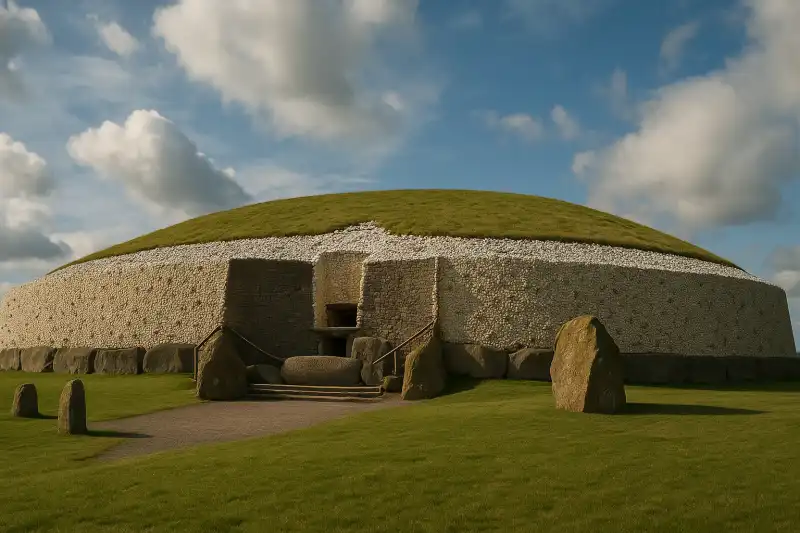
Start with the Boyne Valley Passage Tombs through the Brú na Bóinne Visitor Centre. This is the controlled gateway for the main visits to Newgrange and Knowth, so your tour time sets the rhythm of the whole day. Arrive early, use the visitor centre well, and do not plan a tight lunch booking right after the tour.
Newgrange gets the attention because of its winter solstice alignment, and fair enough. Around sunrise near the solstice, light can enter the passage through the roof box above the entrance and reach deep into the chamber. The engineering is elegant, but the real point is not just clever astronomy. This was a tomb, a ceremonial place, and a statement in stone and earth around 3200 BCE.
Knowth is the site that rewards people who slow down. Its great mound is surrounded by smaller satellite tombs, and the kerbstones carry one of the densest collections of megalithic art in western Europe. Spirals, lozenges, arcs, and cup marks wrap the mound in a visual language we can describe but not fully translate. Give it time. The stones are quiet now, but the ambition here was not subtle.
Logistically, this is a day for patience. You will move by visitor-centre shuttle rather than your own car once inside the managed route. If the weather turns, stay with the plan unless conditions are genuinely miserable. The visitor centre context helps, and the tombs make more sense when seen as a connected Boyne landscape rather than separate famous stops.
Day 2: Dowth and the Hill of Tara
Use Day 2 for the sites that are easier to miss if you only book a standard Newgrange tour. Start at Dowth if access conditions suit your route. Unlike Newgrange and Knowth, Dowth is not usually experienced through the same interior-tour system, so treat it as a landscape visit rather than a chamber visit. That actually helps the Boyne Valley feel less curated. You are looking at a great mound in its rural setting, not just a managed monument.
Dowth matters because it keeps the trio honest. Newgrange, Knowth, and Dowth were not isolated wonders. They formed a dense Neolithic ceremonial zone along the River Boyne, built by communities who moved earth, stone, timber, bodies, and stories through the same valley. Dowth’s winter light associations and carved stones belong to that wider pattern, even if the visitor experience is quieter.
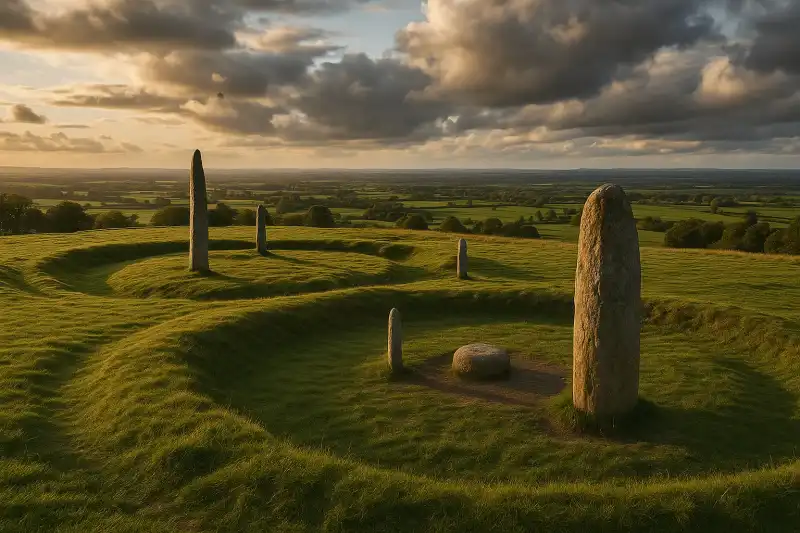
Then drive to the Hill of Tara. The site can disappoint people who expect a single grand monument. Do not visit it that way. Tara is a walking landscape of earthworks, mounds, ditches, and views, tied to Irish kingship traditions and later medieval memory. The Mound of the Hostages, a Neolithic passage tomb on the hill, shows that Tara’s importance did not begin with kings. The place had ritual weight long before medieval writers made it the symbolic seat of high kings.
Allow more time than the map suggests. Tara is not physically hard, but it needs unhurried walking and a little imagination. The Lia Fáil, the so-called Stone of Destiny, draws attention, yet the more interesting experience is reading the hill as a layered ceremonial map. If wind or rain is sharp, shorten the walk and save energy for Day 3.
Day 3: Loughcrew Cairns and a slower Meath finish
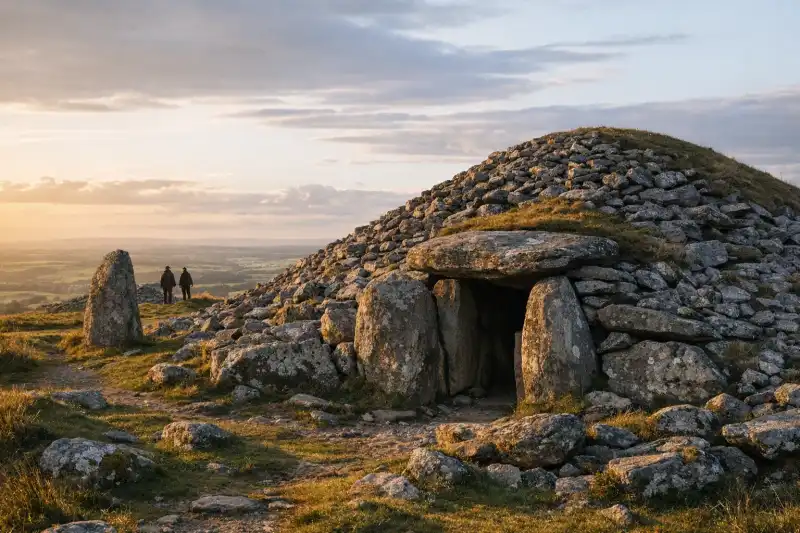
Drive west to Loughcrew Cairns and resist the urge to treat it as a quick add-on. The road approach is rural, the hill walk takes effort, and weather can change the whole mood of the visit. On a clear day, the views explain why the site feels so different from the lower Boyne tombs.
Loughcrew is often linked with equinox light, especially Cairn T, where sunlight can illuminate carved stones inside the chamber around sunrise near the equinoxes. Access to interiors can vary, so check current conditions before building the day around entering a cairn. Even from outside, the hilltop cemetery gives you a strong sense of Neolithic monument building as a regional practice, not a single famous valley phenomenon.
The carvings are part of the pleasure here. Look for circles, radial forms, cup marks, and abstract patterns rather than expecting a captioned story. These marks are not decoration in the modern sense. They are part of how the tombs handled memory, ritual, and place, though the exact meanings remain out of reach.
Keep the afternoon deliberately loose. If the weather is poor, Loughcrew may take more energy than expected. If conditions are good and you still have time, you can add a nearby Meath heritage stop, but do not turn this into a checklist day. The best finish is often a slow return toward Dublin or a quiet night in Meath after three days of stones, hills, and old ceremonial ground.
The historical thread: tombs, light, and royal landscapes
The Boyne Valley works as a 3-day route because it shows ancient Ireland as a lived and reused landscape. Newgrange, Knowth, Dowth, and Loughcrew belong to the Neolithic world of passage tombs, carved stones, seasonal light, and communal labor. Tara adds a later political layer, but it also contains earlier ritual ground, which makes the hill feel less like a separate chapter and more like a continuation.
The route also pushes back against a simple “one famous tomb” version of the Boyne Valley. Newgrange is remarkable, but Knowth complicates the story with its art, Dowth widens the landscape, Tara shows how old sacred places could be reworked into kingship memory, and Loughcrew proves that the impulse to build tombs on meaningful horizons reached well beyond the river bend.
Transportation notes
A car gives you the cleanest version of this itinerary. Roads between the sites are manageable, but they are not all fast, and rural routing can be slower than expected. If you are not comfortable driving on Irish country roads, use a guided day tour for Brú na Bóinne and consider a private driver for Tara, Dowth, and Loughcrew.
Public transport is not ideal for the full route. You can reach Drogheda from Dublin by train or bus, but the ancient sites themselves still require taxis, tours, or local transfers. Do not assume that because the sites are close on a map they connect neatly without a car.
If you base in Dublin, start early and avoid planning late dinners after Day 1 or Day 3. If you base in Drogheda or Trim, the site days breathe better. The tradeoff is fewer evening options, which is usually worth it if ancient sites are the point of the trip.
Do not compress all of this into one day unless you are content with a windshield tour. Newgrange and Knowth alone can take much of a day once timed access, shuttles, and the visitor centre are included.
Optional add-ons and swaps
If you want a medieval contrast, add Trim Castle after Tara or on the final afternoon. Remove Dowth or keep Loughcrew shorter if you do this. Trim changes the story from Neolithic and royal ceremonial landscapes to Anglo-Norman power in stone, so it works best as a clear shift rather than another item jammed into the same ancient theme.
For early medieval Ireland, add Monasterboice or the High Crosses of Kells. Remove the optional Meath finish on Day 3 or make this a fourth day. The carved crosses are a good reminder that Ireland’s sacred landscapes kept being rewritten long after the passage tomb builders were gone.
If you have poor weather on the Loughcrew day, swap in Trim Castle or Kells and save Loughcrew for another trip. Loughcrew is much better when the hill walk is safe and the visibility gives you the landscape context.
Shorter and longer itinerary options
For a shorter version, make it a two-day route: Day 1 at Brú na Bóinne for Newgrange and Knowth, Day 2 at Tara and Dowth. Loughcrew is the cut, painful but practical.
For a longer Ireland route, use this as the ancient Meath core before continuing into the planned 5 Days Ancient Ireland: Boyne Valley, Dublin, and Glendalough. That version adds Dublin heritage sites and the monastic valley at Glendalough.
For a westward expansion, the planned 7 Days Ancient Ireland: Boyne Valley, Sligo, and the West would pair this route with Sligo’s megalithic cemeteries and western sites such as Carrowmore, Carrowkeel, and Poulnabrone.
Related ancient sites
- Boyne Valley Passage Tombs
- Newgrange
- Knowth
- Dowth
- Hill of Tara
- Loughcrew Cairns
- Trim Castle
- Monasterboice
- High Crosses of Kells
FAQ
The most common planning questions for this Boyne Valley route are answered below.