Quick route summary
This 7-day ancient Ireland route starts in Dublin and ends in Galway, with bases in Dublin, Sligo, and Galway. It links the Hill of Tara, Newgrange, Knowth, Carrowmore Megalithic Cemetery, Carrowkeel Megalithic Cemetery, Poulnabrone Dolmen, and Dún Aonghasa into one westward route.
The pace is active, but it is not designed to punish you. You move from the Boyne Valley’s chambered tombs to Sligo’s megalithic cemeteries, then cross to the Burren and the Aran Islands. Ireland looks small on a map. The roads, weather, ferries, and site access make it feel larger.
Who this itinerary is for
Use this route if ancient Ireland means more to you than a quick stop at Newgrange. It is built for travelers who want megalithic tombs, ritual landscapes, high crosses, island forts, and enough driving time to see why these places sit where they do.
It is not ideal if you want one base for the week, late starts every morning, or a pub-first trip with archaeology on the side. You can still have good evenings in Dublin, Sligo, and Galway, but the route works best if you protect the mornings and accept a few long transfer stretches.
Route at a glance
- Day 1: Overnight in Dublin. Arrive, then visit Tara and Loughcrew if your flight timing and energy allow.
- Day 2: Overnight in Dublin. Spend the day around Brú na Bóinne for Newgrange, Knowth, and the Boyne passage tomb landscape.
- Day 3: Overnight in Sligo. Move from Meath toward Sligo with stops at Dowth, Monasterboice, and Kells.
- Day 4: Overnight in Sligo. Visit Carrowmore and keep the day local enough to notice the wider ritual landscape.
- Day 5: Overnight in Sligo. Drive to Carrowkeel for hilltop passage tombs in the Bricklieve Mountains.
- Day 6: Overnight in Galway. Transfer south and west via Poulnabrone Dolmen and Kilmacduagh.
- Day 7: Overnight in Galway. Take a day trip to Inis Mór for the Aran Islands stone forts and Dún Aonghasa.
Practical logistics before you go
Dublin is the simplest start because flights, rental cars, and Boyne Valley tours all cluster there. Sligo is the right middle base for Carrowmore and Carrowkeel. Galway is the practical finish for the Aran Islands, with enough transport options to soften the end of the trip.
A rental car gives the best version of this itinerary. The Boyne Valley can be done by guided day tour from Dublin, and the Aran Islands work by ferry from Galway, but Carrowkeel, Poulnabrone, Kilmacduagh, and the transfer days are awkward without a car. If you do not want to drive on rural Irish roads, use tours for the Boyne Valley and Aran Islands, then budget for private transfers or a driver in the middle.
Book Brú na Bóinne access before you build the rest of the Boyne Valley day. Newgrange and Knowth visits use a managed visitor-center and shuttle system, and the schedule can shape the whole day. Also watch the weather for Day 7. Inis Mór is not a place to force into a stormy ferry day.
Do not overpack the days. Irish prehistoric sites often need walking, uneven ground, and time outside without much shelter. The history is better when you are not sprinting from car park to car park.
Day 1: Dublin arrival, Hill of Tara, and Loughcrew
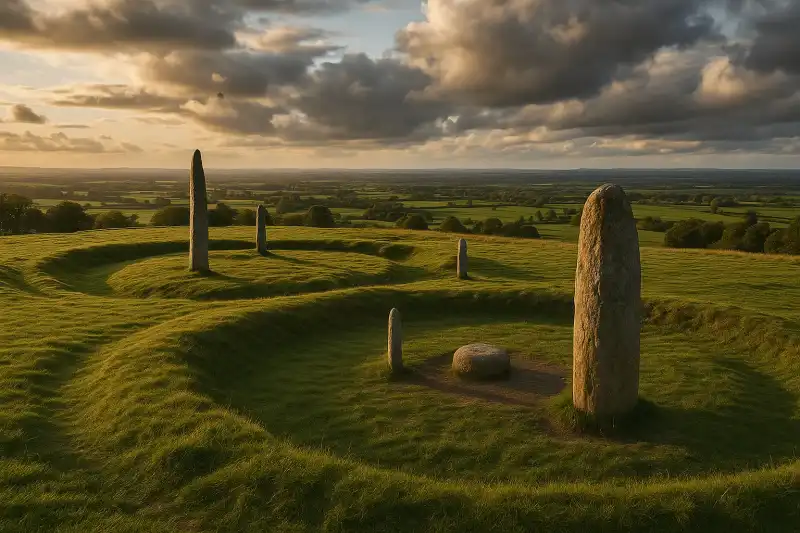
If you arrive in Dublin in the morning and feel steady after the flight, use the afternoon for the Hill of Tara. It is a gentle first site because the visit is mostly landscape reading: earthworks, mounds, open grass, and views across Meath. Tara is tied to Irish kingship traditions, but it is not a castle or palace. Its authority came from ceremony, memory, routeways, and the way later stories gathered around the hill.
Keep the visit slow. The Mound of the Hostages is a small passage tomb, much older than the medieval kingship traditions that later made Tara famous. That overlap is the point. Ireland’s sacred landscapes were reused, reinterpreted, and argued over for a very long time.
If daylight and energy hold, continue to Loughcrew Cairns. The cairns crown Slieve na Calliagh, and the climb adds effort to the day. Do not add it after a late arrival or bad weather. The reward is a hilltop cemetery with carved stones and sightlines that make the Boyne Valley feel like part of a wider Neolithic world.
Sleep in Dublin tonight. It may look inefficient to return east, but it keeps Day 2 clean for Brú na Bóinne access and avoids making your first day a tired cross-country drive.
Day 2: Newgrange and Knowth at Brú na Bóinne
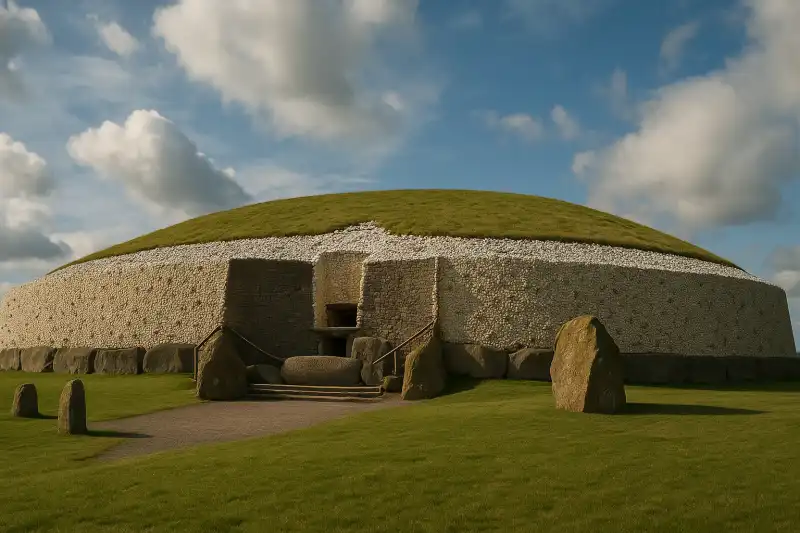
Today revolves around the Boyne Valley Passage Tombs, especially Newgrange and Knowth. Book ahead and let the visitor-center schedule set the pace. This is not a casual pull-up-and-wander site.
Newgrange is famous for its winter solstice alignment, when sunlight can reach into the passage around sunrise. Even outside that narrow moment, the structure is worth careful attention. The mound dates to around 3200 BCE, older than Stonehenge and the Great Pyramid. The rebuilt white quartz facade is debated in presentation, but the tomb’s scale and orientation still do the real work.
Knowth often surprises people more. Its great mound is surrounded by smaller satellite tombs, and its kerbstones hold one of the densest collections of megalithic art in western Europe. Spirals, lozenges, arcs, and cup marks appear again and again, but they do not explain themselves neatly. That is part of the pull.
If you want a guided solution from Dublin, this is the day where it makes sense. A Boyne Valley day tour from Dublin can remove the transport problem, though you should still check whether it includes the specific Brú na Bóinne access you want.
Return to Dublin for the night. Resist adding too many extra ruins. Newgrange and Knowth are dense sites, and the best part of the day is having enough headspace to compare them.
Day 3: Dowth, Monasterboice, and Kells before Sligo
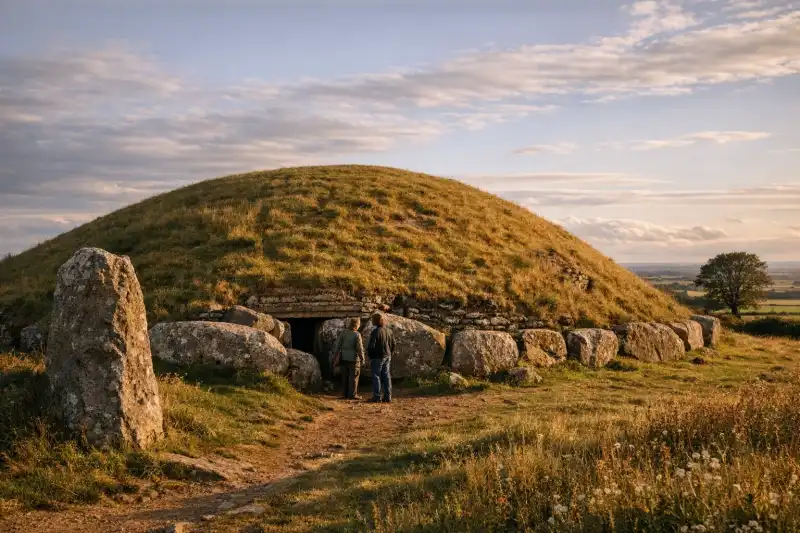
Leave Dublin and use the transfer toward Sligo as a historical bridge rather than a dead driving day. Start with Dowth, the quieter third major tomb in the Brú na Bóinne group. Access and presentation differ from Newgrange and Knowth, so check local conditions before assuming a full interior visit. Even from outside, Dowth helps the Boyne Valley feel less like a two-site package and more like a ritual landscape.
Then shift forward in time at Monasterboice. Its round tower and carved high crosses belong to early medieval Christian Ireland, when monasteries acted as religious communities, landholders, art centers, and places of learning. The Muiredach Cross is the famous one, but slow down at the panels. Biblical scenes, ornament, and local stone carving meet in a way that feels both learned and very physical.
If timing allows, add the High Crosses of Kells. Kells is tied to one of Ireland’s great monastic traditions, and the town setting makes a useful contrast with open landscapes like Tara and Carrowmore. This is a good day for people who like seeing how older sacred geographies and Christian monument-making start to sit beside each other.
Drive on to Sligo and stop there. Do not push to Carrowmore tonight unless you are early, rested, and visiting in long summer light. You will understand Sligo’s prehistoric landscape better after sleep.
Day 4: Carrowmore and the Sligo megalithic landscape
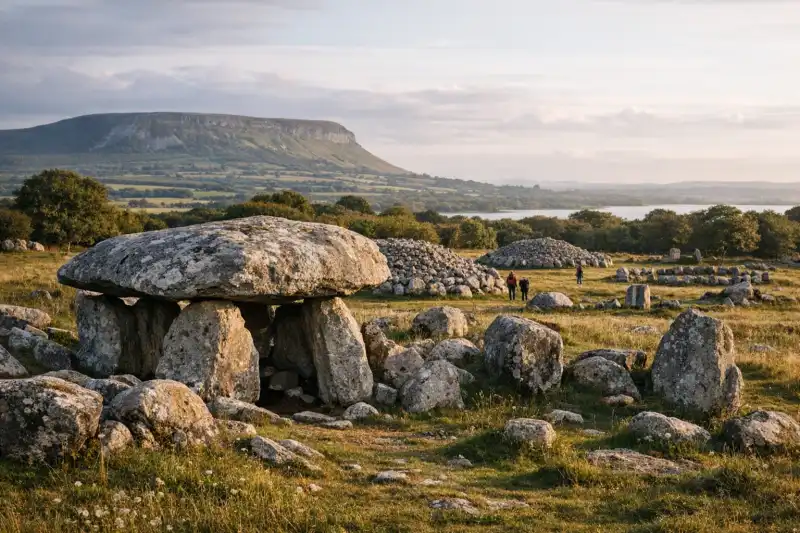
Give Carrowmore Megalithic Cemetery most of the day’s attention. It sits close to Sligo town, but do not treat it as a quick roadside stop. Carrowmore is one of Ireland’s great megalithic cemeteries, with stone circles, dolmens, and low tomb remains spread across a landscape watched over by Knocknarea.
The site can look modest at first because many tombs are low and open. That is exactly why it needs time. The pattern matters more than any single dramatic monument. You are looking at a cemetery used in the Neolithic, with tombs arranged in ways that suggest memory, procession, and the repeated marking of the dead.
Use Sligo as your base and keep the logistics simple: short drive, proper shoes, rain layer, and enough patience to walk between the monuments. If you have extra time, look toward Queen Maeve’s Cairn on Knocknarea from a distance rather than cramming in another full hike. The route already has a hillier day coming.
This is also a good day to slow the itinerary down. After two Boyne Valley days and a transfer, Sligo gives you a chance to reset without leaving the ancient theme behind.
Day 5: Carrowkeel and the Bricklieve Mountains
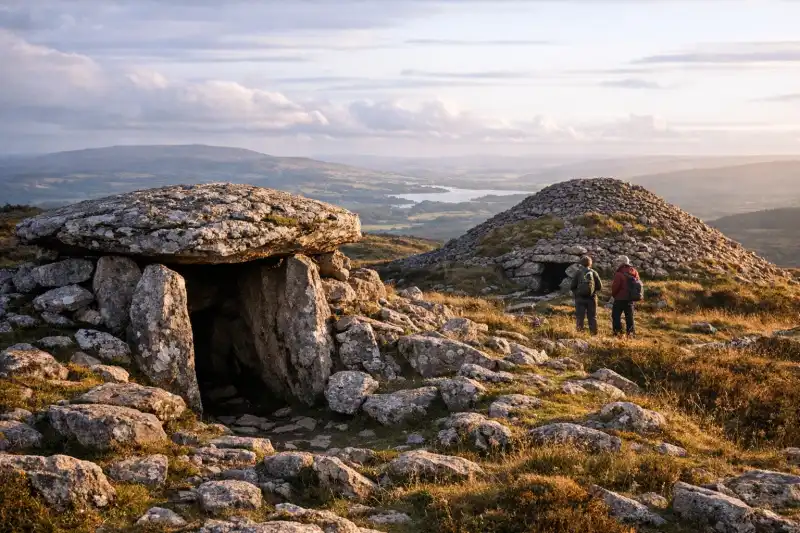
Carrowkeel Megalithic Cemetery is the more demanding Sligo day, and that is part of its character. The tombs sit in the Bricklieve Mountains, where weather, narrow roads, and walking conditions matter. Start earlier than you think you need to, and do not attempt it in poor visibility if you are not comfortable on exposed hills.
The payoff is real. Carrowkeel’s passage tombs are smaller and rougher-feeling than Newgrange, but the setting is magnificent in a hard, quiet way. Some tombs preserve roof boxes or light-related architectural features that invite comparison with the Boyne Valley, though you should avoid reducing the site to a simple copy of Newgrange. It belongs to its own western landscape.
Bring food and water, and keep the day uncluttered. This is not the moment to stack three distant attractions because a map says they are close. Rural driving and hill walking take time, and the tombs deserve better than a rushed check-in.
Return to Sligo for a second night. That second Sligo night is what keeps the middle of the route sane.
Day 6: Poulnabrone, Kilmacduagh, and the road to Galway
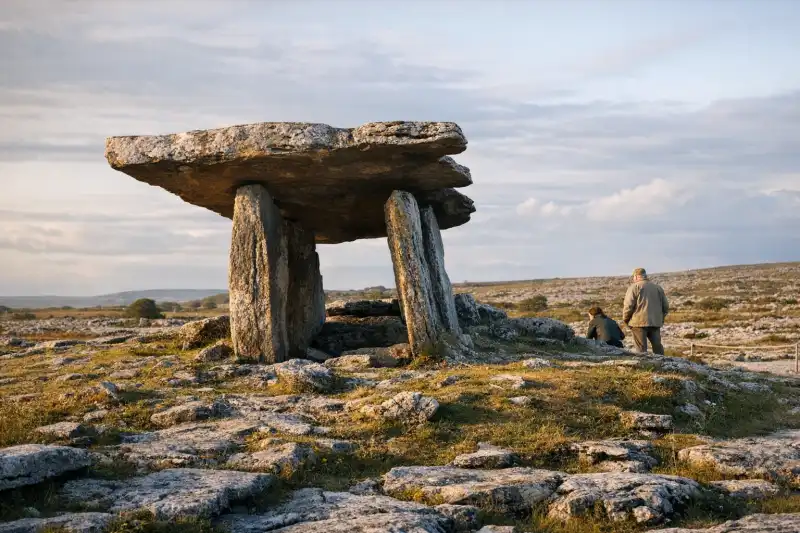
This is the longest transfer day, so be honest about it. Leave Sligo after breakfast and drive toward the Burren for Poulnabrone Dolmen. The dolmen is one of Ireland’s most photographed prehistoric monuments, but the setting is the reason it works: a portal tomb rising from cracked limestone pavement, with very little visual clutter around it.
Poulnabrone dates to the Neolithic, and excavations found human remains from dozens of individuals. That detail changes the mood. It is not just a sculptural stone arrangement in a beautiful landscape. It was a burial place, revisited by communities who placed their dead in a stark limestone world that still feels exposed.
If you have time, continue to Kilmacduagh, an early medieval monastic site with a tall round tower and scattered church ruins. It makes a useful chronological counterpoint after so many Neolithic sites. Ireland’s ancient travel story reaches beyond tombs and stone circles. Monastic sites reshaped the island’s sacred geography in the Christian period, often with their own legends, land claims, and local power.
Finish in Galway and stay there. Do not add the Cliffs of Moher to this day unless you are deliberately turning it into a very long sightseeing transfer. For this route, Poulnabrone and Kilmacduagh are enough.
Day 7: Inis Mór and Dún Aonghasa
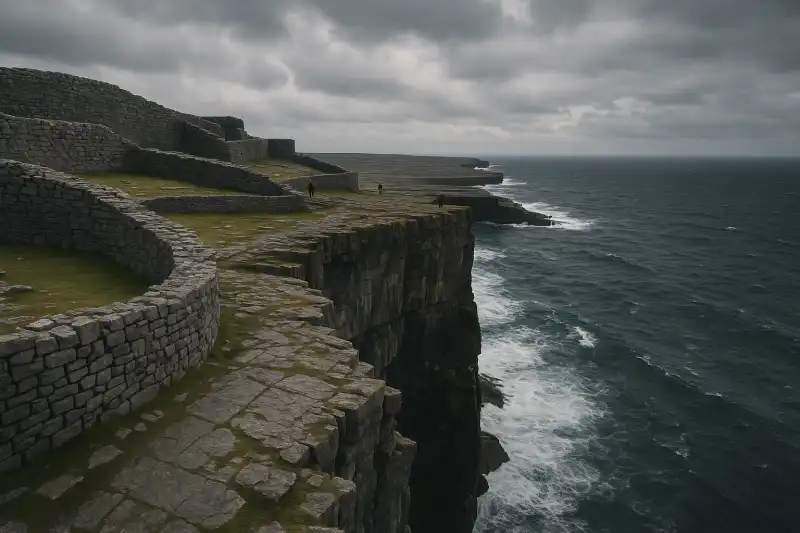
End with the Atlantic. Take an early ferry or flight to Inis Mór and plan the day around the Aran Islands Stone Forts, especially Dún Aonghasa. Weather decides how smooth this day feels. Build slack into the evening and do not schedule a tight onward connection.
Dún Aonghasa sits at the edge of cliffs, with great arcs of dry-stone wall facing inland and the Atlantic dropping away behind it. The site is often described as a fort, but it also feels ceremonial. Its exact function shifted over time, and the cliff-edge position makes any simple military explanation feel too small.
Use a bike, minibus, shuttle, or local transport from the ferry area. Walking the whole island day is possible for strong walkers in good conditions, but it eats time. Save your energy for the approach to the fort and for standing still once you get there. The stones are quiet now, but the choice of location was not subtle.
If you prefer to avoid the planning friction, an Aran Islands and Dún Aonghasa tour from Galway can make sense, especially if you want ferry timing handled for you. Just check the route, island time, and cancellation terms before booking.
Return to Galway for the night. It is a strong finish because the route begins with passage tombs under green hills and ends with stone walls facing the ocean.
The historical thread: tombs, kingship, and Atlantic edges
This route works because it does not treat ancient Ireland as one period. It starts with Neolithic tomb builders in Meath, moves through Sligo’s megalithic cemeteries, crosses the Burren’s burial landscape, and ends at an Atlantic stone fort whose meaning reaches into later prehistoric and early historic worlds.
The Boyne Valley shows monument building at a scale that still feels organized and ambitious. Tara adds the later memory of kingship, where older tombs became part of a political and ceremonial landscape. Sligo changes the texture: lower monuments, wider views, and cemeteries that feel woven into mountains and coast. Poulnabrone strips the tomb idea down to stone, bone, and limestone. Dún Aonghasa closes the route with walls, cliffs, and the sense that power in ancient Ireland often came from controlling edges, routes, and stories.
The nice thing is that the route gets less tidy as it goes west. That is not a flaw. It is the point.
Transportation notes
A rental car is the most practical tool for this itinerary. Dublin to the Boyne Valley is manageable by tour, but the full route asks for flexibility: rural Meath, Sligo side roads, the Burren, and the Galway ferry connection.
Do not self-drive if you are nervous about narrow roads, left-side driving, or rural parking in poor weather. In that case, build the trip from guided pieces: Boyne Valley from Dublin, train to Sligo, a local driver for Carrowmore and Carrowkeel, train or bus onward to Galway, then an Aran Islands day tour.
Brú na Bóinne requires advance planning. Carrowkeel requires weather judgment. The Aran Islands require ferry or flight flexibility. Those are the three logistics points that can reshape the route.
The biggest compression warning is Day 6. Sligo to Poulnabrone to Galway is a real transfer, not a lazy scenic loop. Keep it focused or add an extra night between Sligo and Galway.
Optional add-ons and swaps
Add Glendalough if you want a stronger early medieval monastic day near Dublin. Remove Loughcrew on Day 1 or add an extra day after Dublin. Do not squeeze Glendalough into the Boyne Valley day.
Add Clonmacnoise if you want one of Ireland’s great monastic river sites. It works as a swap for Kilmacduagh on Day 6 if you route from Sligo toward Galway through the Midlands instead of the Burren, though you would lose Poulnabrone.
Add Céide Fields if Neolithic landscapes matter more than a smooth route. It pairs thematically with Carrowmore and Carrowkeel, but it pulls you north into County Mayo. Remove Day 6’s Burren detour or add another night on the west coast.
Add Kylemore Abbey if you want a later historic Connemara day after Galway. It does not replace any Neolithic site cleanly, so treat it as an extra day rather than a swap unless you are cutting the Aran Islands.
Shorter and longer itinerary options
For a shorter trip, make this a 3-day Boyne Valley route: Tara and Loughcrew on Day 1, Newgrange and Knowth on Day 2, then Dowth, Monasterboice, and Kells on Day 3. That keeps the focus tight and avoids the long westward travel.
For a 5-day version, keep Dublin, the Boyne Valley, and Sligo. Cut Poulnabrone and the Aran Islands. It hurts, but the route becomes much easier and still gives you Newgrange, Knowth, Carrowmore, and Carrowkeel.
For a 10-day version, add Glendalough near Dublin, Céide Fields from the Sligo or Mayo side, and one extra night in Galway or on Inis Mór. If you continue south, Kerry sites such as Skellig Michael, Gallarus Oratory, and Staigue Stone Fort belong to a different west-coast route and need more time than a quick add-on.
Related ancient sites
- Dowth
- Loughcrew Cairns
- Monasterboice
- High Crosses of Kells
- Kilmacduagh
- Glendalough
- Clonmacnoise
- Céide Fields
- Kylemore Abbey
FAQ
The most common planning questions for this route are answered below.
Can you do this ancient Ireland itinerary without a car?
Parts of it work without a car, especially Dublin to the Boyne Valley on a tour and Galway to the Aran Islands by ferry. Sligo, Carrowkeel, Poulnabrone, and the cross-country transfers are much easier with a rental car or private driver.
How many nights should you spend in Sligo?
Spend two nights in Sligo if you want both Carrowmore and Carrowkeel without rushing. Carrowmore is easy from town, while Carrowkeel needs more patience for rural roads, weather, and walking.
Is Newgrange worth visiting if you cannot enter the chamber?
Yes, but expectations matter. The exterior, mound construction, kerbstones, and wider Boyne Valley setting still explain why the tomb mattered. If interior access is limited, pair Newgrange with Knowth for more art and landscape context.
Is Dún Aonghasa possible as a day trip from Galway?
Yes, in settled weather. Take an early ferry or flight to Inis Mór, then use a bike, minibus, or shuttle to reach the fort. Keep the evening flexible because Atlantic crossings can be delayed or cancelled.