Quick route summary
This 3-day route uses Athens as a single base and links the city’s central ancient sites with two Attic day trips. Start with the Acropolis of Athens, the Ancient Agora of Athens, and Kerameikos, then spend a day at Eleusis, the sanctuary tied to the Eleusinian Mysteries. The final day follows the Attic coast toward Sounion, the Temple of Poseidon at Sounion, and Ancient Thorikos.
The pace is active, but not silly. You are not trying to see all of Athens, every museum gallery, and half the Peloponnese in three days. The route stays focused on a useful historical question: how did ancient Athens connect civic life, sacred landscapes, sea power, and the resources of Attica?
Who this itinerary is for
This itinerary is for travelers who want ancient Athens beyond one Acropolis morning. It works well if you like walking, can start early, and do not mind one or two trips outside the city center. It is especially good for first-time Athens visitors who want the Acropolis, but also want to understand the city around it: courts, stoas, cemeteries, sanctuaries, roads, mines, and coast.
It is not the best plan if you want a slow museum-heavy trip, late breakfasts every day, or a broad mainland Greece route with Delphi and the Peloponnese. Those are worth doing, but this route is deliberately Attic. It keeps the geography tight so the sites can talk to each other.
Route at a glance
- Day 1: Overnight in Athens. Walk the Acropolis, Ancient Agora, and Kerameikos, with short transfers or metro hops if needed.
- Day 2: Overnight in Athens. Visit Eleusis from Athens, then return for a lighter evening.
- Day 3: Overnight in Athens. Head to Sounion and Thorikos by driver, rental car, or carefully planned tour route along the Attic coast.
Practical logistics before you go
Base yourself in central Athens for all three nights. Plaka, Monastiraki, Syntagma, Koukaki, and areas near the Acropolis Museum all work, depending on budget and noise tolerance. Moving hotels would waste time.
Book the Acropolis for the earliest practical entry, especially in warm months. The rock gets hot, shade is limited, and crowd flow affects how much you can actually notice. Pairing the Acropolis with the Agora and Kerameikos works because the sites are close, but it is still a long walking day. Wear real shoes, not optimistic sandals.
Eleusis is close enough to Athens to visit as a half day or easy day trip, but public transport can feel less intuitive than the distance suggests. A taxi, guided trip, or carefully planned bus or suburban connection is better than improvising late in the morning.
Sounion is the day where logistics matter most. Standard Cape Sounion tours often focus on sunset at the Temple of Poseidon and may not include Thorikos. If you care about Ancient Thorikos, arrange a private driver, rent a car if you are comfortable, or confirm the stop in advance. Do not assume a generic Sounion tour will detour to a mining town and theater site.
Day 1: Acropolis, Agora, and Kerameikos
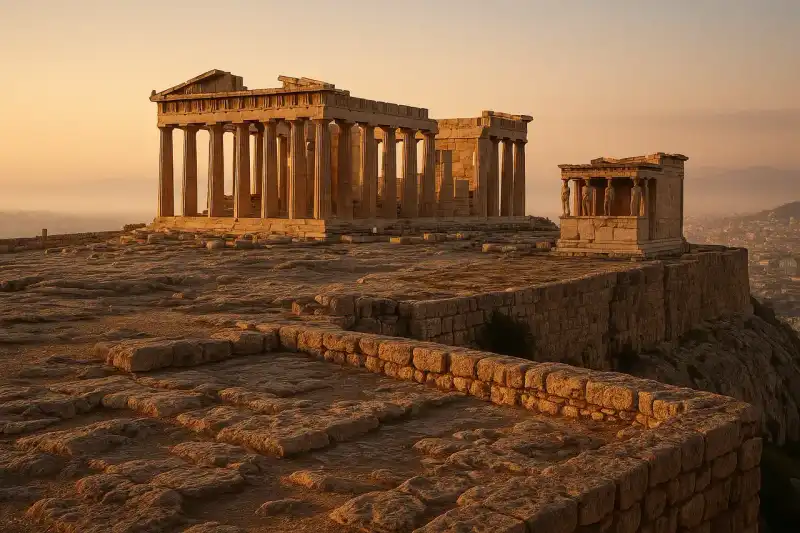
Start early at the Acropolis of Athens. The Parthenon gets the attention, but give the whole rock time: the Propylaia, the Erechtheion, the Temple of Athena Nike, the slopes, and the sightlines over the city. This was not only a beautiful hilltop. It was a sacred and political statement rebuilt after the Persian destruction of Athens in 480 BCE, then shaped into stone during the 5th-century BCE democracy and empire.
If you want a guide anywhere in Athens, this is a sensible place for one. A focused Acropolis and Ancient Athens guided tour can help connect monuments that otherwise blur into marble names. Just avoid tours that rush you straight from viewpoint to viewpoint without time to look.
Continue downhill to the Ancient Agora of Athens. This is where the day becomes more interesting. The Agora was not a backdrop for democracy in the abstract. It was a working civic space with stoas, law courts, altars, monuments, shops, and routes people used daily. The restored Stoa of Attalos helps you picture scale, while the Temple of Hephaestus shows how a well-preserved monument can almost distract from the messy public life around it.
Finish at Kerameikos, Athens’ ancient cemetery and gateway zone. The Sacred Gate and Dipylon Gate connected the city to roads leading outward, including the Sacred Way toward Eleusis. Grave reliefs here make Athens feel less like a city of famous politicians and more like a place of families, craftsmen, mourners, and status-conscious citizens trying to be remembered properly.
This is a dense day. Do not add the National Archaeological Museum unless you have unusual stamina. Eat, walk slowly, and let the city’s ancient map settle in your head.
Day 2: Eleusis and the Sacred Way
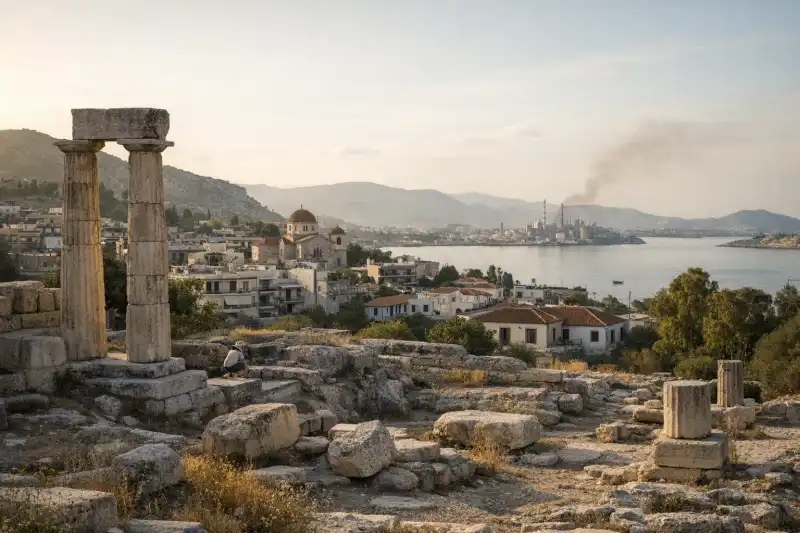
Spend today at Eleusis, west of Athens. The ruins are quieter than the Acropolis, and the site asks for a different kind of attention. Eleusis was the home of the Eleusinian Mysteries, initiation rites connected with Demeter, Persephone, agriculture, death, and hope for a better fate after death. The exact rituals were secret, which is part of why the place still feels hard to pin down.
The important thing is not to arrive expecting a complete temple complex that explains itself. Eleusis is fragmentary, layered, and historically charged. The Telesterion, the great initiation hall, was rebuilt and expanded over time to hold large groups of initiates. Athens did not keep this cult at arm’s length. The procession from Athens to Eleusis along the Sacred Way tied city, countryside, myth, and civic religion into one repeated movement.
Logistics are less dramatic than the history, but they still matter. You can reach Eleusis by taxi, organized tour, or public transport with planning. Do not leave too late, especially in summer. The site has exposed areas, and the historical payoff is better when you are not reading signs while overheated.
When you return to Athens, keep the evening light. If you still have energy, walk a section of the city connected with the ancient roads or revisit the Agora area from outside. The better move may simply be dinner and rest. Eleusis is not visually loud, but it gives you a lot to think about.
Day 3: Sounion and Thorikos
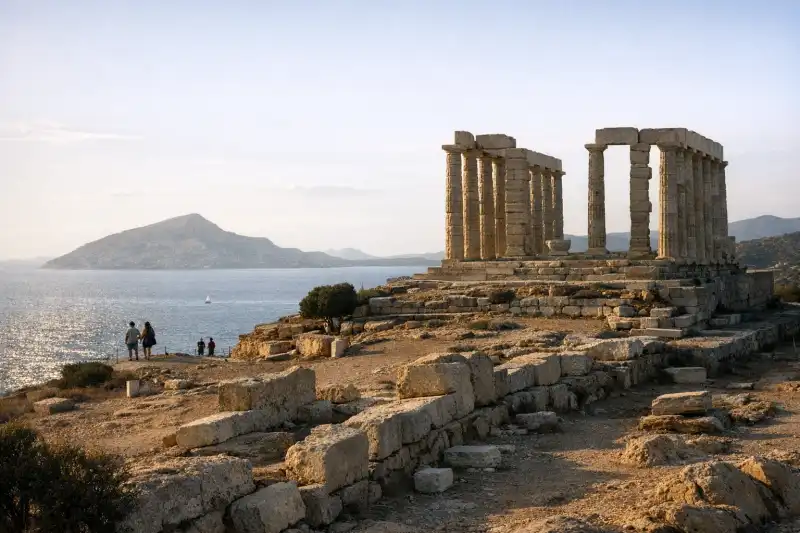
Use your final day for the Attic coast. Start with Ancient Thorikos if you have a driver or rental car, then continue to Sounion and the Temple of Poseidon at Sounion. If you are using a standard tour, check the order and stops carefully. A Cape Sounion and Temple of Poseidon half-day tour usually solves Sounion transport, but it may not include Thorikos.
Thorikos is the site that makes the day more than a pretty coastal finish. It was tied to the Lavrion mining district, where silver helped finance Athenian power, including the fleet that mattered so much in the Persian Wars. The theater at Thorikos is unusually early and irregular in shape, and the site’s mining landscape reminds you that Athens did not run on speeches alone. It ran on labor, ore, ships, tribute, and hard choices.
Continue to Sounion for the Temple of Poseidon. The location is dramatic, but try not to let the view flatten the history into a sunset postcard. A sanctuary at the edge of Attica made sense for a city whose wealth and danger both came by sea. Sailors, merchants, soldiers, and officials moved through a world where Poseidon was not decorative. He was part of how people understood risk.
If you want the classic late light at Sounion, make the day slower and accept a later return to Athens. If you prefer easier logistics, go earlier and skip the sunset crowd. Either way, do not try to add Vravrona, Marathon, and Oropos today. Attica looks compact until traffic and coastal roads start charging interest.
The historical thread: city, sanctuary, and the Attic edge
This route works because it treats Athens as more than a hill with a famous temple. Day 1 shows the city’s public and sacred center: the Acropolis above, the Agora below, and Kerameikos at the edge where roads, burials, and civic movement met.
Day 2 follows one of those outward routes to Eleusis. The Mysteries show a side of Greek religion that was not just public sacrifice and marble temples. It involved secrecy, initiation, myth, agriculture, and the hope that ritual knowledge could change a person’s relationship with death.
Day 3 turns toward the coast and the mining district. Thorikos and Sounion make Athens feel less self-contained. Silver, ships, sea routes, sanctuaries, and border landscapes all mattered. The city’s democracy and monuments did not float above the rest of Attica. They depended on it.
Transportation notes
Central Athens is easiest on foot and by metro. For Day 1, walking is part of the point, but pace yourself. The Acropolis rock, Agora paths, and Kerameikos can add up, especially in heat.
For Eleusis, use a taxi, guided tour, or public transport planned in advance. It is close to Athens, but not a site to approach lazily if you only have three days. Check opening hours before going, because a late start can turn a good half day into an awkward one.
For Sounion and Thorikos, a private driver or rental car gives the best control. If you use a standard Cape Sounion tour, assume it goes to the Temple of Poseidon only unless Thorikos is clearly listed. Self-driving is manageable for confident drivers, but Athens traffic and coastal road timing can be annoying.
Do not overpack Attica. Marathon, Vravrona, Oropos, and other sites are tempting, but they belong to extra days or swaps. The strongest 3-day version keeps the route readable.
Optional add-ons and swaps
If you want another sanctuary day, swap Eleusis for Vravrona, the sanctuary of Artemis near wetlands east of Athens. This is a good choice if you are more interested in Artemis, childhood rites, and a quieter landscape than the Eleusinian Mysteries. Do not try to combine both on a normal 3-day route.
For a battle-focused swap, add the Marathon Tomb instead of Eleusis or Thorikos. It changes the route toward the Persian Wars and Athenian memory of the dead from 490 BCE. It works best with a driver and a willingness to trade sacred landscape for battlefield commemoration.
For a more unusual sanctuary, consider the Amphiareion of Oropos. It was a healing and dream-oracle sanctuary, and it pairs well with travelers interested in ancient medicine, incubation, and local cult practice. It is not a casual add-on from central Athens, so give it its own half day.
If you only have two days, keep Day 1 and choose between Eleusis or Sounion. The Acropolis, Agora, and Kerameikos are the non-negotiable core.
Shorter and longer itinerary options
For a shorter visit, use this as a two-day route: Day 1 for the Acropolis, Agora, and Kerameikos, then Day 2 for either Eleusis or Sounion. Choose Eleusis for religion and ritual, Sounion for coast, sanctuary, and Attic geography.
For a longer Athens stay, add one day for museums and one day for Vravrona, Marathon, or Oropos. That makes the route feel less rushed and gives you more time to connect objects in museum cases with the landscapes around Athens.
For a broader mainland Greece route, extend beyond Attica to Delphi, Ancient Corinth, Mycenae, and Epidaurus. That is a different itinerary, though. Once you cross into the Peloponnese or head to Delphi, the trip stops being a compact Athens and Attica route.
Related ancient sites
FAQ
The most common planning questions for this route are answered below.