Quick route summary
This 5-day Angkor route uses Siem Reap as a single base and builds outward from the core temples to the quieter outer sites. You start with Angkor Wat, then spend a full day inside Angkor Thom at Bayon Temple, the royal terraces, and nearby monuments. The middle of the trip moves through Ta Prohm and Preah Khan, then the final two days reach Banteay Srei and Beng Mealea.
The pace is full, but it leaves room to think. Angkor rewards early starts, long pauses, and the occasional skipped temple. Trying to see every ruin around Siem Reap in five days is how good trips turn into hot, dusty checklists.
Who this itinerary is for
This itinerary is for travelers who want more than the standard Angkor Wat photo stop, but do not want to spend a week changing hotels or chasing every remote temple. It works well for first-time visitors who care about Khmer history, temple planning, sculpture, and the way Angkor’s sacred geography spread across forests, reservoirs, roads, and royal cities.
It is not ideal if you want slow resort days, nightlife-heavy evenings, or a single sunrise visit followed by pool time. It also asks for some stamina. The distances are not enormous, but stone temples in Cambodian heat can wear you down faster than the map suggests.
Route at a glance
- Day 1: Overnight in Siem Reap. Visit Angkor Wat, then keep the afternoon light with Banteay Kdei and Prasat Kravan on the short circuit.
- Day 2: Overnight in Siem Reap. Explore Angkor Thom, Bayon, Baphuon, the Terrace of the Elephants, and the Terrace of the Leper King with short transfers inside the old royal city.
- Day 3: Overnight in Siem Reap. Use a driver for Ta Prohm, Preah Khan, Neak Pean, and Ta Som on the northern circuit.
- Day 4: Overnight in Siem Reap. Drive north to Banteay Srei, then return through Banteay Samré, East Mebon, and Pre Rup.
- Day 5: Overnight in Siem Reap. Visit Beng Mealea by car, then add Bakong, Preah Ko, and Lolei if the day still has room.
Practical logistics before you go
Stay in Siem Reap for the full route. It is the practical base for Angkor passes, airport access, drivers, guides, restaurants, and early starts. A tuk-tuk works well for the core circuit, but a car is better for Banteay Srei and Beng Mealea, especially in hot season or during heavy rain.
Angkor tickets are usually sold as 1-day, 3-day, and 7-day passes. For this plan, a multi-day pass is the sensible choice. Check current rules before you go, because ticket windows, accepted payment, and pass validity can change. Carry your pass with you each day. It may be checked more than once.
Guides make the most sense at Angkor Wat, Angkor Thom, and Banteay Srei, where the bas-reliefs and temple layout carry a lot of the story. A driver alone is enough for many smaller stops if you are comfortable reading before or after each visit. For Day 1, an Angkor Wat sunrise and small circuit tour can be useful if you want one clean first-day setup without negotiating transport in the dark.
Heat is the main planning problem. Start early, rest after lunch when possible, and avoid stacking sunset viewpoints every night. Angkor is not just one monument. It is a huge ritual and political landscape, and it gets better when you are not half-cooked by 2 p.m.
Day 1: Angkor Wat and a measured first circuit
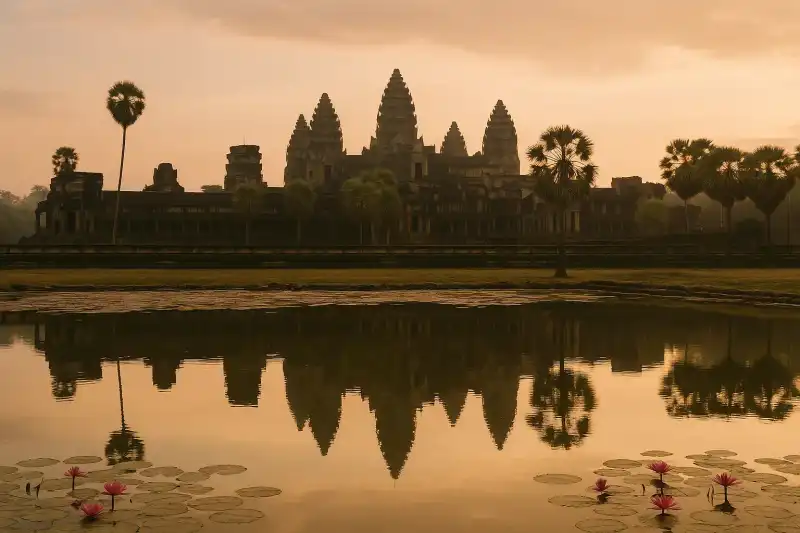
Start with Angkor Wat, either at sunrise or shortly after the sunrise crowd begins to thin. The temple was built in the early 12th century under Suryavarman II and first dedicated to Vishnu, which matters when you begin reading the galleries. Much of Angkor later took on stronger Buddhist layers, but Angkor Wat’s original plan still points toward a Hindu cosmic order built in sandstone.
Give the bas-reliefs real time. The Churning of the Ocean of Milk is not just decoration. It turns myth into architecture, stretching gods, demons, serpents, and cosmic ambition along a gallery wall. The central towers are the famous silhouette, but the lower galleries explain why the place feels so carefully controlled.
Do not overpack the afternoon. After Angkor Wat, add Banteay Kdei for a softer, more worn temple-monastery atmosphere, then Prasat Kravan if you want a compact brick temple with Vishnu reliefs that feel different from Angkor Wat’s grand stone program. This is enough for a first day.
Logistics are simple if you arrange a tuk-tuk or driver through your hotel the night before. If you do sunrise, leave early enough to clear the ticket and entrance process without rushing. Return to Siem Reap for a proper break. The temptation is to keep going because the sites are nearby. Resist it. You have four more temple days.
Day 2: Angkor Thom, Bayon, and the royal terraces
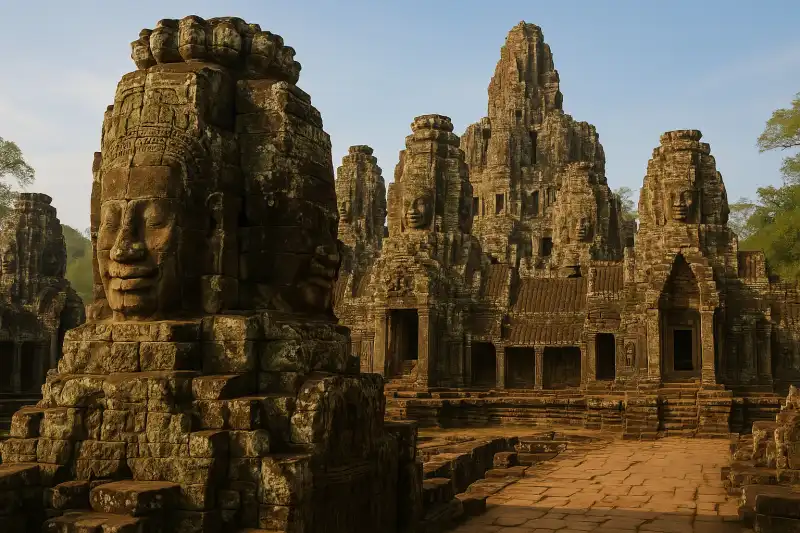
Today belongs to Angkor Thom, the walled royal city of Jayavarman VII. Enter through one of the gates if your route allows it, and notice the causeway figures pulling the naga. The city was not subtle about kingship. It presented power as cosmic order before you even reached the center.
Make Bayon Temple your anchor. The face towers are the obvious draw, but the lower bas-reliefs are just as rewarding. Look for scenes of markets, boats, soldiers, animals, and ordinary movement. They give Angkor Thom a human pulse that balances the royal and divine imagery above.
Continue to Baphuon, an older temple mountain later altered with a reclining Buddha. Its restoration history is almost as interesting as its form. The temple had to be reassembled after decades of disruption, a huge stone puzzle complicated by lost records and political violence.
Finish with the Terrace of the Elephants and the Terrace of the Leper King. These are easy to rush because they look like edges rather than buildings. Slow down. This was royal viewing architecture, a place where ceremonies, armies, and court life would have been staged in front of the palace zone.
Use a tuk-tuk or car today and walk only the sections that make sense. Angkor Thom looks compact on a map, but the heat, exposed causeways, and stone stairways add up. If you have extra energy, add Preah Pithu or the Royal Palace area. If not, stop after the terraces and call that a good decision.
Day 3: Ta Prohm, Preah Khan, and the northern circuit
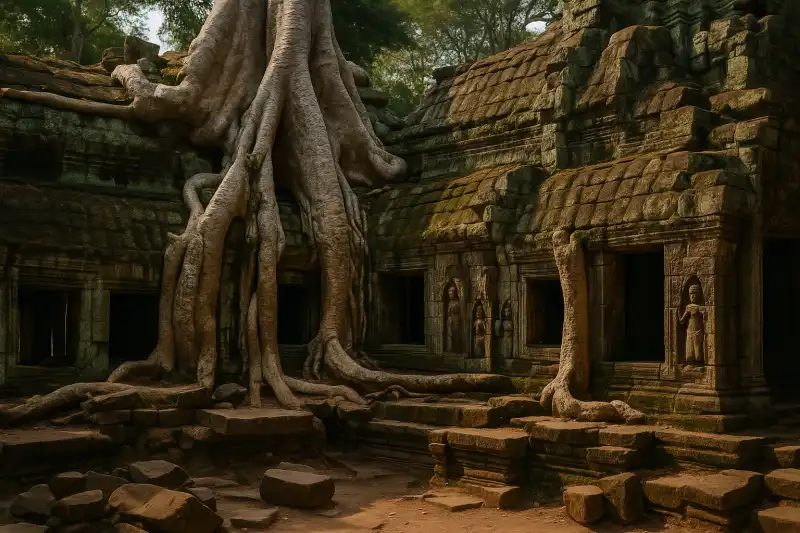
Start early at Ta Prohm. The trees are famous, but the better story is Jayavarman VII’s building program. Ta Prohm was a Buddhist monastery and temple complex tied to the king’s family and to a wider network of religious foundations. The roots make it photogenic. The inscriptions and scale make it political.
From there, continue to Preah Khan, one of the best places in Angkor to feel how temple, city, monastery, and ceremonial space could overlap. Give this site more time than the map suggests. Its long galleries, courtyards, carved lintels, and partly collapsed passages create a slow rhythm that rewards wandering.
Add Neak Pean for a different mood. The small island temple sits within a water setting that points toward healing and sacred balance. It is not a long visit, but it helps explain why water mattered so much at Angkor. Reservoirs, pools, moats, and canals were not background scenery.
End at Ta Som if you still have patience for one more compact temple. Its overgrown gate is lovely, but the site also works as a quieter Jayavarman VII stop after the bigger foundations of the morning.
This is a driver day, not a day to improvise site by site. Bring water, sun protection, and a plan for lunch. If you are tired after Preah Khan, skip one of the smaller stops. The northern circuit should feel spacious, not like an endurance test.
Day 4: Banteay Srei and the eastern temples
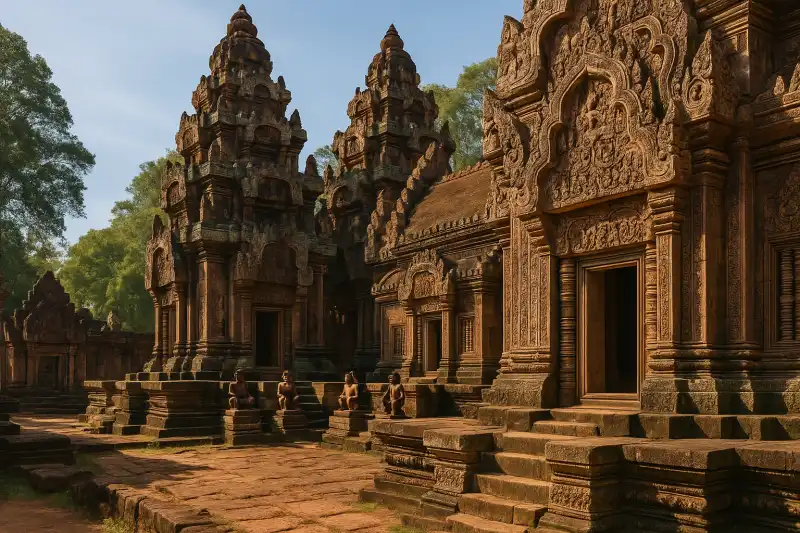
Leave Siem Reap early for Banteay Srei. It sits farther from the core Angkor temples, so a car or reliable driver makes the day much easier. The temple is small, but the carving is dense enough that rushing it feels wasteful. Built in the 10th century and associated with courtiers rather than a king, Banteay Srei is a useful reminder that Khmer art was not only royal monumentality.
The pink sandstone holds detail beautifully. Look closely at lintels, pediments, guardians, and devatas. The scenes are compact and controlled, with a precision that feels very different from Angkor Wat’s long narrative galleries. This is one of the few sites where a guide can change the visit completely, because so much of the value is in reading small carved scenes.
On the return, stop at Banteay Samré. It is calmer than the headline temples and has an elegant Angkorian plan with strong enclosure walls and a central sanctuary. Then continue through East Mebon and Pre Rup if the afternoon is still workable. East Mebon once stood on an island in the East Baray, a reminder that Angkor’s landscape included huge engineered waterworks, not just isolated temples.
A Banteay Srei and outer temples day trip makes sense here if you want transport, timing, and interpretation bundled together. If you go independently, do not combine this day with Beng Mealea unless you are comfortable with a long drive-heavy schedule. It is possible, but not pleasant for most travelers.
Day 5: Beng Mealea and a quieter Angkor finish
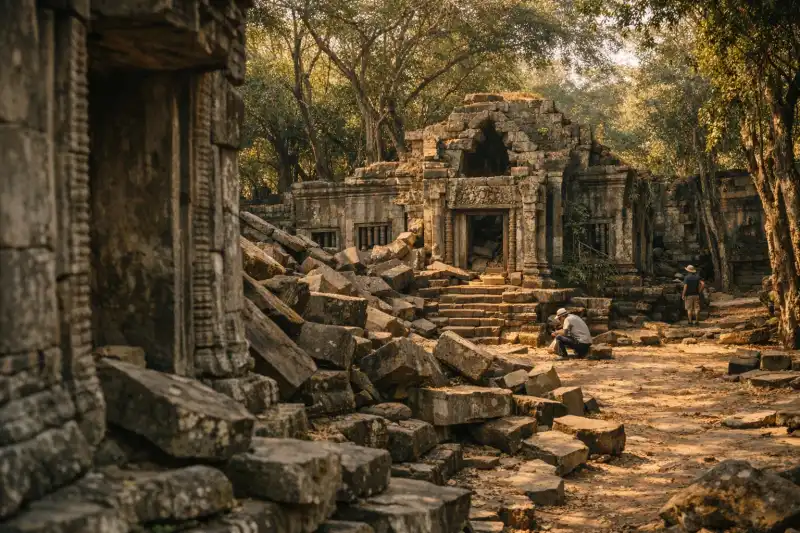
Use your final day for Beng Mealea, a large, atmospheric temple east of the main Angkor area. The drive is part of the commitment, so start early and use a car. Beng Mealea is often described through its collapsed galleries and jungle mood, but it is not just a ruin with trees. Its plan has strong Angkor Wat-era echoes, which makes the broken state of the site even more interesting after Day 1.
Move slowly here. The pleasure is not in ticking off named chambers. It is in seeing causeways, libraries, galleries, and fallen stonework as pieces of a once-ordered sacred plan. The site feels raw, but it was designed with care. That tension is the whole point of the visit.
If you have energy on the way back, add the Roluos group: Bakong, Preah Ko, and Lolei. These earlier temples help pull the story back before Angkor Wat and Jayavarman VII. Bakong, in particular, is useful because it shows the temple mountain idea taking strong form before the later monuments made it enormous.
This is a good day for a Beng Mealea day trip from Siem Reap if you want to avoid arranging a longer private transfer yourself. Keep the evening quiet. Five days of Angkor is rewarding, but by now your brain will probably be full of towers, lintels, moats, and heat.
The historical thread: royal cities, sacred water, and Khmer ambition
This route works because it does not treat Angkor as one temple. It starts with Angkor Wat’s 12th-century statement of royal and cosmic order, then moves into Jayavarman VII’s Buddhist city at Angkor Thom, with Bayon at the center and Ta Prohm and Preah Khan extending the king’s religious and political reach.
The outer days widen the picture. Banteay Srei shows the precision of 10th-century carving outside the main royal core. East Mebon and Neak Pean point to Angkor’s water imagination, where reservoirs, islands, moats, and sacred pools shaped how power looked on the ground. Beng Mealea and the Roluos temples stretch the story in two directions: outward into a more ruinous Angkorian landscape and backward toward earlier Khmer temple mountains.
The stones are quiet now, but the ambition was not. Angkor was a landscape of kings trying to make religion, water, architecture, and authority reinforce each other. Seeing the temples across five days gives that idea room to breathe.
Transportation notes
Use Siem Reap as your base for all five nights. Changing hotels would add friction and save almost no time.
For Days 1 and 2, a tuk-tuk is usually enough if you are comfortable with heat and dust. For Days 3, 4, and 5, consider a car, especially for the northern circuit, Banteay Srei, and Beng Mealea. The longer drives are more comfortable with air conditioning, and arriving less tired changes how much you absorb at the sites.
Self-driving is not the best choice for most visitors. Hiring a tuk-tuk, car, or guide is common, affordable by many travel standards, and simpler than dealing with rural roads, parking, ticket checks, and uncertain timing. Cycling can be rewarding for fit travelers on selected core routes, but do not build this whole 5-day plan around a bicycle unless you already know you handle heat well.
Route compression is the main mistake. Angkor Wat, Angkor Thom, Ta Prohm, Banteay Srei, and Beng Mealea can technically be smashed into fewer days, but the result is a blur. Five days lets you separate the royal city, the tree-wrapped temples, the fine-carving day, and the outer-temple day.
Optional add-ons and swaps
If you want a nature and sacred-landscape day, add the Kulen Mountain temples. Remove the Roluos group from Day 5 or replace Day 3’s smaller northern stops. Kulen works best as its own outing, not as a casual extra after a full Angkor circuit.
For a quieter hilltop temple, add Phnom Bok. Cut East Mebon or Pre Rup from Day 4 if you do this. Phnom Bok takes more effort than the flat temple stops, but the view helps you understand how Angkor sat within a wider plain.
For sunset near Siem Reap, Phnom Krom can replace an evening return to town. Do not add it after a punishing day unless you still have legs for the climb and the transfer.
If you want a much bigger outer-temple push, add Koh Ker or Prasat Thom at Koh Ker. Remove Beng Mealea or turn the trip into a 6 or 7-day route. Koh Ker deserves more than being tacked onto the end of an already full Angkor day.
Shorter and longer itinerary options
For a shorter trip, use the first three days of this route: Angkor Wat, Angkor Thom, Ta Prohm, and one outer-temple day.
For a longer Cambodia route, continue beyond Siem Reap with 7 Days in Ancient Cambodia: Angkor, Koh Ker, Beng Mealea, and Preah Vihear. That version should add more northern Cambodia logistics and make room for longer drives.
For a deeper country-wide plan, use 10 Days in Ancient Cambodia: Angkor to Pre-Angkor Temples. That is the better format for adding Sambor Prei Kuk, Phnom Penh-area sites, and a fuller pre-Angkor story.
Related ancient sites
- Thommanon
- Chau Say Tevoda
- Ta Keo
- Baksei Chamkrong
- Preah Pithu
- Royal Palace of Angkor Thom
- Prasat Suor Prat
- Phnom Bok
- Kulen Mountain temples
- Koh Ker
FAQ
The most common planning questions for this route are answered below.