Quick route summary
This 10-day Cambodia route starts in Siem Reap, spends six nights around Angkor, then moves north to Koh Ker and Preah Vihear before turning south through Kampong Thom and ending in Phnom Penh. The core bases are Siem Reap, Sra’aem, Kampong Thom, and Phnom Penh.
The route is built for travelers who want the Khmer story in layers: Angkor Wat, Angkor Thom, Ta Prohm, Banteay Srei, Koh Ker, Preah Vihear Temple, Sambor Prei Kuk, and Phnom Da. It is not a lazy itinerary. The first half is temple-dense, and the second half has long road transfers. That said, the pace is realistic if you use drivers for the remote days and avoid adding every ruin that appears on the map.
Who this itinerary is for
This itinerary is for travelers who care about ancient Cambodia beyond the famous Angkor sunrise. It suits people who want to understand how Khmer architecture moved from early brick sanctuaries and pre-Angkor forest cities to immense temple mountains, hydraulic landscapes, Buddhist foundations, and remote border sanctuaries.
It is not ideal for travelers who want one relaxed resort base in Siem Reap, short sightseeing days, or a beach add-on without sacrificing temple time. It also does not suit anyone who wants to self-drive everything. Rural Cambodia is rewarding, but navigation, road conditions, heat, checkpoints, and site spacing make a driver the sane choice for several days.
The big warning is simple: do not overpack Angkor. The map makes temples look close together, but sandstone, sun, stairs, causeways, and repeated early starts add up. A 10-day route works best when a few sites get room to breathe.
Route at a glance
- Day 1: Overnight in Siem Reap. Visit Angkor Wat, with an early start and a light afternoon.
- Day 2: Overnight in Siem Reap. Explore Angkor Thom, Bayon, Baphuon, and the royal terraces by tuk-tuk, car, bike, or guided circuit.
- Day 3: Overnight in Siem Reap. Follow the eastern Angkor route through Ta Prohm, Banteay Kdei, Prasat Kravan, Pre Rup, and East Mebon.
- Day 4: Overnight in Siem Reap. Take the grand circuit to Preah Khan, Neak Pean, Ta Som, and quieter northern stops.
- Day 5: Overnight in Siem Reap. Drive out to Banteay Srei, Banteay Samré, and Phnom Bok if the climb makes sense.
- Day 6: Overnight in Siem Reap. Visit the Roluos temples, then add Phnom Krom for a lighter day near Tonle Sap.
- Day 7: Overnight in Sra’aem. Leave Siem Reap for Beng Mealea and Koh Ker, then continue north.
- Day 8: Overnight in Kampong Thom. Visit Preah Vihear on the mountain ridge, then transfer south.
- Day 9: Overnight in Phnom Penh. Spend the morning at Sambor Prei Kuk, with an optional rural stop before the road to Phnom Penh.
- Day 10: Overnight in Phnom Penh. Day trip south toward Phnom Da, Tonle Bati, and Phnom Chisor, then finish in the capital.
Practical logistics before you go
Siem Reap is the best base for Angkor. Stay there for the first six nights rather than changing hotels around the archaeological park. Tuk-tuks work well for the main Angkor circuits, though a car is more comfortable in the hot season or for outer temples. Bicycles are possible for strong riders, but this itinerary is already active. Save your energy for walking the sites.
The Angkor pass covers the main park and many nearby temples, but always check current rules before you go. Some outer sites, including Koh Ker and Preah Vihear, may require separate tickets or local transport arrangements. Preah Vihear also involves a steep final approach, usually handled by local vehicles or motorbikes near the site.
Guided tours make the most sense on Days 1, 2, 5, 7, and 8. Angkor Wat and Angkor Thom benefit from historical context, Banteay Srei rewards close reading, and Koh Ker plus Preah Vihear are easier when transport is handled. If you want one structured day early in the trip, an Angkor Wat, Angkor Thom, and Bayon tour can help you understand the basic vocabulary before wandering more independently.
Heat matters. So does repetition. Plan early starts, shade breaks, and at least one lighter afternoon. Temple fatigue is real, and it usually appears around the moment someone suggests “just one more small temple.” Sometimes that small temple is wonderful. Sometimes it is the point where the day stops being fun.
Day 1: Angkor Wat and the first look at Khmer scale
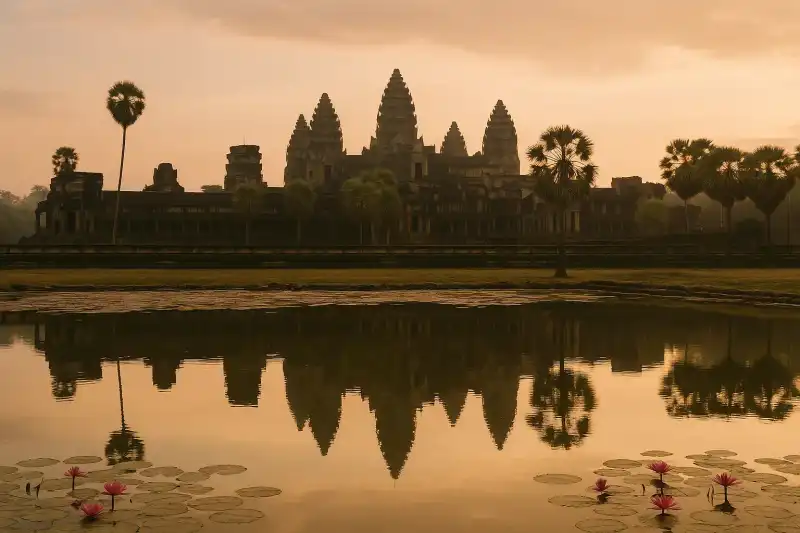
Start with Angkor Wat, but do not make sunrise the only point of the day. The dawn view is beautiful when the weather cooperates, but the temple is more interesting once you slow down and notice how carefully the whole complex is arranged. The long causeway, moat, galleries, towers, and central sanctuary all pull you toward a mountain-shaped idea of sacred power.
Angkor Wat was built in the early 12th century under Suryavarman II and was first dedicated to Vishnu. That matters because much of Angkor later became strongly associated with Buddhist kingship, especially under Jayavarman VII. Here, the bas-reliefs still preserve a world of Hindu epic scenes, celestial figures, royal processions, and cosmic order carved into stone.
Give the outer galleries proper time. The Churning of the Ocean of Milk scene is not just decoration. It turns mythology into a long, disciplined procession of gods, demons, serpents, and divine ambition. This is where the temple starts to feel less like a monument and more like a carved argument about the universe.
Logistics are straightforward but tiring. Go early, return to Siem Reap for lunch or a rest, then decide whether to revisit in softer afternoon light. Do not stack Angkor Thom onto this day unless you are deliberately compressing the route. Angkor Wat can fill a full first day without trying very hard.
Day 2: Angkor Thom, Bayon, and the royal city
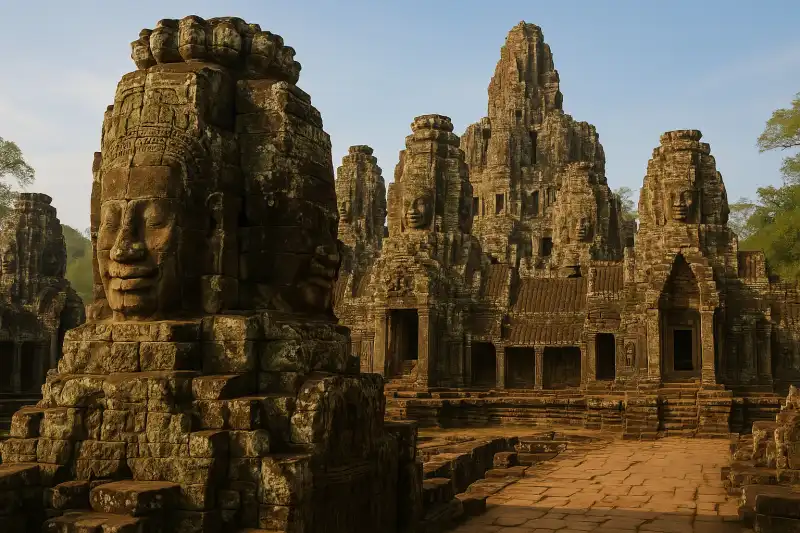
Today is about Angkor Thom, the late 12th-century royal city built by Jayavarman VII after a period of war and political recovery. Entering through one of the gates gives the right first impression. This was not a single temple, but a walled capital with causeways, gates, religious monuments, palace zones, terraces, and water management built into the plan.
At the center, Bayon Temple is stranger than its postcard image. The face towers are famous, but the bas-reliefs are just as useful for understanding the city. They show battles, processions, market scenes, boats, animals, and ordinary life alongside royal and religious imagery. The stones are quiet now, but the political ambition here was not subtle.
Continue to Baphuon, an 11th-century temple mountain later altered with a large reclining Buddha. Its restoration history is unusually dramatic. The monument was dismantled for conservation before Cambodia’s civil war, and the records needed to rebuild it were disrupted. Visiting it after Bayon gives the day a useful contrast: earlier temple-mountain geometry beside Jayavarman VII’s more crowded sacred city.
Finish with the Terrace of the Elephants and the Terrace of the Leper King. These are easy to rush because they sit in the open, but they help you imagine the royal square as a ceremonial space. Use a tuk-tuk or car between stops if it is hot. Walking everything inside Angkor Thom sounds romantic until the sun starts doing math on your shoulders.
Day 3: Ta Prohm, Banteay Kdei, and Angkor’s eastern temples
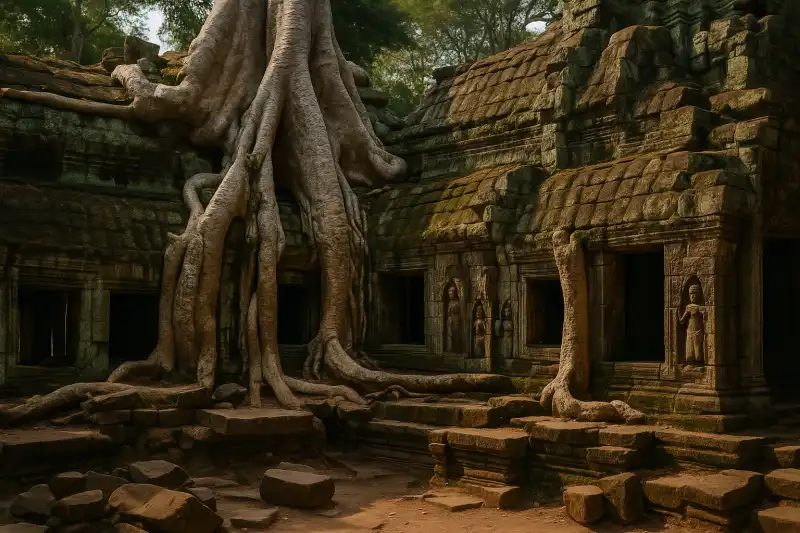
Start early at Ta Prohm. The trees are the headline, but the site is more than roots and atmosphere. Ta Prohm was founded by Jayavarman VII and dedicated to his mother, part of a larger pattern in which the king used Buddhist temple foundations to express family devotion, royal legitimacy, and state power at the same time.
Give yourself enough time to look past the famous root-covered doorways. The temple’s corridors, courtyards, collapsed stones, and inscriptions point to a large religious institution that once had personnel, supplies, ritual obligations, and economic support. The ruin feels wild now, but its original operation was organized.
Continue to Banteay Kdei, a softer, less crowded monastic complex nearby. It is a good place to slow the pace after Ta Prohm. Then add Prasat Kravan, whose brick towers preserve unusual Vishnu reliefs inside. Brick can feel modest after Angkor Wat’s stone mass, but here it carries fine religious imagery in a compact space.
In the afternoon, visit Pre Rup and East Mebon. Both connect nicely to the story of reservoirs and temple mountains around the East Baray. East Mebon once stood on an island in a huge artificial reservoir, which is a useful reminder that Angkor’s power was also hydraulic, agricultural, and administrative. Keep the afternoon flexible. If heat wins, choose one of the two and do it well.
Day 4: Preah Khan, Neak Pean, and the northern circuit
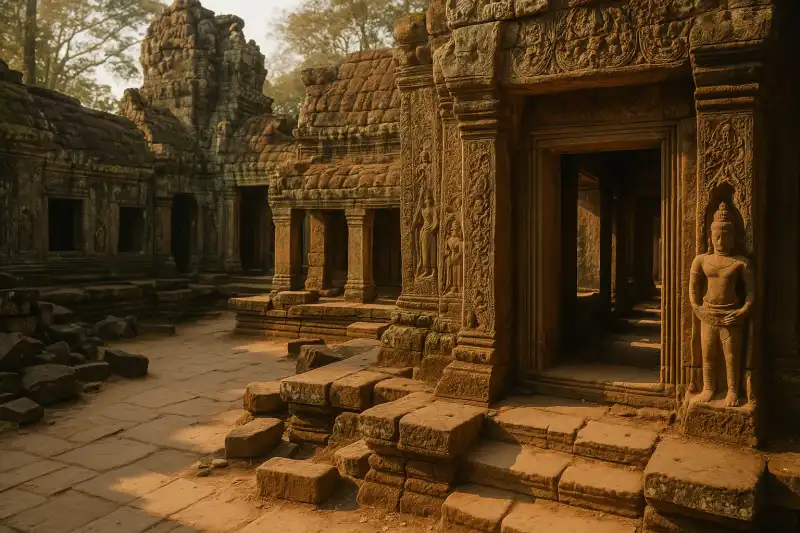
Preah Khan deserves more time than many Angkor itineraries give it. Jayavarman VII founded it in the late 12th century, probably on or near the site of a major victory. It functioned as a temple, monastery, and city-like religious institution. The layout is long, layered, and easy to wander through slowly.
Look for the way doorways, shrines, laterite walls, and tree-framed passages create a rhythm rather than a single grand reveal. Preah Khan is especially good for travelers who like ruins with edges, repairs, interruptions, and traces of reuse. It feels less polished than Angkor Wat, and that is part of its appeal.
Continue to Neak Pean, a small island temple reached by a causeway across water. Its design is tied to ideas of healing pools and sacred geography, with a central shrine surrounded by symbolic ponds. It is compact, but it changes the pace of the day. After several large complexes, the quiet symmetry feels almost medicinal.
Add Ta Som if you still have energy, especially for the overgrown gate, then use Preah Pithu as an optional quieter stop if you want another temple cluster without the same crowd pressure. This is a good day for a driver or tuk-tuk who understands the grand circuit. Do not let the list become a race.
Day 5: Banteay Srei, Banteay Samré, and Phnom Bok
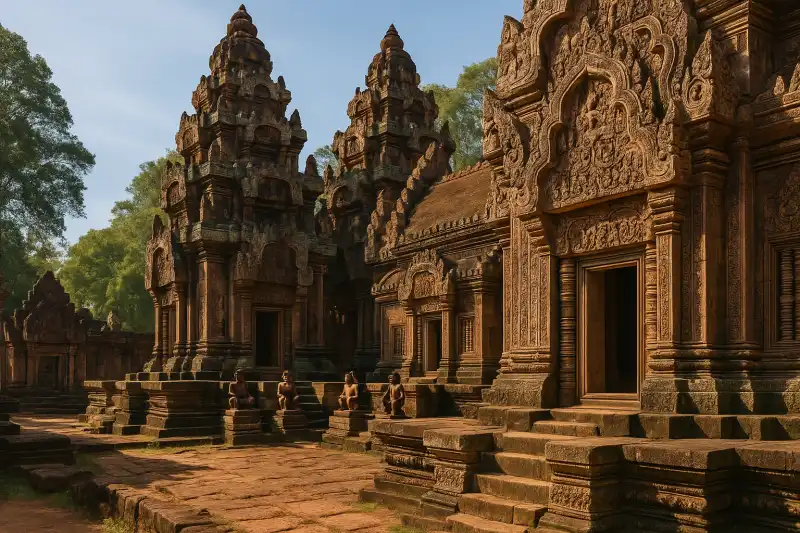
Drive northeast from Siem Reap to Banteay Srei. The temple is small, so some visitors treat it as a quick photo stop. That is a mistake. The carving is the point. Built in the 10th century and associated with the reign of Rajendravarman II, Banteay Srei uses pink sandstone that allowed unusually fine relief work.
This is one of the best places in Cambodia to look closely at lintels, pediments, guardians, and scenes from Hindu mythology. The scale is intimate, but the craftsmanship is sharp. Give the site more time than the map suggests, especially in the morning before tour groups thicken.
Pair it with Banteay Samré, a 12th-century temple with strong Angkor Wat-era architectural echoes. It is usually calmer and helps balance the day: Banteay Srei for detail, Banteay Samré for enclosure, proportions, and the pleasure of moving through a well-preserved Khmer plan.
If the heat is reasonable, add Phnom Bok, a hilltop temple connected to the wider Angkor landscape. The climb is the catch. Do not add it casually at midday. If you prefer a guided outer-temple day, a Banteay Srei and Angkor grand circuit tour can handle transport, but make sure it does not rush the carving.
Day 6: Roluos, Phnom Krom, and early Angkor foundations
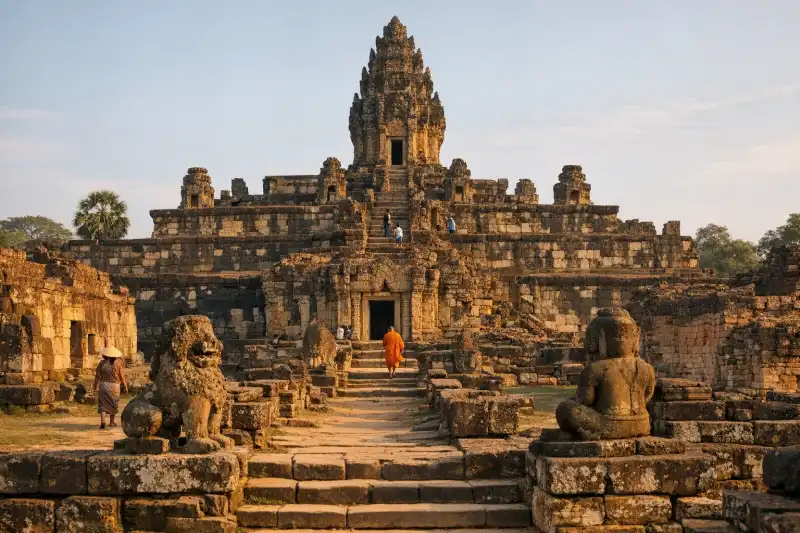
Use Day 6 as a lighter Siem Reap day. Visit the Roluos group, especially Preah Ko, Bakong, and Lolei. These sites connect to Hariharalaya, an early Khmer capital before Angkor’s later monumental expansion. The atmosphere is different from Angkor Wat: smaller, older, more brick and early sandstone, with less visual pressure to be grand at every turn.
Preah Ko, dedicated in the late 9th century under Indravarman I, preserves elegant brick towers and guardian figures tied to royal ancestors. Bakong is the day’s anchor. Its stepped temple-mountain form points forward to later Angkorian architecture, but it still feels experimental in a readable way. You can see the Khmer idea of a state temple taking shape before the huge statements of the 10th to 12th centuries.
Lolei is more fragmentary, but that is useful too. Not every ancient site arrives with clean edges and perfect visitor flow. Sometimes the value is in seeing how temples, later Buddhist use, village life, and restoration needs sit beside each other.
In the late afternoon, consider Phnom Krom near Tonle Sap. The hilltop setting gives a broader sense of the water landscape that helped feed and shape Angkor. Make this optional. After five temple days, a half-rest day is not wasted time. It is how you keep the second half of the itinerary from becoming a punishment.
Day 7: Beng Mealea and Koh Ker
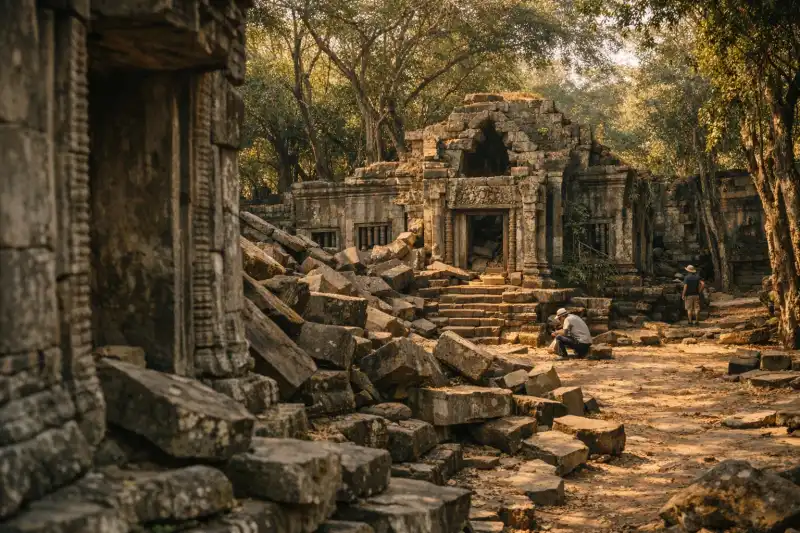
Leave Siem Reap early with a private driver. Start at Beng Mealea, one of the best places to feel how a large Khmer temple can shift from architecture into controlled ruin. Collapsed galleries, raised walkways, broken blocks, and forest growth create a very different visit from the more managed Angkor core.
Beng Mealea is often described through its atmosphere, but its plan matters too. It shares architectural language with Angkor Wat-era building, including galleries, courtyards, and a large enclosure. The experience is rougher, though. Good shoes help, and so does patience. This is not a place to rush between loose stones and shaded corridors.
Continue to Koh Ker, the short-lived 10th-century capital associated with Jayavarman IV. The move from Angkor to Koh Ker was political as well as architectural. For a brief period, power shifted northeast, and the monuments here feel more remote, more experimental, and more tied to a forested landscape.
Prioritize Prasat Thom and Prasat Bram. Prasat Thom’s pyramid form is one of the route’s sharpest visual breaks from Angkor Wat, while Prasat Bram gives you brick towers wrapped by roots without the crowds of Ta Prohm. A Koh Ker and Beng Mealea private trip is useful here because the road day is long and public transport is the wrong tool. Overnight near Sra’aem rather than returning to Siem Reap if you plan to visit Preah Vihear next.
Day 8: Preah Vihear on the mountain edge
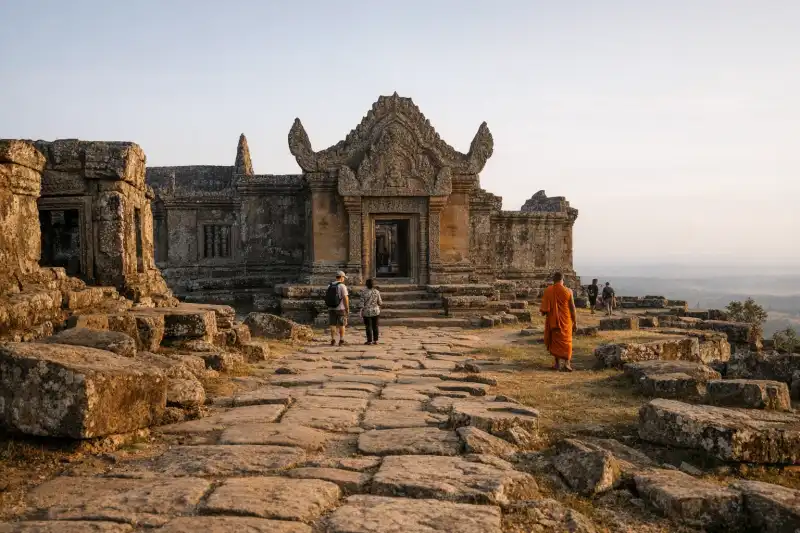
Preah Vihear Temple is the day this itinerary stops feeling like an Angkor extension and becomes a route across Khmer sacred geography. The temple climbs along a north-south axis on the Dangrek Mountains, using processional causeways, stairways, gopuras, and cliff-edge views to make movement part of the religious experience.
The site developed over several centuries, with important phases under Khmer kings including Suryavarman I and Suryavarman II. Unlike Angkor Wat, where the monument gathers around a central mass, Preah Vihear stretches across the ridge. You feel the sequence in your legs. That is part of the point.
Logistics need respect. The final approach usually requires local transport from the base area, and conditions can change. Carry cash, water, sun protection, and patience. Check current access rules before committing, especially because the temple sits near the Thai border and has a modern political history as well as an ancient one.
If time and local advice allow, add Prasat Preah Vihear Chendaeng as a quieter nearby stop. Then make the long transfer south to Kampong Thom. This is not a day for extra sightseeing ambition. Preah Vihear plus the drive is enough.
Day 9: Sambor Prei Kuk and the forest city before Angkor
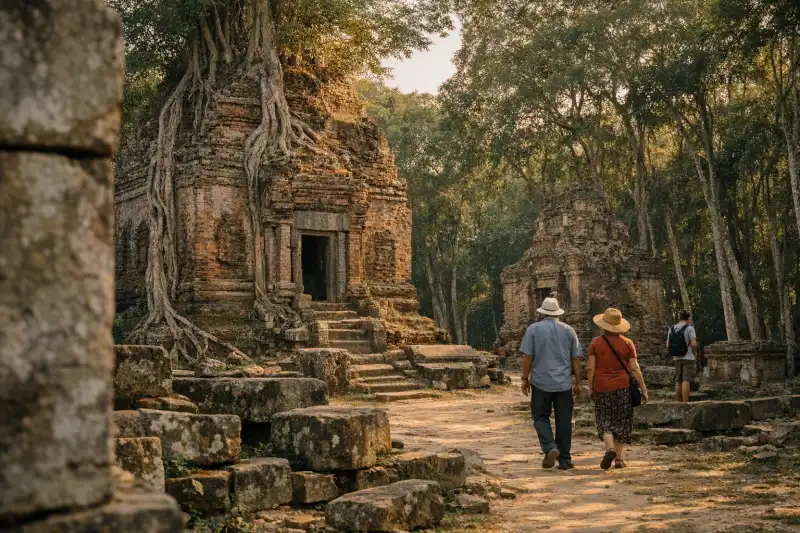
Spend the morning at Sambor Prei Kuk, one of the most important pre-Angkorian sites in Cambodia and a good corrective after a week of Angkorian sandstone. This was associated with Ishanapura, a Chenla-period center that flourished before Angkor became the dominant name in Khmer history.
The temples are mostly brick, set among trees, with octagonal towers, carved lintels, and a quieter forest rhythm. Pay attention to the material change. Brick is not a lesser version of Angkor’s stone. It belongs to an earlier architectural world, with its own experiments in form, sacred space, and decoration.
Sambor Prei Kuk is spread out enough that a local guide or careful driver coordination helps. The forest setting is lovely, but it also means heat, uneven paths, and a slower pace than a compact temple visit. Give it the morning rather than treating it as a roadside stop.
If you want one additional pre-Angkor note and the routing works, add Prasat Andet, a quiet brick temple site in rural Cambodia. Otherwise, drive on toward Phnom Penh and keep the evening simple. This day connects the route backward in time, and it works best when Sambor Prei Kuk remains the focus.
Day 10: Phnom Da and Takeo’s early Khmer landscape
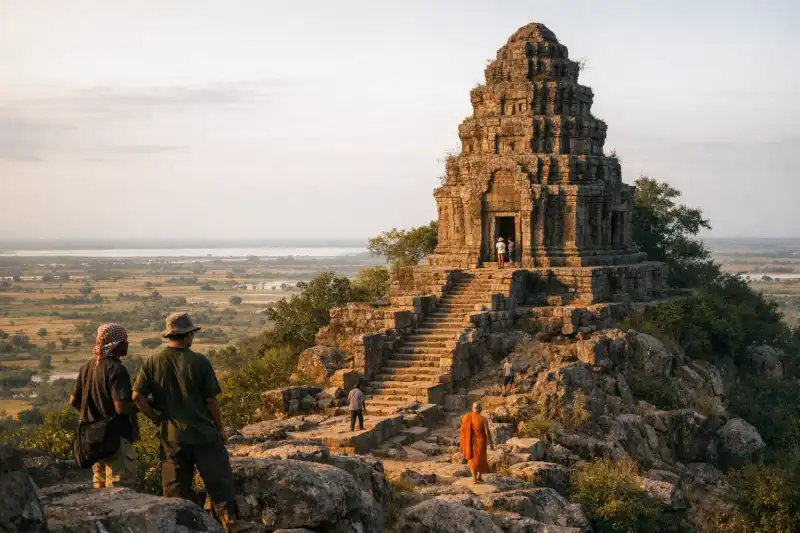
End with a long day trip south from Phnom Penh to Phnom Da. This hilltop temple complex in Takeo Province reaches into the early historic and pre-Angkorian world of southern Cambodia, closer to the Mekong and old trade-linked landscapes than to Angkor’s inland imperial core.
Phnom Da is not as polished a visitor experience as Angkor Wat or Bayon, and that is part of the lesson. The site asks you to think about Cambodia before the Angkor story hardens into a familiar sequence of kings and temple mountains. Southern routes, waterways, early brick sanctuaries, and regional power all matter here.
If the day is running smoothly, pair Phnom Da with Tonle Bati or Phnom Chisor. Tonle Bati gives you an Angkorian temple in a lakeside setting south of Phnom Penh, while Phnom Chisor adds another hilltop sanctuary with a climb and wide rural views. Do not try to force all three if you started late.
Return to Phnom Penh for the night. This is the right place to stop. By now, the route has moved from Angkor’s grandest monuments to earlier and more regional Khmer landscapes. Adding another site just to add it would weaken the shape of the trip.
The historical thread: Khmer power before, during, and beyond Angkor
This route works because it does not treat Cambodia’s ancient sites as one long Angkor highlight reel. Angkor Wat, Angkor Thom, Ta Prohm, Preah Khan, and Banteay Srei show the imperial center at different moments: Hindu kingship, Buddhist foundations, royal cities, temple mountains, reservoirs, and carved mythologies used to organize power.
Koh Ker complicates the story. For a short time in the 10th century, the political center moved away from Angkor, leaving behind a pyramid sanctuary and forest temples that feel ambitious rather than provincial. Preah Vihear complicates it again, stretching Khmer sacred architecture along a mountain ridge where movement, height, and borderland geography become part of the ritual design.
Sambor Prei Kuk and Phnom Da pull the route backward. They remind you that Angkor did not appear from nowhere. Earlier brick sanctuaries, southern networks, Chenla-period centers, and regional cult sites shaped the vocabulary that Angkor later enlarged. The best part of this itinerary is that Angkor becomes more impressive, not less, when you see what came before it and what lay beyond its central plain.
Transportation notes
Use Siem Reap as your base for Days 1 through 6. Tuk-tuks are practical for Angkor Wat, Angkor Thom, Ta Prohm, Preah Khan, and the Roluos group. Hire a car if you want air conditioning, if you are traveling in the hot season, or if you plan to combine outer temples.
For Day 7, hire a private driver. Beng Mealea and Koh Ker are too spread out for casual public transport. For Day 8, keep the driver and coordinate the Preah Vihear approach locally. Expect a long transfer after the site, and do not schedule a second major attraction that day.
For Day 9, Kampong Thom is the sensible base for Sambor Prei Kuk. You can visit from Siem Reap or Phnom Penh, but both make the day less graceful. For Day 10, Phnom Penh is the right base for Takeo Province.
Do not self-drive this full route unless you already know rural Cambodian roads and are comfortable with changing conditions. The cost of a driver is not just convenience. It buys you fewer wrong turns, better timing, local site knowledge, and enough energy to care about the temples when you arrive.
Optional add-ons and swaps
If you want a sacred landscape day from Siem Reap, add the Kulen Mountain temples. Remove Day 6’s Roluos and Phnom Krom combination, or add an extra night in Siem Reap. Kulen works best when you are not trying to squeeze it between two heavy Angkor days.
For a more remote northwest Khmer site, add Banteay Chhmar. This is a serious swap, not a casual detour. Remove the Takeo day or add one to two days, depending on your transport plan. Banteay Chhmar rewards travelers who like large, quieter temple complexes and do not need everything polished.
If you are traveling between Phnom Penh and eastern Cambodia, consider Wat Nokor near Kampong Cham. Remove Phnom Da if you want this route to lean east rather than south. Wat Nokor is interesting because an Angkorian sanctuary and a living Buddhist monastery occupy the same complex.
If you are continuing toward Battambang, add Wat Ek Phnom. Do not tack it onto this exact 10-day route unless you are extending west after Phnom Penh or reshaping the trip around Battambang. It is better as part of a northwest Cambodia extension than as a rushed final-day add-on.
Shorter and longer itinerary options
For a compact first visit, adapt the 5 Days in Angkor: Core Temples and Outer Temples route down to the essentials. Focus on Angkor Wat, Angkor Thom, Ta Prohm, and one outer-temple day if you can manage it.
For a fuller Siem Reap route without the long northern and southern transfers, use 5 Days in Angkor: Core Temples and Outer Temples. That version should keep the temple quality high while reducing road fatigue.
For a strong middle option, 7 Days in Ancient Cambodia: Angkor, Koh Ker, Beng Mealea, and Preah Vihear keeps the Angkor and northern Cambodia arc but skips the pre-Angkor finish through Kampong Thom and Takeo.
To make this 10-day plan gentler, add one extra night in Siem Reap after Day 4 or one extra night in Kampong Thom before Phnom Penh. The route improves more from rest than from another temple.
Related ancient sites
- Phnom Bok
- Phnom Krom
- Prasat Preah Stung
- Prasat Damrei
- Prasat Neang Khmau
- Prasat Preah Khan (Kampong Svay)
- Preah Khan Kompong Svay
- Prasat Suor Prat
- Ta Keo
- Thommanon
- Chau Say Tevoda
- Prasat Pram
- Prasat Bram (Koh Ker)
FAQ
The most common planning questions for this route are answered below.