Quick route summary
This 7-day route starts and ends in Siem Reap, using the city as the main base for Angkor and one northern overnight near Sra’aem for Preah Vihear Temple. The route begins with Angkor Wat, Angkor Thom, Bayon Temple, and Ta Prohm, then moves outward to Banteay Srei, Beng Mealea, Koh Ker, and Preah Vihear.
The pace is full, but it has a sensible arc. You give Angkor’s core temples several days before driving to the more remote northern sites. Do not try to add Phnom Penh, Sambor Prei Kuk, Battambang, and beach time to the same week. Cambodia’s temple geography rewards patience more than ambition.
Who this itinerary is for
This itinerary is for travelers who want ancient Cambodia beyond a quick Angkor Wat sunrise. It works well if you can handle early starts, heat, long temple days, and at least one road-heavy transfer toward the Thai border.
It is not ideal if you want a relaxed resort trip, a no-driving itinerary, or a route built entirely around Siem Reap nightlife and short outings. Those can be good trips, but this one is about Khmer royal cities, temple mountains, Buddhist foundations, remote capitals, and the practical reality of getting between them.
Route at a glance
- Day 1: Overnight in Siem Reap. Visit Angkor Wat early, with time for the bas-reliefs, central sanctuary, and a slower afternoon.
- Day 2: Overnight in Siem Reap. Focus on Angkor Thom, including Bayon, Baphuon, the royal terraces, and the palace area.
- Day 3: Overnight in Siem Reap. Visit Ta Prohm, then add Banteay Kdei, Ta Keo, or Thommanon depending on heat and energy.
- Day 4: Overnight in Siem Reap. Use the grand circuit for Preah Khan, Neak Pean, East Mebon, and Pre Rup.
- Day 5: Overnight in Siem Reap. Hire a car and driver for Banteay Srei and Beng Mealea.
- Day 6: Overnight in Sra’aem. Drive north to Koh Ker, including Prasat Thom and root-wrapped brick temples, then continue toward Preah Vihear.
- Day 7: Overnight in Siem Reap. Visit Preah Vihear, then return to Siem Reap with enough road buffer.
Practical logistics before you go
Use Siem Reap for the first five nights and the final night. Add one northern overnight near Sra’aem if Preah Vihear matters to you. You can do Koh Ker and Preah Vihear as a brutal long day from Siem Reap, but it turns two excellent sites into a road endurance test.
Buy the Angkor pass that matches your temple days and confirm current ticket rules before arrival. The first four days are inside or near the Angkor Archaeological Park, while Beng Mealea, Koh Ker, and Preah Vihear may involve separate ticketing or local arrangements depending on current rules.
Transport changes by distance. Tuk-tuks are fine for Angkor Wat, Angkor Thom, and nearby circuits if you can handle heat and dust. A car is better for the grand circuit in hot months and strongly preferred for Banteay Srei, Beng Mealea, Koh Ker, and Preah Vihear.
Guides are most useful at Angkor Wat, Angkor Thom, Preah Khan, and Preah Vihear. For remote temple days, a good driver who understands pacing can be as valuable as a guide. The biggest practical mistake is overpacking days until every temple becomes sandstone blur.
Day 1: Angkor Wat and the central sanctuary
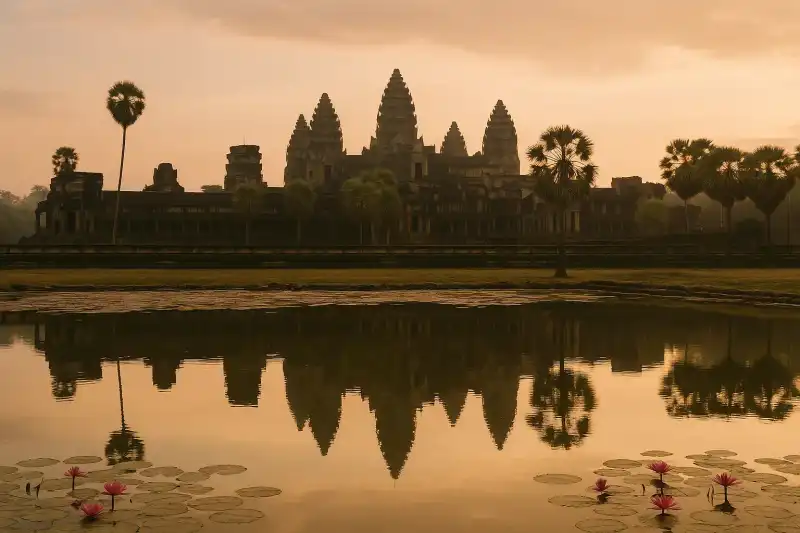
Start with Angkor Wat early. Sunrise is popular, but the better visit begins after the first photo rush. Stay for the galleries, the causeway, the moat, the central towers, and the long bas-relief narratives. The temple needs time to stop being only an outline against the sky.
Built in the 12th century under Suryavarman II and originally dedicated to Vishnu, Angkor Wat turns movement into a staged approach. The long western causeway, layered enclosures, central towers, and raised sanctuary all make the visitor climb inward and upward. The design is doing political and religious work at the same time.
A guided Angkor Wat sunrise tour from Siem Reap can be useful if you want timing, transport, and relief interpretation handled together. The guide matters most after sunrise, when the carvings and temple plan start asking for explanation.
Keep the afternoon light. You can add a small nearby temple, but this itinerary works better if Day 1 is not stuffed. Angkor Wat is a major site, and tomorrow’s Angkor Thom day is physically demanding.
Day 2: Angkor Thom, Bayon, and the royal city
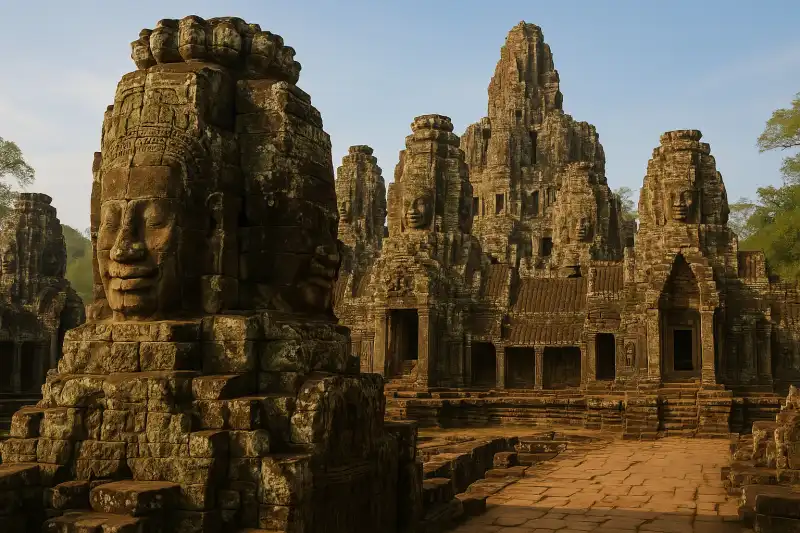
Spend the day inside Angkor Thom, the walled city associated with Jayavarman VII. Enter through one of the gates if possible, because the approach helps the city make sense. Angkor Thom was not a temple cluster. It was a capital, with gates, walls, roads, state temples, terraces, and royal space arranged to feel cosmic and political at once.
Begin at Bayon Temple. The face towers are famous, but the bas-reliefs deserve just as much time. They show battles, boats, processions, markets, animals, and ordinary people, which gives Bayon a livelier texture than many visitors expect from a royal monument.
A guided Angkor Thom and Bayon tour is worth considering because the city is easy to underread. Without context, it becomes faces, terraces, steps, and heat. With context, it becomes a royal city rebuilt around Buddhist kingship after a turbulent period.
Continue to Baphuon, then walk the Terrace of the Elephants, Terrace of the Leper King, and Royal Palace of Angkor Thom. Much of the palace was built in wood and other perishable materials, so the surviving stone is only part of the old city. That missing architecture is worth remembering.
Return to Siem Reap before the day turns into exhaustion. Angkor Thom rewards slow movement, but it is not gentle on tired legs.
Day 3: Ta Prohm, Banteay Kdei, and the eastern circuit
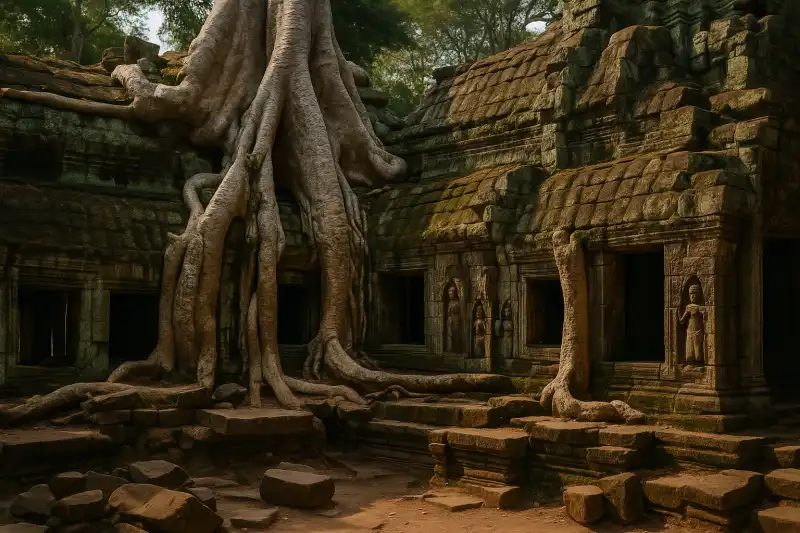
Start at Ta Prohm before the heaviest crowds. The tree roots and collapsed galleries are dramatic, but Ta Prohm was not built as a ruin-in-the-jungle mood piece. It was a major Buddhist monastery-temple founded under Jayavarman VII, tied to land, people, ritual, and administration.
Look beyond the most photographed roots. Doorways, blocked passages, devata carvings, courtyards, and long corridors show how complex the site was before modern conservation made collapse part of the visitor experience. Ta Prohm is a good place to think about restoration as a choice, not just a neutral process.
Continue to Banteay Kdei if you want a quieter Buddhist monastic atmosphere. Its worn galleries and courtyards are easier to enjoy after Ta Prohm because they keep the theme but reduce the crowd pressure.
If you still have energy, add Ta Keo or Thommanon. Ta Keo is a stark temple mountain, physically demanding and unfinished in feel. Thommanon is smaller and more refined. Choose based on your energy, not completion instinct.
Day 4: Preah Khan, Neak Pean, and the grand circuit
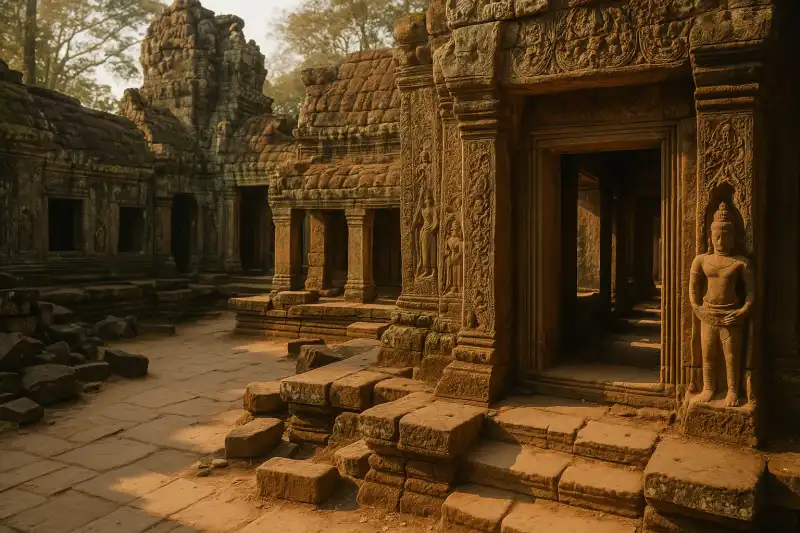
Use Day 4 for the grand circuit by tuk-tuk or car, starting with Preah Khan. Give it more time than the map suggests. Preah Khan was another major Jayavarman VII foundation, part temple, part monastery, part city-like complex, with long corridors, shrines, courtyards, and tree-held walls.
Preah Khan is less instantly legible than Angkor Wat, which is exactly why it rewards patience. It feels like a place where sacred, administrative, and educational functions overlapped. The site also shows how Angkor’s monuments can feel both planned and maze-like.
Continue to Neak Pean, the island temple associated with water and healing symbolism. It is a very different experience: smaller, quieter, and built around pools rather than temple-mountain height. That contrast helps keep the day from becoming another sequence of corridors.
Add East Mebon and Pre Rup if heat and time allow. East Mebon once stood on an island in the East Baray reservoir, which is a useful reminder that Angkor’s power was tied to water landscapes as well as stone temples. Pre Rup gives you a temple-mountain finish, but do not force sunset if the day has already run long.
Day 5: Banteay Srei and Beng Mealea
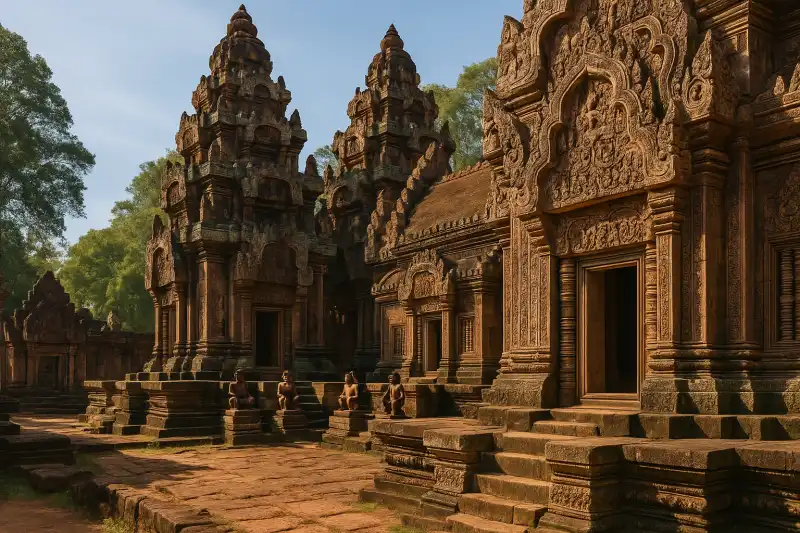
Hire a car and driver for this day. Banteay Srei and Beng Mealea sit outside the core Angkor circuit, and the trip is much easier when transport is not improvised. A Banteay Srei and Beng Mealea private tour from Siem Reap makes sense if it gives you enough time at both sites.
Start with Banteay Srei. The temple is compact, but its pink sandstone carvings are extraordinarily fine. This is not a site where size does the talking. The pleasure is in lintels, pediments, figures, and surfaces carved with a level of control that rewards slow looking.
Continue to Beng Mealea, a much larger and more collapsed temple complex. Beng Mealea gives a rougher sense of Angkor-era architecture under pressure from vegetation, fallen stone, and time. It can feel adventurous, but it still needs respect. Stay on permitted routes and do not treat loose stone as playground equipment.
This is a long day, so avoid adding more stops unless your driver has a sensible plan and you still have real energy. Return to Siem Reap for the night and pack for tomorrow’s northern route.
Day 6: Koh Ker and the northern Khmer capital
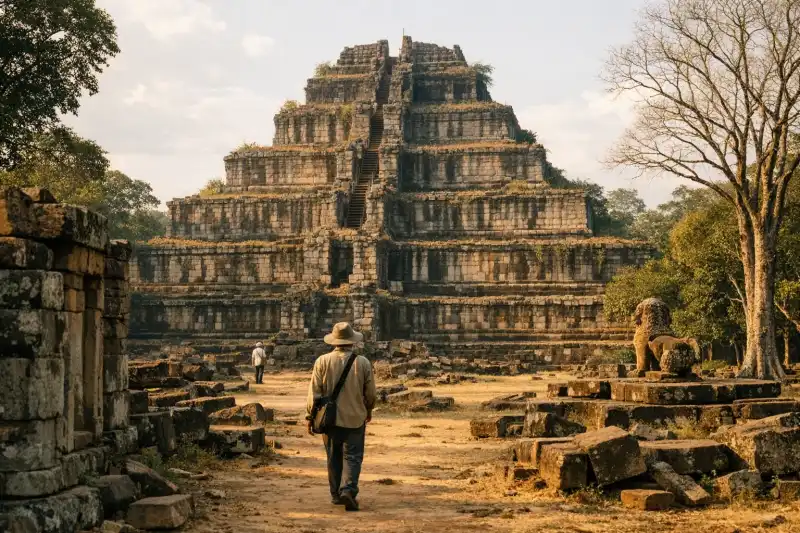
Leave Siem Reap early for Koh Ker. This was a 10th-century Khmer capital under Jayavarman IV, and it feels different from Angkor because it was a short-lived political center with its own geography, scale, and temple spread. The road time is part of the commitment, so do not start late.
Focus on Prasat Thom at Koh Ker, the stepped pyramid sanctuary that gives the site its strongest visual identity. It is a reminder that Khmer kingship did not always speak through the same architectural forms seen at Angkor Wat or Bayon.
Add Prasat Bram or Prasat Pram if access and timing work. The brick towers wrapped in roots are atmospheric, but they also show how quickly smaller monuments can be swallowed when maintenance stops and forest pressure returns.
After Koh Ker, continue toward Sra’aem or another practical base near Preah Vihear. This overnight is the route’s pressure release valve. It keeps Day 7 from becoming an unreasonable drive from Siem Reap to the border region and back.
Day 7: Preah Vihear and return to Siem Reap
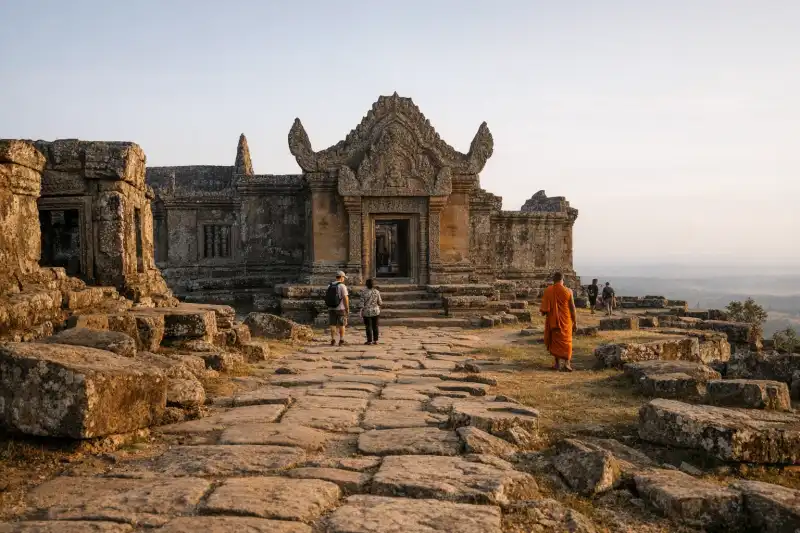
Start early for Preah Vihear Temple. The final ascent usually requires local transport arrangements, so confirm logistics the night before. This is not the day to improvise with vague timing.
Preah Vihear is a Khmer mountaintop sanctuary arranged along a long north-south axis, with gopuras, causeways, stairs, and terraces leading toward the cliff edge. Its setting changes the whole mood. Angkor’s monuments often manage water, roads, and city space. Preah Vihear uses height, approach, and the edge of the plateau.
If timing and access allow, include Prasat Preah Vihear Chendaeng or another nearby stop only if it does not compromise the main visit. Preah Vihear deserves the clear part of your morning.
Return to Siem Reap with a generous road buffer. Do not book a tight evening flight. The final day has too many moving parts: mountain access, temple time, lunch, road conditions, and the long drive back.
The historical thread: from Angkor’s royal center to the northern temple roads
This route works because it moves outward in historical and logistical rings. Angkor Wat and Angkor Thom show royal architecture at the center of Khmer power. Ta Prohm and Preah Khan show Jayavarman VII’s Buddhist foundations, with temple-monasteries that functioned as more than devotional monuments. Banteay Srei and Beng Mealea stretch the map beyond the core circuit. Koh Ker shows a different royal capital. Preah Vihear ends the route with a sanctuary built around ascent, cliff, and long-distance authority.
The thread is movement. Khmer power was not confined to one city or one temple type. It moved through roads, reservoirs, capitals, monasteries, quarries, sacred mountains, and frontier sanctuaries. The stones are quiet now, but the ambition behind the route was not modest.
Transportation notes
Use Siem Reap as the main base and hire transport by day. Tuk-tuks work well for the Angkor core if you are comfortable with heat and dust. Cars are better for the grand circuit, Banteay Srei, Beng Mealea, Koh Ker, and Preah Vihear.
For the northern section, strongly consider sleeping near Sra’aem after Koh Ker. Returning to Siem Reap after Koh Ker and then driving back north for Preah Vihear wastes time and energy. A single northern overnight makes the route feel planned rather than punished.
Do not rely on public transport for this itinerary. Cambodia’s main towns are connected, but this temple route is site-to-site travel. Drivers, guides, and local arrangements matter.
Road conditions, ticket rules, and access procedures can change, especially for remote sites. Confirm the latest details in Siem Reap before leaving the core Angkor area. The more remote the temple, the less you want surprises at the gate.
Optional add-ons and swaps
If you want earlier Khmer history near Siem Reap, add the Roluos group with Bakong, Preah Ko, and Lolei. Remove the Day 4 grand circuit or extend the trip by one day.
If sacred landscape matters more than remote ruins, add the Kulen Mountain temples instead of Beng Mealea. This changes Day 5 into a mountain and river-carving day, so do not try to keep every stop.
If you want a remote Khmer temple without going to Preah Vihear, consider Banteay Chhmar as a separate extension from Siem Reap. Remove Preah Vihear and Koh Ker only if you are prepared for different road logistics.
If you want pre-Angkor context, save Sambor Prei Kuk for a longer Cambodia route. It sits better on a route toward Kampong Thom or Phnom Penh than as a rushed add-on to this Angkor and northern temples itinerary.
Shorter and longer itinerary options
For a shorter route, adapt the 5 Days in Angkor: Core Temples and Outer Temples itinerary by keeping Siem Reap as the single base and focusing on Angkor Wat, Angkor Thom, Bayon, and Ta Prohm.
For a 5-day version, keep Days 1 through 5 and skip Koh Ker and Preah Vihear. That gives you Angkor’s core, the grand circuit, Banteay Srei, and Beng Mealea without the northern overnight.
For a longer route, build toward a 10-day ancient Cambodia itinerary with Roluos, Kulen, Sambor Prei Kuk, and possibly Phnom Chisor or Tonle Bati. The extra days should add context, not just more ruins in a blur.
Related ancient sites
- Angkor Wat
- Angkor Thom
- Bayon Temple
- Baphuon
- Terrace of the Elephants
- Terrace of the Leper King
- Ta Prohm
- Preah Khan
- Neak Pean
- Banteay Srei
- Beng Mealea
- Koh Ker
- Prasat Thom at Koh Ker
- Prasat Bram at Koh Ker
- Preah Vihear Temple
FAQ
The most common planning questions for this route are answered below.