Quick route summary
This 5-day route starts in Bangkok, uses Ayutthaya as the first ancient capital base, then continues north to Sukhothai for Thailand’s earlier royal and Buddhist landscapes. The core sites are Wat Mahathat Ayutthaya, Wat Phra Si Sanphet, Wat Chaiwatthanaram, Sukhothai Historical Park, Wat Mahathat Sukhothai, Wat Si Chum, and Si Satchanalai.
The route style is a practical overland temple itinerary with three bases: Bangkok at the start, Ayutthaya for two nights, and Sukhothai for the final three nights. The pace is active, but not punishing. The main thing to protect is Day 3, because the Ayutthaya to Sukhothai transfer takes real time and should not be treated like a sightseeing day with a bus ride attached.
Who this itinerary is for
This itinerary is for travelers who want ancient Thailand beyond a quick Bangkok side trip. It works well if you like ruined capitals, Buddhist sculpture, quiet temple compounds, and the way political power shows up in city plans, moats, prangs, chedis, and processional spaces.
It is not ideal if you want one easy hotel base for the whole trip. It is also not the best plan if your Thailand trip is mainly beaches, food markets, and slow city wandering. Those are worth their own time. This route is built for people who are willing to move north and give Sukhothai more than a rushed stop.
Route at a glance
- Day 1: Overnight in Ayutthaya. Travel from Bangkok to Ayutthaya, then visit the central historical park around Wat Mahathat and Wat Phra Ram.
- Day 2: Overnight in Ayutthaya. Focus on the royal temple area and the riverside ruins, with Wat Phra Si Sanphet and Wat Chaiwatthanaram as the anchors.
- Day 3: Overnight in Sukhothai. Transfer from Ayutthaya to Sukhothai and keep sightseeing light on arrival.
- Day 4: Overnight in Sukhothai. Spend the day in Sukhothai Historical Park, especially Wat Mahathat and Wat Si Chum.
- Day 5: Overnight in Sukhothai. Make a day trip to Si Satchanalai, including Wat Chedi Chet Thaeo and Wat Chang Lom.
Practical logistics before you go
The best bases are Ayutthaya for the first ruins and Old Sukhothai or nearby New Sukhothai for the second half. Old Sukhothai is usually better for temple access, especially if you want to bicycle or start early. New Sukhothai has more local town infrastructure, but you will spend more time transferring to the park.
From Bangkok to Ayutthaya, trains, vans, taxis, and private transfers all work. The train has charm and avoids some road traffic, but taxis and transfers are simpler with luggage. From Ayutthaya to Sukhothai, the route gets less tidy. You may need a train or bus connection through Phitsanulok, a long bus, or a private car. Do not plan major ruins on both ends of that transfer.
Guided tours make the most sense in Ayutthaya if you are short on time or want help connecting the Buddhist, royal, and trade history. A Bangkok to Ayutthaya temple tour can solve the transport problem for a day trip, but this itinerary is better with an overnight stay. In Sukhothai, a guide is less necessary for basic movement, but helpful if you want to understand the art and inscriptions rather than simply cycle between pretty ruins.
Heat and sun matter. The parks look gentle on maps, but exposed temple grounds can drain you quickly. Start early, build in a midday rest, and avoid stacking every famous ruin into one afternoon. Thailand rewards people who leave space between temples.
Day 1: Bangkok to Ayutthaya and the central ruins
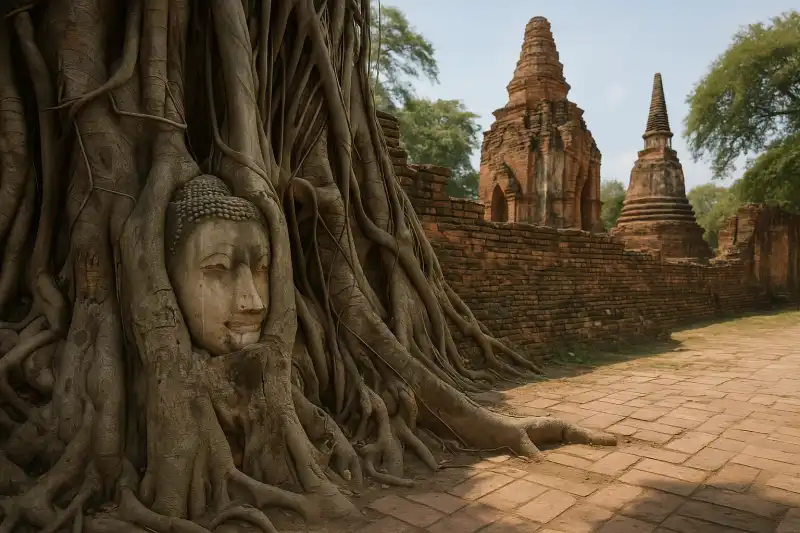
Leave Bangkok in the morning and travel to Ayutthaya. The trip can be easy, but your choice of transport changes the feel of the day. The train is slower and more atmospheric. A taxi or private transfer is smoother with bags. Vans can be efficient, but less pleasant if you are carrying much luggage.
After checking in, keep the temple loop compact. Start with Wat Mahathat Ayutthaya, one of the old city’s most visited ruins because of the Buddha head held in tree roots. Give the famous image a respectful minute, then look beyond it. Wat Mahathat was tied to royal and religious authority, and its broken prang and surrounding Buddha images show how much of Ayutthaya’s sacred architecture was vertical, urban, and politically charged.
Add Wat Phra Ram if the heat and timing are on your side. Its Khmer-style prang is a useful reminder that Ayutthaya did not appear in isolation. The kingdom absorbed, adapted, and argued with older regional forms, including Khmer temple architecture and Buddhist court ritual.
This is not the day to race across the entire island. Ayutthaya’s ruins are spread through a modern city, and road crossings, heat, and temple fatigue all slow you down. Use a tuk-tuk, bicycle, or hired driver depending on your comfort level. End with dinner near your hotel and save the heavier royal sites for tomorrow.
Day 2: Ayutthaya royal temples and riverside ruins
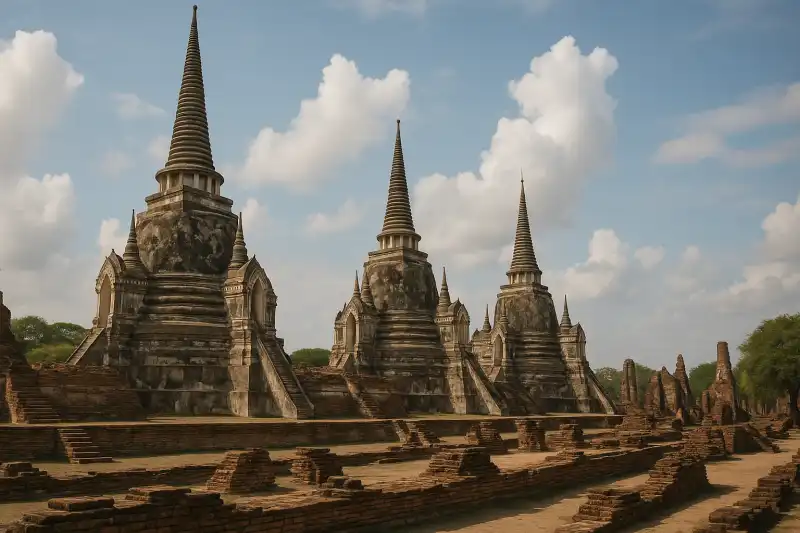
Start with Wat Phra Si Sanphet, the former royal temple of Ayutthaya. Unlike many working temples, this was a court temple associated with the palace, not a monastery for resident monks. The three restored chedis are graceful now, but the message was not subtle: kingship, relics, ceremony, and dynastic memory all concentrated inside the royal zone.
Stay nearby long enough to understand the old palace area before moving on. Ayutthaya was capital of a wealthy kingdom from the 14th to the 18th century, and its position among rivers helped it become a trading city linked to China, Japan, Persia, Europe, and the wider maritime world. The ruins feel inland today, but historically this was a plugged-in capital, not a quiet backwater.
In the afternoon, go to Wat Chaiwatthanaram, west of the island along the Chao Phraya River. Its Khmer-inspired central prang and surrounding towers create one of Ayutthaya’s strongest silhouettes. It was built in the 17th century under King Prasat Thong, and the layout carries ideas of Buddhist cosmology as well as royal display.
Logistically, this is the day when a tuk-tuk, driver, or boat-linked route can help. Bicycles are pleasant for some central ruins, but the riverside sites add distance and traffic exposure. If you want sunset at Wat Chaiwatthanaram, do it, but do not plan a long transfer afterward. Spend a second night in Ayutthaya and let the day breathe.
Day 3: Ayutthaya to Sukhothai transfer
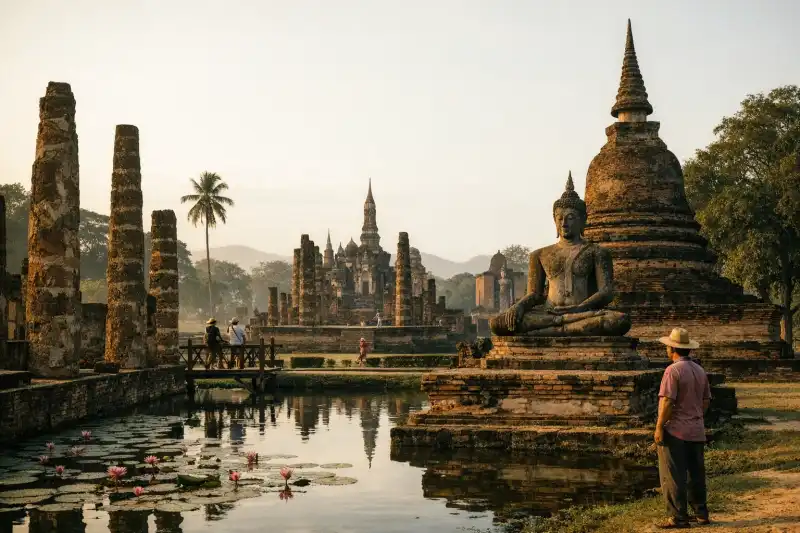
Today is mostly about moving from the Ayutthaya world to the Sukhothai world. That shift matters historically. Ayutthaya is the later, river-trading capital with dense urban ruins. Sukhothai points you toward an earlier center associated with 13th and 14th-century Thai kingship, Buddhist imagery, inscriptions, and a calmer landscape of moats, ponds, and brick temples.
Do not make this day too clever. Depending on your route, you may travel by train and bus via Phitsanulok, by long-distance bus, or by private car. A private transfer is the simplest and most expensive option. Public transport is possible, but it can consume the day and leave you with awkward arrival timing.
If you arrive with daylight left, use it gently. Check into Old Sukhothai if temple access is your priority, then take a short orientation walk or arrange bicycles for the next morning. If you are staying in New Sukhothai, confirm transport to the historical park before you go to bed. Small logistical details matter here because early starts are the difference between a beautiful morning and a sweaty trudge.
Historically, treat this as a palate cleanser rather than a lost day. You are moving from one model of Thai power to another. Ayutthaya feels like a capital built for diplomacy, trade, war, and royal ceremony. Sukhothai feels more spacious, with Buddhist images and water features doing much of the talking.
Day 4: Sukhothai Historical Park core zone
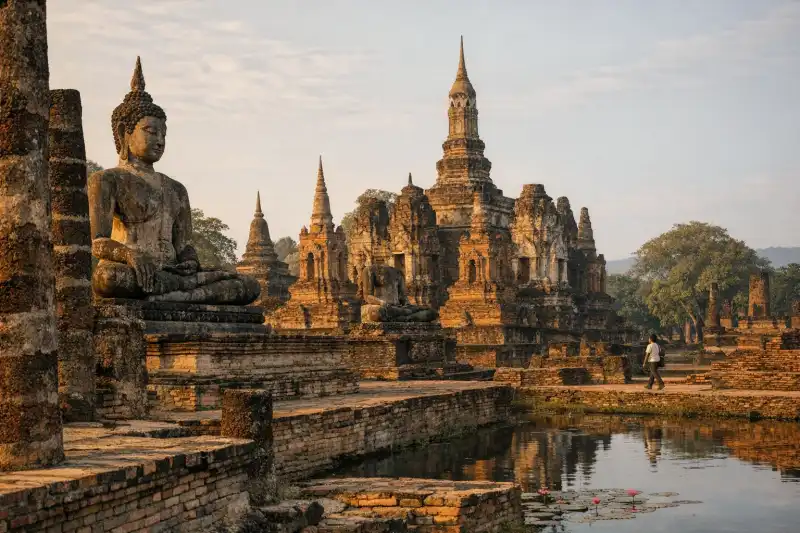
Give Sukhothai Historical Park a full day. The central zone is easy to enjoy by bicycle, tram, or tuk-tuk, but it deserves more than a quick circuit. Start early at Wat Mahathat Sukhothai, the spiritual center of the old city. Its large seated Buddha images, lotus-bud chedis, and surrounding structures create a different mood from Ayutthaya’s broken prangs.
Sukhothai is often described as Thailand’s first capital, but the cleaner way to think about it is as a major early Thai kingdom whose art and inscriptions became powerful in later memory. The famous King Ramkhamhaeng inscription, though debated in scholarship, is tied to ideas about early Thai writing, kingship, and Buddhist patronage. You do not need to settle the academic arguments to feel that Sukhothai became a place where later Thailand looked for origins.
After the central zone, go to Wat Si Chum. The huge seated Buddha, partly enclosed by a tall mondop, is one of the most affecting images on this route. The scale is theatrical, but the experience is quiet if you time it well. Look at how the narrow approach controls your view. Sukhothai’s builders understood anticipation.
A Sukhothai Historical Park tour is useful if you want interpretation and transport combined, but independent cycling works well for many travelers. The main warning is heat. Ride early, rest during the harshest hours, then return for late afternoon light if you still have energy.
Day 5: Si Satchanalai and the northern Sukhothai world
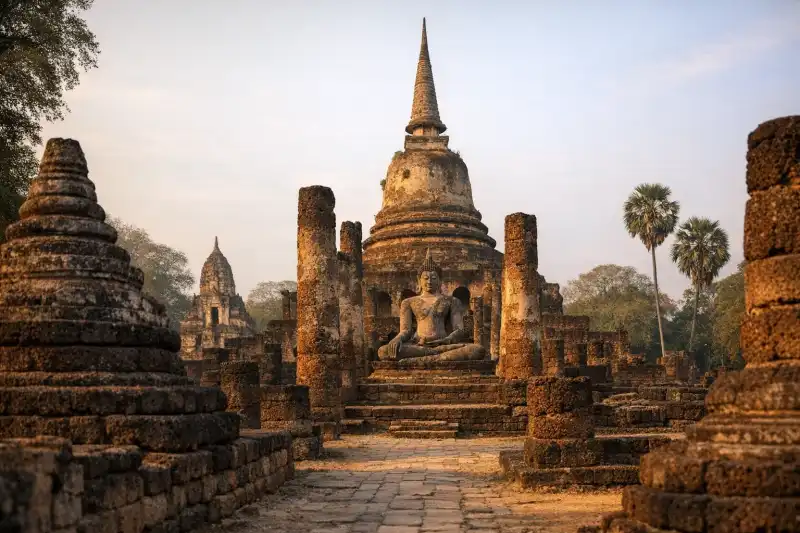
Use the final day for Si Satchanalai, north of Sukhothai. This is the day most likely to be skipped by rushed travelers, which is a shame. Si Satchanalai was closely tied to the Sukhothai kingdom and later regional power, but it feels quieter, greener, and less heavily worked by the standard tourist circuit.
Start with Wat Chedi Chet Thaeo. The name points to its rows of chedis, and the variety of forms makes the site especially rewarding if you have just spent a day looking at Sukhothai’s central monuments. It feels like a study in memorial architecture, with different shapes holding different visual arguments about status, devotion, and memory.
Then visit Wat Chang Lom, known for the elephant figures around its chedi base. Elephant-ringed stupas appear elsewhere in the region too, but seeing one here helps connect Sukhothai and Si Satchanalai as parts of a shared artistic world rather than separate sightseeing boxes.
Transport is the awkward part. A car or hired driver is easiest. Limited public options may work, but they reduce your flexibility and can make the day feel brittle. Bring water, snacks, and patience. Si Satchanalai is not difficult once you are there, but getting there smoothly is what makes the day satisfying instead of tiring.
The historical thread: rival capitals, Buddhist images, and the shape of Thai kingship
This route works because Ayutthaya and Sukhothai tell different parts of Thailand’s ancient and medieval story. Ayutthaya shows a later kingdom that grew rich from river networks, trade, war, diplomacy, and court ritual. Its ruins are urban and layered, with royal temples, Khmer-influenced towers, and sacred spaces folded into a living modern city.
Sukhothai and Si Satchanalai shift the mood. The parks are more open, the Buddha images often feel calmer, and the city plans give water, walls, and sightlines more room. The historical memory around Sukhothai is powerful because later Thailand often looked back to it for language, kingship, and Buddhist identity.
Seeing them together keeps the story from becoming too neat. Thai history was not a straight line from one perfect capital to another. It was regional, competitive, adaptive, and full of borrowed forms. The pleasure of this itinerary is watching those forms change as you move north.
Transportation notes
Bangkok to Ayutthaya is the easy leg. Train, van, taxi, and private transfer all work, though luggage and heat may push you toward a car. If you plan to arrive and sightsee the same day, do not choose the slowest possible transfer just for romance.
Ayutthaya is manageable by tuk-tuk, bicycle, hired driver, or a mix. Bicycles are best for confident riders who are comfortable with heat and city traffic. Tuk-tuks and drivers are better if you want to cover both the central island and riverside temples without turning the day into a navigation exercise.
Ayutthaya to Sukhothai is the route’s main logistical tax. Check current train, bus, and transfer options before locking hotels. Many travelers connect through Phitsanulok, then continue by bus or car. A private transfer saves friction, but costs more. Either way, protect Day 3 from overpacking.
For Sukhothai Historical Park, stay near Old Sukhothai if ruins are the priority. For Si Satchanalai, hire a driver if your budget allows. Self-driving is possible for travelers comfortable with Thai roads, but do not make your first nervous drive in Thailand a long temple day with rural navigation.
Optional add-ons and swaps
If you have one extra day between Sukhothai and Bangkok, consider Kamphaeng Phet. Its laterite ruins and forested archaeological areas fit the Sukhothai world well. To add it, remove the second Ayutthaya night or extend the trip to six days. Do not squeeze it into Day 3 unless you enjoy turning good sites into errands.
For a longer ancient Thailand route, continue east toward Phimai Historical Park. This changes the historical frame from Thai capital cities to Khmer sacred architecture in northeast Thailand. Add at least two days and cut nothing from Sukhothai if you can help it.
Another strong extension is Phanom Rung, especially if you want a dramatic Khmer hilltop temple after the flatter river and park landscapes of Ayutthaya and Sukhothai. It pairs better with Phimai than with this 5-day route. To include it, build a 7-day or longer itinerary rather than forcing a long detour.
If you need to shorten the route, cut Si Satchanalai first, not because it is weak, but because it is the hardest day-trip logistics piece. Keep Ayutthaya and Sukhothai Historical Park. They carry the main historical arc.
Shorter and longer itinerary options
For a shorter trip, use Ayutthaya as a 2-day route from Bangkok: one day for Wat Mahathat, Wat Phra Ram, and the central ruins, then one day for Wat Phra Si Sanphet and Wat Chaiwatthanaram. It will not give you Sukhothai’s calmer early-capital story, but it works if your trip is based in Bangkok.
For a tighter 3-day version, spend one night in Ayutthaya and two nights in Sukhothai, skipping Si Satchanalai. That is efficient, but the transfer day will feel heavy.
For a longer route, extend this into a 7-day ancient Thailand itinerary by adding Khmer temple sites such as Phimai, Phanom Rung, and Prasat Muang Tam. That version is more varied, but also much more demanding. It needs careful transport planning and should not be treated as a casual add-on to this 5-day plan.
Related ancient sites
- Wat Phra Ram
- Wat Chang Lom
- Wat Chedi Chet Thaeo
- Kamphaeng Phet
- Phimai Historical Park
- Phanom Rung
- Prasat Muang Tam
- Ban Chiang
FAQ
The most common planning questions for this route are answered below.