Quick route summary
This 10-day ancient Mexico route starts in Mexico City and ends in Campeche, using four bases: Mexico City, Oaxaca City, Merida, and Campeche. It links the great central Mexican city of Teotihuacan, the Mexica sacred precinct at Templo Mayor, the Zapotec hilltop capital of Monte Alban, the mosaic-walled ceremonial spaces of Mitla, and the Maya lowland cities of Chichen Itza, Uxmal, and Calakmul.
The pace is ambitious. It is not a lazy loop, and it should not be padded with every ruin between the airports. The reward is a clear historical sweep: cities built on highland basins, sacred centers reshaped by later empires, Zapotec power above the Oaxaca Valley, and Maya capitals adapted to forests, water stress, dynastic display, and regional rivalry.
Who this itinerary is for
This itinerary is for travelers who want Mexico’s ancient sites to drive the trip, not sit politely between food walks and beach days. It works best if you are comfortable with early starts, domestic flights, hired drivers when useful, and a few days where the map looks easier than the road feels.
It is not ideal if you want one base, minimal transfers, or a slow Yucatan vacation. It also asks too much of travelers who dislike heat, long drives, or archaeological sites with uneven shade. Mexico has enough ancient places to fill a month. This route is a curated spine, not a collecting mission.
Route at a glance
- Day 1: Overnight in Mexico City. Visit Templo Mayor in the historic center after arrival, using a taxi, rideshare, metro, or walking route if you are already nearby.
- Day 2: Overnight in Mexico City. Day trip to Teotihuacan with an early bus, driver, or guided tour.
- Day 3: Overnight in Oaxaca City. Add Cuicuilco in southern Mexico City if time allows, then fly or take a long bus to Oaxaca.
- Day 4: Overnight in Oaxaca City. Visit Monte Alban by taxi, shuttle, or guided half-day trip.
- Day 5: Overnight in Oaxaca City. Visit Mitla and the eastern Oaxaca Valley with a driver or day tour.
- Day 6: Overnight in Merida. Fly from Oaxaca to Merida, usually via Mexico City, and keep Dzibilchaltun optional.
- Day 7: Overnight in Merida. Visit Chichen Itza early by rental car, bus, driver, or guided day trip.
- Day 8: Overnight in Merida. Spend the day at Uxmal and Kabah, using a rental car, driver, or Puuc route tour.
- Day 9: Overnight in Campeche. Transfer from Merida to Campeche and visit Edzna if the timing is kind.
- Day 10: Overnight in Campeche. Visit Calakmul with a very early start, or make it easier by sleeping near Xpujil before the site day.
Practical logistics before you go
The best base cities are Mexico City, Oaxaca City, Merida, and Campeche. Do not change hotels more often than that unless you decide to overnight near Xpujil for Calakmul. That one extra move can be worth it, but random one-night stops elsewhere will eat the trip alive.
Domestic flights make this itinerary possible. The Oaxaca to Merida leg often routes through Mexico City, so treat Day 6 as a transfer day, not a full sightseeing day. Buses are comfortable on some routes, but they are not magic. A long bus that saves money can still cost the energy you needed for the next morning’s ruins.
Guided tours make the most sense at Teotihuacan, Monte Alban, Chichen Itza, and Calakmul. Not because independent travel is impossible, but because context and transport both matter. At Teotihuacan, a guide can explain why the so-called Avenue of the Dead is not just a ceremonial boulevard. At Calakmul, a driver solves the harder problem: getting you into the forest and back without turning the day into a logistics exam.
Build the route around mornings. Heat matters in central Mexico and the Yucatan, and shade varies wildly. Carry water, a hat, and more patience than the map seems to require. This is a 10-day route, so one lighter day is not a failure. It is the reason the final days still feel good.
Day 1: Templo Mayor and the Mexica core of Mexico City
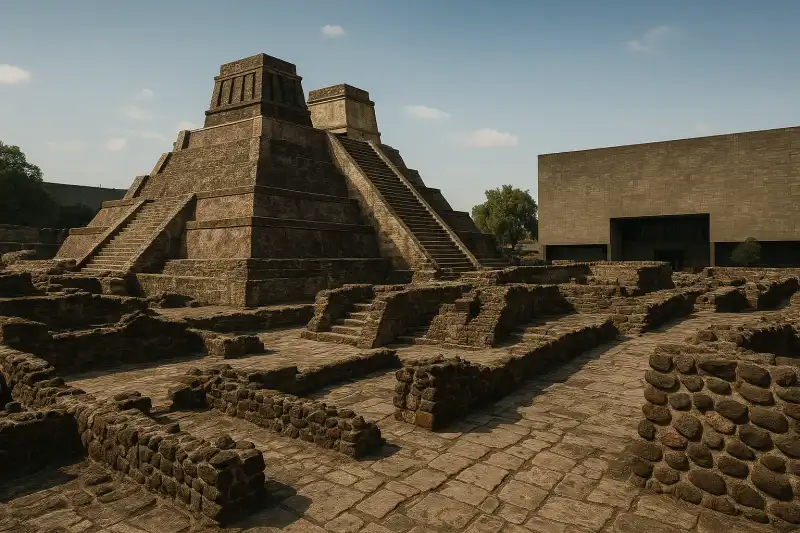
Start in Mexico City’s historic center, but keep the first day tight. Templo Mayor is the right opening because it makes the modern capital feel layered immediately. The Mexica temple precinct sat at the ritual heart of Tenochtitlan, the island capital the Spanish encountered in 1519. Today the excavated remains sit beside the Metropolitan Cathedral, which is not subtle as historical geography.
Give the site and museum more time than the footprint suggests. The Coyolxauhqui stone, found in 1978, changed modern understanding of the sacred precinct and helped drive major excavation work. It is also a good reminder that Mexico City is not built beside the ancient capital. It is built on top of it.
Logistics are easy compared with later days. Use the metro, a taxi, a rideshare, or walk if your hotel is close and the route feels comfortable. Do not add Teotihuacan today. Arrival days and giant ancient cities are a bad combination.
Day 2: Teotihuacan from Mexico City
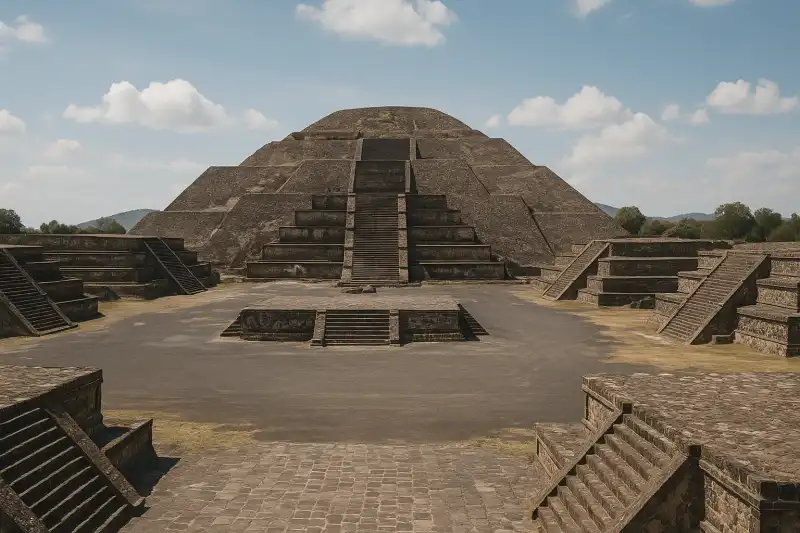
Leave early for Teotihuacan. The site is northeast of Mexico City, and the trip works by bus, private driver, or guided tour. This is a good day for a Teotihuacan day tour from Mexico City if you want transport handled and real interpretation on site.
Teotihuacan was already ancient by the time the Mexica gave it the name many travelers know. At its height in the first half of the first millennium CE, it was one of the largest cities in the Americas, with planned avenues, apartment compounds, murals, workshops, and temples laid out at a scale that still feels stern. The Pyramid of the Sun gets the attention, but the city’s urban planning is the better story.
Do not treat the Avenue of the Dead as a quick stroll. Distances stretch in the sun. Prioritize the Pyramid of the Sun area, the Pyramid of the Moon, the Ciudadela, and the Feathered Serpent Pyramid. The carved serpent heads there are not decoration in the casual sense. They are political theology in stone.
Return to Mexico City and keep the evening simple. Teotihuacan is a full day if you actually look at it.
Day 3: Cuicuilco and a lighter transfer day
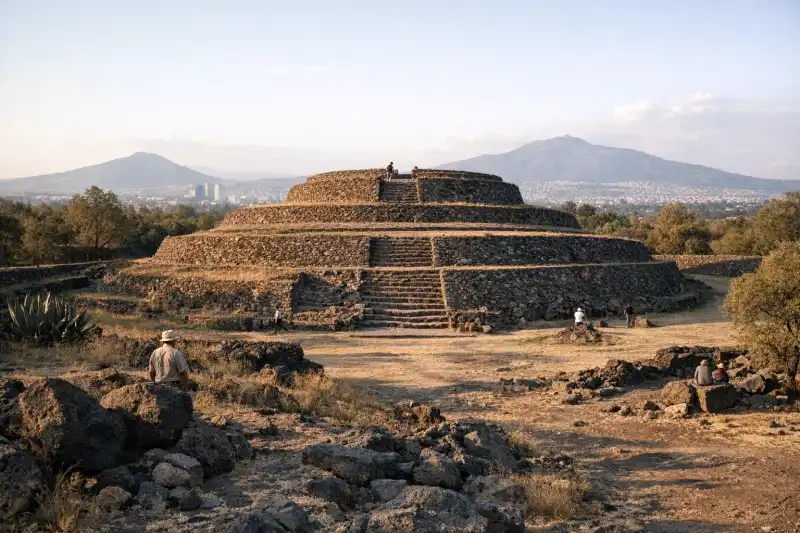
If your Oaxaca transfer is late enough, visit Cuicuilco in southern Mexico City before leaving. This circular pyramid site belongs to an older chapter of the Basin of Mexico, before Teotihuacan became the dominant urban force. Lava from eruptions around the Pedregal area reshaped this landscape, and the site’s round form gives the day a very different feel from Teotihuacan’s hard axes.
Keep this optional. The main job today is getting to Oaxaca City without arriving exhausted. Flying is usually the cleanest choice. The bus can work, but it is long enough that you should not pretend you will arrive ready for a museum, a long dinner, and a serious walk.
If you skip Cuicuilco, that is fine. Use the morning for the National Museum of Anthropology or a slow historic center hour instead, then transfer. A good itinerary knows when not to squeeze.
Day 4: Monte Alban above Oaxaca
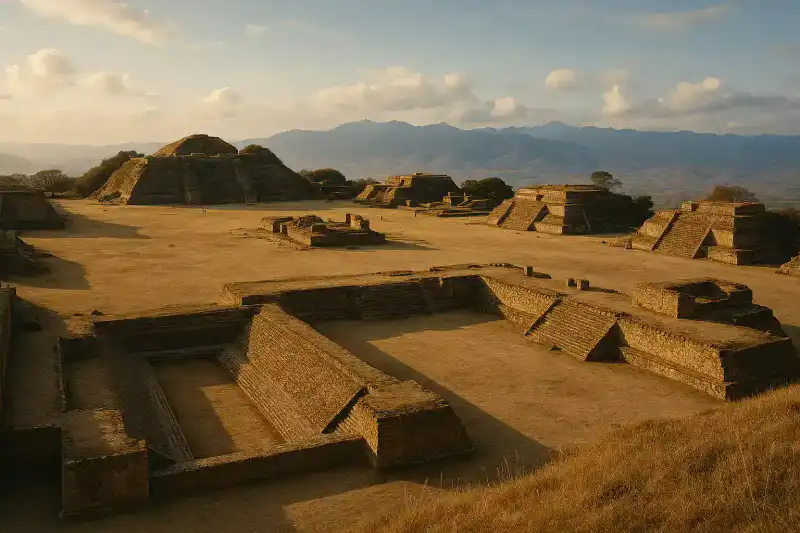
Visit Monte Alban early from Oaxaca City. The site sits on a leveled mountain above the valley, and the setting is part of the message. The Zapotec did not just occupy a convenient hill. They reshaped the summit into a civic and ceremonial center with sightlines across the valleys below.
Use a taxi, shuttle, or guided half-day tour. A Monte Alban guided tour from Oaxaca is useful if you want help reading the site’s plazas, tombs, carved stones, and political geography. Otherwise, independent travel is manageable, especially if you arrange your return before you go up.
Look for the danzantes, the carved figures often discussed as captives, rulers, or ritualized bodies depending on interpretation. They are not a decorative side note. They show how early Zapotec power used bodies, writing, and public stone to make authority visible.
Return to Oaxaca City for the afternoon. Do not pair Monte Alban with Mitla on the same day unless you are short on time and willing to flatten both visits. Each deserves its own mental space.
Day 5: Mitla and the eastern Oaxaca Valley
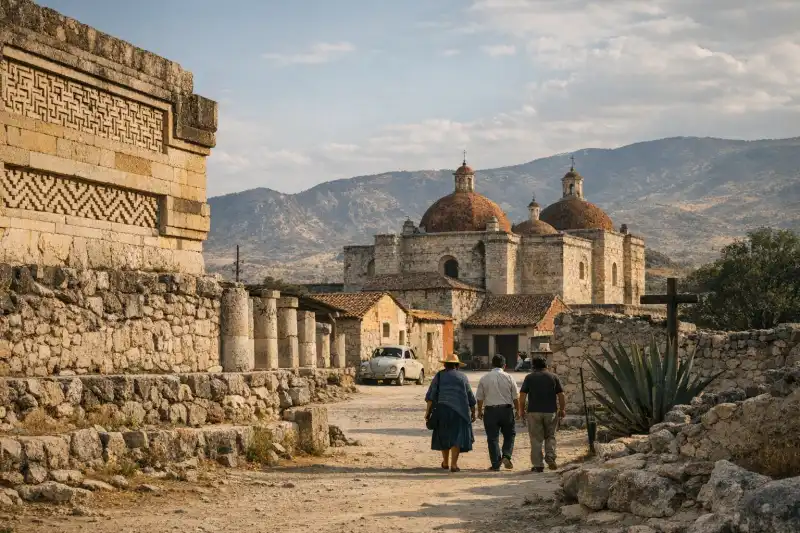
Spend today in the eastern Oaxaca Valley at Mitla. If Monte Alban is about hilltop command, Mitla feels more intimate and more precise. Its stone mosaic panels are made from thousands of fitted pieces, forming geometric patterns that still look almost textile-like in the walls.
Mitla became especially important in the Postclassic period and is often associated with Zapotec ritual authority and the world of the dead. The Spanish church built into the site makes the continuity and rupture hard to miss. This is one of those places where the colonial layer does not hide the ancient one. It sits on it, argues with it, and depends on it.
Go by driver, taxi arrangement, or day tour. Many tours add craft stops or natural sights, which can be pleasant, but check the pacing. If Mitla is the reason you are going, make sure it gets the best part of the day.
Return to Oaxaca City and sleep there again. Resist the urge to start the Yucatan transfer tonight unless your flight schedule leaves no better option.
Day 6: Fly to Merida and settle into the Maya route
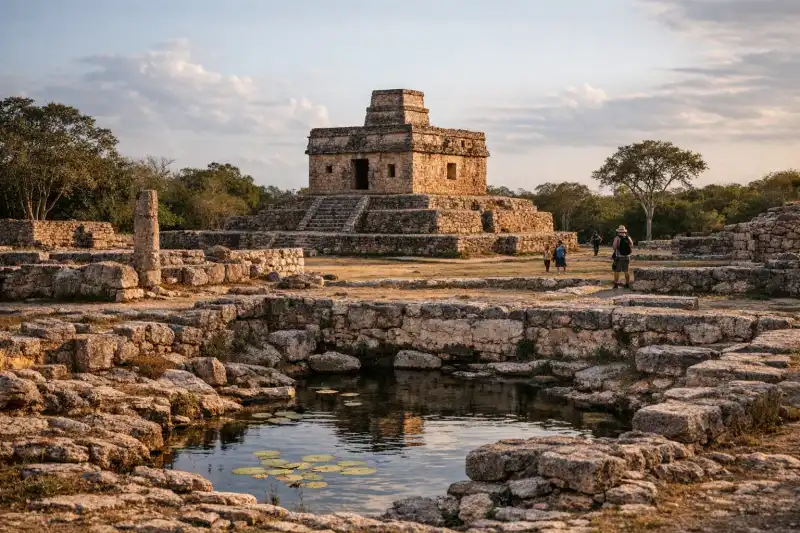
Day 6 is the hinge between highland and lowland Mexico. Fly from Oaxaca to Merida, usually connecting through Mexico City. If the connection is smooth and you arrive early, consider Dzibilchaltun as a short introduction to the northern Maya lowlands. If the flight slips, skip it without guilt.
Dzibilchaltun is known for the Temple of the Seven Dolls and its long occupation history. It is not as dramatic as Chichen Itza or Uxmal, but it helps reset the eye. The building materials, heat, vegetation, and site rhythm all feel different from Mexico City and Oaxaca.
Use this as a recovery day. Check the car rental if you are driving, confirm tomorrow’s Chichen Itza plan, and sleep in Merida. The next two days are much better if you do not arrive already behind.
Day 7: Chichen Itza with an early start
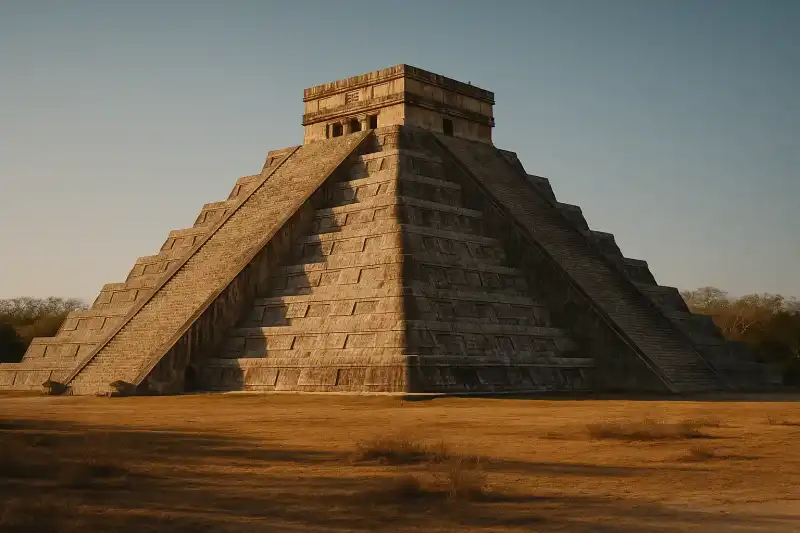
Leave Merida early for Chichen Itza. This is the most crowded site on the route, and timing matters. A Chichen Itza day trip from Merida can be worth it if you want transport, tickets, and guiding handled in one move.
El Castillo is the famous image, but do not let it swallow the day. The Great Ball Court is enormous, and its carved panels preserve scenes of ritualized competition and sacrifice. The Sacred Cenote also matters because it ties the city to offerings, pilgrimage, and water in a dry limestone landscape.
Historically, Chichen Itza is fascinating because it does not fit a tidy single-culture label. Its architecture and imagery show northern Maya traditions alongside forms that have long invited comparison with central Mexican styles. The result is a city that feels connected, competitive, and politically alert.
Return to Merida rather than pushing onward. The day is hot, popular, and visually dense. A quiet evening is not wasted time.
Day 8: Uxmal and the Puuc hills
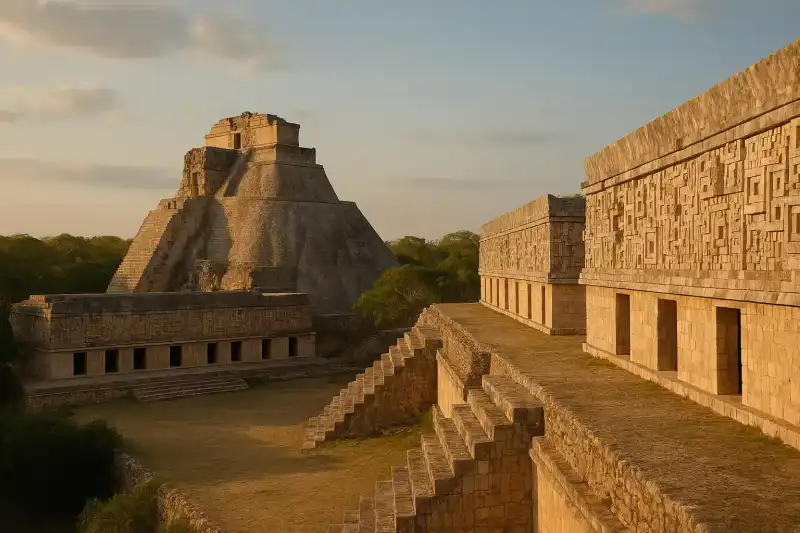
Today is for Uxmal and, if your pace allows, Kabah. This is one of the best days of the itinerary. Uxmal’s Puuc architecture rewards slow looking: stacked stone masks, careful proportions, long palace facades, and buildings that feel composed rather than merely large.
The Pyramid of the Magician has a rounded, unusual profile, while the Governor’s Palace shows how Puuc architects used surface patterning with real confidence. The stones are quiet now, but the political ambition here was not shy. Uxmal was not trying to be Chichen Itza. It had its own grammar of power.
Kabah adds the Codz Poop, often called the Palace of the Masks, with repeated Chaac masks across the facade. After one or two, look again. Repetition is the point. In a region where rain mattered intensely, the rain god’s face could become architecture.
Use a rental car, private driver, or Puuc route tour. Do not add every Puuc site today unless you are already experienced with ruin-heavy days. Uxmal and Kabah are enough for most travelers.
Day 9: Campeche transfer with Edzna
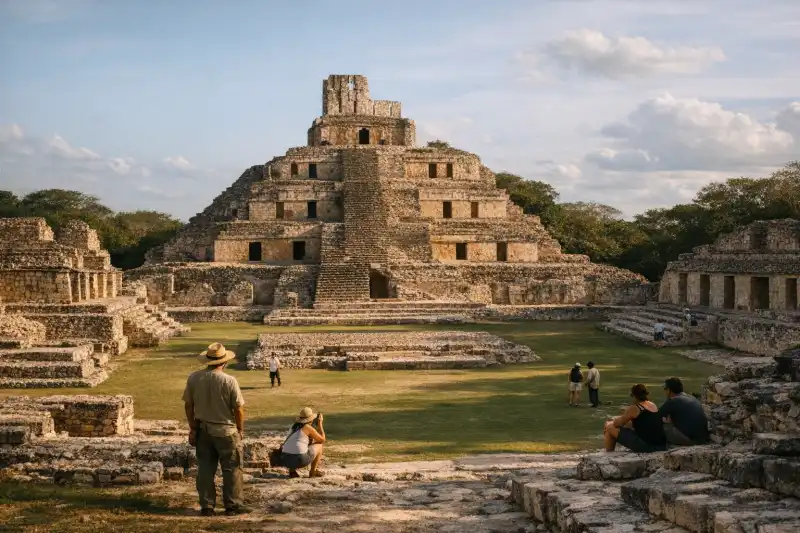
Travel from Merida to Campeche, then visit Edzna if the schedule works. Edzna is a smart bridge between the polished Puuc world and the forest routes around Calakmul. Its plazas, temple platforms, and water-management history show how Maya cities adapted to local conditions rather than following one fixed model.
The site is often quieter than Chichen Itza and Uxmal, which helps. Give yourself time to stand back from the main structures and read the spaces between them. Ancient cities were not only monuments. They were movement, drainage, ritual routes, household zones, and managed terrain.
Logistics depend on your transport. With a rental car, the day is straightforward. Without one, arrange a driver or tour from Campeche. Public transport is not the best fit if you want to protect the afternoon and avoid uncertainty.
Sleep in Campeche. It is a pleasant base, and staying there keeps the route from becoming a blur before the hardest day.
Day 10: Calakmul and the forest city
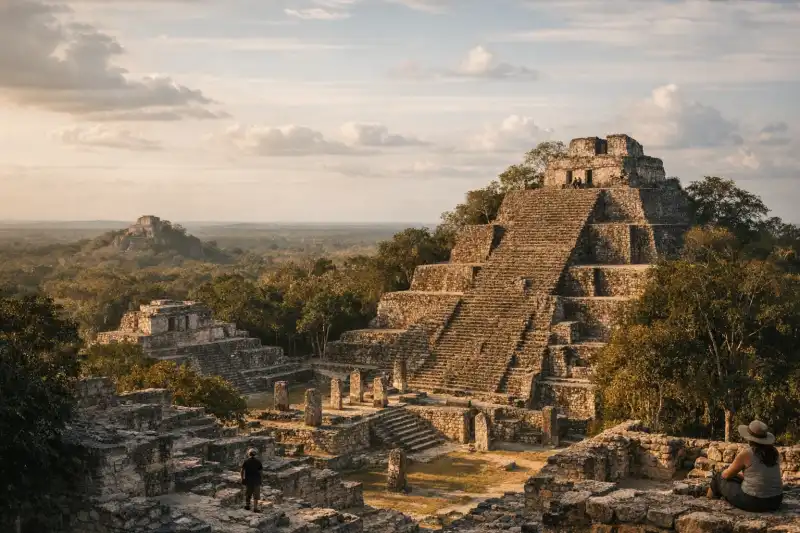
Calakmul is the big finale, but it is also the day that needs the most respect. The site lies deep in the Calakmul Biosphere Reserve, and the approach takes time. Many travelers should sleep near Xpujil the night before, then visit early, rather than forcing a punishing same-day round trip from Campeche.
The historical payoff is real. Calakmul was one of the great powers of the Classic Maya world and a major rival of Tikal. Its emblem glyph, dynastic monuments, and huge urban footprint point to a city that projected power through both architecture and political networks. Climbing above the forest canopy, if access rules allow it during your visit, makes the scale easier to feel.
This is not a day for improvisation. Confirm access, road timing, fuel, food, water, and return plans in advance. Hire a driver if you are not confident with the route. If weather, road conditions, or timing make Calakmul unrealistic, swap in Becan near Xpujil or keep Edzna as the stronger Campeche-area finish.
End in Campeche or continue onward the next day. Do not book a tight flight after Calakmul. The forest does not care about your connection.
The historical thread: cities, sacred landscapes, and power in motion
This route works because it does not treat ancient Mexico as one story. Teotihuacan shows urban planning at a scale that shaped later imagination in central Mexico. Templo Mayor brings the route into the Mexica world, where sacred geography, tribute, warfare, and lake-city engineering met in the heart of Tenochtitlan.
Oaxaca changes the angle. Monte Alban and Mitla show Zapotec power across time: first as hilltop civic theater, later as refined ceremonial architecture tied to lineage, ritual, and the dead. Then the Yucatan and Campeche shift the route again, into Maya cities that managed limestone terrain, water, dynastic competition, trade, and regional styles.
The best part is the contrast. Teotihuacan’s strict avenues, Mitla’s fitted mosaics, Uxmal’s patterned facades, and Calakmul’s forest scale are not variations on one theme. They are different answers to the same old questions: how to gather people, impress rivals, speak to gods, manage land, and make authority feel natural.
Transportation notes
Use flights for the long jumps. Mexico City to Oaxaca can be done by bus, but flying saves energy. Oaxaca to Merida is the route where flying matters most, even with a connection.
Do not rent a car in Mexico City for this itinerary. It adds stress without much benefit. Around Oaxaca, taxis, shuttles, and drivers work well. Around Merida and Campeche, a rental car gives the most flexibility, especially for Uxmal, Kabah, Edzna, and the Calakmul approach. If you do not want to drive, use private drivers or guided tours for those days.
Calakmul deserves special caution. The drive is long, services are limited near the site, and the forest road adds time. Overnight near Xpujil if you can. If you stay in Campeche, accept that Day 10 will be very long.
Do not compress this into eight days by cutting rest and transfer time. The sites will still be there, but your ability to care about them may not.
Optional add-ons and swaps
Add Ek Balam if you want another northern Yucatan site with strong sculpture and a less overwhelming feel than Chichen Itza. Remove Dzibilchaltun or keep Day 7 focused only on Chichen Itza if you add it.
Add Mayapan from Merida if you are interested in the last major Maya capital in the northern Yucatan. Remove Kabah or use it as a substitute for Dzibilchaltun. Mayapan is historically useful because it shows a later walled city, not just the Classic and Terminal Classic sites travelers often see.
Add Labna and Sayil if Puuc architecture is your favorite part of the trip. Remove Chichen Itza only if you have already been there, or add a day in Merida. Do not try to bolt them onto Uxmal and Kabah unless you like your site days very full.
Add Becan if Calakmul logistics become too hard. It works especially well from Xpujil and gives you a moated Maya city with strong Campeche atmosphere. Remove Calakmul only if access, timing, or fatigue makes the bigger site unreasonable.
Add Palenque only with more time. It belongs to a larger Chiapas and Maya lowlands route, not a casual detour from Campeche. If you add it, give yourself at least two extra days and cut something substantial, probably the Oaxaca section or the Merida Puuc day.
Shorter and longer itinerary options
For a shorter Yucatan-focused route, use 3 Days in the Yucatan Maya Sites from Merida if you mainly want Chichen Itza, Uxmal, and one nearby add-on.
For a fuller regional route without Mexico City and Oaxaca, use 5 Days in the Yucatan: Chichen Itza, Uxmal, Mayapan, and Ek Balam. It is better for travelers who want fewer flights and more time based in Merida.
For a middle route through the peninsula, 7 Days in the Maya World: Yucatan, Campeche, and Quintana Roo makes more sense than this 10-day version if Maya sites are your main interest and central Mexico can wait.
To make this route longer, add two nights near Xpujil and Palenque, or add more time in Mexico City for museums, Cuicuilco, and possibly Tula. Do not extend by adding single-night stops at random. Mexico rewards depth.
Related ancient sites
- Kabah
- Dzibilchaltun
- Edzna
- Ek Balam
- Mayapan
- Labna
- Sayil
- Becan
- Palenque
- Tula
- Xochicalco
- Great Pyramid of Cholula
FAQ
The most common planning questions for this route are answered below.