Quick route summary
This 7-day route starts and ends in Athens, then loops through Delphi and the Peloponnese with overnights in Athens, Delphi, Nafplio, Sparta, Kalamata, and Athens again. It begins with the Acropolis and Ancient Agora of Athens, then continues to Delphi, Ancient Corinth, Mycenae, Epidaurus, Ancient Sparta, Mystras, and Ancient Messene.
The pace is full, but it has a clear shape. You move from Athenian civic space to Apollo’s oracle, then into the Bronze Age Argolid, healing sanctuaries, Spartan territory, Byzantine hill cities, and one of the best-preserved ancient urban sites in the Peloponnese. Do not add Olympia, Meteora, Crete, or the islands to this same week unless you are willing to cut something important.
Who this itinerary is for
This itinerary is for travelers who want ancient Greece as a route, not just Athens plus one famous day trip. It works best if you can handle early starts, rental-car logistics, changing bases, and several days where the reward comes from connecting places rather than staying put.
It is not ideal if you want a relaxed Athens city break, island time, or a no-driving trip based entirely on trains and buses. You can do pieces of this route with guided tours, but the full version needs road flexibility, especially from Delphi through the Peloponnese.
Route at a glance
- Day 1: Overnight in Athens. Visit the Acropolis, Ancient Agora, and Kerameikos with short walks or taxis between sites.
- Day 2: Overnight in Delphi. Drive or transfer northwest from Athens, with an optional Orchomenos stop if timing works.
- Day 3: Overnight in Nafplio. Visit Delphi early, then drive south through the Corinth corridor and stop at Ancient Corinth if daylight allows.
- Day 4: Overnight in Nafplio. Use Nafplio as a base for Mycenae and Epidaurus, with Argos only if the day stays comfortable.
- Day 5: Overnight in Sparta. Drive south via Nemea if you want athletic and sanctuary context before Laconia.
- Day 6: Overnight in Kalamata. Visit Mystras early, touch the ancient Sparta landscape, then continue toward Messene.
- Day 7: Overnight in Athens. Visit Ancient Messene, then return toward Athens with a long road buffer.
Practical logistics before you go
Use Athens only for the opening night and final return. The rest of the route works better as a loop, not as a series of day trips from the capital. Nafplio is the strongest base for Mycenae and Epidaurus. Sparta is practical for Mystras. Kalamata or the Messene area saves time for Ancient Messene.
A rental car is the simplest way to run this itinerary after Athens. Greek buses can connect some towns, and guided day trips cover Delphi, Mycenae, and Epidaurus, but they do not stitch this 7-day route together cleanly. If you do not want to drive, book private transfers for the Delphi to Peloponnese and Peloponnese loop sections.
Guides are most useful at the Acropolis and Agora, Delphi, Mycenae, Epidaurus, and Ancient Messene. These are places where context changes the visit. Without it, Delphi can become a pretty mountain sanctuary, Mycenae a gate and a tomb, and Messene a large spread of walls and stones.
The route intentionally skips Olympia, Sounion, Crete, northern Greece, and the islands. That is not because they are secondary. It is because seven days is already tight. Overpacking ancient Greece is the fastest way to remember only roads and ticket booths.
Day 1: Acropolis, Agora, and ancient Athens
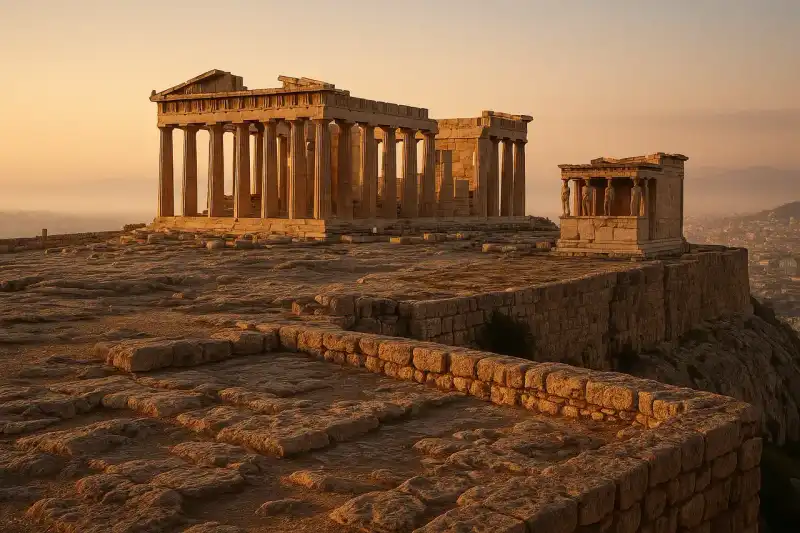
Start early at the Acropolis. The Parthenon will pull your attention first, but give the whole hill time: the Propylaea, Erechtheion, Temple of Athena Nike, theater slopes, and the way the sanctuary sits above the modern city. Athens makes more sense when you see sacred architecture, civic pride, and landscape all working together.
A guided Acropolis and Ancient Agora tour is useful if this is your first time in Athens. A good guide can keep the day from turning into a list of marble names and help you understand why the Acropolis and Agora belong together.
Continue to the Ancient Agora of Athens. The Agora was not only a market. It was a civic landscape of law, religion, commerce, discussion, memory, and public display. If the Acropolis shows Athens looking upward to the gods, the Agora shows the city arguing with itself on the ground.
If time and energy allow, finish at Kerameikos. The cemetery and city-gate area gives the day a different mood: roads, burials, boundary markers, and the edge between city and outside world. Keep the evening easy. Tomorrow is a road day to Delphi.
Day 2: Athens to Delphi
Leave Athens in the morning and head toward Delphi. You can do this by rental car, private transfer, or guided trip, but for this 7-day route a car gives the cleanest continuation into the Peloponnese. Do not underestimate the drive out of Athens. Start early and avoid planning a late-night arrival in Delphi.
If timing works, stop at Orchomenos for a quieter Mycenaean and Boeotian layer before Delphi. Its tholos tomb and deep regional history make a useful reminder that Bronze Age Greece was not only Mycenae. Skip it if traffic or fatigue is already building.
Arrive in Delphi with time to settle in and walk the town or visit the lower sanctuary area if hours allow. The main sanctuary is better saved for the next morning when you can give it a clear head. Delphi needs more attention than a quick coach stop.
Sleep in Delphi. Staying nearby instead of rushing back to Athens is one of the decisions that makes this route work.
Day 3: Delphi sanctuary and the road to Nafplio
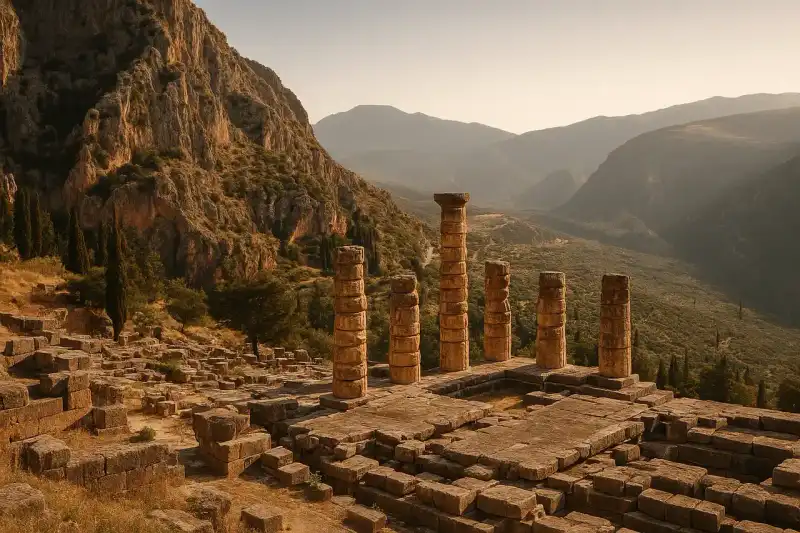
Visit Delphi early. The sanctuary of Apollo was one of the great Panhellenic centers, where cities, rulers, and individuals sought oracular guidance and displayed offerings along the Sacred Way. The setting is dramatic, but the political competition here was not subtle. Greek cities used sanctuaries to pray, consult, remember victories, and show off.
Take time for the Temple of Apollo, theater, treasuries, stadium area if open and practical, and the museum. The Charioteer is worth slowing down for, not because it is famous, but because it preserves a rare bronze presence from a world where most bronze statues were melted down.
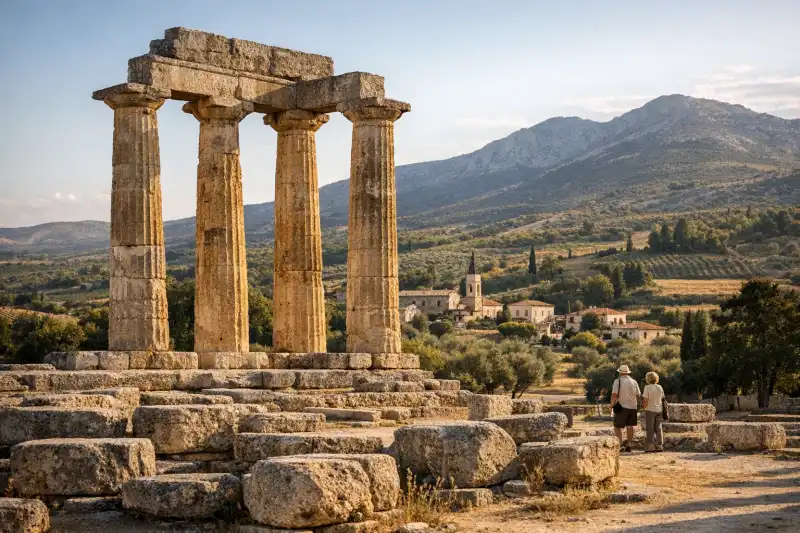
After Delphi, drive south toward the Peloponnese. If daylight and energy allow, stop at Ancient Corinth. Corinth’s position near the isthmus made it a commercial and strategic hinge, and the site helps bridge mainland Greece and the Peloponnesian route ahead.
Continue to Nafplio for the night. Do not try to add Mycenae today unless you skipped Delphi depth. Nafplio gives you a practical and pleasant base for the Argolid.
Day 4: Mycenae and Epidaurus
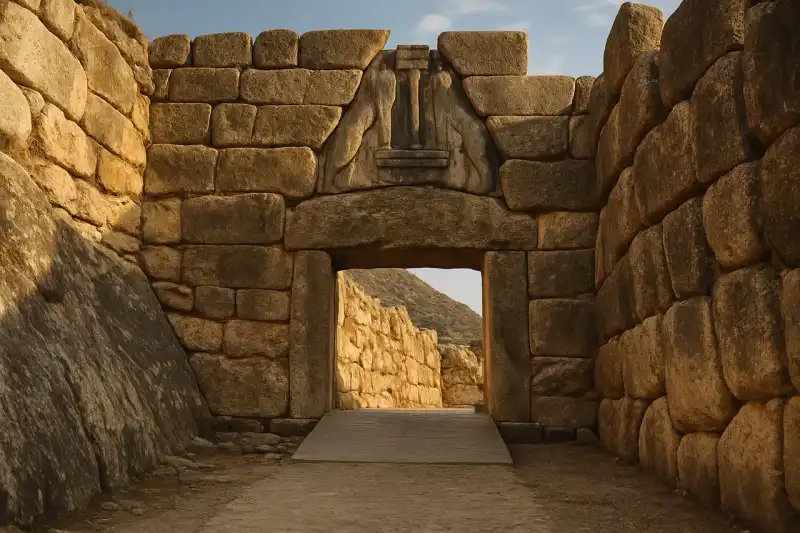
Start with Mycenae. The Lion Gate, Cyclopean walls, grave circles, palace area, and nearby tholos tombs make the Bronze Age feel materially heavy. Mycenae is famous through Homeric memory, but the archaeology is older and stranger than the later stories people attached to it.
The site is most rewarding if you think in terms of palace power, fortified landscapes, elite burial, and regional control. The so-called Treasury of Atreus is a good example of the problem and pleasure of Mycenae: later names can be misleading, but the engineering and ambition are real.
Continue to Epidaurus, the sanctuary of Asclepius. The theater is the obvious draw, but the healing sanctuary matters just as much. Pilgrims came seeking treatment, ritual help, dreams, and divine attention. This is a different kind of sacred landscape from Delphi: less oracle politics, more healing, body, and hope.
A Mycenae and Epidaurus day trip from Nafplio or Athens can make sense if you want transport and guiding handled together. If you are driving yourself, keep Argos as an optional add-on only if the day is still comfortable. Return to Nafplio for a second night.
Day 5: Nemea and Sparta
Leave Nafplio and head toward Laconia. If you want a strong stop on the way, visit Nemea. The sanctuary of Zeus and the stadium connect myth, athletics, and regional identity, and the site is usually calmer than the headline stops. It gives the day a useful pause before the long drive south.
Continue to Ancient Sparta. This is where expectations need managing. Sparta’s surviving remains are modest compared with its ancient reputation. That mismatch is historically interesting. A city famous for discipline, military culture, and austerity does not present itself today like Athens, Delphi, or Messene.
Walk the ancient theater area and surviving ruins with a realistic eye. Sparta is not a site of grand intact monuments. It is a place where the absence of showy remains becomes part of the story. Ancient fame and modern archaeological visibility are not the same thing.
Stay overnight in Sparta. The practical reason is Mystras, which deserves your early energy tomorrow.
Day 6: Mystras and the layered Sparta landscape
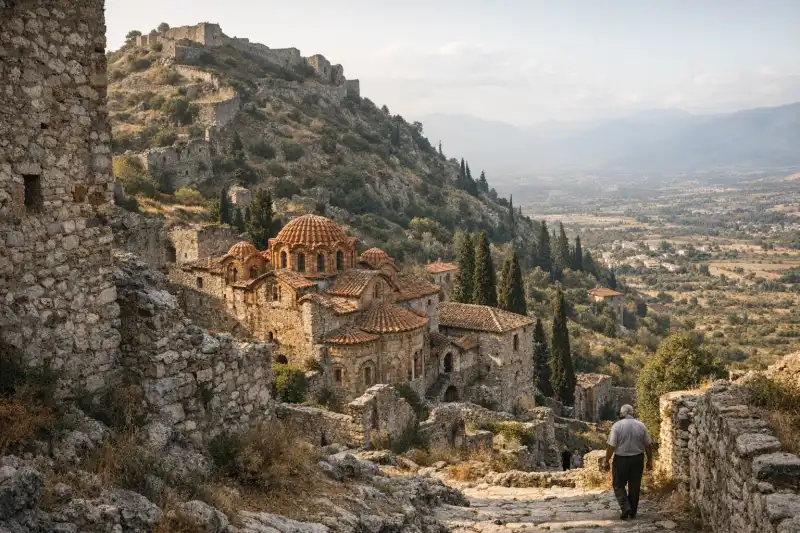
Start early at Mystras, also listed as Byzantine Mystras. It is later than the Classical and Hellenistic focus of much of this route, but it belongs here because the Sparta landscape did not stop mattering when ancient Sparta faded. Mystras became a major Byzantine hill city, with palaces, churches, monasteries, frescoes, and steep stone streets.
The climb is part of the visit. Plan footwear and water accordingly. Mystras can be physically tiring, especially in heat, but the reward is seeing how a medieval city occupied the slopes above the old Spartan plain. The layers are not tidy. That is what makes the day interesting.
If you skipped Ancient Sparta yesterday, touch the main Sparta ruins today before leaving. Keep it short. Mystras is the stronger site on the ground, and the route still needs to reach Kalamata or the Messene area.
Drive west toward Kalamata for the night. This position keeps Day 7 from becoming too punishing.
Day 7: Ancient Messene and return toward Athens
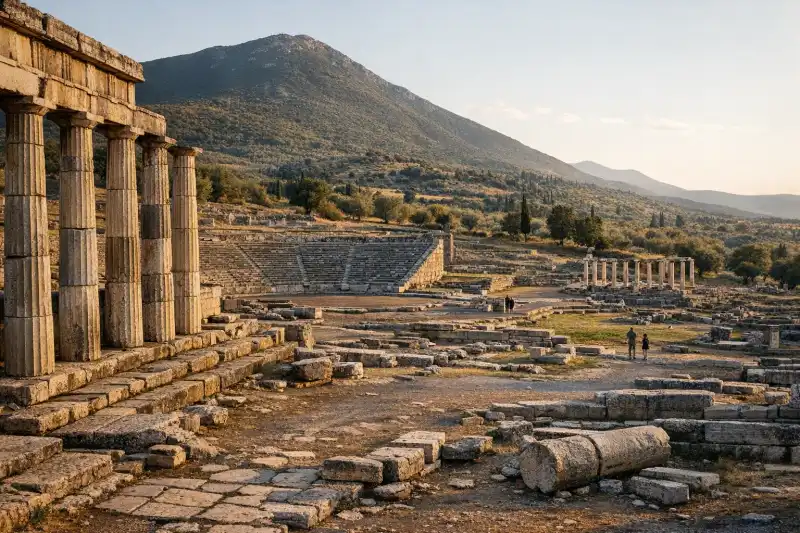
Visit Ancient Messene in the morning. Give this site more time than the map suggests. It is one of the best-preserved ancient cities in Greece, with fortifications, theater, stadium, sanctuaries, public buildings, and a city plan that is easier to read than many better-known sites.
Messene also changes the political story of the route. Founded after the Theban defeat of Sparta in the 4th century BCE, the city became a statement of Messenian freedom and identity after long Spartan domination. The stones are quiet now, but the political meaning was pointed.
Do not rush straight to the stadium and leave. Walk enough of the site to understand the urban fabric. Messene is a strong final stop because it brings together city planning, defense, civic space, athletic life, and memory of liberation.
After the visit, return toward Athens with a long buffer, or add one more Peloponnese night if you dislike long drives. If you fly out the same evening, you are asking too much of the day.
The historical thread: cities, sanctuaries, and the politics of memory
This route works because ancient Greece was never one single story. Athens shows civic religion and public debate. Delphi shows Panhellenic competition and oracular authority. Corinth shows the strategic isthmus. Mycenae pulls the route back into Bronze Age palace power. Epidaurus shifts the focus to healing and ritual. Sparta asks you to think about reputation versus remains. Mystras shows how the same landscape kept changing. Messene ends with a city built into political memory after Spartan power was broken.
The route is a useful antidote to the idea that ancient Greece is only Athens plus mythology. Roads, sanctuaries, theaters, tombs, healing cults, mountain passes, and fortified cities all shaped the ancient world. The best moments come when the sites start arguing with each other.
Transportation notes
Do Athens on foot, metro, and taxi. Pick up a rental car only when you leave for Delphi, unless you are very comfortable with city driving and parking. Returning the car in Athens at the end is simplest if flights allow.
Driving is the backbone of this itinerary. Delphi to Nafplio, Nafplio to Sparta, Sparta to Kalamata, and Kalamata to Athens are not hard in concept, but they require attention, daylight, tolls, mountain roads in places, and realistic buffers.
If you do not want to drive, use a combination of guided day trips and private transfers. Public buses can connect some towns, but they will cost you flexibility and make Ancient Messene much harder to fit well.
Do not compress Delphi, Mycenae, Epidaurus, Sparta, Mystras, and Messene into four days from Athens. It is possible only as a road grind. The route needs overnight bases to keep the ancient sites from becoming brief stops between drives.
Optional add-ons and swaps
If Olympia is a priority, add Olympia after Ancient Messene and extend the trip by one day. If you must keep seven days, remove Sparta and Mystras or cut Messene. None of those cuts is painless.
If remote architecture is your obsession, add Bassae or the Temple of Apollo Epicurius at Bassae between Messene and the return to Athens. This needs careful road planning and usually works better with an extra night.
If you want a coastal Attica finish, add Sounion and the Temple of Poseidon at Sounion after returning to Athens. Remove Kerameikos or the optional Orchomenos stop if you need to protect the schedule.
If battlefield history matters, add the Marathon Tomb as an Attica side trip. It belongs better to a 3-day Athens and Attica itinerary than to this Peloponnese-heavy week.
Shorter and longer itinerary options
For a shorter route, use the 5 Days in Ancient Greece: Athens, Delphi, and the Peloponnese itinerary. It keeps Athens, Delphi, Corinth, Mycenae, and Epidaurus, then cuts the deeper Peloponnese.
For a compact city version, use the 3 Days in Ancient Athens and Attica itinerary. That is the better choice if you want one base and no rental car.
A longer mainland-and-Crete Greece route needs closer to 10 days. That gives the mainland more space and adds Crete instead of forcing Minoan sites into this Peloponnese loop.
Related ancient sites
- Acropolis
- Acropolis of Athens
- Ancient Agora of Athens
- Kerameikos
- Delphi
- Orchomenos
- Ancient Corinth
- Mycenae
- Epidaurus
- Argos
- Nemea
- Ancient Sparta
- Mystras
- Ancient Messene
- Olympia
FAQ
The most common planning questions for this route are answered below.