Quick route summary
This 7-day ancient Thailand route starts near Bangkok and ends in Buriram, moving from the ruined royal city of Ayutthaya to the older landscape of Sukhothai Historical Park, then east into Thailand’s Khmer temple belt at Phimai Historical Park, Phanom Rung, and Prasat Muang Tam.
The pace is active, with four bases and one long transfer day. It is not a lazy week, but it is a coherent one: royal Ayutthaya, early Thai Sukhothai, and the Angkor-connected sanctuaries of Isan all belong in the same conversation if you give the route enough time.
Who this itinerary is for
Use this route if you want Thailand’s ancient sites without treating them as quick breaks between beaches or food stops. It suits travelers who like temple plans, old capitals, sculpture, processional architecture, and the way political power leaves traces in brick, laterite, and sandstone.
It is not ideal if you want one base for the whole week. It is also not the best first Thailand route for someone who dislikes long drives or early starts. Ayutthaya is easy from Bangkok, but Sukhothai and the Khmer temples ask for more patience. The payoff is real, but the map does not do the distances justice.
Route at a glance
- Day 1: Overnight in Ayutthaya. Travel from Bangkok and visit the central Ayutthaya ruins, including Wat Mahathat and Wat Phra Si Sanphet.
- Day 2: Overnight in Ayutthaya. Use a tuk-tuk, bike, or driver for Ayutthaya’s riverside and royal temple ruins.
- Day 3: Overnight in Sukhothai. Transfer north from Ayutthaya, then make a light first visit to Sukhothai’s central zone.
- Day 4: Overnight in Sukhothai. Visit Sukhothai Historical Park early, then drive to Si Satchanalai if your energy holds.
- Day 5: Overnight in Nakhon Ratchasima. Make the long move east and visit Phimai, with Prasat Phanom Wan if timing works.
- Day 6: Overnight in Buriram. Visit Phanom Rung, giving the hilltop approach and sanctuary more time than the map suggests.
- Day 7: Overnight in Buriram. Visit Prasat Muang Tam, then keep the rest of the day flexible for departure or a slower finish.
Practical logistics before you go
The cleanest bases are Ayutthaya for two nights, Sukhothai for two nights, Nakhon Ratchasima for one night, and Buriram for two nights. You can start from Bangkok, but do not waste one of the seven days sleeping there unless your flight timing forces it.
Trains, vans, and buses work well for Bangkok to Ayutthaya and can work for the longer move toward Sukhothai if you are patient. The northeastern Khmer section is different. Phimai, Phanom Rung, and Prasat Muang Tam are easier with a rental car, private driver, or carefully arranged transfers. Public transport can get you near some places, but it can eat the day.
Guided tours make the most sense in Ayutthaya if you are coming as a day trip from Bangkok, in Sukhothai if you want art historical context, and in Isan if you want to avoid piecing together temple transfers yourself. This is especially true for the Khmer sites, where the road network matters as much as the monuments.
Heat changes the route. Start temple days early, take the middle of the day seriously, and avoid stacking every ruin in the province into one outing. Thailand’s ancient sites often sit in open parks with limited shade. The plan below intentionally skips Chiang Mai, Ban Chiang, Si Thep, and the far border temples. They are worthy sites, but adding them would turn a focused week into a geography stunt.
Day 1: Ayutthaya arrival and the central ruins
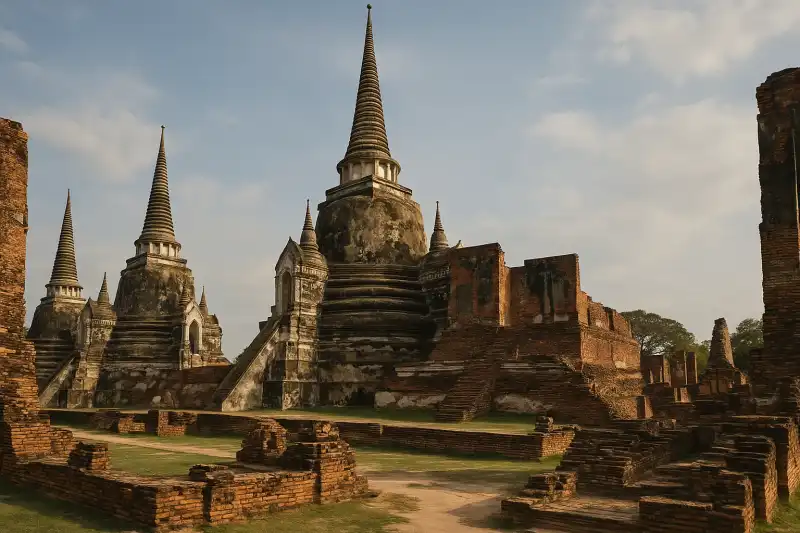
Travel from Bangkok to Ayutthaya in the morning by train, van, taxi, or private transfer. The city is close enough to Bangkok for a day trip, but sleeping here makes the ruins feel less like a checklist. Drop your bags, eat something simple, and start with the central historical park.
Begin at Wat Mahathat Ayutthaya, famous for the Buddha head held in tree roots. Give the site more attention than that single image. Wat Mahathat was one of Ayutthaya’s major religious centers, and its collapsed prangs and rows of seated Buddhas make the old city’s damage feel physical rather than abstract.
Continue to Wat Phra Si Sanphet, the royal temple of the Ayutthaya kings. Unlike active monasteries, it served the palace compound and did not house resident monks. Its three large chedis are a useful reminder that Ayutthaya was not just a trading city. It was a court city with a sharp sense of ritual space.
Logistics are easy today if you keep the loop tight. Walk short sections, rent a bicycle if the heat is reasonable, or hire a tuk-tuk for a few hours. If you are starting from Bangkok and want a one-day version, an Ayutthaya temple day tour from Bangkok solves the transport, but this 7-day route is better with the overnight.
Day 2: Ayutthaya riverside temples and royal memory
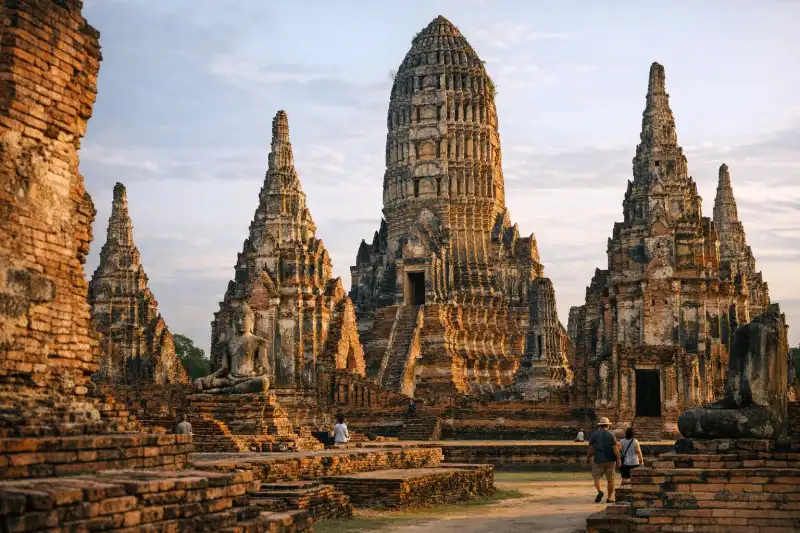
Use the second Ayutthaya day for the sites that benefit from more space and better timing. Start with Wat Phra Ram if you want a quieter morning. Its Khmer-style prang rises near ponds and parkland, and the setting helps you see how Ayutthaya borrowed, adapted, and reworked older regional forms.
Return to Wat Phra Si Sanphet if you rushed it on Day 1, then save Wat Chaiwatthanaram for late afternoon if the weather cooperates. Built in the 17th century under King Prasat Thong, Wat Chaiwatthanaram uses a central prang and surrounding towers in a layout that clearly nods toward Khmer cosmology. It is not subtle architecture. It wants you to read royal order in stone and brick.
Ayutthaya’s history is also a warning about easy labels. It was a Buddhist kingdom, a commercial hub, a diplomatic player, and a city shaped by warfare. The 1767 Burmese destruction looms large in the ruins, but the city’s earlier wealth and international connections matter just as much.
Do not overpack the day. The distances are not huge, but the heat, road crossings, and repeated temple stops add up. Hire a tuk-tuk by the hour if you want less friction, and leave enough time to sit near the river rather than chasing every minor ruin.
Day 3: Transfer to Sukhothai and the old capital at dusk
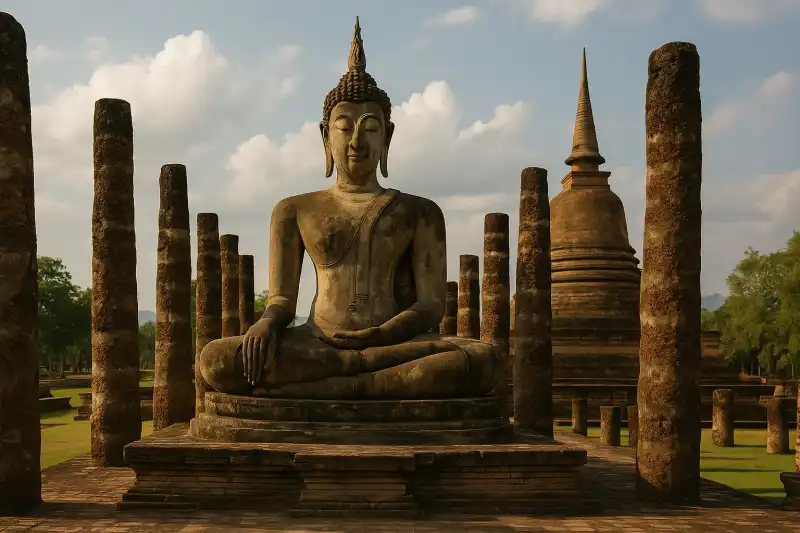
This is a travel day with a reward at the end. Move from Ayutthaya to Sukhothai by bus connection, private car, or a longer transfer arranged through your hotel. Do not pretend it is a quick hop. Expect much of the day to go into movement, food stops, and settling in.
If you arrive with daylight left, make a gentle first visit to Sukhothai Historical Park. Focus on the central zone and Wat Mahathat Sukhothai, the ceremonial heart of the old capital. Sukhothai’s name is often tied to the rise of Thai kingship in the 13th and 14th centuries, especially the memory of King Ramkhamhaeng, though the history is more layered than a simple origin story.
The mood changes here after Ayutthaya. Sukhothai is lower, calmer, and more spread through landscaped space. The Buddha images, lotus-bud chedis, and water features make power feel less defensive than in Ayutthaya. That does not mean it was gentle politics. It just wore a different architectural face.
Keep this evening light. Rent a bicycle only if you still have energy, and save the deeper park visit for tomorrow. A tired first look is fine. A forced full circuit after a transfer is how good ruins become a blur.
Day 4: Sukhothai Historical Park and Si Satchanalai
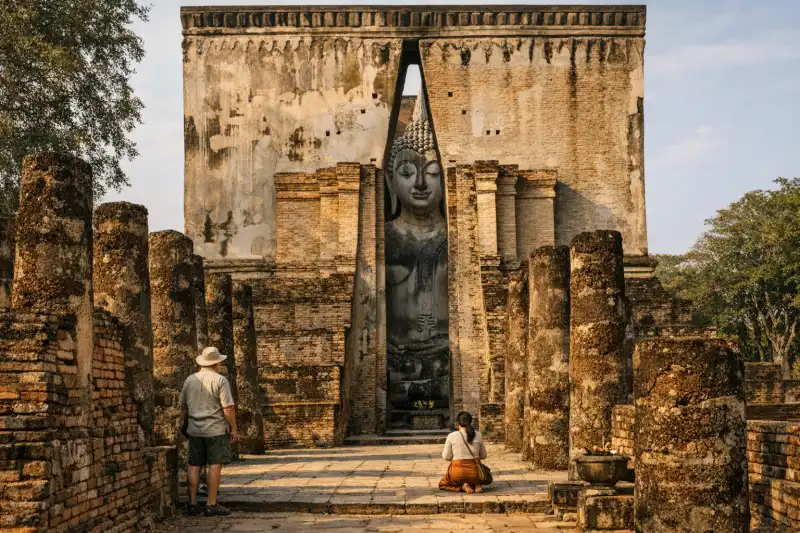
Start early at Sukhothai Historical Park. The central zone is one of the easiest ancient landscapes in Thailand to explore by bicycle, but the ease can trick you into moving too fast. Spend proper time at Wat Mahathat, then continue to Wat Si Chum, where a huge seated Buddha fills a narrow mondop with remarkable theatrical control.
Wat Si Chum is often remembered for its scale, but look at the architecture around the image too. The tight walls, the slit of sky, and the approach all shape the encounter. Sukhothai art is often praised for graceful Buddha images, and here that grace has weight. It is calm, but not small.
If you want a fuller day, hire a driver for Si Satchanalai, north of Sukhothai. This old city was tied to the Sukhothai kingdom and later Ayutthaya power, and it has a quieter rhythm than the main park. Wat Chang Lom and Wat Chedi Chet Thaeo are especially useful for seeing how elephant imagery, chedi forms, and royal religious patronage carried across the region.
This is a good day for a guide if you care about art history. A Sukhothai Historical Park guided tour can help separate what is Sukhothai, what is later restoration, and what belongs to broader Thai Buddhist visual language. If you are traveling independently, choose either a deep Sukhothai day or a Sukhothai plus Si Satchanalai day. Doing both at full intensity is tiring.
Day 5: Long transfer to Phimai and the Khmer road
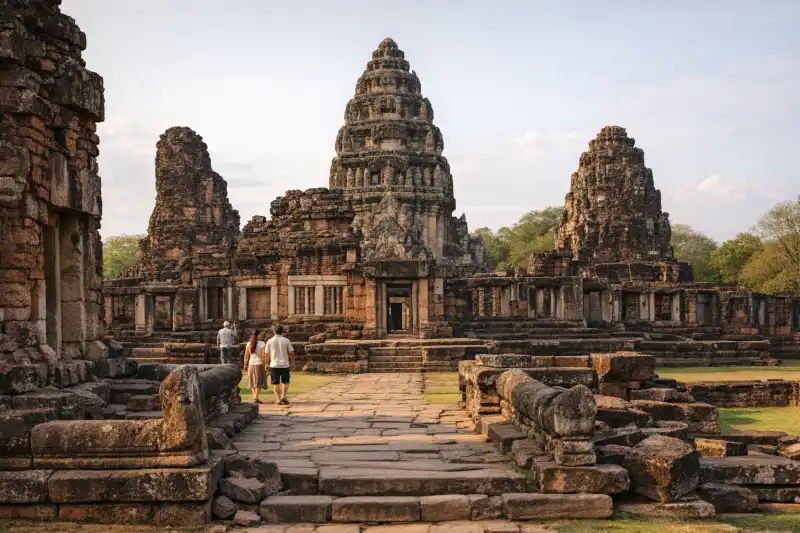
Day 5 is the logistical hinge of the itinerary. Leave Sukhothai early and move toward Nakhon Ratchasima, usually called Korat. This is a long transfer by road, and it is the day most likely to break if you plan casually. A private car is the smoothest option. Buses can work, but check connections carefully and do not expect much temple time if the schedule slips.
The goal is Phimai Historical Park, one of Thailand’s great Khmer temple complexes. Phimai Sanctuary is built in the Angkorian world of sandstone sanctuaries, enclosure walls, lintels, and sacred axes. One especially interesting point: Phimai faces southeast, unusual enough to invite discussion, and it was connected to Angkor by a wider network of roads, rest houses, and temple sites.
If you arrive early enough, add Prasat Phanom Wan near Nakhon Ratchasima. It is quieter than Phimai and helps make the regional pattern clearer. These were not isolated monuments dropped into the countryside. They formed part of a Khmer sacred and political geography that reached across what is now northeastern Thailand.
This is a sensible place to use a driver. A Phimai and Phanom Rung private driver search is useful if you want help linking the Isan sites without losing time to transfers. Overnight in Nakhon Ratchasima rather than pushing straight to Buriram unless you have a strong reason.
Day 6: Phanom Rung and the hilltop Khmer sanctuary
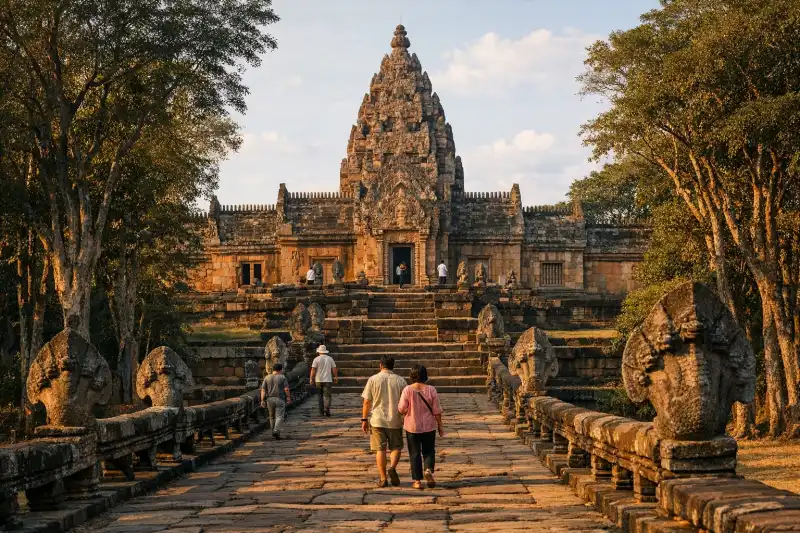
Drive from Nakhon Ratchasima or Buriram to Phanom Rung, also listed as Prasat Hin Khao Phnom Rung in some planning contexts. The temple sits on an extinct volcano, and the approach matters. Do not just arrive at the nearest parking area, take a few photos, and leave. The long causeway, naga bridges, stairways, and terraces prepare you for the sanctuary.
Phanom Rung was built and expanded across the Khmer period, with strong 10th to 13th century phases. Its sandstone carving is among the finest in Thailand’s Khmer temple belt, and the sanctuary’s alignment with sunrise on certain days still draws attention. The famous lintel showing Vishnu reclining on the serpent Ananta also has a modern story: it was removed, surfaced abroad, and returned to Thailand in the late 20th century.
The site rewards slow looking. Notice how the hilltop setting turns movement into ritual. Each level changes the body before the sanctuary changes the view. The stones are quiet now, but the political ambition here was not modest.
Sleep in Buriram tonight. You can combine Phanom Rung and Prasat Muang Tam in one day, and many travelers do, but this route separates them so you are not rushing the strongest Khmer site in Thailand after a long previous transfer.
Day 7: Prasat Muang Tam and a slower Buriram finish
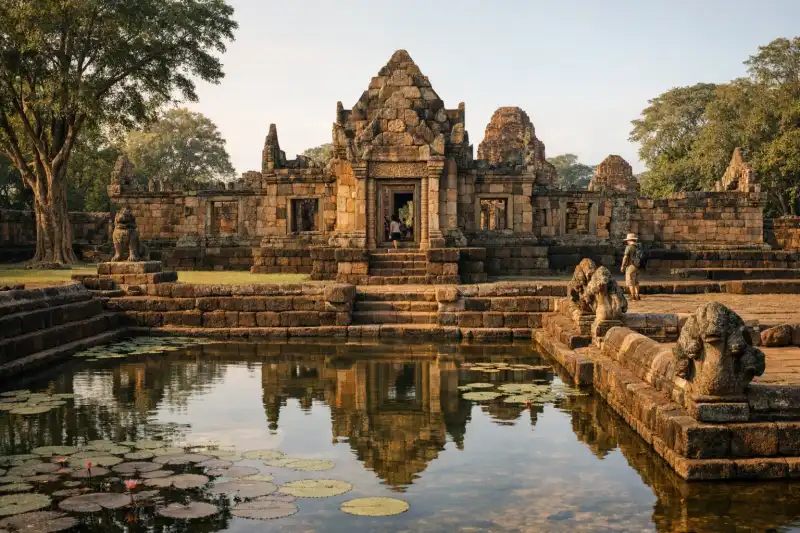
Finish at Prasat Muang Tam, a lower, more intimate Khmer temple near Phanom Rung. If Phanom Rung is about ascent, Muang Tam is about enclosure, water, and symmetry. Its lotus ponds, laterite walls, sandstone lintels, and quiet courtyards make it one of the most satisfying final stops on the route.
The temple is usually linked to the 10th and 11th centuries, and its plan reflects Hindu sacred architecture shaped for a local landscape. The water features are not decoration in the modern sense. They help frame purity, boundary, and approach. After a week of ruined capitals and major sanctuaries, Muang Tam is a good reminder that ancient architecture often worked by controlling pace as much as by showing size.
If you did not have enough time at Phanom Rung on Day 6, you can return briefly today, but do not turn the last day into a scramble. Better to see Muang Tam well and leave with some energy than to add another distant temple and spend the afternoon in a van.
End in Buriram, or continue by road or rail depending on your wider Thailand plans. If you are flying out of Bangkok soon, build in buffer time. This route has already asked a lot of the map.
The historical thread: Thai capitals, Khmer sanctuaries, and borrowed forms
This itinerary works because it does not treat Thai history as one straight line. Ayutthaya shows a powerful early modern kingdom using Buddhist kingship, river trade, and court ritual to build a capital. Sukhothai reaches back toward earlier Thai royal memory, with art and inscriptions that later generations used to imagine political origins. Phimai, Phanom Rung, and Prasat Muang Tam pull the route into the Khmer world, where sacred architecture, Sanskritic court culture, and Angkorian networks extended deep into present-day Thailand.
The most interesting part is the overlap. Ayutthaya’s prangs echo Khmer forms. Sukhothai’s monuments draw from older regional and Sri Lankan Buddhist ideas. The Khmer temples in Isan sit inside modern Thailand but speak in an architectural language shared with Angkor. Borders came later. The stones remember a messier region.
Transportation notes
Bangkok to Ayutthaya is the easy part. Trains, vans, taxis, and private transfers all work. Ayutthaya itself can be done by bicycle, tuk-tuk, or car, depending on heat and patience.
Ayutthaya to Sukhothai takes longer than many travelers expect. There is no perfect high-speed link between the two ancient capitals. Plan around buses, a hired car, or a train plus road transfer through nearby cities. If you dislike uncertain connections, pay for the cleaner transfer.
Sukhothai to Nakhon Ratchasima is the hardest move. Do not schedule a delicate temple plan on the assumption that every connection will line up. If the budget allows, this is the best place for a private driver.
For Phimai, Phanom Rung, and Prasat Muang Tam, a car or driver saves the route. Self-driving is possible for confident drivers, but avoid it if you are uncomfortable with rural navigation, Thai road habits, or long days behind the wheel. Overnight bases matter here: Nakhon Ratchasima keeps Phimai sane, and Buriram keeps Phanom Rung and Muang Tam from becoming a forced march.
Optional add-ons and swaps
Add Si Thep Historical Park if you want a wider pre-Ayutthaya and Dvaravati-to-Khmer arc. To make room, cut the second Ayutthaya day or skip Si Satchanalai. Do not simply add Si Thep on top of the existing plan unless you have an extra day.
Add Ban Prasat Archaeological Site near Nakhon Ratchasima if prehistoric settlement and burial archaeology interest you. Remove Prasat Phanom Wan or make Day 5 less ambitious. It changes the story from temples to deep regional occupation, which is a useful shift.
Add Prasat Ta Muen only if you are comfortable with a more remote borderland temple day. Swap it for the slower Day 7, not for Phanom Rung. Check current access before committing, since frontier sites can be less predictable than the main historical parks.
If the route feels too full, cut Si Satchanalai first. It hurts, but it preserves the clean Ayutthaya, Sukhothai, Phimai, Phanom Rung, and Muang Tam arc without adding another long excursion.
Shorter and longer itinerary options
For a shorter central Thailand version, use 3 Days in Ayutthaya and Central Thailand Ancient Sites and focus on Ayutthaya’s core temples from a Bangkok or Ayutthaya base.
For a medium route, 5 Days Bangkok to Ayutthaya and Sukhothai Ancient Sites keeps the focus on the two old capitals and skips the long push into the Khmer temple belt.
For a deeper trip, 10 Days in Ancient Thailand can add Chiang Mai, Chiang Saen, Ban Chiang, Si Thep, or more northeastern Khmer sites. That version needs rest days and sharper route discipline. Thailand has enough ancient material for ten days, but not every site belongs in the same week.
Related ancient sites
- Wat Chang Lom
- Wat Chedi Chet Thaeo
- Prasat Phanom Wan
- Ban Prasat Archaeological Site
- Noen-U-Loke
- Non Ban Jak
- Si Thep Historical Park
- Prasat Kamphaeng Yai
- Prasat Pueai Noi
- Ban Chiang
FAQ
The most common planning questions for this ancient Thailand route are answered below.