Quick route summary
This 10-day ancient Thailand route starts in Bangkok, uses Ayutthaya as the first stop, then moves north to Sukhothai Historical Park, Si Satchanalai, and Chiang Mai before cutting east to Ban Chiang and the Khmer temple country of Isan. It ends with Phimai Historical Park, Phanom Rung, and Prasat Muang Tam before returning to Bangkok.
The route style is a country loop with several bases: Ayutthaya, Sukhothai, Chiang Mai, Udon Thani, and Nakhon Ratchasima. It is busy in a sensible way, not relaxed. Thailand’s ancient sites are spread across old river capitals, mountain temples, prehistoric villages, and Khmer frontier sanctuaries, so the trip works best if you accept that some travel days are part of the story.
Do not overpack this route with every ruin on the map. Ten days sounds generous until you start crossing from central Thailand to the north, then back across to Isan. The reward is real historical range, but only if you leave enough slack to notice what changes from region to region.
Who this itinerary is for
This itinerary is for travelers who want Thailand’s ancient history beyond a quick Bangkok side trip. It suits people who can handle transfers, early starts, and a few driver-heavy days in exchange for a wider view of Thai, Lanna, prehistoric, and Khmer-era landscapes.
It is a good fit if you like ruined capitals, brick stupas, Buddhist image halls, museum context, old city walls, and quiet temple compounds where the modern village still presses close. It is not ideal if you want one beach base, a slow food-focused Thailand trip, or only the easiest train-linked sights.
If this is your first Thailand visit and you also want islands, markets, and long Bangkok time, cut this route down. The ancient sites deserve attention. They do not work as hurried decorations around a beach holiday.
Route at a glance
- Day 1: Overnight in Ayutthaya. Travel from Bangkok, then visit Ayutthaya’s central ruins and royal temple sites by tuk-tuk, bicycle, or driver.
- Day 2: Overnight in Sukhothai. See Ayutthaya’s riverside and parkland temples early, then transfer north toward Sukhothai.
- Day 3: Overnight in Sukhothai. Spend the day inside Sukhothai Historical Park, with bicycles or local transport making the ruins manageable.
- Day 4: Overnight in Sukhothai. Day trip to Si Satchanalai for a quieter UNESCO landscape, old kilns, and elephant-ringed chedis.
- Day 5: Overnight in Chiang Mai. Transfer to Chiang Mai, then keep the old-city and Wiang Kum Kam visits compact.
- Day 6: Overnight in Chiang Mai. Visit Doi Suthep, Wat Umong, and a smaller Lanna ruin without turning the day into a temple marathon.
- Day 7: Overnight in Chiang Mai. Long day to Chiang Saen, or overnight there if you want a softer northern route.
- Day 8: Overnight in Udon Thani. Fly or transfer east, then use a driver for Ban Chiang and possibly Phu Phra Bat.
- Day 9: Overnight in Nakhon Ratchasima. Transfer south through Isan and focus on Phimai plus nearby Khmer sanctuaries.
- Day 10: Overnight in Bangkok. Visit Phanom Rung and Muang Tam with a driver, then return toward Bangkok.
Practical logistics before you go
The best base cities are Ayutthaya for the first ruin cluster, Sukhothai for the UNESCO parks, Chiang Mai for Lanna temples, Udon Thani for Ban Chiang, and Nakhon Ratchasima for Phimai. You can trim one base, but you will pay for it with longer drives and less useful site time.
Transit is mixed. Bangkok to Ayutthaya is easy by train, van, taxi, or tour. Ayutthaya to Sukhothai takes planning because it is not a simple high-speed rail hop. Sukhothai to Chiang Mai is manageable by bus or private car. Chiang Mai to Udon Thani is best handled by flight if schedules cooperate. The Isan temple section is where drivers start to matter.
Guided tours make sense in three places: Ayutthaya if you are starting from Bangkok and want a frictionless first day, Chiang Mai if you want temple context without negotiating transport to the hill and forest sites, and the Khmer temple days in Isan, where distances and sparse public transit can waste hours.
Thailand’s heat is not background noise. It shapes the route. Start early at Ayutthaya, Sukhothai, Phimai, and Phanom Rung. Save museums, meals, transfers, or hotel downtime for the hottest part of the afternoon. A 10-day ancient-sites trip that ignores heat will feel twice as long by Day 6.
Tickets are usually straightforward compared with some major world sites, but opening hours, restoration access, and museum schedules can change. Check the latest local times before locking driver days. Also confirm whether your driver understands waiting time at archaeological sites, not just point-to-point transfer.
Day 1: Ayutthaya royal ruins
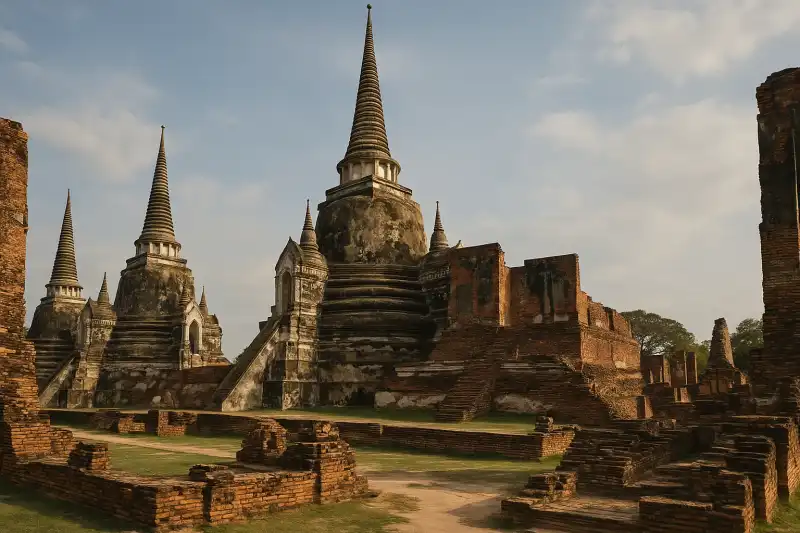
Start from Bangkok and travel to Ayutthaya early. The old capital sits close enough to Bangkok that people often treat it as a quick day trip, but sleeping here gives the ruins room to breathe. Ayutthaya was founded in 1350 and grew into a powerful trading capital connected to China, Persia, Japan, Europe, and the wider Southeast Asian world.
Begin with Wat Mahathat Ayutthaya, best known for the Buddha head caught in tree roots. The famous photo is not the whole story. The temple was tied to royal ritual and relic worship, and its collapsed prang tells you something about both Ayutthaya’s ambition and the damage that followed the Burmese sack of 1767.
Continue to Wat Phra Si Sanphet, the former royal temple. Unlike many Thai temples today, this was not a monastery with resident monks. It belonged to the palace precinct and royal ceremony. The three restored chedis create a clean visual rhythm, but the political message was not subtle: kingship, relics, and sacred space were being staged in brick and stucco.
Move around the historical park by bicycle only if you are comfortable in heat and traffic. A tuk-tuk or hired driver is less romantic, but often smarter. If you are coming from Bangkok just for the day, an Ayutthaya temples day tour from Bangkok can solve the transport problem, though this route works better if you overnight in Ayutthaya.
Keep the evening easy. This is the first day of a long route, and Ayutthaya rewards a second look after the day-trip crowds thin.
Day 2: Ayutthaya riverside temples and the road north
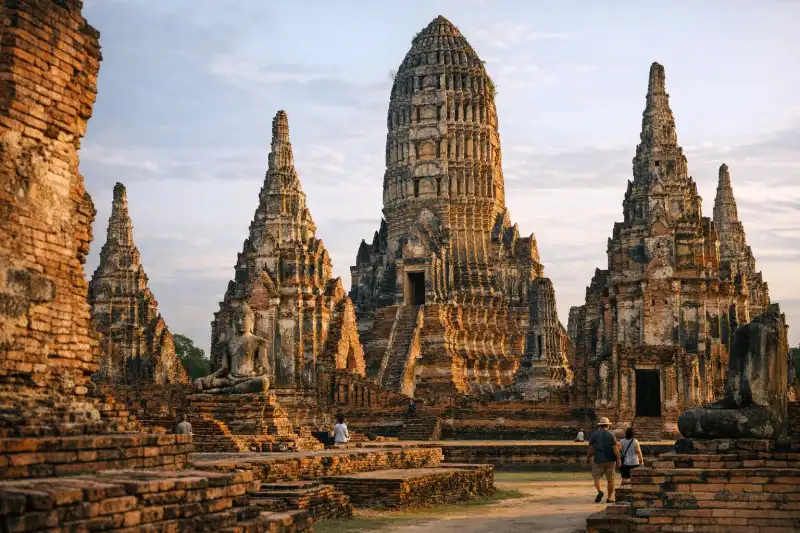
Use the morning for the Ayutthaya sites that sit slightly outside the central cluster. Wat Chaiwatthanaram is the one to prioritize. Built in the 17th century under King Prasat Thong, it uses a Khmer-inspired plan with a central prang and surrounding towers. It faces the river with a theatrical confidence that still works, especially in angled morning or late afternoon light.
Add Wat Phra Ram if you want one more central ruin before leaving. Its tall prang and parkland setting make it easier to read than some of Ayutthaya’s denser ruins. This is a good moment to notice how Ayutthaya borrowed older Khmer forms while turning them into something distinctly tied to its own court culture.
Do not try to add every Ayutthaya temple before heading north. The transfer to Sukhothai is the real work of the day. Depending on your budget and schedule, use a private car, bus connection, or rail and road combination. None of these options is as tidy as the map makes it look.
Arrive in Sukhothai with enough energy left for dinner and a quiet reset. If you reach the park area before dark, resist the urge to start racing through ruins. Tomorrow is the day for that.
Day 3: Sukhothai Historical Park
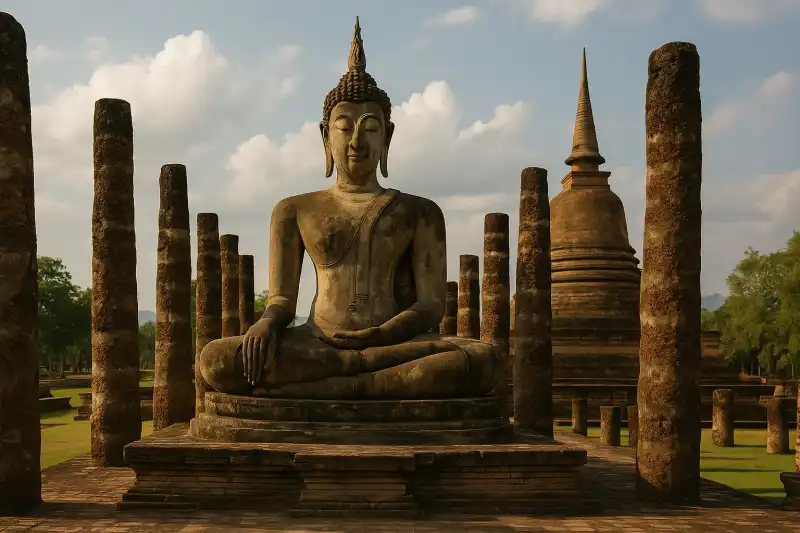
Give Sukhothai Historical Park a full day. This is one of the easiest ancient landscapes in Thailand to enjoy slowly because the main ruins sit across a broad, bike-friendly park with ponds, lawns, and clear sightlines. The setting is calmer than Ayutthaya, but the history is not smaller.
Start at Wat Mahathat Sukhothai, the spiritual center of the old capital. Sukhothai rose in the 13th century, and its art is often linked with elegant Buddha images, lotus-bud stupas, and a court culture that later Thai history looked back on with real affection. The stones are quiet now, but the royal and religious messaging was carefully arranged.
Then ride or transfer to Wat Si Chum. The seated Buddha fills a narrow mandapa so completely that the visit feels almost architectural before it feels devotional. The hand alone is worth time. It is one of those details that makes you slow down without anyone telling you to.
A bicycle works well here if the weather is reasonable. If the heat is heavy, use the park tram, a tuk-tuk, or split the day into morning and late afternoon sessions. The mistake at Sukhothai is not lack of ambition. It is trying to see everything at noon.
Day 4: Si Satchanalai and the kilns
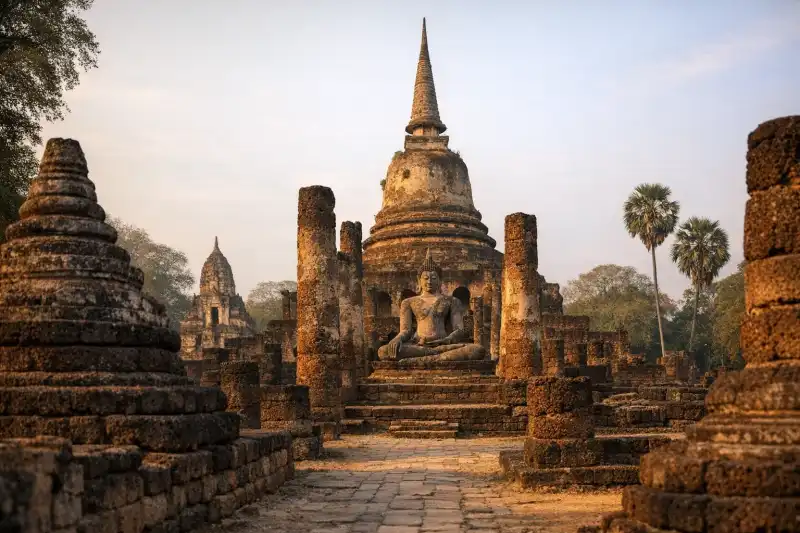
Make a day trip to Si Satchanalai, north of Sukhothai. This site is quieter, greener, and less instantly legible than the main Sukhothai park, which is part of its appeal. Give it more time than the map suggests.
Start with Wat Chedi Chet Thaeo, where different chedi forms sit close together in a compact sacred area. The variety is useful. It shows that Sukhothai-era religious architecture was not one frozen style, but a working vocabulary of stupas, shrines, images, and local choices.
Continue to Wat Chang Lom, known for its elephant-ringed chedi. Elephant bases appear in several Thai and Sri Lankan-influenced Buddhist contexts, and here they give the monument a grounded, almost processional feel. The animals are not decoration only. They help the structure announce protection, strength, and sacred support.
If you have a driver, ask about the kiln areas connected with the old ceramic industry. Si Satchanalai was not just a temple landscape. It was tied to production, trade, and the movement of goods. That practical layer makes the ancient city feel less like a museum park and more like a working region.
Return to Sukhothai for a second night. This is a built-in recovery evening before the route shifts north to Chiang Mai.
Day 5: Chiang Mai old city and Lanna ruins
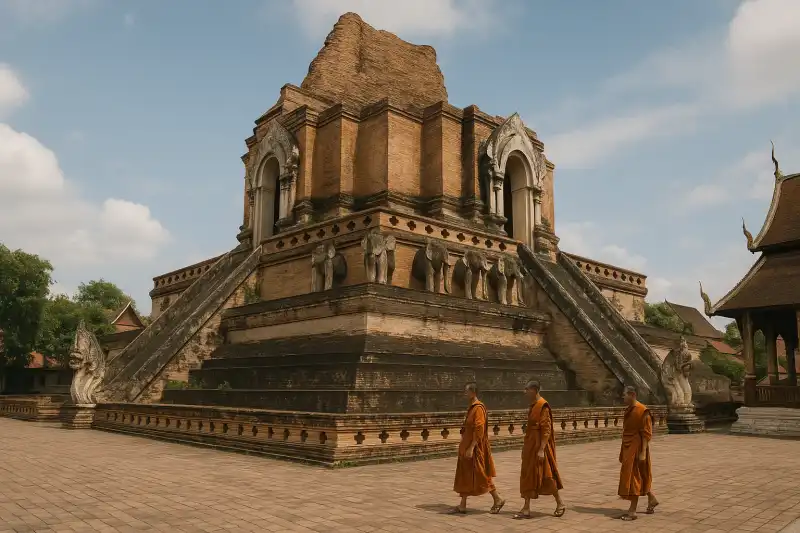
Transfer to Chiang Mai, then keep the first day modest. The city is full of temples, but this itinerary is not a contest to count them. Start with Wat Chedi Luang, the great ruined stupa in the old city. It was begun in the late 14th century and expanded in the Lanna period, then partly damaged, often associated with earthquake damage in later tradition.
The scale matters. Wat Chedi Luang once held the Emerald Buddha, now in Bangkok, and its broken mass still dominates the old-city temple scene. The ruin is not polished into neatness, which is part of why it works. You can feel both royal ambition and later loss in the same brick body.
If time and energy allow, add Wiang Kum Kam south of the city. This was an earlier settlement linked with King Mangrai before Chiang Mai became the durable Lanna capital. Flooding and shifting settlement patterns left parts of it buried, which gives the site a different mood from the active temples inside the old city.
Use taxis, rideshare, or a driver rather than trying to stitch everything together on foot. Chiang Mai’s old city is walkable in pieces, but Wiang Kum Kam is not a casual add-on after a long transfer unless you plan it properly.
Day 6: Doi Suthep, forest temples, and a lighter Chiang Mai day
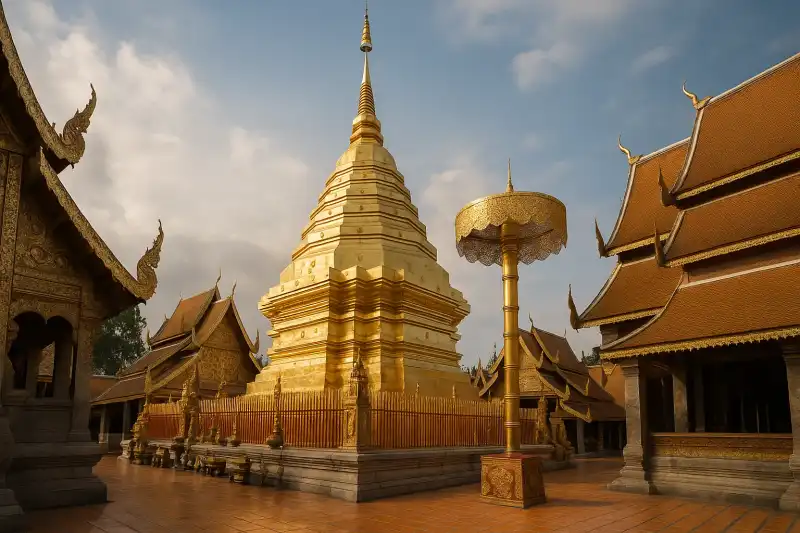
Start early for Wat Phra That Doi Suthep, the mountain temple above Chiang Mai. The site is active, popular, and still religiously important, so treat it as a living temple rather than an archaeological stop. Dress correctly, move calmly, and do not turn the main terrace into a photo shoot.
The temple’s relic tradition and mountain placement connect Lanna kingship, Buddhist merit, and the geography of Chiang Mai in a way that is easy to miss if you only come for the view. The climb, the naga stair, and the elevated terrace all help frame the city below as part of the sacred landscape.
Later, visit Wat Umong, a forest temple known for tunnels and a quieter setting. It offers a useful contrast with Doi Suthep. One is elevated, bright, and ceremonial. The other is shaded, low, and inward-facing. That contrast says a lot about the range of Buddhist spaces around Chiang Mai.
If you still have energy, add Wat Ku Meng as a small Lanna ruin near the city. Do not force it if you are fading. This route needs a lighter day somewhere, and Chiang Mai is the best place to take it. A Chiang Mai Doi Suthep and temple tour can be useful if you want transport and context without negotiating separate rides.
Day 7: Chiang Saen and the Mekong frontier
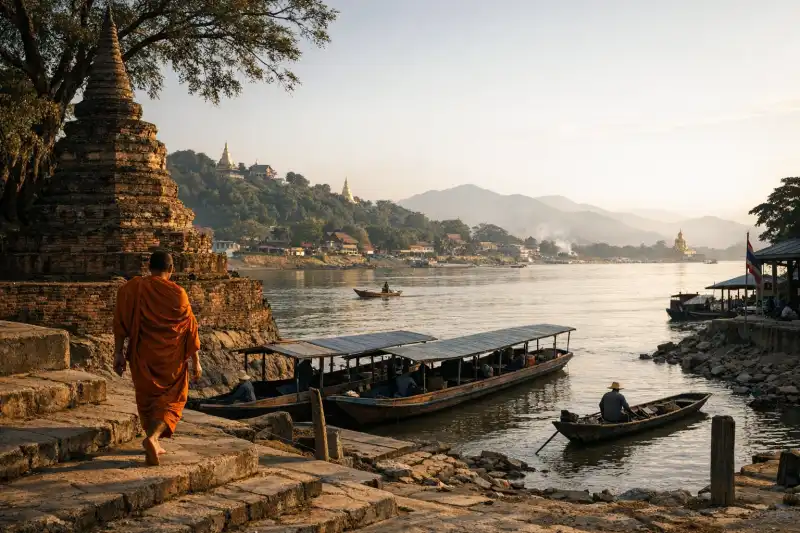
Chiang Saen is the awkward northern reach of this route. It sits in Chiang Rai Province near the Mekong and the Golden Triangle, far enough from Chiang Mai that you should take the logistics seriously. A long day trip is possible with a driver, but an overnight in Chiang Rai or Chiang Saen is kinder.
The old town preserves walls, temple remains, and a river setting that helps shift the route from central Thai capitals to northern frontier history. Chiang Saen was connected to the wider Lanna world, but the Mekong location gives it a different feel from Chiang Mai’s old city. River movement, borderland politics, and trade routes matter here.
Do not expect one monumental centerpiece like Phanom Rung or Sukhothai’s Wat Mahathat. Chiang Saen is more about walking the old town, reading fragments, and understanding how northern Thailand faced outward toward Laos, Myanmar, and the Mekong corridor.
If you are tired by this point, this is the day to simplify. Either hire a good driver and accept a long day, or swap Chiang Saen for a closer Lanna add-on such as Lamphun. The historical payoff is good, but not if you arrive exhausted and leave after twenty minutes.
Day 8: Ban Chiang and prehistoric Thailand
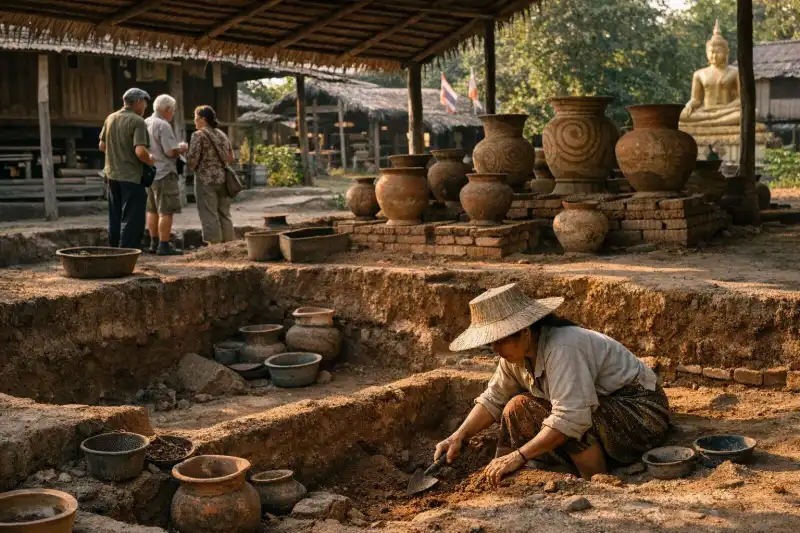
Shift east to Udon Thani, ideally by flight from Chiang Mai if schedules work. Today changes the route’s time scale completely. Ban Chiang is not a ruined capital or temple complex. It is a prehistoric archaeological site associated with distinctive painted pottery, burials, settlement evidence, and early metallurgy.
That change is exactly why it belongs in a 10-day ancient Thailand route. Ban Chiang reminds you that Thailand’s past did not begin with brick temples or court chronicles. Communities here were making, burying, trading, and working metal long before the monumental sites later travelers tend to prioritize.
Use a driver from Udon Thani so you can control timing. Museum context matters here more than dramatic architecture, so do not rush the displays just because the site lacks a giant ruin. The pottery forms and burial evidence are the point.
If you have enough time and transport, add Phu Phra Bat Historical Park. Its rock shelters, prehistoric art, and later sacred use add another layer to the day. If your flight arrives late, skip Phu Phra Bat rather than turning Ban Chiang into a half-visit.
Day 9: Phimai and the Khmer road through Isan
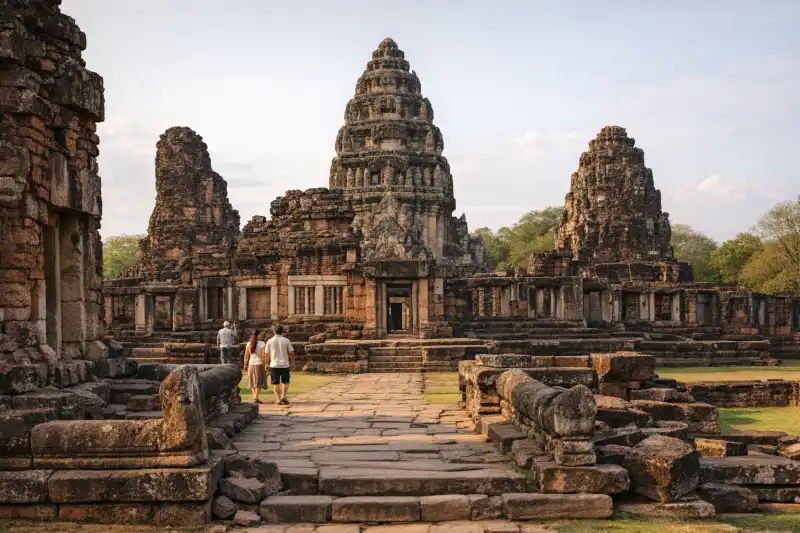
Transfer to Nakhon Ratchasima and focus on Phimai Historical Park. Phimai is one of Thailand’s great Khmer temple complexes, and it helps make sense of Isan’s position within the Angkorian world. The sanctuary is aligned unusually compared with many Khmer temples, and its Buddhist associations complicate any simple Hindu-only reading of Khmer architecture.
Use the Phimai Sanctuary page for deeper planning if you want to linger over the carvings, gateways, and axial layout. The site rewards slow looking. Doorways, lintels, and sanctuary approaches do much of the storytelling.
If you have a driver and enough daylight, add Prasat Phanom Wan near Nakhon Ratchasima. It is quieter than Phimai and shows how Khmer sacred architecture was not limited to the famous headline sites. Smaller sanctuaries were part of a wider religious and political geography across the Khorat Plateau.
Do not combine Phimai, Phanom Wan, and a long onward drive too casually. Isan distances look manageable until road time eats the afternoon. Overnighting in Nakhon Ratchasima is the practical choice.
Day 10: Phanom Rung and Muang Tam
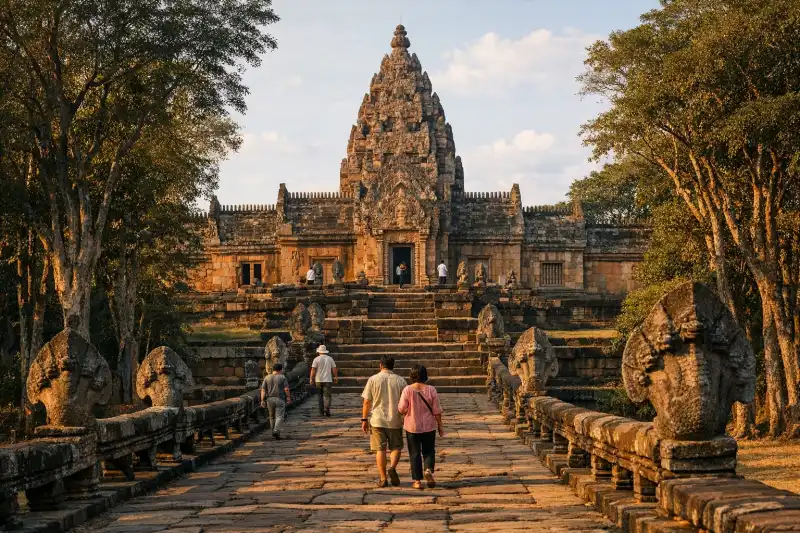
End with the Buriram temple pair: Phanom Rung and Prasat Muang Tam. This is a driver day. Public transport can be patched together by determined travelers, but it is a poor use of your last day if you also need to return toward Bangkok.
Phanom Rung sits on an extinct volcano, and the approach is part of the experience. The causeway, naga bridges, stairways, and sanctuary pull you upward in stages. The temple is associated with Shiva worship and Angkor-era power, and its famous solar alignments show how architecture, ritual, and landscape could be made to cooperate.
Then visit Prasat Muang Tam below. Its ponds, courtyards, and lower setting make a useful counterpoint to Phanom Rung’s height and drama. The carvings are often easier to enjoy here because the site feels less crowded and less performative. Give it time rather than treating it as the second stop you race through.
A private tour or driver for Phimai, Phanom Rung, and Muang Tam can make sense if you are compressing the Isan section, but avoid trying to see all three major sites on one rushed day unless you accept a very early start.
Return to Bangkok by evening if the route is ending there, or fly from a regional airport if your wider trip allows it. This is a strong finish, but it is not a gentle one.
The historical thread: capitals, frontiers, and borrowed sacred forms
This route works because it does not pretend ancient Thailand was one neat story. Ayutthaya shows a river capital built on trade, royal Buddhism, and political display. Sukhothai and Si Satchanalai pull the route toward earlier Thai state formation, art, and production. Chiang Mai and Chiang Saen bring in Lanna, mountain temples, and Mekong-facing northern history.
Then Ban Chiang changes the clock. Its pottery, burials, and metallurgy push the route into prehistoric community life, before the grand capital and temple narratives take over. Finally, Phimai, Phanom Rung, and Muang Tam show how Khmer architecture and Angkor-era sacred planning reached deep into what is now Thailand.
The best part is the friction between regions. Brick Ayutthaya prangs do not feel like Sukhothai lotus-bud stupas. Lanna mountain temples do not feel like Ban Chiang burial archaeology. Khmer sandstone sanctuaries in Isan do not feel like the old capitals of the central plains. The differences are the point.
Transportation notes
Use trains, buses, flights, and hired drivers together. No single transport mode solves this whole route.
Bangkok to Ayutthaya is the easiest leg. Ayutthaya to Sukhothai needs planning because the route is not as direct as a first-time visitor might expect. Sukhothai to Chiang Mai is usually straightforward by bus or private car. Chiang Mai to Udon Thani is best by flight when schedules line up, because overland travel burns too much time.
The northeast section is where hiring drivers becomes the difference between a good itinerary and a logistical punishment. Ban Chiang, Phu Phra Bat, Phimai, Phanom Wan, Phanom Rung, and Muang Tam are not lined up neatly for casual public transport sightseeing. Regional buses can work for patient travelers, but they reduce flexibility at the sites.
Do not self-drive unless you are comfortable with Thai roads, rural navigation, parking, and long days behind the wheel. A hired driver is often less stressful and lets you arrive at ruins with enough attention left to care about them.
The main compression warning is simple: do not try to fold Days 8, 9, and 10 into two days unless you drop sites. Ban Chiang plus the Khmer temples are geographically broad. If you rush them, you will spend the end of the trip looking at highways.
Optional add-ons and swaps
Add Kamphaeng Phet if you want another UNESCO-linked historic city between Sukhothai and the central plains. Remove Chiang Saen or shorten the Chiang Mai section to make room. Kamphaeng Phet is more coherent as a route stop than as a rushed side trip.
Swap Day 7 for Wat Phra That Hariphunchai in Lamphun and Wat Phra That Lampang Luang in Lampang if you want less road time than Chiang Saen. This keeps the focus on Lanna and northern religious architecture while making the logistics easier.
Add Prasat Pueai Noi if you want a quieter Khmer sanctuary in Khon Kaen Province. Remove Phu Phra Bat or Prasat Phanom Wan to avoid overloading the Isan section.
Add Prasat Sdok Kok Thom only if you are building a separate eastern Thailand Khmer route. It is historically rewarding, especially for inscriptions and Angkor-era context, but it sits too far from this main 10-day loop to add casually.
If you need to cut the whole itinerary down, remove Ban Chiang first only if prehistoric archaeology is not your thing. Otherwise remove Chiang Saen. Those are the two biggest detours.
Shorter and longer itinerary options
For a compact central Thailand version, use a 3-day Ayutthaya route focused on Ayutthaya, Wat Mahathat Ayutthaya, Wat Phra Si Sanphet, Wat Chaiwatthanaram, and Wat Phra Ram. When published, it should live at /itineraries/ayutthaya-central-thailand-3-day-itinerary/.
For a 5-day route, link Bangkok, Ayutthaya, and Sukhothai, then stop before the northern and Isan detours. That version should use /itineraries/bangkok-ayutthaya-sukhothai-5-day-itinerary/ when available.
For a 7-day route, keep Ayutthaya, Sukhothai, and the headline Khmer temples at Phimai, Phanom Rung, and Muang Tam. The planned route-family page is /itineraries/ancient-thailand-7-day-itinerary/.
A longer version would add more of Isan and split the north properly, with separate nights in Chiang Rai or Chiang Saen. That is a better 14-day trip than an overloaded 10-day one.
Related ancient sites
- Wat Phra Ram
- Wat Chaiwatthanaram
- Sukhothai
- Wat Chang Lom
- Wat Chedi Chet Thaeo
- Wiang Kum Kam
- Wat Ku Meng
- Phu Phra Bat Historical Park
- Prasat Phanom Wan
- Prasat Muang Tam
- Wat Phra That Hariphunchai
- Wat Phra That Lampang Luang
FAQ
The most common planning questions for this ancient Thailand route are answered below.